
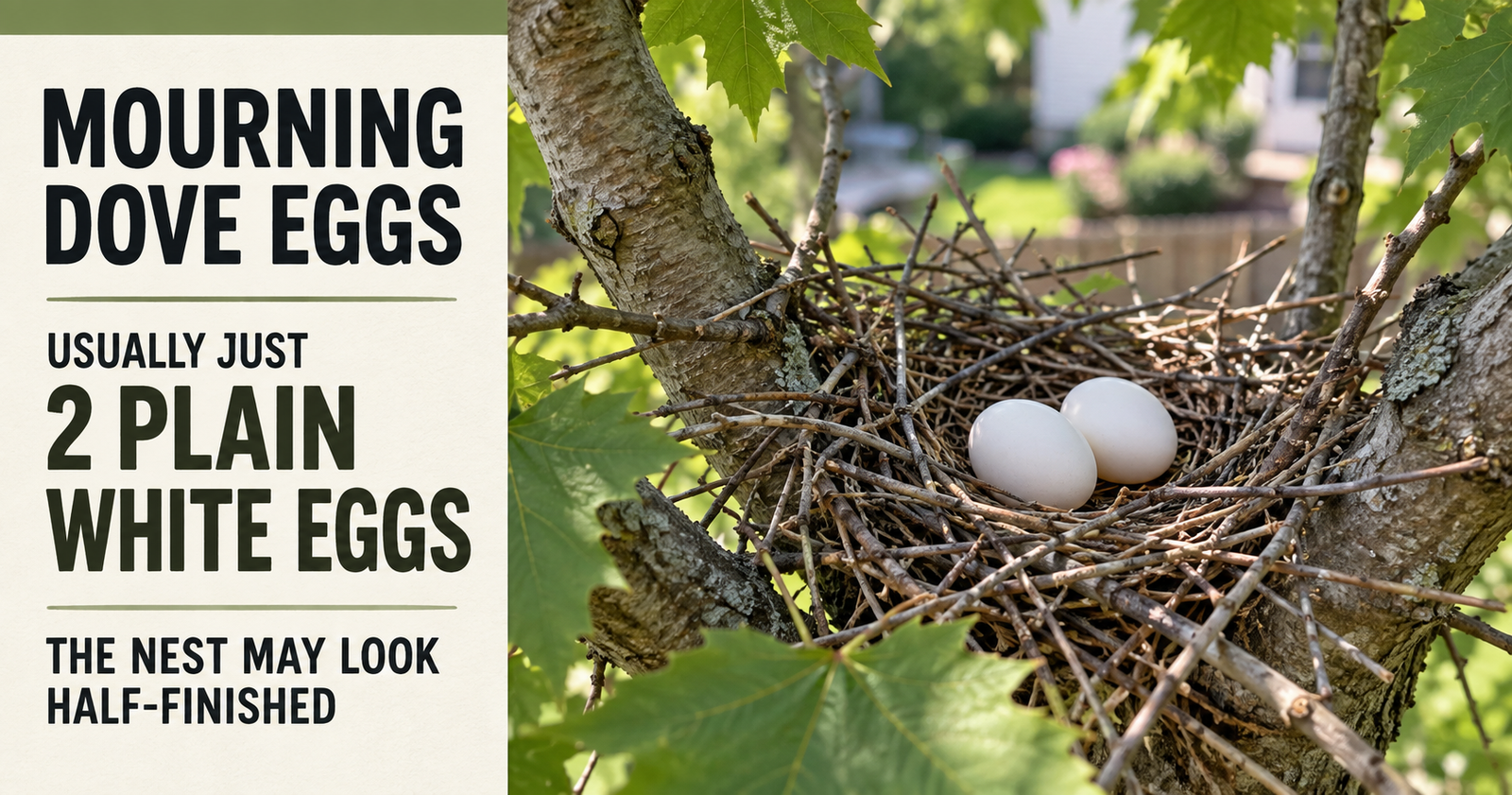
If I found two plain white eggs sitting on what looked like a poorly assembled pile of twigs, Mourning Dove would immediately be on my shortlist. The adult bird's shape, coloring, behavior, and calls can help confirm that identification; see Mourning Dove identification clues for the main field marks.
Not because white eggs automatically mean Mourning Dove.
They don’t.
The better clue is the combination:
two white eggs + flimsy open nest + the location + adult Mourning Doves coming and going.
Mourning Dove eggs are surprisingly plain for such an interesting bird.
No speckles.
No brown blotches.
No blue-green background.
They’re simply smooth, unmarked white eggs, and a normal clutch contains two.
According to the Cornell Lab’s Mourning Dove nesting information, the eggs measure roughly 1 to 1.2 inches long and 0.8 to 0.9 inches wide.
But if I found an active nest, I wouldn’t get anywhere near it with a ruler.
I’d back up and watch the parents.
The adult birds can tell you much more than another close-up photograph of the eggs ever will.
Two White Eggs Is the Classic Mourning Dove Clutch
This is one of the most useful things to remember.
Two eggs.
Cornell lists two as the typical Mourning Dove clutch, and NestWatch’s Mourning Dove profile likewise shows a very consistent clutch of one to two eggs.
Most of the time, you’re looking for two.
That consistency is useful because clutch size varies much more dramatically in plenty of other backyard birds.
If I find a flimsy Mourning Dove-looking nest with six eggs inside, I’m not going to ignore that contradiction.
Something else may be going on.


Don’t Panic If There’s Only One Egg
This is where watching the same nest over time gets interesting.
A Mourning Dove doesn’t necessarily produce both eggs at once.
MU Extension’s Mourning Dove biology guide notes that the first egg is followed by the second about 24 hours later.
So imagine checking a nest one evening.
One egg.
You check responsibly from a distance the next day.
Two eggs.
Nothing mysterious happened.
You simply caught the pair halfway through laying the clutch.
That’s the kind of observation I’d actually want to photograph and document if I had an accessible Mourning Dove nest around the property.


The Eggs Are Smaller Than They Look Under a Sitting Dove
An adult Mourning Dove can make those two eggs look substantial when it stands up.
In reality, each egg is only around an inch long.
Cornell gives a range of about 1.0 to 1.2 inches in length and 0.8 to 0.9 inches across.
That’s roughly what I’d expect from a bird around robin size.
Again, I wouldn’t handle eggs to confirm measurements.
Size is supporting evidence.
The adults, nest, location, clutch size, and egg appearance together are much more useful.
The Nest May Look More Suspicious Than the Eggs
Honestly, the nest might be the thing that gets your attention first.
Mourning Dove nests can look almost comically flimsy.
A few sticks.
Some grass stems.
Maybe pine needles.
And daylight visible straight through parts of the bottom.
Then somehow two delicate white eggs are sitting on top of it.
That’s normal.
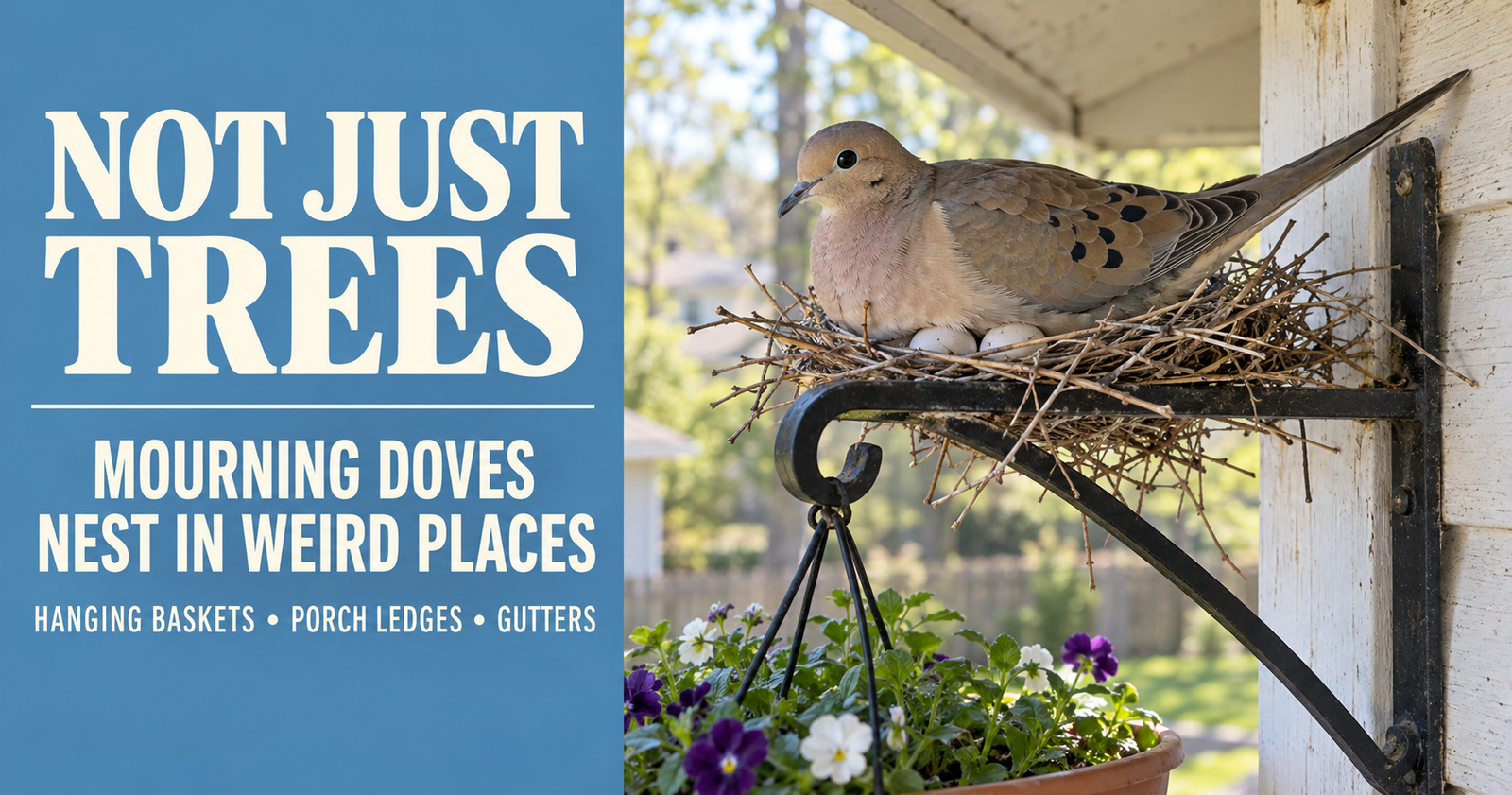
Our guide to the weird places Mourning Doves build nests goes deeper into what those nests look like and why you may find one in a tree, hanging planter, gutter, ledge, or another place around the house.
So don’t dismiss a loose platform of twigs because it doesn’t look “finished.”
The doves may already consider it move-in ready.


Where I’d Expect to Find the Eggs
Trees and shrubs are obvious places to check.
But Mourning Doves don’t always choose obvious locations.
NestWatch documents them using live tree branches, vines and tangles, buildings, and even the ground. Hanging flowerpots and other human-made structures are particularly well documented.
That’s why I pay more attention to the adult bird’s routine than to where I think a nest should be.
If a dove keeps disappearing behind the same hanging basket, that’s interesting.
If one sits motionless on a ledge for hours, that’s interesting.
If a male keeps delivering twigs to one exact spot, that’s really interesting.
Follow the behavior from a distance and the birds may reveal the nest themselves.
The Parent Sitting on the Eggs Might Be Dad
This is one of my favorite Mourning Dove nesting details.
Both parents incubate.
That alone isn’t unusual enough to shock anyone.
But they tend to divide the day into recognizable shifts.
The male generally takes much of the midmorning through afternoon incubation period, while the female handles later afternoon, nighttime, and early morning.
So if you’ve got an active Mourning Dove nest visible from a window, you may actually be able to watch the parental shift change.
That’s far more interesting to me than repeatedly walking up to the nest to count eggs.
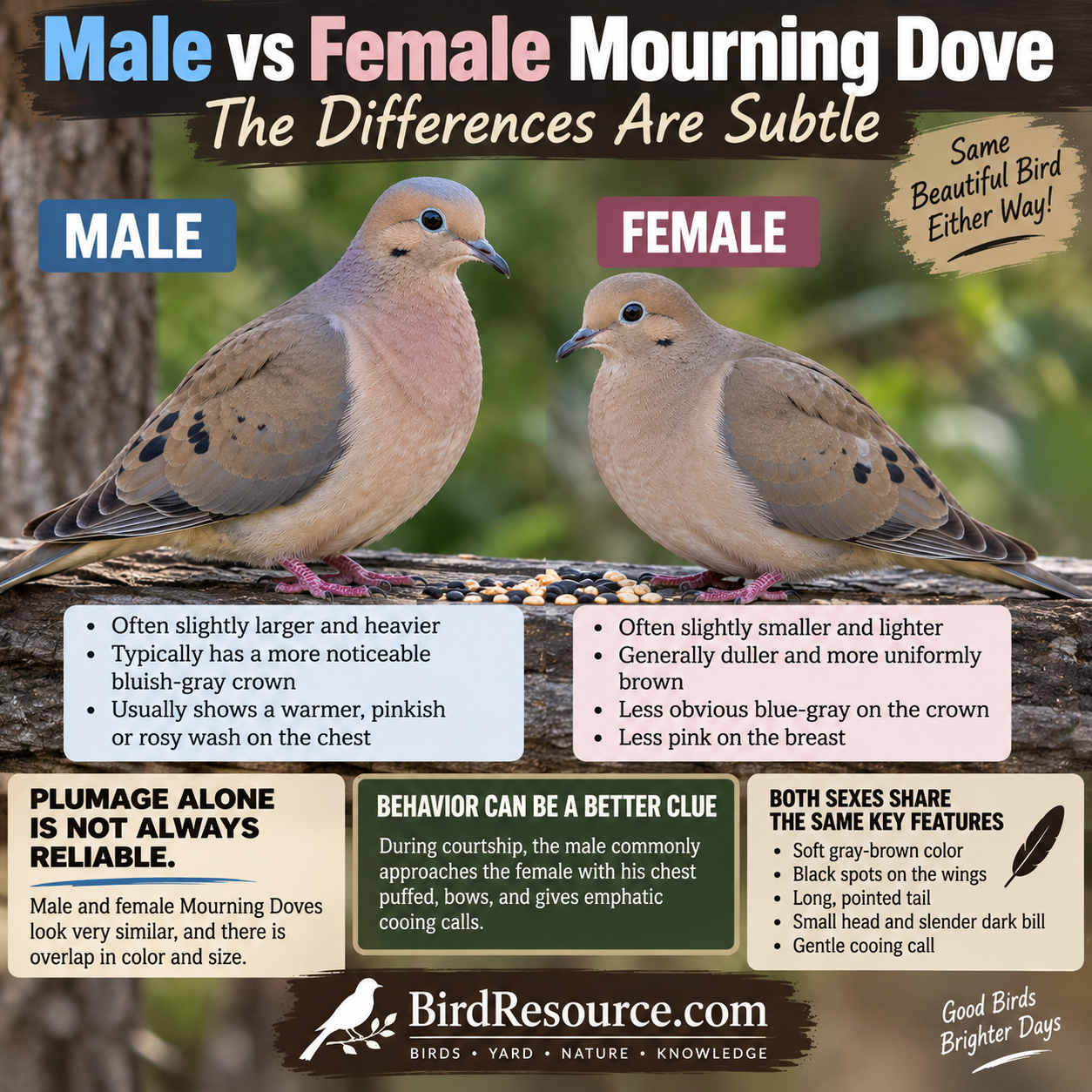
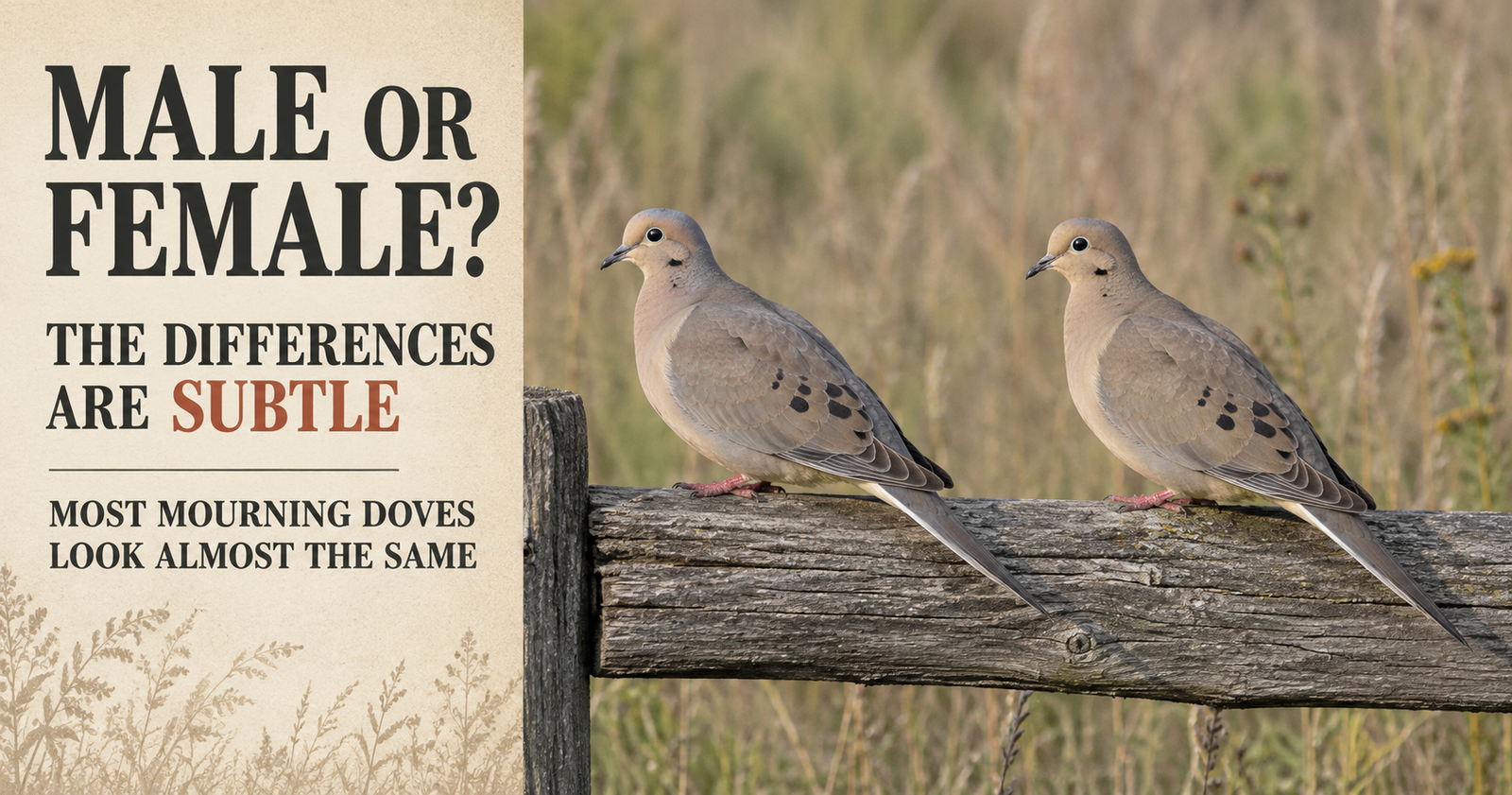
It also gives us another real-world way to distinguish the sexes, which we covered in our male vs female Mourning Dove guide.
How Long Until Mourning Dove Eggs Hatch?
About two weeks.
Cornell lists an incubation period of approximately 14 days, while NestWatch data puts the average around the same general range.
That’s fast.
If I discovered eggs today, I’d start paying much closer attention over the following two weeks.
Not by disturbing the nest.
By watching it.
Are the parents still switching incubation duties?
Does the sitting bird suddenly begin behaving differently?
Are adults making more trips?
Has the nest gone from quiet to containing two tiny heads?
The whole nesting attempt changes quickly.
What Hatches Out of Those Perfect White Eggs Looks Nothing Like a Dove
This is the transformation I find hardest to believe.
The egg is smooth and clean.
The adult is sleek and beautifully feathered.
Then the baby hatches looking almost nothing like the bird you recognize.
Cornell describes newly hatched Mourning Doves as helpless, eyes closed, sparsely covered with cream-colored down, and initially unable even to hold their heads up properly.
Then roughly two weeks later, they’re approaching fledging.
That’s an enormous amount of development in a very short time.
We’ll keep the baby stage in its own article rather than turning this egg guide into another fledgling guide.
How Can I Be Sure They’re Mourning Dove Eggs?
I wouldn’t identify them from egg color alone.
NestWatch’s egg-identification guidance specifically warns that egg color and markings should be treated as supporting evidence rather than definitive identification.
That’s exactly how I’d approach it.
I’d look at:
The number of eggs
Two strongly fits Mourning Dove.
The color
Plain, unmarked white fits.
The nest
A simple open platform of sticks fits.
The location
Tree, shrub, vine, building structure, planter, or another known Mourning Dove nesting location fits.
The parents
This is the big one.
If adult Mourning Doves are incubating the eggs, the mystery is pretty much over.
White Eggs Don’t Automatically Mean Mourning Dove
This is worth emphasizing.
Other birds lay white eggs.
Other doves can lay white eggs.
Some cavity-nesting birds lay white eggs.
So I wouldn’t upload a photograph of two white eggs with no information about location, nest structure, region, or parents and expect perfect identification.
Context makes bird identification much easier.
A nest isn’t just a container holding eggs.
The nest itself is evidence.
So is the habitat.
So is the calendar.
And the adult bird is often the strongest clue of all.
What If the Nest Suddenly Has No Parent on It?
I wouldn’t immediately assume abandonment.
Adult birds have to leave occasionally.
And if you’ve approached the nest, you may be the reason the parent moved away.
Back off.
Give the bird space.
Watch from somewhere less intrusive.
A window can be perfect if the nest happens to be around the house.
Binoculars are even better when the nest is farther away.
Standing directly beside the eggs waiting for Mom or Dad to return can prevent the exact behavior you’re trying to observe.
Don’t Touch the Eggs Just to See If They’re Warm
I wouldn’t handle them.
There’s no useful reason.
You don’t need to pick up an egg to determine whether it’s alive.
You don’t need to rotate it for a photograph.
You don’t need to candle a wild Mourning Dove egg.
You don’t need to move it toward the center because the nest looks badly built.
The doves have been successfully raising young in those questionable-looking nests without us redesigning them.
Observe.
Photograph responsibly if you can do so without disturbance.
Then leave the parents in charge.
What If One Egg Falls Out?
This is a situation where I’d be careful about improvising.
An egg outside a nest could have been displaced for several reasons, and the circumstances matter.
Rather than repeatedly handling an active native bird nest or trying to rebuild it yourself, I’d contact a licensed wildlife rehabilitator or appropriate wildlife authority if there’s a genuine problem requiring intervention.
Mourning Doves are native migratory birds, and active nests, eggs, and young have legal protections.
Sometimes the best intervention is simply keeping people and pets away.
Why Only Two Eggs?
Two eggs is extremely characteristic of doves and pigeons.
NestWatch notes that most pigeons and doves characteristically produce two eggs per clutch.
Mourning Doves make up for that small clutch in another way:
they can nest repeatedly.
Cornell reports anywhere from one to six broods depending on conditions and location, while NestWatch notes that pairs may nest two or three times in succession.
So instead of producing a huge clutch all at once, Mourning Doves can run the parenting cycle repeatedly.
Build.
Two eggs.
Incubate.
Raise young.
Potentially start again.
That’s a lot of work hidden behind two very simple white eggs.
Common Questions About Mourning Dove Eggs
What color are Mourning Dove eggs?
Mourning Dove eggs are plain white and unmarked. They don’t normally have the speckles or colored markings seen on many backyard bird eggs.
How many eggs do Mourning Doves lay?
Usually two. A normal clutch is remarkably consistent compared with many other bird species.
How big are Mourning Dove eggs?
Cornell reports approximately 1 to 1.2 inches long and 0.8 to 0.9 inches wide.
How long do Mourning Dove eggs take to hatch?
Incubation lasts roughly 14 days.
Do both Mourning Dove parents sit on the eggs?
Yes. Both parents incubate. The male generally handles much of the daytime shift, while the female usually covers later afternoon, overnight, and early morning.
Why is there only one egg in my Mourning Dove nest?
The clutch may not be complete yet. The second egg is commonly laid about a day after the first.
Are Mourning Dove eggs speckled?
No. Typical Mourning Dove eggs are unmarked white.
Can Mourning Doves lay eggs in a hanging flowerpot?
Yes. Hanging flowerpots are a documented Mourning Dove nesting location.
Should I touch Mourning Dove eggs?
I wouldn’t. There’s normally no reason to handle wild bird eggs, and unnecessary activity around an active nest can disturb the parents.
Will Mourning Doves reuse the same nest?
They sometimes reuse their own nests or nests previously built by other species.
Two White Eggs Can Tell You a Surprisingly Big Story
If I had an accessible Mourning Dove nest around the house, this is the part I’d want to document.
Day one:
one white egg.
About a day later:
two.
Then I’d watch from a distance to see whether I could recognize the male taking his daytime incubation shift and the female taking over later.
About two weeks after incubation begins, those two plain eggs can become two helpless little birds.
And roughly another two weeks after that, the nest may already be empty.
That’s what makes Mourning Dove nesting so easy to miss.
The whole story can happen in about a month while we’re walking past the same planter, tree, gutter, or porch ledge every day.
Sometimes all it takes to notice it is knowing to look for two little white eggs sitting on a nest that barely looks capable of holding them.
Mason Reed is the Bird Nesting & Identification Contributor for BirdResource.com, where he helps everyday birdwatchers recognize the nests, eggs, young birds, and small behavioral clues that reveal what’s actually happening around their homes.