
If there’s one backyard bird you’ve probably heard without realizing what it was, I’d put the Mourning Dove near the top of the list.
That slow, hollow:
coo-OOO-oo… oo… oo
can sound so much like an owl that people go outside looking for one.
Then there’s the other Mourning Dove sound almost everyone has heard.
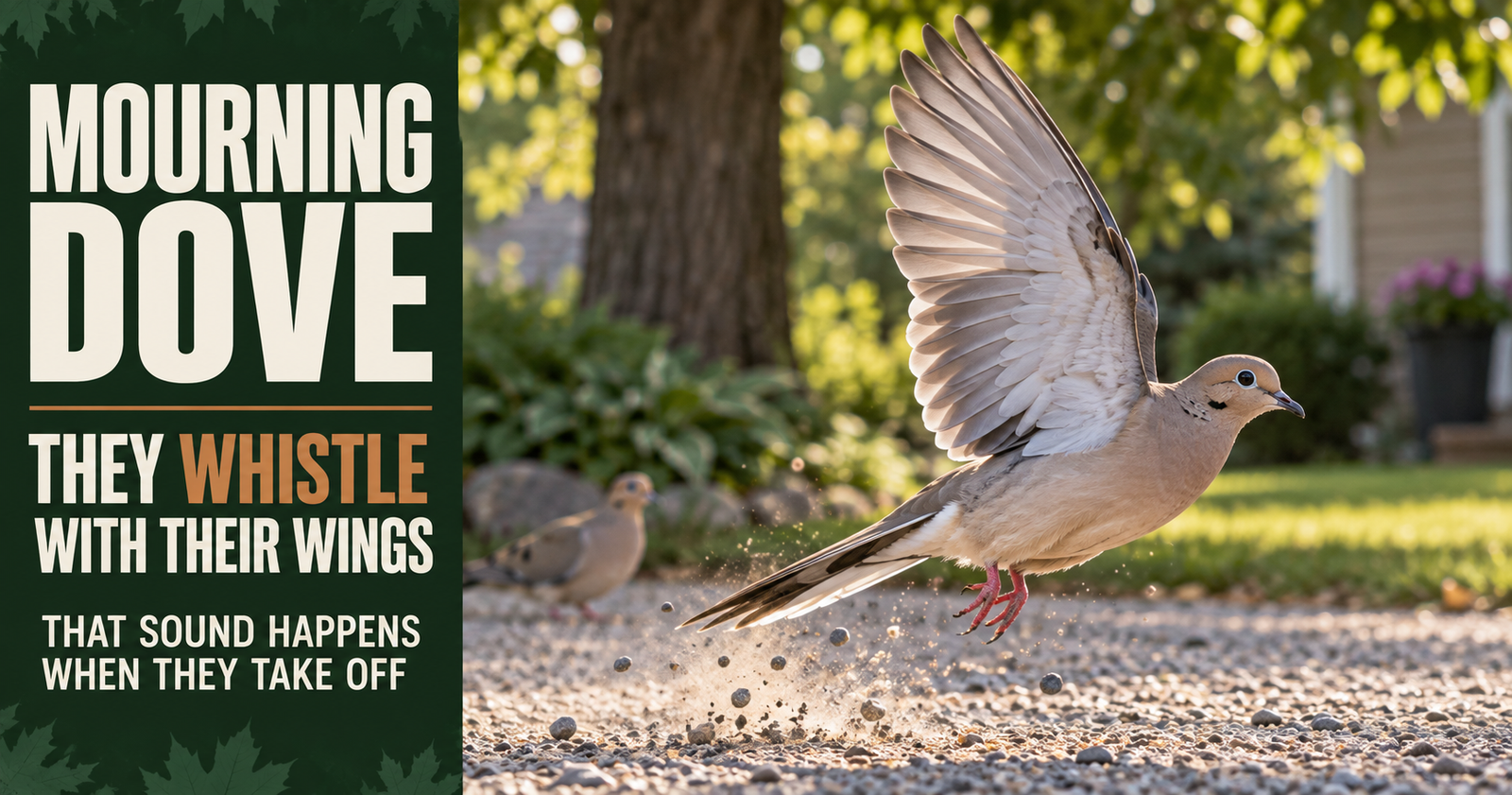
A dove explodes off the ground and its wings make a sharp whistling sound as it flies away.
That’s not the bird calling.
The wings themselves are making the noise.
Mourning Doves are incredibly common across North America, but they’re much more interesting than the quiet brown birds sitting on telephone wires make them look.
They can swallow thousands of seeds before flying away to digest them.
They feed their babies something called crop milk.
They may build one of the flimsiest-looking nests you’ve ever seen.
They can raise multiple broods in a single breeding season.
And the oldest known Mourning Dove survived for more than 30 years.
So if these birds are already walking underneath your feeder, nesting beside your porch, or waking you up with that mournful coo, here’s what you’re actually looking at.
What Does a Mourning Dove Look Like?
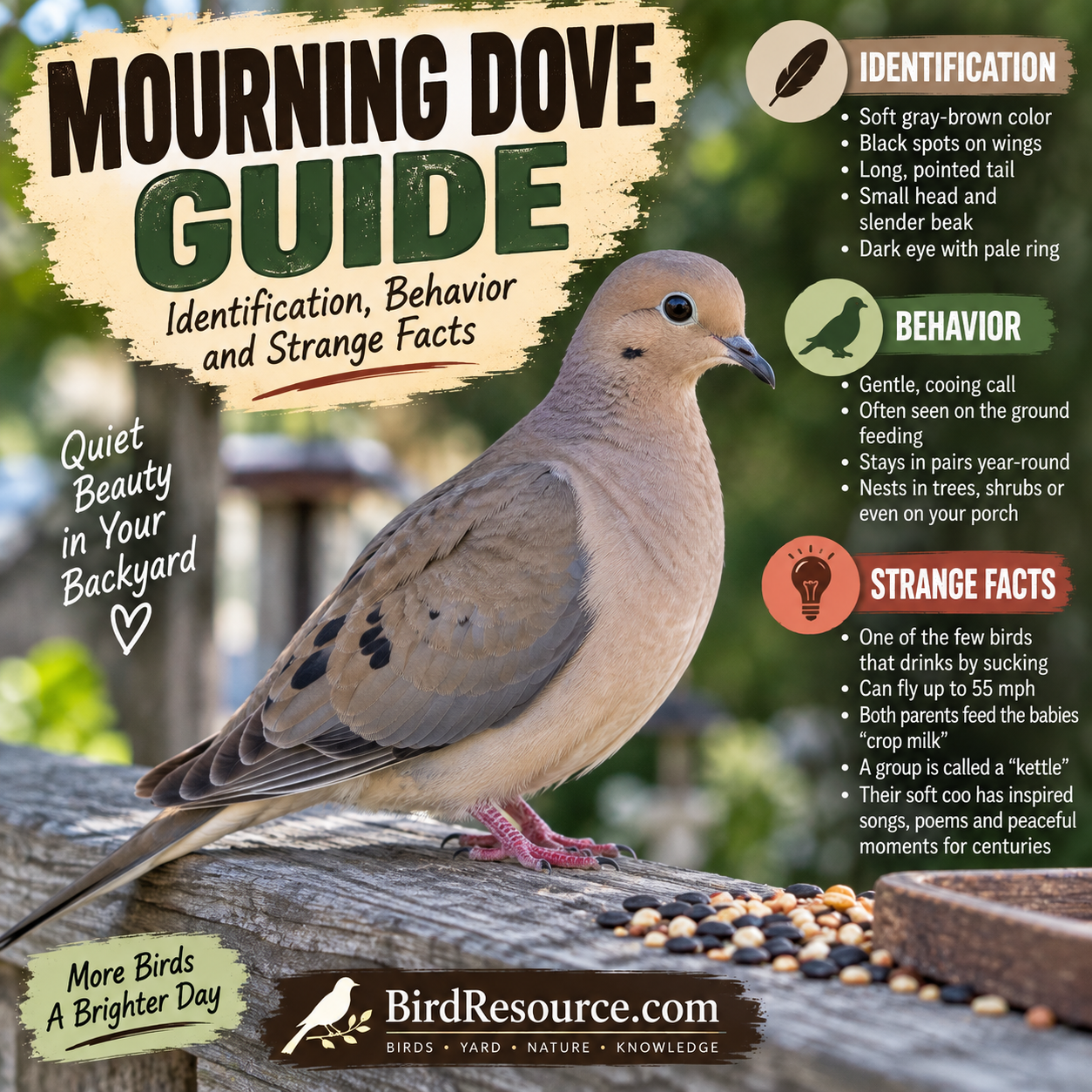
Mourning Doves have a shape that’s surprisingly easy to recognize once you know what matters.
Look for:
a small rounded head, plump body, thin dark bill, short pinkish legs, and a long pointed tail.
That tail is one of my favorite identification clues.
Cornell describes the long pointed tail as unique among North American doves. When the bird spreads it in flight, you’ll often see white along the outer edges.
The overall plumage is soft brown, gray, and buff rather than brightly colored.
There are dark spots on the wings and a small dark mark on the side of the neck.
They’re roughly robin-sized, but their proportions are completely different. The little head sitting on that fuller body gives them a very distinctive silhouette.
You can compare photographs and identification details in the Cornell Lab’s Mourning Dove identification guide.


Why Are They Called Mourning Doves?
The name comes from the sound.
Their slow, drawn-out coo has a sad or mournful quality to human ears.
That’s mourning as in grieving, not morning as in breakfast time.
You’ll sometimes see people call them “morning doves,” probably because they hear the birds early in the day.
But the correct name is:
Mourning Dove.
And that famous coo isn’t necessarily a bird sitting around feeling sad.
It’s communication.
Unmated males commonly give the familiar perch-coo from a noticeable location.
So the sound that feels sad to us can actually be part of a male Mourning Dove advertising himself.

Is That Mourning Dove Actually an Owl?
Probably not if you’re hearing the familiar soft dove coo during the day.
This confusion happens constantly.
The Mourning Dove’s low, hollow song has an owl-like quality, especially when the bird is hidden.
Before deciding you’ve got an owl somewhere in the neighborhood, try locating the sound.
You may find a slender dove sitting on:
a telephone wire,
a rooftop,
a fence,
a bare branch,
or another exposed perch.
Males often have favorite cooing perches and can return to them repeatedly.
Once you’ve connected the actual bird with the sound, it’s much harder to mistake it for an owl again.
What Does a Mourning Dove Sound Like?
The famous song is only the beginning.
According to the Cornell Lab’s Mourning Dove sound guide, the familiar perch-coo is mainly given by unmated males.
Paired males also make a different nest call during nesting activity.
Females can vocalize while sitting on the nest too.
Then there’s the sound that isn’t a voice at all.
The wings whistle.
When a Mourning Dove takes off or lands, air moving across specialized wing feathers creates that familiar high-pitched whistling or whinnying sound.
So if a dove blasts away from underneath your feeder and you hear:
whrrr-WHEEE!
the bird isn’t screaming because you scared it.
You’re hearing its wings.
Why Do Mourning Dove Wings Whistle?
The whistle appears to be more than an accidental side effect of flying.
Cornell notes that the loud wing sound may help startle predators or warn other Mourning Doves.
Think about a flock feeding on the ground.
One bird detects danger and launches.
That sudden burst of wing noise could immediately tell nearby doves:
Something just happened.
And because the sound is mechanically produced during flight, the bird doesn’t have to stop escaping to give a separate alarm call.
We’ll give this behavior its own article later because the science behind a bird making an alarm-like sound with its feathers is far too interesting to bury inside one paragraph.
Where Do Mourning Doves Live?
Almost everywhere people are likely to notice them.
Mourning Doves favor open and semi-open landscapes rather than deep forest.
Cornell lists habitats such as:
open country,
woodland edges,
grasslands,
agricultural areas,
roadsides,
and backyards.
They’re especially easy to spot on overhead perches.
Telephone and utility wires might as well have been designed for Mourning Doves.
If you live in the United States, there’s a very good chance you’ve seen them even if you never knew their name.
Why Are Mourning Doves Always on Power Lines?
Power lines give them an elevated, relatively open perch.
From there, a dove can rest, watch its surroundings, communicate, and quickly launch into flight.
They also love fences, bare branches, rooftops, and similar exposed perches.
Once you start noticing their silhouette, you’ll probably realize just how many Mourning Doves have been sitting above roads and yards you’ve driven past for years.
That little head and long tail are difficult to unsee once you know them.
What Do Mourning Doves Eat?
Almost entirely seeds.
And I mean that much more literally than I would for many backyard birds.
Cornell reports that seeds make up about 99 percent of a Mourning Dove’s diet.
They eat seeds from wild grasses, weeds, and herbs along with cultivated grains. They can also eat peanuts and occasionally berries or snails.
Mourning Doves are primarily ground feeders.
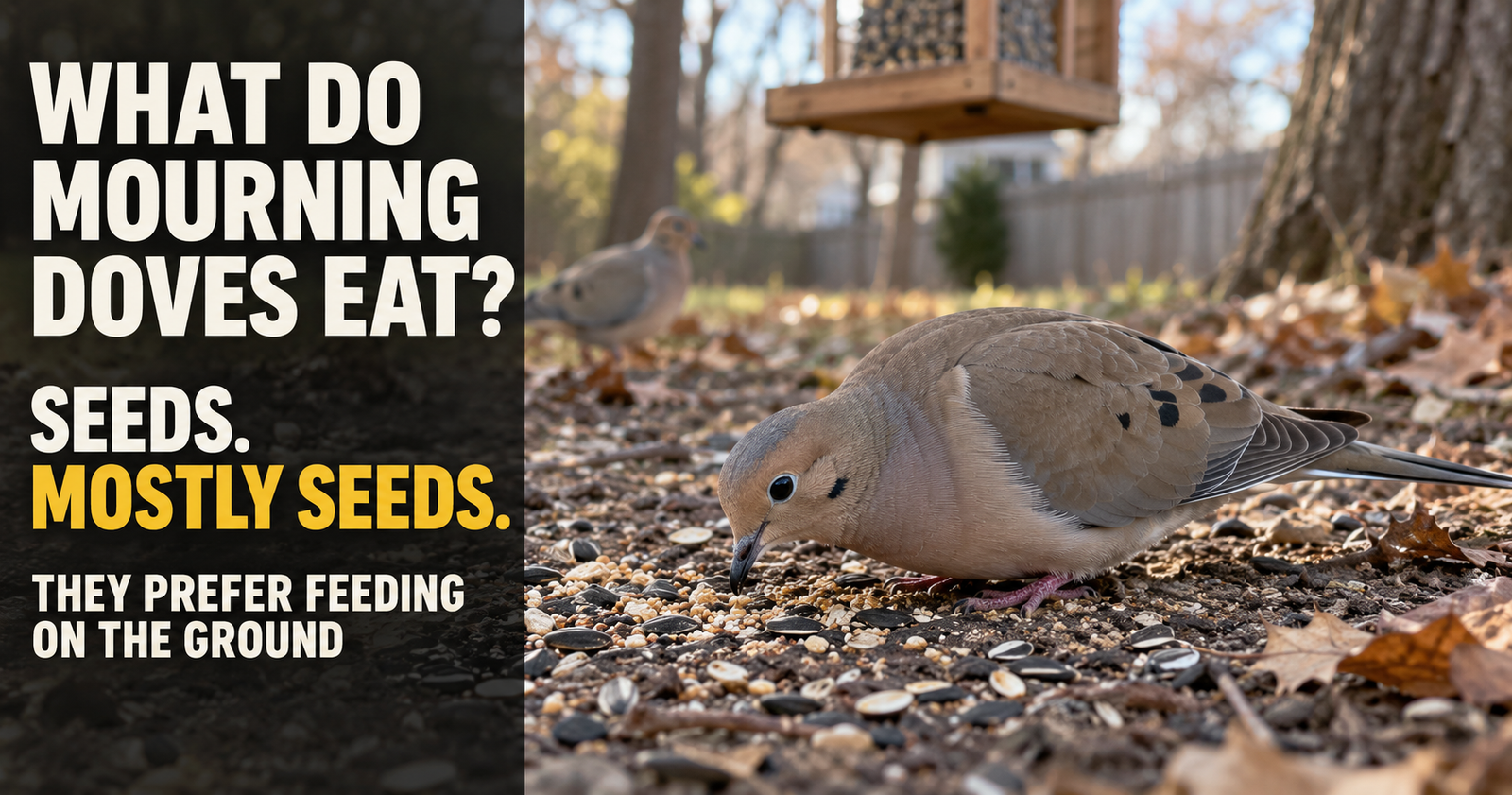
You’ll often see them walking underneath bird feeders picking up seed other birds knocked down.
That’s not necessarily because they’re getting leftovers.
Feeding on open ground is completely normal Mourning Dove behavior.

Mourning Doves Can Hold an Absurd Number of Seeds
This is one of those facts that changes how you watch the bird.
Mourning Doves don’t have to digest each seed as they pick it up.
They can rapidly swallow seeds and store them in an enlarged part of the esophagus called the crop.
Then they can fly somewhere safer and digest the meal.
Cornell reports a record of 17,200 bluegrass seeds in a single Mourning Dove crop.
Seventeen thousand.
In one bird.
So when a Mourning Dove appears to be vacuuming seeds off the ground, that’s basically what it’s doing.
What’s the Best Food for Mourning Doves?
If Mourning Doves are already around your yard, small seeds are an easy place to start.
Cornell specifically recommends scattering seed such as millet on the ground or offering it on a platform feeder.
That feeding style fits the bird naturally.
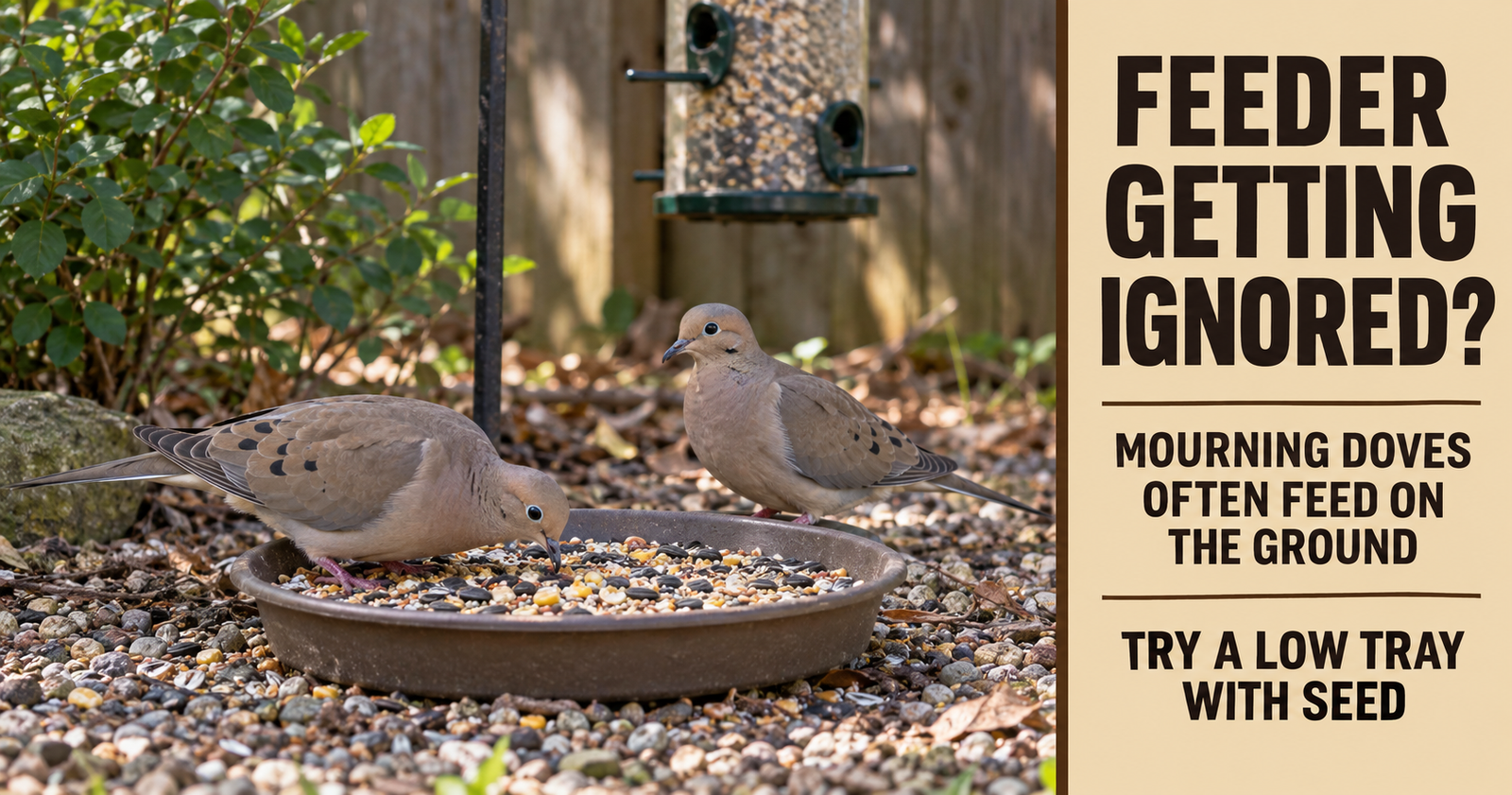
I wouldn’t make a Mourning Dove balance awkwardly on some tiny hanging perch if my entire goal were attracting doves. The practical setup changes are covered in attract Mourning Doves without a tiny perch.
Give them room.
We’ll build separate guides around what Mourning Doves eat, the best seed for them, and feeders that actually match the way they prefer to feed.
Where Do Mourning Doves Nest?
This is where Mourning Doves sometimes appear to have questionable construction standards.
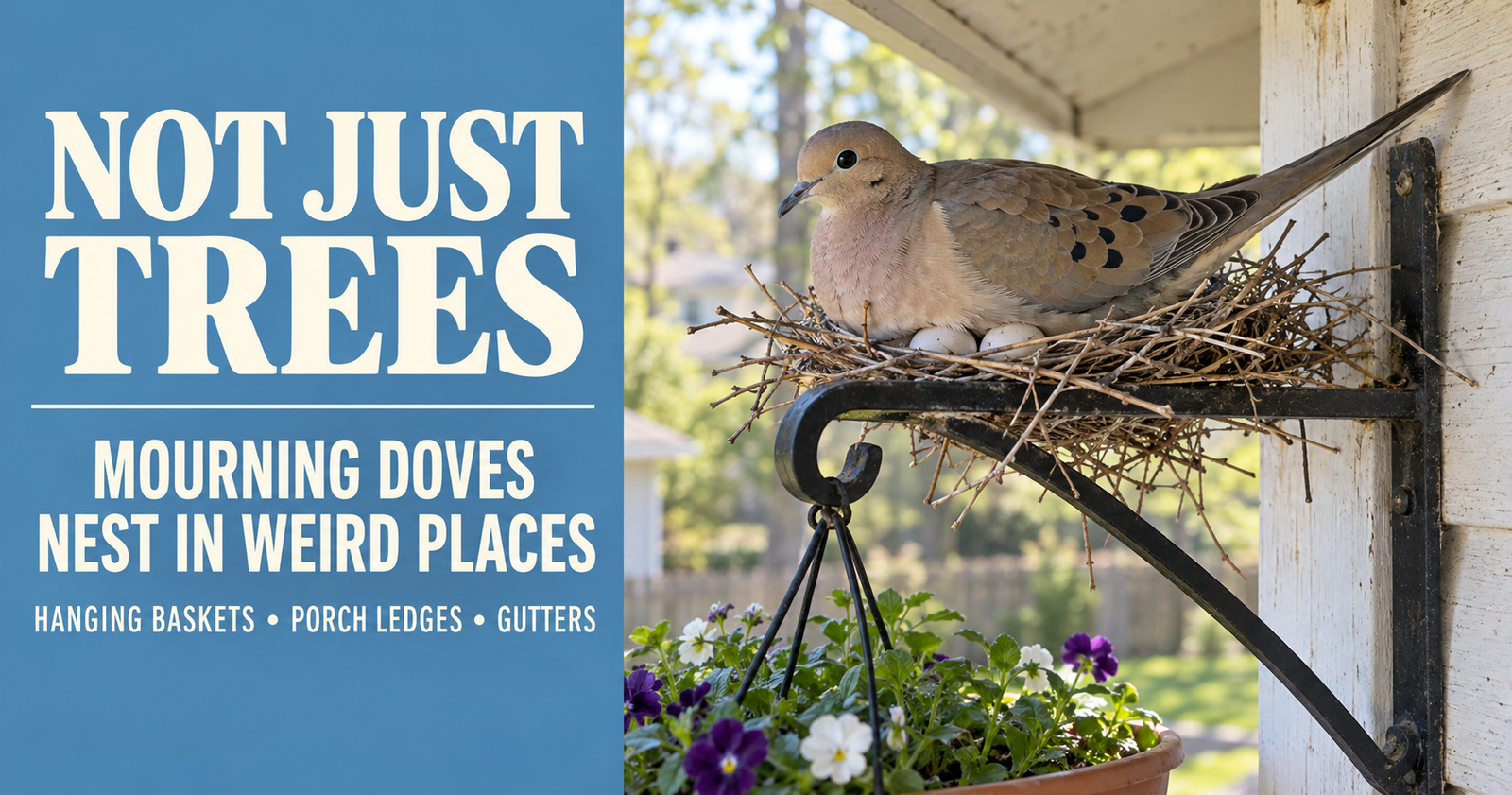
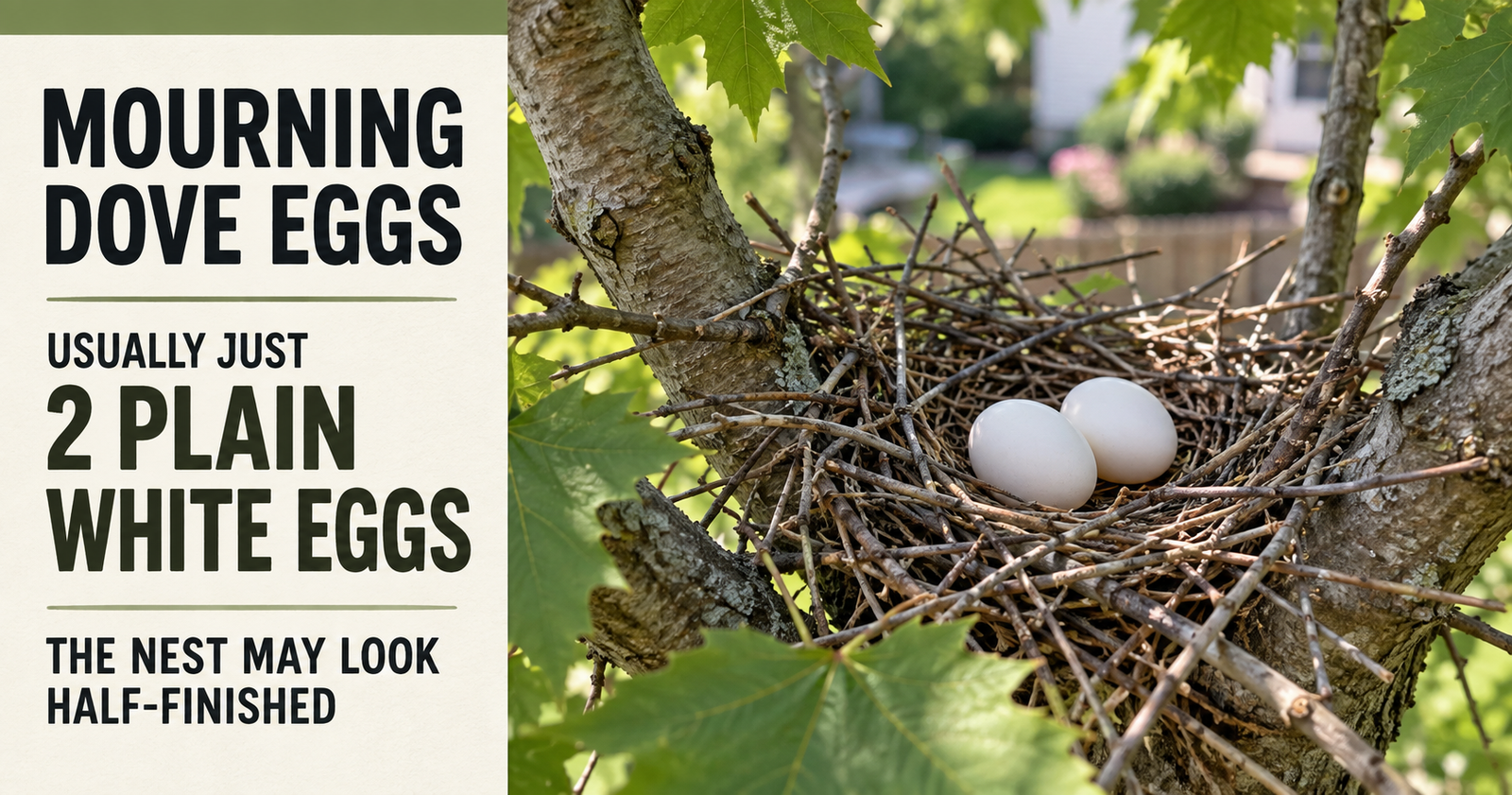
They usually build simple platform-like nests from twigs, pine needles, and grass stems.
Cornell describes the finished nest as a flimsy assembly around 8 inches across.
That’s not me insulting the bird’s craftsmanship.
That’s genuinely how these nests can look.
You may look through the bottom and wonder how the eggs aren’t falling straight through.
Yet the design works often enough that Mourning Doves remain one of our most abundant birds.
They commonly nest in trees and dense foliage, but they’re remarkably flexible.
They may also nest on:
gutters,
eaves,
railings,
abandoned equipment,
and sometimes directly on the ground.
Both Parents Build the Nest, but They Have Different Jobs
Nest construction is almost like an assembly line.
The male gathers material.
He brings twigs to the female.
She arranges them into the nest.
Cornell describes the male passing nesting material to the female while standing on her back as she builds.
Construction can take only 2 to 4 days.
That helps explain why the finished product doesn’t look like an elaborate woven masterpiece.
The Mourning Dove apparently values speed and practicality.
What Do Mourning Dove Eggs Look Like?
Simple.
Mourning Dove eggs are plain white and unmarked.
A typical clutch contains just two eggs.
The eggs are roughly an inch long, and incubation lasts around 14 days.
Two eggs may sound like a tiny family compared with birds laying large clutches.
But Mourning Doves can compensate by nesting repeatedly.
Cornell lists anywhere from one to six broods in a breeding season.
That’s an incredible amount of parenting.
What Do Baby Mourning Doves Look Like?
Newly hatched Mourning Doves aren’t the smooth brown birds you see walking around your yard.
They’re helpless.
Their eyes are closed.
They’re sparsely covered in cream-colored down.
They can’t even hold their heads up properly at first.
Then development happens quickly.
Cornell lists a nestling period of only about 12 to 15 days.
So in roughly two weeks, the helpless hatchling has developed enough to leave the nest.
That doesn’t mean it’s suddenly an independent adult.
We’ll give baby Mourning Doves their own guide because finding a young dove on the ground is exactly the kind of situation where knowing the developmental stage matters.
Mourning Dove Parents Make “Milk”
This is one of the strangest things about doves and pigeons.
Both Mourning Dove parents produce a nutritious substance commonly called crop milk.
It’s produced from the lining of the crop and fed to the babies.
No, it’s not milk in the mammalian sense.
There are no mammary glands involved.
But it provides extremely rich food for rapidly growing nestlings.
And both Mom and Dad can produce it.
This is one reason Mourning Doves can raise young successfully on a diet strategy very different from birds that spend all day catching insects for their babies.
Do Mourning Doves Mate for Life?
Mourning Doves form strong pair bonds, and paired birds show some wonderfully gentle behavior.
Cornell describes pair members preening one another around the head and neck.
They may also touch bills and bob their heads together.
You’ll often see two Mourning Doves sitting closely together, which naturally makes people wonder whether they’re a lifelong couple.
The actual question of whether they mate for life deserves a more careful answer than simply saying yes or no, so we’ll treat pair bonds separately rather than oversimplifying it here.
How Can You Tell a Male Mourning Dove From a Female?
This is much harder than sexing a Northern Cardinal.
Male and female Mourning Doves look similar.
Males tend to show somewhat stronger coloration, including a more bluish-gray crown and pinkish or rosy wash around the breast and neck.
Females generally look browner and slightly duller.
But lighting and individual variation can make this surprisingly difficult in the backyard.
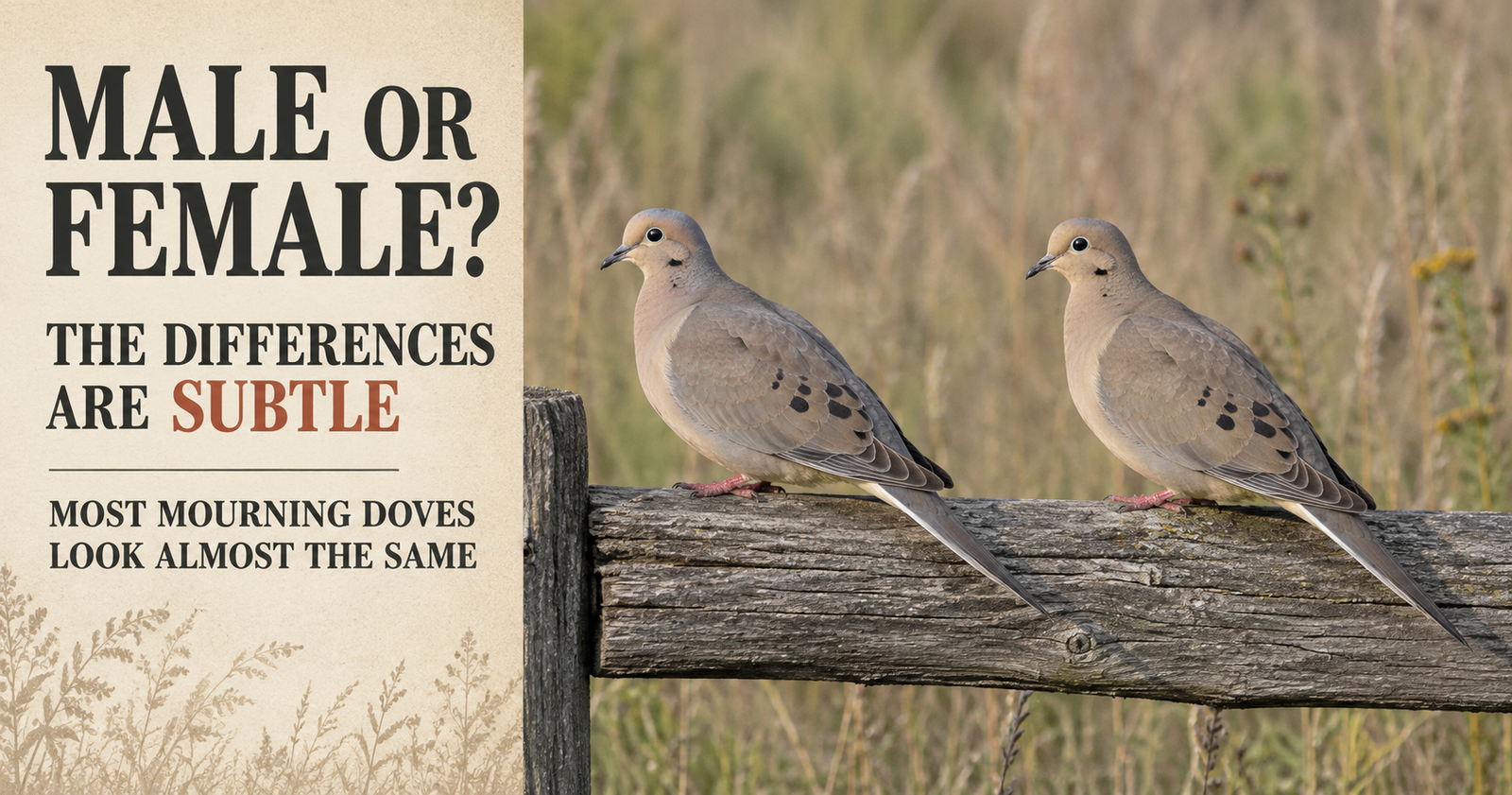
Our dedicated male-versus-female guide will focus on the features that are actually useful rather than pretending every dove can be sexed instantly from one photograph.
Do Mourning Doves Migrate?
Some do.
Some don’t travel nearly as far.
Mourning Doves occur across an enormous range, and seasonal movement varies geographically.
Birds from colder northern portions of the range are more likely to move south for winter, while birds in warmer areas may remain year-round.
That’s why you can see Mourning Doves throughout winter in many parts of the United States even though migration is occurring elsewhere.
Migration will get its own article because the answer depends heavily on where the bird started.
How Fast Can a Mourning Dove Fly?
Fast enough that the quiet bird walking underneath your feeder suddenly turns into a missile.
Cornell describes Mourning Dove flight as fast and bullet straight.
Those pointed wings generate powerful flight, and the long tail helps with maneuvering.
The contrast is one of my favorite things about the species.
On the ground:
gentle little seed eater.
Startle it:
WHOOSH.
It’s gone.
How Long Do Mourning Doves Live?
Most wild Mourning Doves won’t approach anything close to the species longevity record.
But that record is astonishing.
Cornell reports that the oldest known Mourning Dove was a male at least 30 years and 4 months old.
He had originally been banded in Georgia in 1968 and was recovered in Florida in 1998.
Thirty years is exceptional, not normal.
Wild birds face predation, disease, weather, collisions, hunting, and numerous other hazards.
Still, knowing that a Mourning Dove is biologically capable of surviving three decades makes the ordinary bird sitting on your power line seem a little less ordinary.
Why Do Mourning Doves Bob Their Heads?
Watch one walking across bare ground and you’ll probably notice the characteristic head movement.
The body moves forward.
The head seems to bob.
This type of movement helps birds stabilize their visual world while walking.
Rather than their view bouncing uncontrollably with every step, the head remains relatively stable for part of the movement and then quickly catches up.
To us it looks like bobbing.
To the bird, it’s part of keeping track of a moving world.
Do Mourning Doves Drink Water Differently From Other Birds?
Doves and pigeons have another unusual ability.
Many birds take a sip, raise their head, and let gravity help move the water down.
Doves can drink more continuously by drawing water into the bill.
That lets them take a surprisingly fast drink.
If you’ve got Mourning Doves around a birdbath, watch closely.
Even something as ordinary as drinking reveals that these birds aren’t built quite like many of the other backyard species around them.
Mourning Dove vs Pigeon
They’re relatives, but they aren’t the same bird.
The familiar Rock Pigeon is generally heavier and bulkier with a shorter-looking tail.
A Mourning Dove is more delicate and streamlined, with that long pointed tail and much smaller-looking head.
Mourning Doves also have the characteristic black wing spots and soft brown-gray coloration.
If the bird looks like someone took a pigeon and made it slimmer, smaller-headed, longer-tailed, and more graceful, you’re moving in the right direction.
Mourning Dove vs Eurasian Collared-Dove
This comparison is increasingly useful because Eurasian Collared-Doves now occur across large parts of North America.
The collared-dove is generally larger and paler.
Its tail is more squared-off.
And adults have the obvious black half-collar on the back of the neck.
Mourning Doves are slimmer, show dark spots on the wings, and have that long pointed tail.
The tail alone can be extremely helpful once you’ve learned both birds.
We’ll build a full comparison later because these two regularly show up in the same kinds of human-altered landscapes.
Are Mourning Doves Endangered?
No.
Mourning Doves remain extremely abundant across North America and are considered a species of low conservation concern.
That doesn’t mean their population has been completely stable.
Cornell reports an estimated decline of about 20 percent between 1966 and 2019 based on the North American Breeding Bird Survey.
They’re also heavily hunted where legal and regulated.
Despite those pressures, Mourning Doves remain among the most familiar and widespread birds on the continent.
Why Do I Keep Seeing Two Mourning Doves Together?
You may be watching a bonded pair.
Paired Mourning Doves spend time together and engage in behaviors such as mutual preening.
During breeding season, you’ll also see males pursuing females and interacting with rival males.
But two doves sitting together aren’t automatically proof of a lifelong pair.
Outside breeding season, Mourning Doves can gather in groups and even form large flocks.
Behavior and season help tell the story.
Are Mourning Doves Friendly?
I’d call them tolerant rather than friendly in the human sense.
They’re comfortable living around people.
They nest around homes.
They feed in yards.
They sit on buildings and wires.
But they’re still wild birds.
A Mourning Dove calmly walking underneath your feeder isn’t asking to become a pet.
It’s simply learned that your yard is a usable place.
That’s exactly the relationship I want with backyard wildlife.
Give the bird useful habitat.
Then let it remain wild.
Common Questions About Mourning Doves
Why does a Mourning Dove sound so sad?
The familiar low coo sounds mournful to human ears, which is where the species gets its name. The song is communication, not evidence that the bird is grieving.
Are Mourning Doves the same as pigeons?
No. They’re in the same bird family, but Mourning Doves are a distinct species with a slimmer body, long pointed tail, dark wing spots, and different vocalizations.
What do Mourning Doves eat?
Seeds make up about 99 percent of their diet, according to Cornell. They eat wild seeds, cultivated grains, and feeder seed, usually while foraging on the ground.
Why do Mourning Doves sit on power lines?
Power lines provide elevated, open perches where doves can rest, watch their surroundings, and communicate.
Do Mourning Doves use bird feeders?
Yes, but they particularly suit platform and ground feeding. Seed scattered on the ground can attract them very effectively.
Mason Reed is the Bird Identification & Behavior Contributor for BirdResource.com, where he helps everyday birdwatchers identify the birds around their homes and understand the nesting, feeding, sounds, and behaviors they’re actually seeing.