
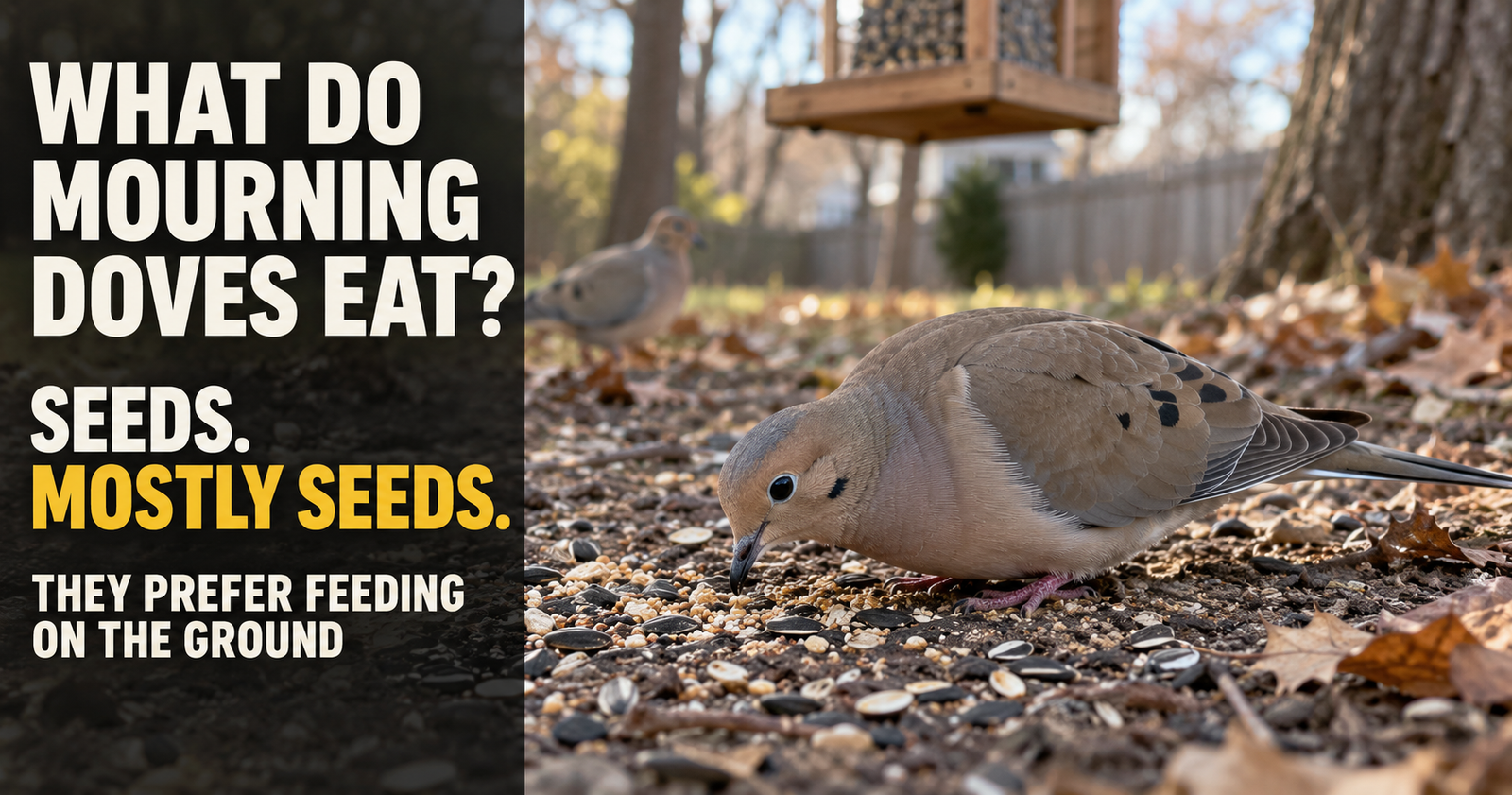
If you want to understand how a Mourning Dove eats, don’t watch the bird feeder.
Watch the ground underneath it.
That’s where I usually expect the real action.
While smaller birds bounce between feeder ports and cardinals crack sunflower seeds one at a time, Mourning Doves often walk around underneath them quietly picking up fallen seeds. That feeding behavior is part of the broader pattern covered in the Mourning Dove behavior guide.
And once you notice how fast they’re eating, it can look like they’re barely chewing anything.
That’s because they aren’t.
Mourning Doves swallow seeds whole and store them temporarily in an expandable pouch called the crop. Once they’ve loaded up, they can fly somewhere safer and deal with digestion afterward.
One recorded Mourning Dove had 17,200 bluegrass seeds in its crop.
That sounds made up.
It isn’t.
According to the Cornell Lab’s Mourning Dove overview, these birds can rapidly fill the crop while feeding and then retreat to a safe perch to digest the meal.
Once you know that, the Mourning Dove underneath your feeder suddenly makes a lot more sense.
It’s not casually snacking.
It’s loading groceries.
Mourning Doves Are Almost Completely Seed Eaters
If I had to summarize the Mourning Dove diet with one word, it would be:
Seeds.
Cornell reports that seeds make up roughly 99 percent of their diet.
That’s unusually straightforward compared with many familiar backyard birds.
Blue Jays eat nuts, seeds, insects, fruit, and occasional animal foods.
Cardinals eat seeds, fruit, berries, and insects.
Mourning Doves are much more committed to the seed aisle.
Their natural diet includes seeds from grasses, weeds, herbs, and agricultural crops.
The Mourning Dove life-history information from Cornell also notes occasional berries, peanuts, and even snails, but those are exceptions compared with the enormous amount of seed these birds consume.

What Seeds Do Mourning Doves Actually Eat?
There’s no single magic Mourning Dove seed.
They take advantage of whatever suitable seeds are available where they live.
Wild foods can include seeds from grasses, weeds, and broadleaf plants.
Around agricultural areas, they also eat spilled grain.
Here in Missouri, MU Extension’s Mourning Dove habitat guide lists foods including millet, wheat, corn, grain sorghum, sunflowers, soybeans, buckwheat, ragweed, crabgrass, pokeweed, and other seed-producing plants.
That’s a pretty broad menu.
But if I’m buying birdseed specifically because I want Mourning Doves around my yard, I wouldn’t try to recreate an entire farm field.
I’d start simple.
Millet Is One of My First Choices
Millet makes a lot of sense for Mourning Doves.
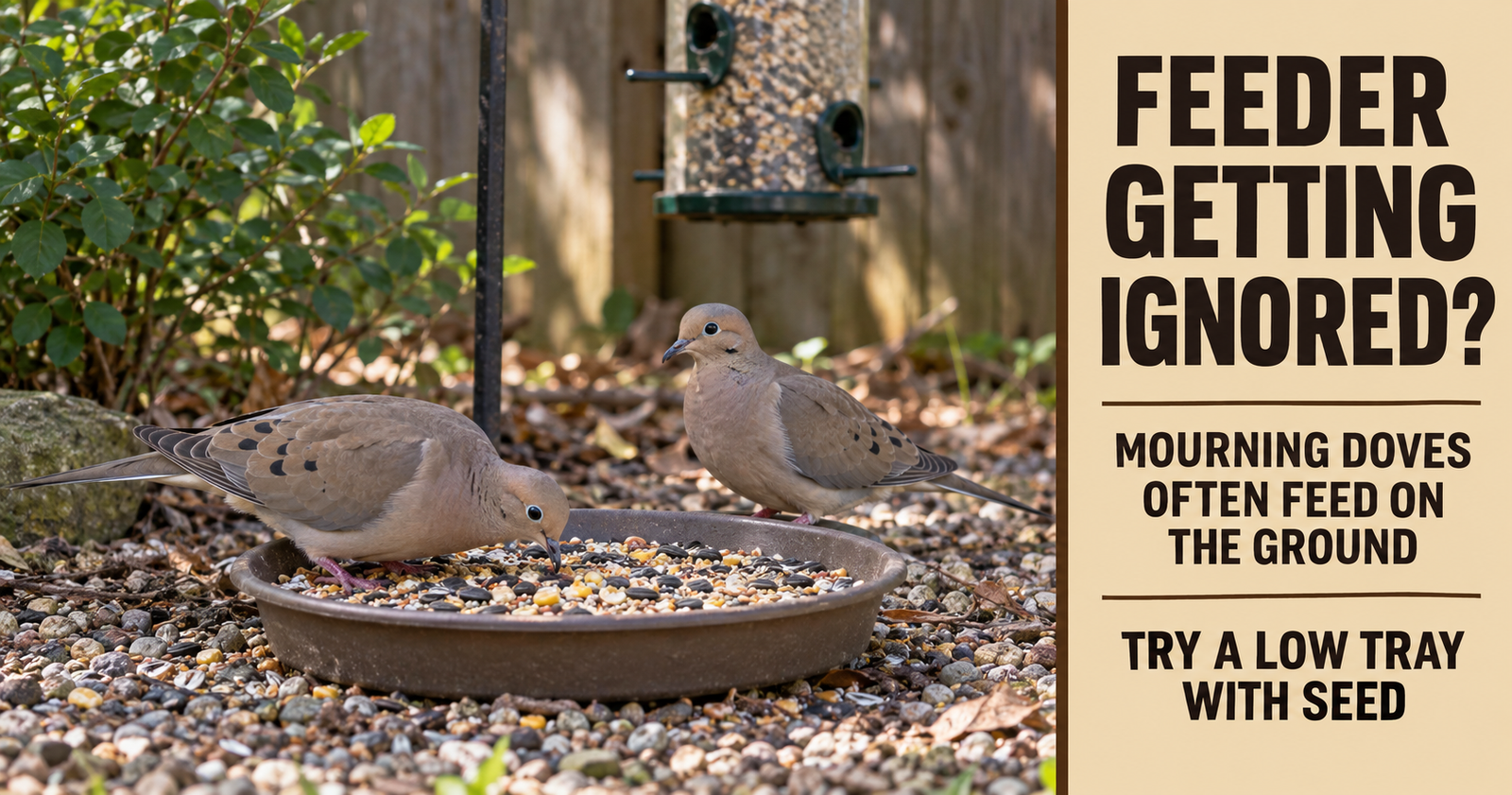
Cornell specifically recommends scattering millet on the ground or offering it on a platform feeder to attract them. If they still overlook that setup, attract Mourning Doves when they ignore a feeder explains how to adjust the feeding area around their natural habits.
MU Extension also describes millets as especially palatable to Mourning Doves.
That’s a strong recommendation from two directions.
And millet fits the way the bird naturally feeds.
It’s small.
It’s easy to swallow whole.
And it works well on the open feeding surfaces Mourning Doves prefer.
This is exactly why I don’t automatically consider millet a cheap filler seed.
Whether something is “filler” depends partly on which bird you’re trying to feed.
A Mourning Dove may be considerably more interested in millet than a bird that keeps throwing it aside to reach sunflower.
Mourning Doves Eat Sunflower Seeds Too
Yes, Mourning Doves eat sunflower seeds.
Penn State Extension lists sunflower among the foods Mourning Doves readily use at backyard feeding stations, along with millet and cracked corn. (extension.psu.edu)
That makes sunflower useful if you’re feeding several species at once.
You don’t necessarily need one bag of seed for cardinals and another completely unrelated bag for doves.
But watch how the birds handle it.
A cardinal has that huge seed-cracking bill and may sit there opening seeds individually.
The Mourning Dove’s feeding strategy is different.
It’s built around picking up and swallowing suitable seeds, storing them in the crop, and grinding them later during digestion.

Cracked Corn Can Bring Mourning Doves In
Cracked corn is another food Mourning Doves use.
You’ll see it recommended for ground-feeding birds because it’s easy to scatter or offer on a platform.
But I wouldn’t dump giant piles of corn around the yard.
Corn can attract plenty of animals besides doves.
It can also become wet and spoiled if too much is left sitting around.
If I’m using cracked corn, I’d rather offer a manageable amount and see how quickly the birds actually use it.
That’s a general rule I follow with bird feeding:
Fresh food beats more food.
Why Are Mourning Doves Always Eating Under My Feeder?
Because the ground is exactly where they’re comfortable feeding.
Mourning Doves are natural ground foragers.
They walk across relatively open ground picking up visible seeds.
And here’s an important detail I think gets missed in a lot of generic bird-feeding advice:
They aren’t built to scratch through heavy litter like a chicken.
MU Extension notes that Mourning Doves have relatively weak feet for scratching and prefer feeding where seeds are exposed and easy to reach.
So when chickadees, finches, or cardinals knock seed from your feeder, the doves underneath aren’t necessarily settling for scraps.
You’ve accidentally created a feeding setup that matches what they already do naturally.
Bare Ground Can Matter More Than Another Feeder
This is something I’d pay attention to if Mourning Doves regularly visit but never seem comfortable.
Look at the ground.
Is it covered with thick vegetation?
Deep mulch?
Tall grass?
Dense plants?
Or can the birds actually walk around and see the seeds?
Research summarized by the USDA notes that Mourning Doves prefer visible, accessible food on relatively open ground and don’t dig for buried seeds.
That’s useful because attracting them may require less equipment than you think.
Sometimes the problem isn’t the seed.
The bird simply can’t comfortably get to it.
Mourning Doves Don’t Crack Every Seed at the Feeder
This is probably my favorite part of their feeding behavior.
Watch a cardinal eat sunflower.
Grab seed.
Manipulate seed.
Crack shell.
Eat kernel.
Repeat.
A Mourning Dove can work much faster because it can swallow suitable seeds whole.
Those seeds enter the crop, an enlarged storage area in the esophagus.
The bird can fill that storage area while it’s exposed on the ground and then leave.
That’s a smart arrangement for an animal that spends a lot of feeding time somewhere predators can see it.
Eat now.
Digest somewhere safer.
What Happens to All Those Whole Seeds?
They eventually have to be broken down.
And that’s where grit becomes important.
Mourning Doves swallow small pieces of sand and gravel that remain in the muscular gizzard and help grind hard seeds.
MU Extension specifically notes that grit helps Mourning Doves break down their seed-heavy diet.
So the little dove picking around a gravel driveway may not always be looking for food.
It may be picking up some of the equipment its digestive system needs to process that food.
That’s the kind of everyday behavior I love noticing because it makes an ordinary scene look completely different.
Do I Need to Buy Grit for Mourning Doves?
For wild Mourning Doves, I wouldn’t rush out and buy a bag of grit.
They naturally obtain small sand and gravel particles from the environment.
Bare soil, gravelly areas, roadsides, and similar places can provide what they need.
If your yard already contains natural access to small mineral particles, the birds are perfectly capable of finding them.
I wouldn’t start sprinkling random gravel into a bird feeder either.
Food and grit serve different purposes.
Let the doves forage naturally for both.
How Much Can a Mourning Dove Eat?
Quite a bit for a bird that looks like it’s casually wandering around.
Cornell reports that Mourning Doves eat roughly 12 to 20 percent of their body weight each day, averaging about 71 calories.
That helps explain the urgency you sometimes see around a productive feeding area.
The bird isn’t pecking at two seeds and calling it breakfast.
It needs a steady supply of energy.
And because it can fill its crop quickly, a Mourning Dove may spend an intense period feeding and then seemingly disappear.
It’s probably not finished with the meal.
It’s just finished collecting it.
What Do Mourning Doves Eat in Winter?
Seeds remain the foundation.
Winter changes what’s naturally available, so backyard feeders can become particularly noticeable sources of food.
Millet.
Sunflower.
Cracked corn.
Other appropriate seed and grain.
Mourning Doves also form larger groups outside the breeding season, so you may suddenly see several birds feeding together rather than the familiar pair you’ve watched during warmer months.
I wouldn’t dramatically change the menu just because the temperature dropped.
I’d focus on keeping appropriate seed dry, fresh, and accessible.
What Do Mourning Doves Eat in Summer?
Still seeds.
That’s one of the things that makes their diet unusual.
Many familiar backyard birds shift heavily toward insects during breeding because they need insect protein for nestlings.
Mourning Doves have a completely different solution for feeding babies, which we’ll cover separately when we get to crop milk.
For the adults themselves, seed remains overwhelmingly important.
Summer simply changes which wild seeds and agricultural foods are naturally available.
Do Mourning Doves Eat Bugs?
Very rarely compared with many backyard birds.
Cornell describes their diet as about 99 percent seeds, with occasional other foods. Audubon similarly describes insects as extremely rare in the Mourning Dove diet. (audubon.org)
So I wouldn’t think of Mourning Doves as insect-eating garden helpers in the same way I might think about birds that actively hunt caterpillars, beetles, or flies.
If you’re trying to attract Mourning Doves, seed is the answer.
Do Mourning Doves Eat Peanuts?
They can.
Cornell includes peanuts among foods found in the Mourning Dove diet.
But peanuts wouldn’t be my first purchase specifically for doves.
I’d save those for birds such as Blue Jays and focus the Mourning Dove feeding area more heavily around smaller seeds and grains.
That’s another advantage of having multiple feeding areas.
You don’t need to make one feeder and one food perfect for every bird in the neighborhood.
What’s the Best Feeder for Mourning Dove Food?
Think wide and easy to stand on.
Penn State Extension lists ground feeding and platform feeders as appropriate for Mourning Doves.
That matches everything we know about their natural behavior.
I want the bird to be able to land normally and walk around.
A large platform feeder makes sense.
A ground-feeding tray makes sense.
Seed scattered responsibly on clean, open ground can work too.
A tiny hanging tube with little perches?
That’s not where I’d start if Mourning Doves were my target.
Should I Just Throw Birdseed on the Ground?
You can scatter appropriate seed, and Cornell specifically recommends ground feeding for Mourning Doves.
But I still care about cleanliness.
I wouldn’t continually throw new seed on top of old wet seed, droppings, hulls, and moldy material.
Rotate or clean heavily used feeding areas.
Offer reasonable amounts.
Don’t let spoiled food accumulate.
A low ground tray can give you more control while still matching the dove’s natural feeding style.
What About Water?
This is another part of feeding behavior worth watching.
Mourning Doves need regular access to water, and their drinking technique is unusual.
Instead of taking a sip and repeatedly tipping the head backward like many birds, doves can draw water up and swallow continuously.
MU Extension notes that Mourning Doves regularly visit water after feeding, often in the morning and evening.
So if you already have the seed figured out, fresh accessible water may be the next simple improvement to your yard.
What I Would Put Out for Mourning Doves
I wouldn’t overcomplicate this.
If Mourning Doves were already walking around my yard, I’d start with:
millet, sunflower seed, or a suitable mix containing foods they actually use.
I’d offer it on a broad platform, ground tray, or clean open feeding area.
Then I’d watch what disappears.
That’s much more useful than buying a giant “premium dove blend” simply because there’s a Mourning Dove printed on the front.
The birds will tell you what they’re eating.
And the pile of rejected seed underneath the feeder will tell you what they’re not.
Common Questions About What Mourning Doves Eat
What is a Mourning Dove’s favorite food?
Mourning Doves eat many kinds of seeds, but millet is an excellent backyard choice and is specifically recommended by Cornell for attracting them.
Do Mourning Doves eat sunflower seeds?
Yes. Sunflower seeds are a good food for Mourning Doves and work particularly well when you’re feeding several backyard species.
Do Mourning Doves eat millet?
Yes. Millet is one of the foods I’d try first if I specifically wanted to attract Mourning Doves.
Do Mourning Doves eat cracked corn?
Yes. Cracked corn is commonly used for Mourning Doves and other ground-feeding birds.
Why do Mourning Doves eat off the ground?
Ground foraging is their normal feeding behavior. They walk across relatively open areas and pick up visible seeds rather than scratching through dense vegetation.
Why do Mourning Doves swallow seeds whole?
Their digestive system is designed for it. Seeds can be stored temporarily in the crop and later ground in the gizzard with the help of swallowed grit.
Do Mourning Doves need grit?
Yes. Small pieces of sand and gravel retained in the gizzard help grind the hard seeds that dominate their diet.
Do Mourning Doves eat insects?
Very rarely. Seeds account for approximately 99 percent of their diet.
Do Mourning Doves eat peanuts?
They can, but peanuts wouldn’t be my first food specifically for attracting Mourning Doves.
How much does a Mourning Dove eat?
Cornell reports that they consume roughly 12 to 20 percent of their body weight each day.
What feeder is best for Mourning Doves?
A wide platform or ground-feeding setup matches their natural feeding behavior much better than a tiny hanging feeder.
Watch the Dove Instead of the Seed Bag
That’s probably the easiest way to understand what Mourning Doves want.
Watch where the bird goes.
Usually down.
Watch how it searches.
It walks instead of scratching.
Watch what happens when it finds good seed.
It swallows quickly instead of sitting there cracking each piece apart.
Then suddenly the bird leaves even though there is still plenty of food.
Now you know why.
Its crop may already be full.
The Mourning Dove underneath your feeder isn’t a clumsy bird waiting for everybody else’s leftovers.
It’s doing almost exactly what it would be doing in a field full of naturally fallen seeds.
Your feeder just happens to be raining dinner onto the ground.
Mason Reed is the Backyard Birding & Feeding Contributor for BirdResource.com, where he helps everyday birdwatchers understand what familiar birds actually eat, how they find food, and the small behaviors that make watching an ordinary backyard much more interesting.