At Bird Resource, we want readers to feel confident that the information they find on our website has been developed with accuracy, usefulness, and clarity in mind.
Birds are an incredibly diverse group of animals, and seemingly simple questions can sometimes have complicated answers. Appearance can vary by age, sex, season, geographic location, and individual bird. Migration patterns can shift. Scientific classifications can change. Bird behavior isn’t always identical from one individual to another.
Because of this, BirdResource.com follows editorial standards designed to help us produce information that is both approachable and responsibly researched.
This page explains how we research, develop, review, update, and correct content published on Bird Resource.
Our Editorial Mission
Bird Resource exists to help everyday people better understand the birds around them. You can also explore Bird Resource's mission and the site's broader purpose.
Our goal isn’t to make bird information unnecessarily technical. At the same time, we don’t want to oversimplify a subject to the point that important facts become inaccurate.
We aim for a balance.
Our articles should be understandable to someone who has never considered themselves a birder while still providing enough detail to genuinely answer the question that brought them to Bird Resource.
Whenever possible, we want readers to leave an article understanding not only the answer, but also why that answer makes sense.
How We Research Bird Information
The research required for an article depends on the subject.
A guide comparing two similar-looking birds may require careful review of identifying characteristics, geographic ranges, plumage differences, size, behavior, and seasonal variations.
An article about nesting may require information about breeding seasons, clutch sizes, incubation, nest locations, and regional differences.
A bird-feeding article may involve diet, feeder preferences, seasonal food availability, and responsible feeding practices. Readers troubleshooting feeder visits may also find feeding and attracting birds guides useful for related advice.
For factual bird information, we prioritize appropriate authoritative and reputable sources. These may include university ornithology programs, government wildlife agencies, scientific publications, recognized conservation organizations, established bird research organizations, and other reliable references relevant to the subject. The FAQ provides a broader overview of how our content is created and the subjects Bird Resource covers.
We may consult multiple sources when a topic benefits from comparison or additional verification.
Sources We Trust
There isn’t one source that is automatically best for every bird question.
Depending on the subject, Bird Resource may consult information from organizations and resources such as university ornithology programs, the U.S. Fish and Wildlife Service, state wildlife agencies, scientific journals, museums, universities, conservation organizations, and established bird research databases.
We evaluate sources based on their relevance, expertise, supporting evidence, and appropriateness for the particular claim being researched.
References to outside organizations do not imply sponsorship, endorsement, partnership, or affiliation with Bird Resource unless explicitly stated.
Bird Identification Standards
Identification content deserves special attention because birds don’t always look exactly like the photograph someone expects to see.
Whenever relevant, an identification guide may consider characteristics such as:
Size and overall shape
Plumage and coloration
Bill shape and size
Wing markings
Tail shape and markings
Male and female differences
Juvenile and adult differences
Seasonal plumage
Behavior
Habitat
Geographic range
Season and migration
Similar-looking species
No single characteristic is necessarily enough to identify every bird accurately.
We therefore try to explain the combination of characteristics that can help distinguish one species from another rather than relying solely on color or one obvious feature.
Scientific Names and Classification
Common bird names are usually the easiest way for readers to understand our content, so those will generally be used throughout Bird Resource.
Scientific names may also be included when they improve identification or clarity.
Bird taxonomy isn’t permanently fixed. Scientific understanding changes, species may be split or combined, and official naming conventions can be revised.
When meaningful classification or naming changes occur, older Bird Resource content may be updated to reflect current information.
Geographic Information Matters
Where a bird was observed can be extremely important.
A species common in one part of the United States may be unusual or absent somewhere else. Some species are present year-round in part of their range while appearing only seasonally elsewhere.
Migration further complicates identification.
For these reasons, we try to avoid presenting geographic information as universally applicable when meaningful regional differences exist.
Readers should consider their location, season, habitat, and other identifying characteristics together when attempting to identify an unfamiliar bird.
Understanding Bird Behavior
Bird behavior isn’t always absolute.
Individual birds can behave differently, and behavior may change with season, breeding activity, food availability, weather, habitat, competition, predators, and other environmental conditions.
When describing bird behavior, we distinguish between commonly documented patterns and claims that would suggest every individual bird behaves exactly the same way.
Words such as “often,” “typically,” “may,” and “can” are sometimes important because wildlife doesn’t always follow a perfectly predictable script.
Firsthand Observations
As Bird Resource grows, some content may include firsthand observations, photographs, feeder experiences, birdhouse projects, product use, backyard experiments, or other original material.
When something is based on personal observation rather than established scientific evidence, we aim to make that distinction clear.
An observation of what one cardinal, feeder, or backyard bird population did does not automatically prove that every bird of that species will behave the same way.
Firsthand experience can make an article considerably more useful, but it should complement reliable information rather than replace it.
Product Recommendations
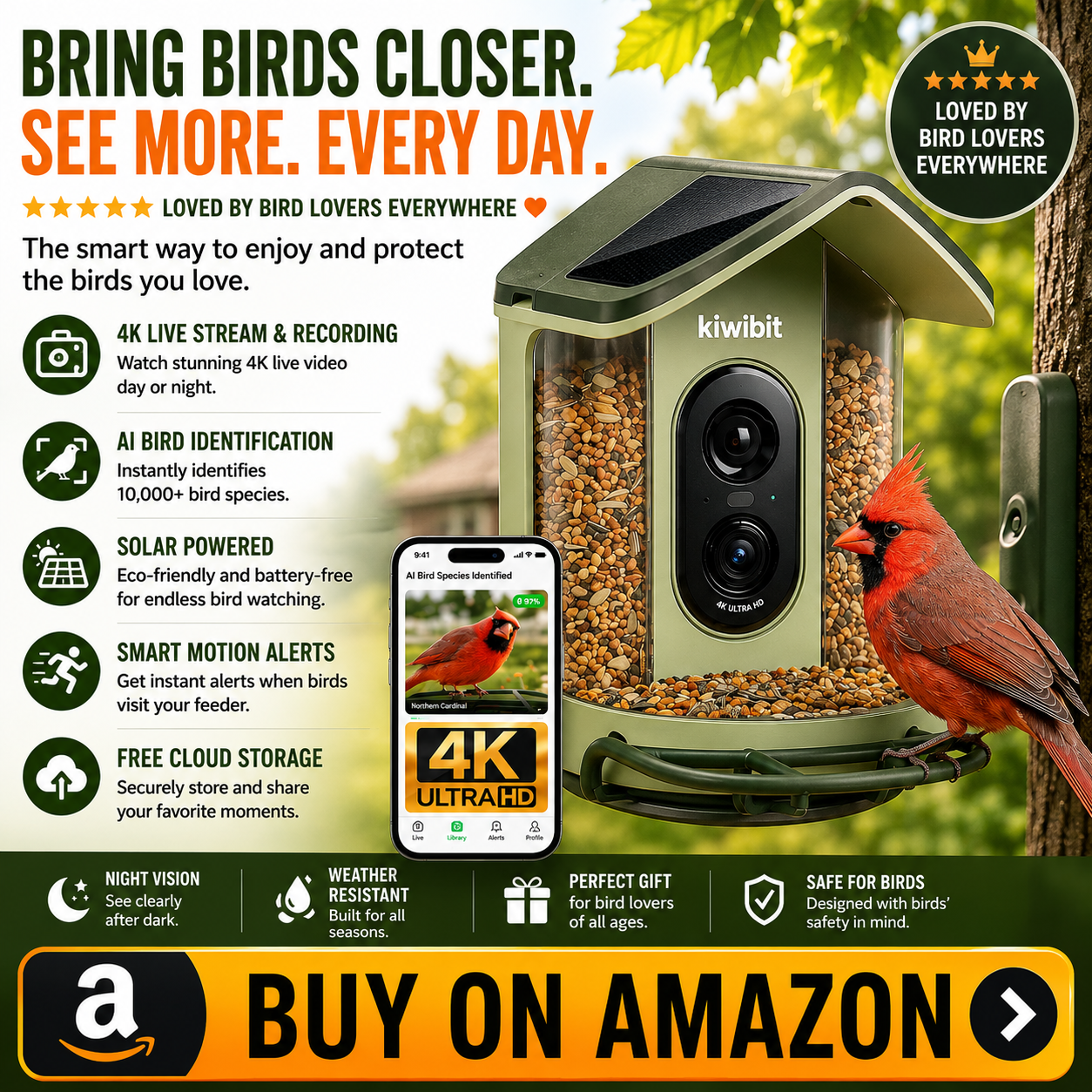
Bird Resource may publish buying guides, product comparisons, individual reviews, and recommendations involving products such as bird feeders, birdhouses, bird baths, binoculars, cameras, bird seed, and other birding equipment. For an example of the smart-feeder products covered by this policy, see the Kiwibit Smart Feeder 2 Mini.
Our goal is to help readers understand which products may fit their particular needs.
Product recommendations may consider factors such as design, intended use, specifications, features, materials, price, available documentation, customer experience, manufacturer information, and other information relevant to the product.
Some products may be personally purchased, used, or tested by Bird Resource. Others may be evaluated primarily through research.
We will not describe a product as personally tested when it wasn’t.
When firsthand testing has occurred and materially affects our recommendation, we may explain the nature of that experience in the article.
Affiliate Relationships and Editorial Independence
Some Bird Resource articles may contain affiliate links.
If a reader follows an eligible affiliate link and makes a purchase, Bird Resource may earn a commission. This generally does not increase the price the reader pays. The full details are explained in our affiliate disclosure.
The possibility of earning a commission does not determine whether factual information about birds is true, nor should it prevent us from discussing meaningful disadvantages of a product. Readers can also review Bird Resource's privacy and tracking practices when considering how affiliate activity relates to the website.
Additional information about these relationships can be found in our Affiliate & Advertising Disclosure.
Sponsored Content and Free Products
If Bird Resource accepts sponsored content, compensation, free products, or another material relationship that could reasonably affect how readers perceive a piece of content, we aim to disclose that relationship clearly when required and appropriate.
Receiving a product does not automatically guarantee a positive review or recommendation.
We don’t want readers to have to guess whether a meaningful commercial relationship exists.
Digital and AI-Assisted Tools
Bird Resource may use modern digital tools, including AI-assisted technology, as part of researching, organizing, developing, editing, formatting, or improving content.
These tools are not treated as authoritative sources of bird facts.
Important factual claims should be supported by appropriate research and reputable source material rather than accepted simply because an automated system produced them.
The responsibility for what appears on BirdResource.com remains with Bird Resource.
Our use of technology is intended to help us produce clearer and more useful content, not to eliminate standards for accuracy.
Images and Illustrations
Bird identification is visual, which makes images particularly important on Bird Resource.
Our website may use original photography, properly licensed photography, illustrations, diagrams, comparison graphics, generated visual material, manufacturer-provided product imagery when appropriately permitted, and other visual resources.
Illustrations and generated images can be useful for explaining concepts, but they should not automatically be treated as photographic evidence of an exact species characteristic.
When precise identification depends on subtle physical characteristics, readers should rely on the accompanying researched information and appropriate real-world references rather than assuming every illustration represents every detail perfectly.
We make reasonable efforts to avoid presenting misleading visual information.
Fact Checking
Accuracy is an ongoing responsibility rather than something that ends the moment an article is published.
Before publication, factual information may be checked against one or more appropriate references depending on the complexity and importance of the subject.
Particular care should be given to information involving species identification, geographic range, diet, migration, nesting, protected wildlife, health and safety, or other claims where inaccurate information could meaningfully mislead readers.
We also recognize that no publishing process is perfect.
If reliable information shows that something we’ve published is incorrect, we want to know about it.
Corrections
Bird Resource welcomes legitimate factual corrections.
If you believe an article contains an error, you may contact us through our Contact Us page.
When reporting a possible error, providing the article title, the specific statement in question, and a reputable supporting source is particularly helpful.
We review correction requests rather than automatically changing content based solely on an email.
When we determine that a meaningful factual error exists, we may correct or clarify the article.
Minor spelling, grammar, formatting, or stylistic changes may be made without a formal correction notice.
Updating Older Content
Bird Resource is intended to become a long-term resource, which means older articles may occasionally need attention.
We may update articles when:
Scientific information changes
Bird names or classifications change
Geographic or migration information requires revision
Better sources become available
Products are discontinued or substantially changed
Recommendations become outdated
New firsthand experience provides useful additional information
Images or graphics can be improved
Readers identify meaningful omissions or errors
An article can be made substantially more useful
The publication date of an article does not necessarily mean every piece of information will remain unchanged forever.
Responsible Wildlife Information
Enjoying birds should not come at the expense of the birds themselves.
When relevant, Bird Resource aims to encourage responsible observation and interaction with wild birds.
Certain wild birds, nests, eggs, feathers, and other wildlife may be protected by federal, state, local, or other laws and regulations.
Bird Resource provides general educational information and does not provide individualized legal advice.
Readers are responsible for understanding and following laws and regulations applicable to their location and circumstances.
Injured and Distressed Birds
Bird Resource is not a wildlife rehabilitation organization, veterinary practice, emergency service, or government wildlife agency.
Our educational articles should never be treated as a substitute for appropriate professional assistance when an animal is injured, sick, orphaned, or otherwise in distress.
If you encounter a wild bird that appears to require immediate help, contact an appropriate licensed wildlife rehabilitator, veterinarian when applicable, or relevant local or state wildlife authority rather than waiting for a response from Bird Resource. The broader disclaimer concerning urgent wildlife situations is provided in immediate help.
We Don’t Provide Individual Bird Identification by Email
Bird Resource publishes guides designed to help large numbers of readers learn about birds.
We are not able to provide individual bird identification, personalized bird-care recommendations, or one-on-one bird advice through email or our contact form.
Please don’t send photographs expecting an individual identification response.
Our contact options are intended primarily for website issues, factual corrections, useful content suggestions, media or business inquiries, relevant collaboration and backlink opportunities, copyright matters, and other matters directly related to BirdResource.com.
Editorial Changes and Improvements
These standards may evolve as Bird Resource grows.
New types of content, technology, research methods, products, partnerships, or publishing practices may require us to refine our processes.
When appropriate, this page may be updated to better explain how Bird Resource operates.
What should remain consistent is the underlying goal:
Publish useful bird information that is approachable, responsibly researched, clearly presented, and worthy of our readers’ trust.
BirdResource.com | Your Guide to the Birds Around You