
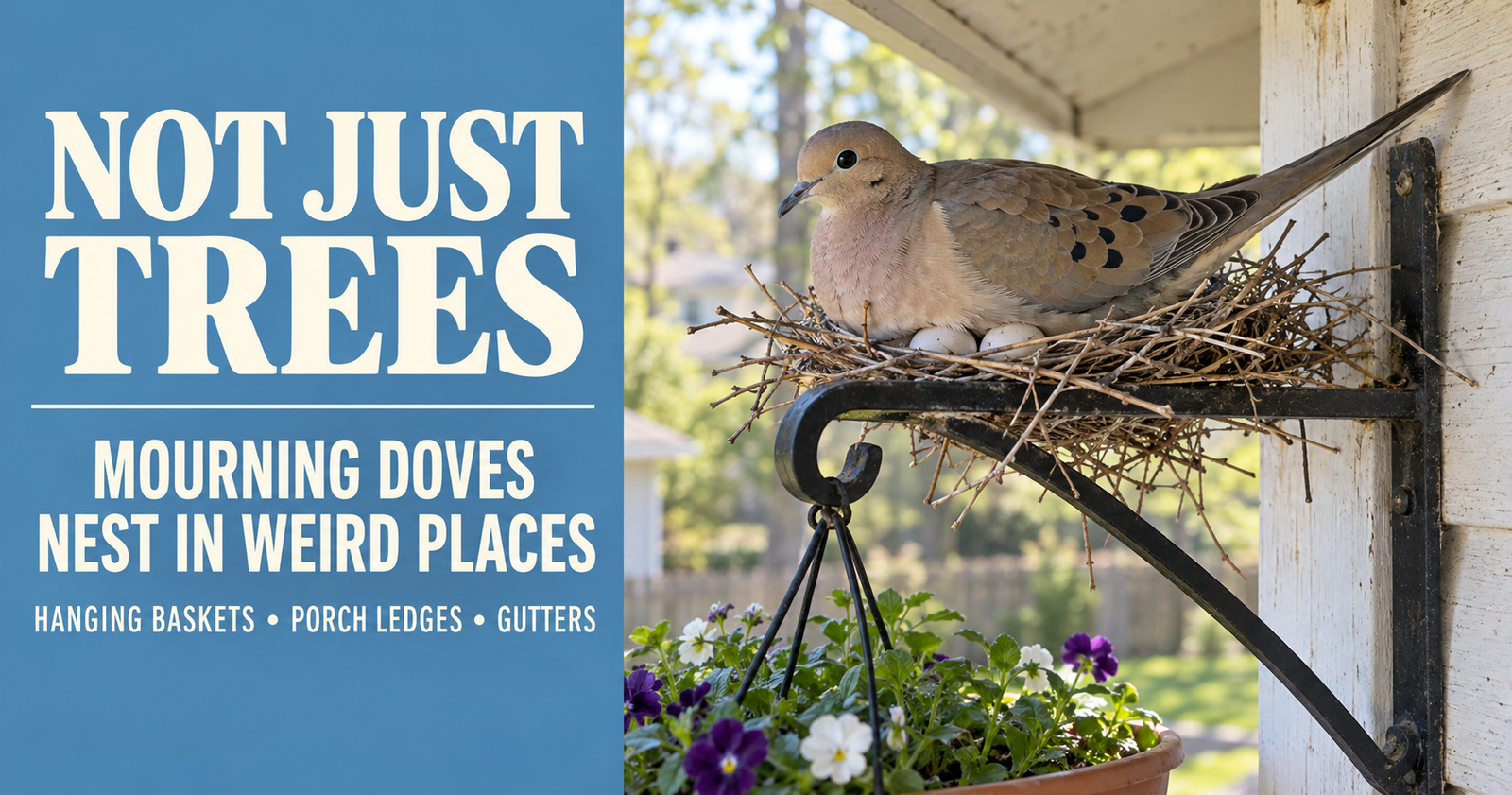
If I saw a Mourning Dove repeatedly flying toward the house carrying a twig, I wouldn’t automatically start searching the trees.
I’d check the porch.
The gutters.
Hanging flowerpots.
Ledges.
Outdoor shelves.
Equipment that hasn’t moved in a while.
And yes, I’d eventually check the trees too.
Mourning Doves build some of the simplest-looking nests of any bird you’re likely to find around a home, and they’re surprisingly flexible about where they put them. Their unusual nesting habits make more sense alongside the species' other physical and behavioral traits, which are covered in Mourning Dove behavior and appearance.
Cornell describes their nest as a flimsy platform of twigs, pine needles, and grass stems.
Sometimes you can practically see through the bottom.
The location can be just as surprising.
Mourning Doves normally nest in trees, shrubs, vines, and other vegetation, but documented nest sites also include gutters, eaves, buildings, hanging flowerpots, abandoned equipment, and even the ground.
So if a pair keeps disappearing somewhere around your house, don’t assume you’re missing a beautifully hidden nest high in a tree.
The nest may be sitting five feet away in a place you walk past every day.
Start by Watching the Birds Instead of Searching Every Tree
This is the first thing I’d do.
Don’t immediately start pushing branches apart looking for a nest.
Watch the doves.
A Mourning Dove carrying a twig is basically giving you directions.
Cornell’s NestWatch recommends watching nesting birds from a distance because birds carrying nesting material can lead you toward the nest site without requiring you to search through every possible location.
Pay attention to repeated trips.
Where does the bird land?
Does it disappear behind the same branch?
Does it keep flying underneath the porch roof?
Is it dropping behind a hanging basket?
Does one bird repeatedly return to the same evergreen?
One trip could mean nothing.
Repeated trips to the same exact spot are much more interesting.


The Male and Female Can Actually Help You Find the Nest
Mourning Dove nest building has a neat division of labor.
The male gathers material.
The female builds.
He may collect a twig, fly back to the nest, and pass it to her while she remains at the nesting site arranging everything.
That means the male can become your biggest clue during construction.
Instead of trying to distinguish tiny differences in feather color, watch the bird carrying sticks.
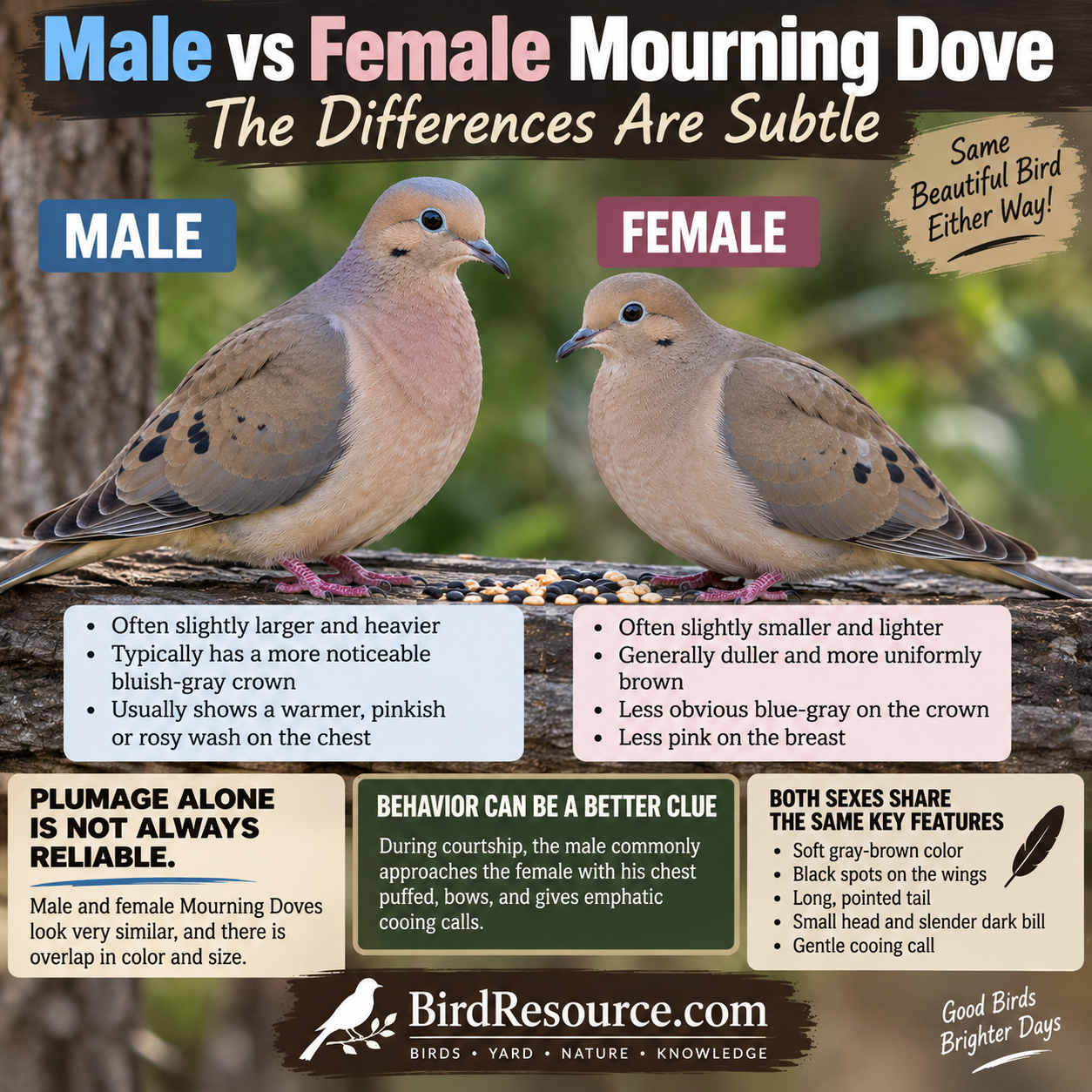
Our male vs female Mourning Dove guide explains this behavior in more detail.
If you can safely watch where that male repeatedly delivers nesting material, you’ve probably solved the mystery.
Trees Are Still One of the First Places I’d Check
The weird locations are fun, but I don’t want to make normal Mourning Dove nesting sound unusual.
Trees and shrubs are classic nest sites.
Cornell reports that Mourning Doves commonly choose dense foliage on branches of evergreens, orchard trees, cottonwoods, mesquite, vines, and other vegetation.
Audubon similarly describes trees and shrubs as typical nesting locations.
Look for a relatively supported horizontal area rather than imagining an elaborate nest hanging from tiny outer branches.
And don’t expect a giant structure.
A Mourning Dove nest can be surprisingly difficult to notice until you know exactly where the bird keeps landing.
Evergreens Can Be Especially Worth Watching
Evergreens offer something useful that a bare deciduous tree can’t provide early in the season.
Cover.
Dense branches can hide a nesting bird surprisingly well.
Cornell’s NestWatch actually recommends placing Mourning Dove nesting cones in shady portions of trees with branches overhead.
That gives us a good clue about the kind of protected structure these birds can appreciate.
If a pair spends a lot of time moving through one dense evergreen during nesting season, I’d pay attention before assuming they’re simply resting there.
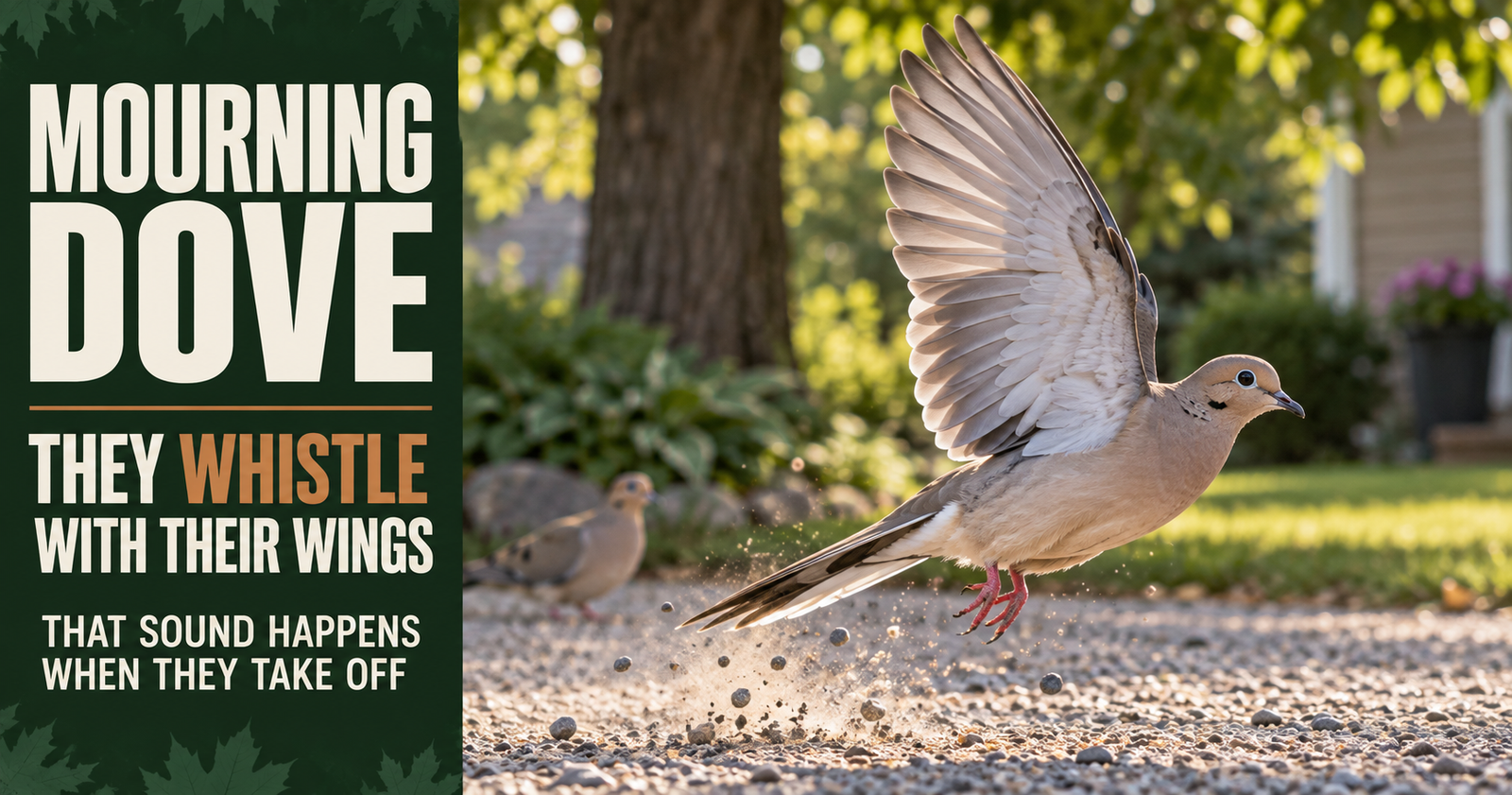

But Mourning Doves Will Nest Right Around Your House
This is where the species gets fun.
Mourning Doves are remarkably tolerant of people.
Cornell documents nests on:
gutters,
eaves,
abandoned equipment,
and other human-made structures.
NestWatch specifically notes that Mourning Doves commonly nest in hanging flowerpots.
Audubon has even highlighted Mourning Doves nesting around homes in places such as outdoor shelving and vents.
So when somebody tells me:
“There are Mourning Doves around my porch every day, but I can’t find the nest.”
I wouldn’t only look outward toward the trees.
I’d look up at the house.
Check Hanging Flower Baskets Before You Water Them
This is one of those places I’d want people to actually inspect during nesting season.
A hanging flower basket can provide:
a supported base,
some vegetation,
a little overhead protection,
and a location above the ground.
Apparently that can be enough for a Mourning Dove.
If you notice a dove repeatedly flying toward one particular planter, don’t shove your hand into it to investigate.
Watch first.
If there’s an active nest inside, suddenly dumping water directly onto it or constantly moving the basket isn’t something I’d want to do.
A bird sitting unusually still inside a hanging basket deserves a closer look from a respectful distance.

Gutters and Eaves Can Become Dove Real Estate
A gutter doesn’t look like a nest site to us.
To a Mourning Dove, parts of a house can provide the same basic thing a sturdy branch does:
a place to support a simple platform nest.
Cornell specifically documents Mourning Doves nesting on gutters and eaves.
That means the bird repeatedly disappearing near your roofline may not simply be landing there.
Watch where it goes.
A nest tucked against part of the structure can be surprisingly hard to see from the ground.
And if you discover an active nest, don’t immediately decide the solution is moving it somewhere “better.”
The doves chose that spot.
Sometimes They Nest on the Ground
This surprises people because Mourning Doves spend so much time in trees and on power lines.
But yes, they can nest directly on the ground.
Cornell notes that ground nesting is particularly common in parts of the West.
NestWatch lists the ground as one of the documented nesting substrates for the species.
A ground nest makes the already-simple Mourning Dove construction look even stranger because there may be very little separating the eggs from the surrounding surface.
If you’re mowing, trimming, clearing brush, or working around an area where doves have been acting unusually, this is worth remembering.
Not every nest is above your head.

Their Nests Really Can Look That Bad
This may be my favorite part.
You find the nest.
You look at it.
And your first thought is:
That’s it?
A Mourning Dove nest can look like somebody dropped a handful of twigs onto a branch and quit halfway through the project.
Cornell calls it a flimsy assembly of twigs, pine needles, and grass stems with little insulation.
The nest is roughly platform-shaped rather than a deep, carefully woven cup.
That’s normal.
Don’t assume you’ve found an unfinished or abandoned nest simply because you can see daylight through parts of it.
The bird may consider the job complete.
Nest Construction Can Be Surprisingly Fast
That simple appearance makes more sense when you realize how quickly construction can happen.
Mourning Dove nest building can take only a few days.
The male gathers material.
The female arranges it.
And before long, the pair can have a functional platform ready for eggs.
They aren’t trying to win a home-building contest.
They need something that supports two eggs and growing nestlings long enough to get them through a remarkably short nesting period.
Apparently, a loose platform of sticks gets the job done.
How High Is a Mourning Dove Nest?
There isn’t one magic height.
Audubon reports that nests are usually below about 40 feet, although unusually high nests can occur.
NestWatch documents Mourning Doves using everything from the ground to trees and human-made structures.
That’s why height alone isn’t particularly useful for identification.
A nest five feet above your patio could be plausible.
So could one considerably higher in a tree.
Location, construction, adult behavior, and eventually the eggs provide much stronger clues when considered together.
Don’t Expect a Traditional Birdhouse
If your goal is getting Mourning Doves to nest around your property, I wouldn’t put up a little enclosed birdhouse with a round entrance hole and expect them to move in.
They’re not typical cavity nesters.
They want an open nesting surface.
That’s why a nesting cone or open platform makes much more sense.
Cornell’s NestWatch actually provides a Mourning Dove nesting-structure plan designed around that behavior.
The cone creates a stable base where the birds can construct their normal flimsy nest.
That’s very different from trying to convince them to enter a wooden box.
A Nesting Cone Could Be a Really Interesting Backyard Test
This is one experiment I’d genuinely like to document on BirdResource.
Put up a properly designed Mourning Dove nesting cone before nesting season.
Record:
where it was installed,
how high it was,
whether it had overhead branches,
when it went up,
when doves first investigated it,
whether they actually built,
and what happened to the nesting attempt.
Cornell’s NestWatch recommends mounting a Mourning Dove nest cone about 6 to 10 feet high in a shady portion of a live tree with branches overhead.
It also notes that Mourning Doves don’t need the cone. It simply provides a sturdy foundation and may encourage them to choose a more convenient location.
That’s exactly the kind of real-world BirdResource project I’d love to follow with original photos and results.
What If Mourning Doves Keep Nesting Somewhere Annoying?
This is where a nesting cone becomes especially interesting.
Maybe they keep choosing:
your hanging planter,
a shelf you use,
part of the porch,
or another inconvenient spot.
You can’t guarantee that putting up a nesting structure will convince the birds to choose it.
Wild birds don’t take reservations.
But giving them a suitable alternative before nesting begins could be worth testing.
NestWatch specifically mentions that cones may encourage doves to nest somewhere more convenient rather than in places such as potted plants.
The key word is before.
Once you’ve got an active nest containing eggs or young, that’s no longer the time to start rearranging things.
Mourning Doves May Reuse Nest Sites
Here’s another reason to remember where you found one.
NestWatch reports that Mourning Doves sometimes reuse their own nests or nests built by other species.
They can also nest repeatedly during the breeding season.
So a location that worked once may remain interesting.
That doesn’t mean the exact same pair will definitely rebuild on the exact same three sticks every year.
But I wouldn’t automatically tear down every old nesting location the moment the young leave without considering whether doves are still actively using the area.
How Can I Tell If a Mourning Dove Nest Is Active?
Watch from a distance.
An adult repeatedly sitting on the nest is an obvious clue.
During construction, watch for material deliveries.
During incubation, the bird may sit remarkably still for long periods.
After hatching, parental activity changes again.
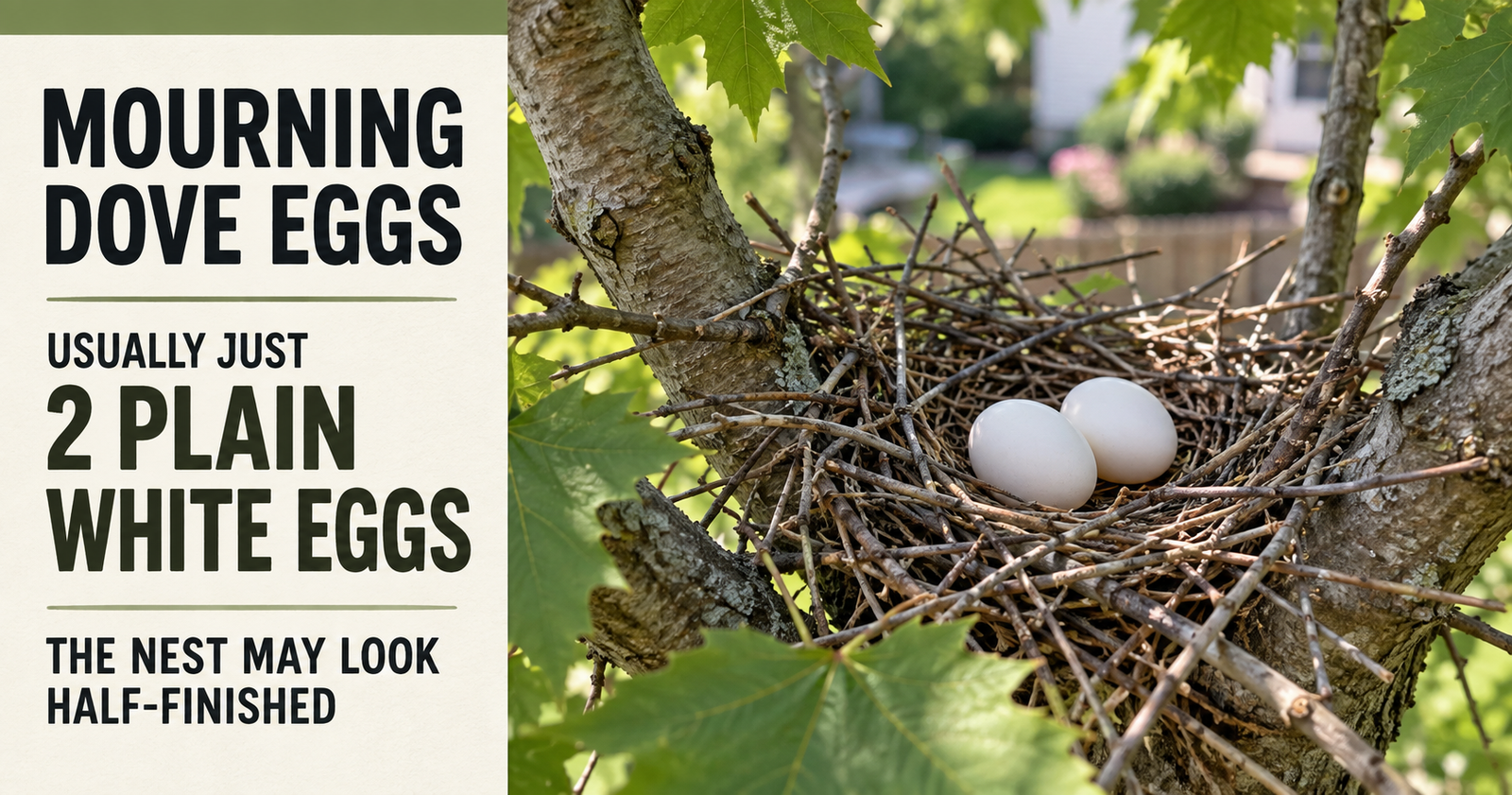
Mourning Dove clutches normally contain two white eggs, and both parents participate heavily in incubation and raising the young.
You don’t need to walk right up to the nest every day to determine what’s happening.
Binoculars and patient observation are much better tools.
Don’t Accidentally Scare a Nearly Fledged Baby Out
This matters once the babies get larger.
NestWatch warns that fully feathered, alert nestlings can leave prematurely if they’re frightened from the nest.
So as the young develop, I’d become more careful, not less.
Don’t lean over the nest repeatedly for photographs.
Don’t poke around trying to see whether the babies can fly.
Let the parents handle the schedule.
A young bird leaving because it was ready and a young bird launching because a person scared it are not the same thing.
What Should I Do If I Find a Nest in a Bad Spot?
If the nest is active, my default would be:
leave it alone.
Audubon’s guidance for nests found around homes emphasizes leaving active nests in place rather than moving them because they’re inconvenient.
Mourning Doves are native migratory birds with federal protection in the United States.
Fortunately, the nesting cycle moves quickly.
Incubation lasts around two weeks, and the young remain in the nest roughly another two weeks.
That hanging basket or porch corner may be inconvenient, but you’re generally not looking at an entire summer of disruption.
Watch First, Then Work Around the Yard
This is probably the most practical thing I’d take from all of this.
Before major trimming during nesting season, watch the shrubs.
Before moving a hanging planter that’s suddenly attracting doves, look inside carefully from a distance.
Before pressure-washing underneath an eave, watch whether birds keep flying there.
Before moving equipment that’s been sitting untouched, look for nesting activity.
Mourning Doves are comfortable enough around people that they sometimes put their family exactly where our next weekend project was supposed to happen.
A few minutes of observation can save a lot of trouble for both you and the birds.
Common Questions About Mourning Dove Nests
Where do Mourning Doves usually build their nests?
Trees and shrubs are common locations, but Mourning Doves also use vines, buildings, hanging flowerpots, gutters, eaves, abandoned equipment, and occasionally the ground.
What does a Mourning Dove nest look like?
Usually like a loose, shallow platform of twigs, pine needles, and grass stems. It can look surprisingly flimsy and unfinished.
How high do Mourning Doves nest?
Nest height varies widely. Many are relatively low, but nests can occur much higher in trees. Mourning Doves also sometimes nest directly on the ground.
Do Mourning Doves nest in hanging baskets?
Yes. Cornell’s NestWatch specifically documents hanging flowerpots as common human-made nesting locations for Mourning Doves.
Do Mourning Doves nest in gutters?
They can. Cornell documents gutters and eaves among the human structures Mourning Doves use for nesting.
Do Mourning Doves use birdhouses?
Not typical enclosed birdhouses. Mourning Doves build open platform nests. A properly designed nesting cone or open platform is much closer to their natural nesting style.
Can I put up a nesting platform for Mourning Doves?
Yes. Cornell’s NestWatch provides plans for a Mourning Dove nesting cone and recommends placing it roughly 6 to 10 feet high in a shady portion of a live tree with overhead branches.
Do Mourning Doves reuse nests?
They sometimes reuse their own nests or nests originally built by other species.
Should I move a Mourning Dove nest on my porch?
I wouldn’t move an active nest containing eggs or young. Give the birds space and let the nesting attempt finish.
Let the Doves Show You Where the Nest Is
That’s the biggest thing I’d do differently instead of wandering around searching every branch.
Watch the birds.
A male carrying twigs is giving away valuable information.
A dove repeatedly disappearing behind the same hanging basket is telling you something.
A bird sitting motionless on a gutter for hours deserves a closer look.
And once you finally find the nest, don’t be disappointed if it looks like the bird spent six minutes building it.
That’s part of what makes Mourning Doves so interesting.
They can take a few twigs, choose a tree branch, flowerpot, gutter, ledge, or some other place you never would have picked, lay two eggs on top of it, and successfully raise another pair of doves.
Sometimes the strangest nest in the yard belongs to one of the most familiar birds in it.
Mason Reed is the Bird Nesting & Backyard Behavior Contributor for BirdResource.com, where he helps everyday birdwatchers understand what birds are actually doing around their homes and how to recognize the small clues that reveal feeding, nesting, and family behavior.