
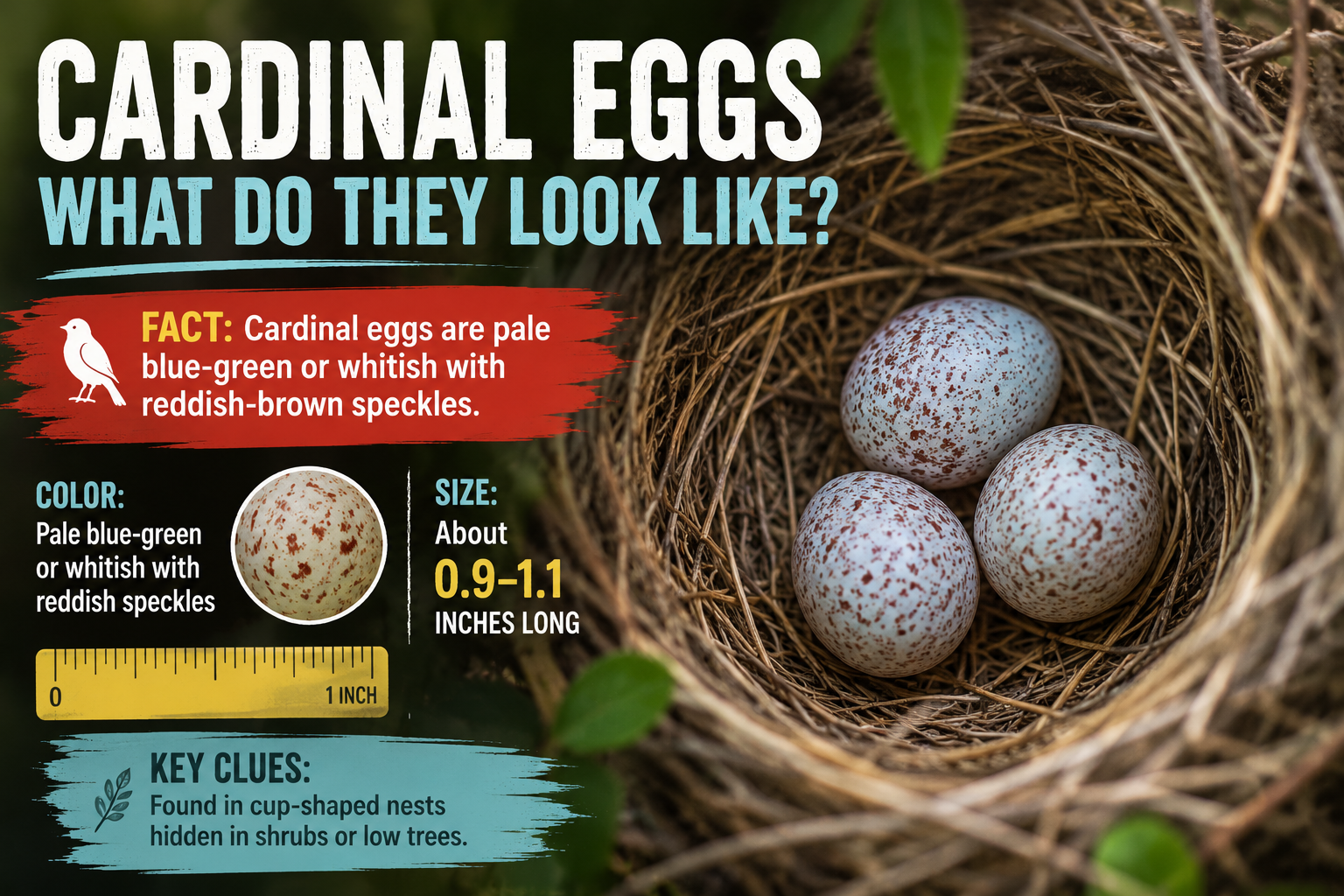
Northern Cardinal eggs are small, pale eggs covered with darker speckles. Their background color can range from grayish white or creamy buff to a subtle greenish white, while the markings can range from pale gray to shades of brown.
They’re also smaller than many people expect. A cardinal egg is usually only about an inch long.
If you’ve found a little cup nest tucked deep inside a shrub and noticed two, three, or four pale speckled eggs inside, Northern Cardinal is certainly one possibility. But I wouldn’t identify the nest from the eggs alone. The guide to how cardinals actually nest explains why a shrub-hidden cup nest is more typical than an enclosed birdhouse.
Plenty of birds lay light-colored, spotted eggs.
The nest location, construction, adult birds nearby, geographic location, and time of year can all help turn a reasonable guess into a much stronger identification.
And there’s another thing worth remembering before we get into the details.
If you have to move branches, touch the nest, or repeatedly approach it just to identify the eggs, I’d leave it alone.Watching the adult birds from a distance will often tell you more than getting a perfect look inside the nest.
What Color Are Cardinal Eggs?
Northern Cardinal eggs aren’t bright red, pink, or anything resembling the color of an adult male.
Their background is considerably more subtle.
Cornell describes Northern Cardinal eggs as grayish white, buffy white, or greenish white, with speckles ranging from pale gray to brown.
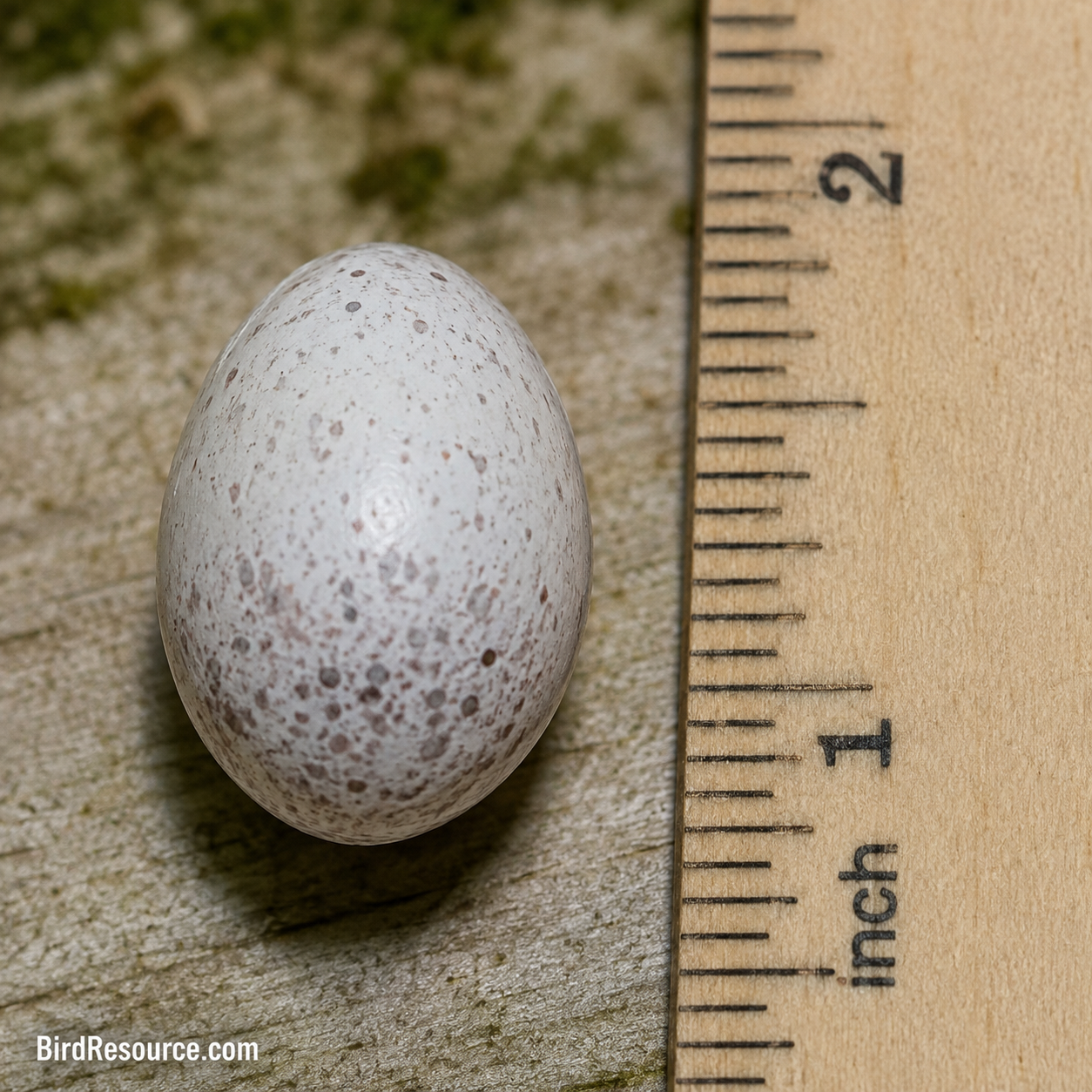
Audubon’s description is similar, describing them as whitish to pale bluish or greenish white with brown, purple, and gray markings.
That natural variation matters.
If you’ve seen one photograph of cardinal eggs online, don’t expect every real nest to contain eggs that match it perfectly.
One clutch may look creamy.
Another can have a cooler gray-green cast.
The amount and darkness of the spotting can vary too.
That’s why I’d identify the whole nesting situation, not just match an egg to a picture.


Are Cardinal Eggs Speckled?
Yes.
Speckling is one of the most recognizable characteristics of Northern Cardinal eggs.
The markings can include gray and various shades of brown, with Audubon also describing purple among the possible marking colors.
Against the pale background, those darker markings can be quite noticeable.
But “pale egg with brown spots” describes the eggs of more than one North American bird.
So while the speckles help, they aren’t a fingerprint.
If the eggs are inside a small open-cup nest hidden within thick vegetation and you’ve repeatedly seen an adult female cardinal entering that exact spot, suddenly the identification becomes much stronger.
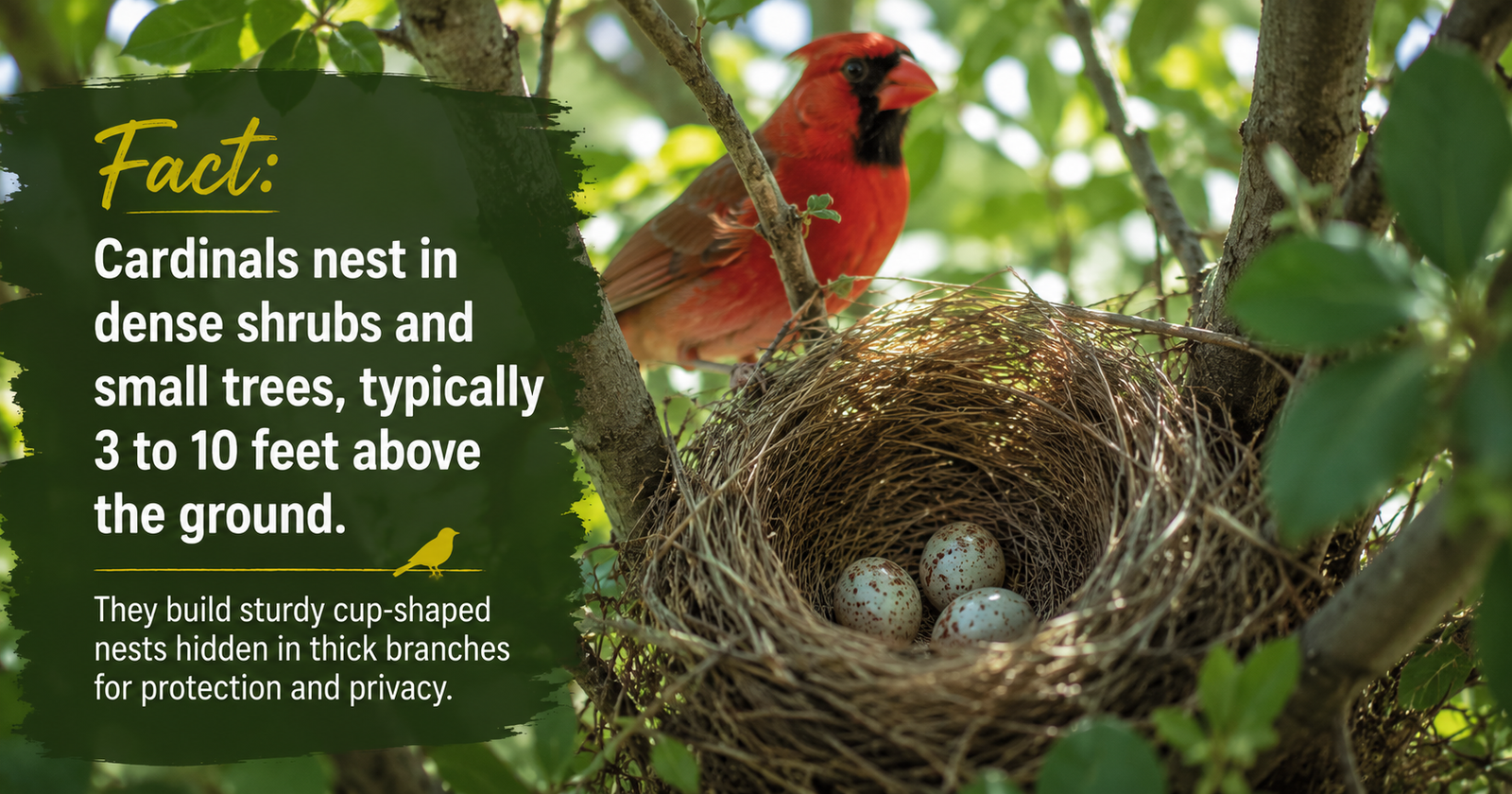
That’s why our guide to the surprisingly easy-to-miss places where cardinals build their nests is useful alongside egg identification. Nest placement can provide an important second set of clues.
How Big Are Cardinal Eggs?
They’re tiny compared with the bird they’ll eventually produce.
Cornell reports Northern Cardinal eggs measuring approximately 0.9 to 1.1 inches long and 0.7 to 0.8 inches wide.
That’s roughly around an inch from end to end.

If you regularly see adult cardinals around a feeder, it can be surprising to imagine one beginning inside something that small. A feeder camera such as Kiwibit’s smart feeder camera can help you observe those visits without approaching a nearby nest.
An adult Northern Cardinal itself measures around 8.3 to 9.1 inches long.
A lot happens between that tiny egg and the full-sized bird sitting outside your window.
What Shape Are Cardinal Eggs?
Northern Cardinal eggs have the familiar oval shape most people picture when they think of a small songbird egg.
They’re not perfectly round, and they’re certainly not miniature copies of a chicken egg in every proportion.
If you’re viewing an active nest from an appropriate distance, though, I wouldn’t spend much time trying to judge tiny differences in egg shape.
Color and markings can help.
Nest structure helps.
Location helps.
And seeing the actual parent is far more useful.
The more clues you combine, the less you’re relying on one subtle characteristic.
How Many Eggs Do Cardinals Lay?
A Northern Cardinal clutch typically contains 2 to 5 eggs according to Cornell.
Audubon describes three or four as common, while also giving the broader range of two to five.
So finding three speckled eggs in a nest would fit perfectly within the normal range.
So would four.
But clutch size isn’t a reliable identification feature by itself.
Many small birds lay several eggs at a time.
It’s another clue to add to everything else you’re observing.
Does a Cardinal Lay All Her Eggs at Once?
No.
Egg laying happens over multiple days rather than the female suddenly producing an entire clutch at once.
That means looking into a nest early in the laying period may not reveal the eventual full clutch.
This is another reason I’d avoid repeatedly checking a nest to see whether another egg has appeared.
The cardinal already knows what’s happening in there.
We don’t need a daily head count.
If you watch from a comfortable distance, you can enjoy the nesting cycle without turning the nest into a daily inspection project.
Which Cardinal Lays the Eggs?
The female.
Adult male and female Northern Cardinals are easy to distinguish once you know what you’re looking for.

The male is predominantly brilliant red with a black facial mask, while the female is mostly pale brown with warm reddish coloration in her crest, wings, and tail. For a fuller look at these differences, see the male and female cardinal differences.
The female builds most of the nest, lays the eggs, and handles the incubation.
The male still plays an important role.

He can accompany her while potential nest locations are being investigated, bring nesting material, defend territory, and bring food. Once the eggs hatch, both parents participate in feeding their rapidly growing young. The details of what cardinal parents feed their young help explain why food availability matters so much during nesting.
Who Sits on Cardinal Eggs?
The female handles incubation.
Cornell gives an incubation period of about 11 to 13 days, while Audubon describes incubation as almost always performed by the female alone.
So if you can safely observe a brown female cardinal sitting low inside a shrub for extended periods, she may be incubating.
That doesn’t mean the bright red male has disappeared.
He may remain active elsewhere in the territory and can bring food to his mate.
The breeding partnership involves different jobs rather than both birds doing exactly the same thing.

Our guide to what really happens between mated cardinal pairs goes much deeper into courtship feeding, pair bonds, nesting responsibilities, and what happens when cardinal pairs separate or lose a mate.

How Long Do Cardinal Eggs Take to Hatch?
Expect roughly 11 to 13 days of incubation.
That’s less than two weeks.
It seems remarkably fast when you consider what’s happening inside.
The embryo develops from a fertilized egg into a tiny bird capable of breaking out of the shell.
And the pace doesn’t slow much after hatching.
Cardinal nestlings spend only about 7 to 13 days in the nest before reaching the fledgling stage.
The entire visible nesting cycle moves quickly.
If you discover eggs one weekend, the nest can look completely different surprisingly soon afterward.
What Do Cardinal Babies Look Like When They Hatch?
Nothing like the brilliant red bird people associate with the species.

Newly hatched Northern Cardinals are largely naked, with only sparse tufts of grayish down. Their eyes are closed, and they’re completely dependent on their parents.
They don’t hatch with a bright crest and red feathers.
They don’t even hatch looking much like the brown fledglings people encounter outside the nest.
Development happens rapidly over the following days.
By the time young cardinals leave the nest, they’re substantially feathered but still don’t resemble adult males.
Our baby cardinal identification guide from hatchling through juvenile shows how dramatically their appearance changes and why the youngster’s dark bill becomes such a useful identification clue.
What Happens to the Eggshells After Cardinals Hatch?
Finding pieces of eggshell around nesting habitat can make people wonder whether a predator destroyed the nest.
That isn’t automatically what happened.
Parent birds commonly remove eggshell material from the nest after hatching.
Keeping the nest clean matters when several helpless nestlings are crowded into a very small space.
So an eggshell fragment on the ground doesn’t necessarily mean you’ve discovered evidence of a failed nest.
Context matters.
If the parents are still actively carrying food into the nesting area, there’s a good chance something much happier happened inside.
What If Cardinal Eggs Don’t Hatch?
Not every egg successfully produces a fledgling.

An egg may fail to develop, an embryo can die during development, weather can affect nesting success, parents can be lost, predators can interfere, or an entire nesting attempt can fail. These early risks are part of the reason the hazards cardinals face is often much shorter than the maximum documented age.
I’d resist trying to diagnose an apparently unhatched egg based on a quick look.
You may not know exactly when incubation began.
You may not know whether the female temporarily left.
And repeatedly approaching the nest to determine whether an egg is “late” creates unnecessary disturbance.
Give an active nest space.
Wild nesting isn’t perfectly predictable, and unsuccessful eggs are unfortunately part of natural reproduction.
What Do Abandoned Cardinal Eggs Look Like?
There’s no visual feature that suddenly appears and tells you with certainty, “This egg has been abandoned.”
An unattended nest isn’t automatically an abandoned nest.
Adult birds have to leave.
They feed, interact with their mate, respond to threats, and perform normal daily activities away from the nest.
Your presence can also influence what you see.
If you’re standing five feet from the shrub waiting for the mother to return, you may be the reason she isn’t returning while you’re watching.
Move well away and allow the birds to resume normal behavior.
How Do I Know If a Cardinal Nest Has Been Abandoned?
This requires patience.
Don’t decide after ten minutes.
Don’t decide because the female flew away when you walked toward the nest.
And don’t decide because you haven’t seen the male recently.
Observe from a distance without hovering over the nesting area.
If you genuinely believe an active nest containing eggs or young has been abandoned or damaged, especially after a known incident involving an adult bird, contact an appropriate wildlife professional for guidance rather than experimenting with the eggs yourself.
Wild bird eggs aren’t DIY incubation projects.
Can I Hatch an Abandoned Cardinal Egg Myself?
This isn’t something I’d recommend.
Northern Cardinals are native wild birds protected in the United States under the Migratory Bird Treaty Act, and possessing wild bird eggs, nests, or birds can be legally restricted.
Beyond legality, successfully incubating a wild songbird egg and raising the resulting hatchling requires specialized knowledge and care.
A kitchen incubator and some improvised baby-bird food aren’t a replacement for licensed wildlife rehabilitation.
If you have a legitimate wildlife emergency, contact a licensed rehabilitator or appropriate wildlife agency.
Can I Touch Cardinal Eggs?
Leave them alone.
The common story that a parent bird will automatically abandon its eggs because it smells human scent is overly simplistic.
But that doesn’t make touching wild eggs a good idea.
Handling creates unnecessary disturbance and introduces the possibility of damaging an extremely fragile egg.
You also don’t need to pick an egg up to identify it.
The safest cardinal egg is one that remains exactly where the female put it.
Will Cardinals Abandon Their Eggs If a Human Touches Them?
Not simply because a person transferred some mysterious human smell onto the shell.
But this myth sometimes leads to the opposite bad advice:
“It’s fine to touch bird eggs because birds can’t smell you.”
That’s not the takeaway I’d use.
Whether smell causes abandonment isn’t the important issue.
Repeated disturbance around a nest can affect nesting birds. Eggs can be damaged. Vegetation can be moved. Predators can potentially notice activity around the location.
There’s almost never a good reason for a casual observer to handle the eggs.
So don’t worry about a magical human scent.
Just respect the nest.
What Should I Do If I Find a Cardinal Egg on the Ground?
First, don’t automatically assume you should take it home.
An egg on the ground can be there for several reasons, and it may not even belong to a cardinal.
Identifying a loose wild bird egg is considerably harder than identifying an egg within an active nest where you can observe the parents.
If the egg appears associated with an active nest or you believe there’s a genuine wildlife emergency, contact a licensed wildlife rehabilitator or appropriate wildlife authority for guidance.
I wouldn’t attempt to incubate it myself.
And I definitely wouldn’t crack it open to “see if anything is inside.”
Do Cardinals Lay Eggs in Birdhouses?
Normally, no.
Northern Cardinals aren’t cavity nesters.

They build open-cup nests hidden inside dense shrubs, saplings, vines, and similar vegetation. Cornell reports nests commonly wedged into forks of small branches from roughly 1 to 15 feet above ground. The vegetation that hides a nest can also contain separate sheltered roosting spots, since cardinals do not normally sleep in the nest itself.

So if you open a traditional enclosed birdhouse and find eggs, Northern Cardinal shouldn’t be your first assumption.
Cardinals may live all around your birdhouses without ever showing the slightest interest in nesting inside one.
For them, vegetation is far more important.
Where Should I Look for Cardinal Eggs?
I’d actually change the question.
Instead of looking for eggs, look for nesting behavior.
Watch where the female goes.
If she repeatedly disappears into the same dense shrub, hedge, vine tangle, or small tree, pay attention.
If the male remains nearby and you notice repeated activity around that location, you may have a nest.
But once you know approximately where it is, you don’t need to force your way through the vegetation to confirm there are eggs.
The fact that the nest is difficult to see is a feature, not a problem.
What Time of Year Do Cardinals Lay Eggs?

Northern Cardinal nesting generally begins during spring and can continue through summer, although exact timing varies considerably across their large range. That seasonal increase in activity can also explain springtime territorial behavior around homes.
Birds in warmer southern regions aren’t necessarily going to follow the exact breeding calendar of birds much farther north.
Cardinals can also make more than one nesting attempt during a breeding season.
That stretches the period during which eggs may be present.
Rather than relying entirely on the calendar, watch what your local birds are doing.
Courtship.
Nest-site investigation.
Females carrying nesting material.
Territorial singing.
Repeated trips into dense vegetation.
Those behaviors tell you the local breeding season has arrived.
Can Cardinals Have More Than One Clutch of Eggs?
Yes.
Northern Cardinals can raise more than one brood during a breeding season. Cornell lists one to two broods, and additional nesting attempts can occur when earlier attempts fail.
The female generally builds another nest rather than simply returning to the old one.
That means a pair using your yard may have eggs in one shrub early in the season and another nest somewhere else later.
If you found the first nest, don’t assume you’ve found the location of every future brood.
Cardinals can be surprisingly good at keeping the next one hidden.
Are All the Eggs in a Cardinal Nest the Same Color?
They generally follow the same overall pale, speckled pattern, but natural variation exists.
Don’t expect every egg to look as though it came off an assembly line.
Background tone, spotting, and the visual effect of lighting can all influence how eggs appear.
Photography complicates this even further.
A shaded nest photographed on a phone may make a pale greenish egg look gray.
Warm sunlight can make a buff-colored egg look creamier.
Camera processing can shift color too.
This is why matching exact shades from internet photographs isn’t a particularly strong identification method.
Cardinal Eggs vs Robin Eggs
This comparison is much easier than some others.
American Robin eggs are famous for their relatively uniform blue color.
Northern Cardinal eggs are pale whitish, buffy, grayish, or greenish and speckled with darker markings.
So if you’re comparing classic unmarked robin-blue eggs with speckled cardinal eggs, the difference can be dramatic.
Nest location and adult birds should still be considered, but egg appearance gives you a useful clue immediately.
Cardinal Eggs vs Mourning Dove Eggs
Mourning Dove eggs are much plainer.
They are generally white and unmarked, while Northern Cardinal eggs have the characteristic pale background with darker speckling.
The nests themselves can look very different too.
Mourning Doves are notorious for building relatively flimsy-looking stick platforms, sometimes so sparse that it’s amazing the eggs remain in place.
A cardinal nest is a more substantial cup with multiple layers of material.
This is a perfect example of why egg and nest together are more informative than either one alone.
Cardinal Eggs vs House Finch Eggs
Now we’re getting into a comparison where I’d be much more cautious.
House Finch eggs can also be pale bluish or greenish and marked with darker specks.
Depending on the individual eggs and lighting, someone relying only on color could easily become confused.
Look beyond the eggs.
Where is the nest?
What does it look like?
Which adults are visiting?
What species are common around the property?
Those contextual clues are much more useful than trying to distinguish two tiny speckled eggs from memory.
Cardinal Eggs vs Pyrrhuloxia Eggs
This can be especially tricky in parts of the Southwest where Northern Cardinals and Pyrrhuloxias can occur.
Audubon describes Pyrrhuloxia eggs as pale grayish white to greenish white with brown and gray spots, which sounds remarkably similar to Northern Cardinal eggs.
That’s exactly why egg color alone isn’t enough.
Adult identification becomes much more important.
A Pyrrhuloxia has a distinctive yellowish, parrotlike bill and grayer overall coloration compared with the familiar red or reddish-orange bill of an adult Northern Cardinal.
Sometimes the best way to identify an egg is to stop staring at the egg and identify its parents.
Why Are Cardinal Eggs Spotted?
Egg pigmentation and patterning are normal features of many bird species.
The markings aren’t evidence that the egg is dirty, diseased, cracked, or beginning to hatch.
If you’ve only handled plain white chicken eggs from a grocery store, wild songbird eggs can look surprisingly elaborate.
Speckles, blotches, and different background colors are completely normal.
The cardinal’s pale spotted egg is simply part of the species’ normal reproductive biology.
How Soon After Hatching Do Baby Cardinals Leave the Nest?
Very soon.
Northern Cardinal nestlings remain in the nest approximately 7 to 13 days after hatching.

That means less than two weeks can separate a nest full of eggs from a nest that’s suddenly empty because the young have fledged. The short timeline behind that change is covered in when the young have fledged.
This catches people off guard.
They check from a distance one day and see nestlings.
Several days later the nest appears empty.
They assume something terrible happened.
Predation is certainly a real risk for wild nests, but an empty nest can also mean the babies did exactly what they were supposed to do.
They left.
If the Nest Is Empty, Look Around Before Assuming the Worst
Newly fledged cardinals don’t immediately become expert adult birds.
They may remain low in shrubs, hop along the ground, make awkward short flights, and continue begging their parents for food.
Their appearance can be confusing too.
Young cardinals are generally brownish and initially have dark gray to black bills rather than the reddish-orange bills of adults.
So if a nest suddenly empties and you begin seeing scruffy brown birds hiding nearby, you may be looking at a successful outcome rather than a disaster.
Give them space.
The parents are probably much more aware of their location than you are.
The Best Cardinal Egg Identification Clue Isn’t Always the Egg
This is the point I’d remember if you find a mystery nest.
Yes, cardinal eggs have a recognizable general appearance.
They’re small.
They’re pale.
They’re speckled.
They’re roughly an inch long.
But none of those characteristics belongs exclusively to Northern Cardinals.
Instead, build the identification piece by piece.
A small open-cup nest is hidden inside dense vegetation.
It’s several feet above the ground.
Inside are three pale, brown-speckled eggs.
A brown female Northern Cardinal repeatedly returns to the nest.
A brilliant red male stays nearby.
At that point, you aren’t guessing based on egg color anymore.
You’ve watched the entire identification come together.
And that’s a much better way to identify a wild bird nest than getting close enough to compare individual speckles with a photograph.
Common Questions About Cardinal Eggs
What is the most common color of cardinal eggs?
Northern Cardinal eggs have a pale base that can appear grayish white, buffy white, or greenish white. Darker gray and brown speckling covers the shell to varying degrees.
Are cardinal eggs blue?
They can have a pale greenish or bluish cast, but they aren’t the solid, unmistakable blue people associate with American Robin eggs. Cardinal eggs normally have visible darker markings.
Are cardinal eggs white?
They can appear whitish, particularly grayish white or buffy white, but they’re normally speckled rather than plain white.
How many cardinal eggs are usually in one nest?
A clutch contains about 2 to 5 eggs, with three or four commonly reported.
How long does a cardinal sit on her eggs?
Incubation takes roughly 11 to 13 days and is performed by the female.
Does the male cardinal sit on the eggs?
Incubation is primarily the female’s job. The male contributes to other aspects of breeding, including territorial behavior, feeding, and later helping provide food for the young.
How big is a cardinal egg?
Approximately 0.9 to 1.1 inches long and 0.7 to 0.8 inches wide.
Do cardinals lay eggs more than once a year?
They can produce multiple broods during a breeding season, so one pair may go through the nesting cycle more than once.
Should I remove an old cardinal nest after the eggs hatch?
Not while it’s active or while young remain in it. Once you’re certain the nesting attempt is completely finished, remember that cardinals generally don’t reuse the same nest. There’s usually no need to preserve an abandoned nest indefinitely unless you simply enjoy leaving it where it is.
What’s the easiest way to know if eggs belong to a cardinal?
Watch the parents.
Egg appearance gets you part of the way there.
The adult bird returning to incubate them can give you the answer.
That’s also the identification method that lets you stay farther away from the nest, which is better for everyone involved.
Caleb Hartwell is the Bird Identification & Behavior Contributor for BirdResource.com, where he helps readers figure out the birds, nests, eggs, and backyard behaviors that aren’t always as obvious as they first appear.