
Cardinals can be incredibly easy to notice during the day and strangely difficult to find once evening arrives.
A bright red male may spend the last hour of daylight hopping around your feeder, calling from the shrubs, and making himself impossible to miss.
Then darkness comes.
Where did he go?
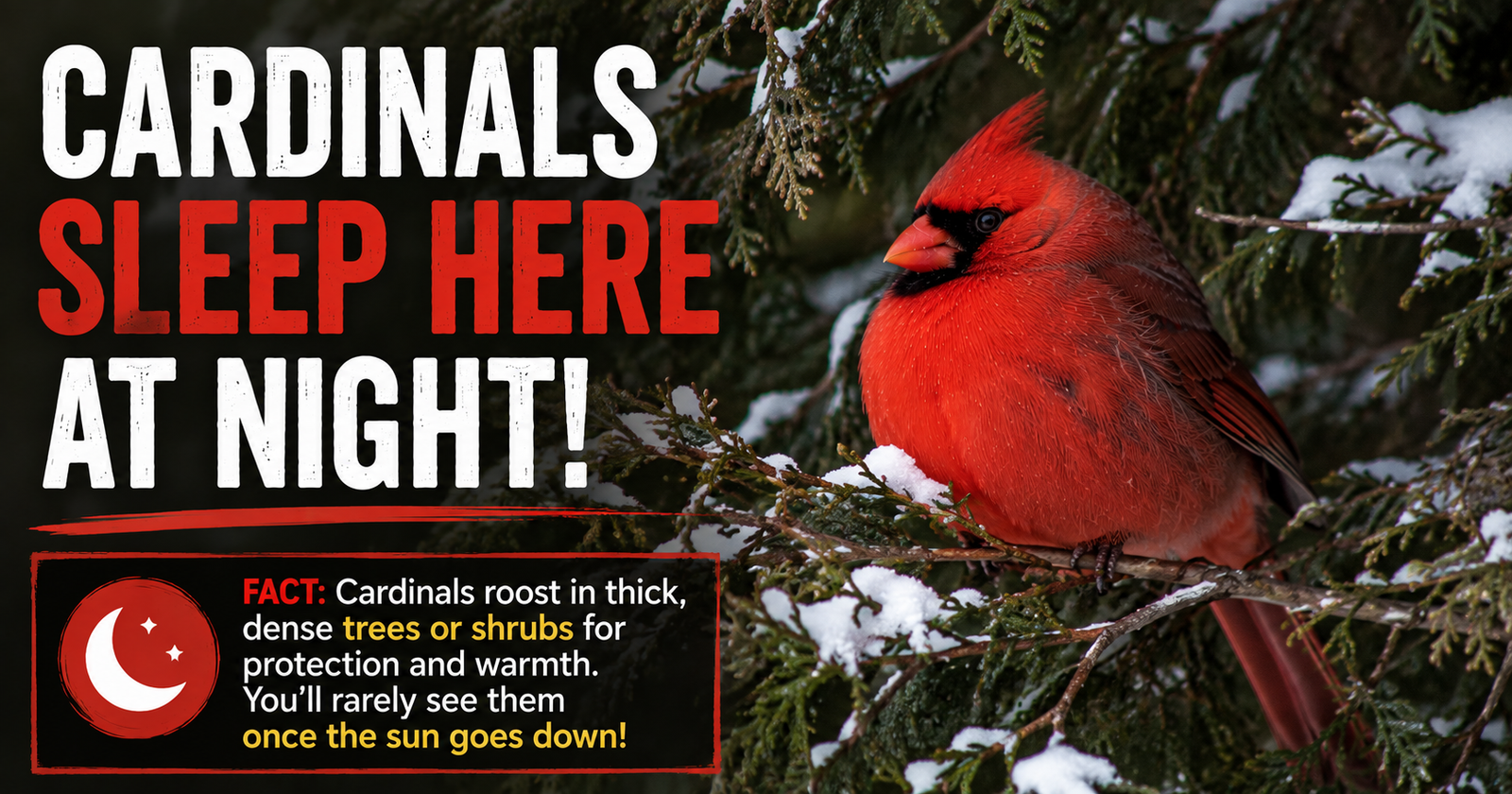
Northern Cardinals generally sleep perched inside protected trees, shrubs, thickets, and other dense vegetation. Audubon specifically notes that songbirds such as cardinals sleep perched in the safety of dense trees or shrubs. Cornell also describes cardinals as birds strongly associated with dense shrubby vegetation and low branches. The cardinal habitat and behavior overview puts these sheltered roosting habits in the broader context of the species’ behavior and habitat.
And there’s one misconception worth clearing up immediately:
Cardinals don’t normally return to their nest every night to sleep.
The nest is primarily for eggs and babies. It isn’t the little permanent house we sometimes imagine when we see one tucked inside a bush.
Where a cardinal actually spends the night is much less obvious, and that’s exactly what helps keep it protected.
Where Do Northern Cardinals Sleep at Night?
Most cardinals roost on branches in sheltered vegetation.
A good nighttime location might be inside:
dense shrubs
thickets
evergreen trees
brushy vegetation
thick hedges
vine-covered areas
trees offering protected interior branches
Cardinals already favor shrubby environments during the day. Cornell describes their habitat as including forest edges, overgrown fields, hedgerows, backyards, marshy thickets, regrowing forests, and ornamental landscaping.
So the bird doesn’t necessarily travel somewhere dramatically different when bedtime arrives.
It finds a protected roost.
That’s the word birdwatchers use for the place where a bird settles to rest or sleep.
And if you’ve ever tried finding a cardinal buried deep inside a hedge after dark, you already understand why these spots work.

What Is a Cardinal Roost?
A roost is simply a place a bird uses for resting or sleeping.
For a cardinal, that usually means a perch rather than a nest.
The bird settles onto a branch, grips it with its feet, gets comfortable, and sleeps.
Audubon describes songbirds such as cardinals settling onto twigs in dense trees or shrubs, sometimes preening before sleep and then tucking the bill into the feathers.
That may sound precarious.
I’d have trouble sleeping on a branch without falling out of the tree.
A cardinal has a major advantage.
Its feet are built for it.

How Can Cardinals Sleep on a Branch Without Falling?
This is one of those little pieces of bird biology that’s far more impressive than it initially sounds.
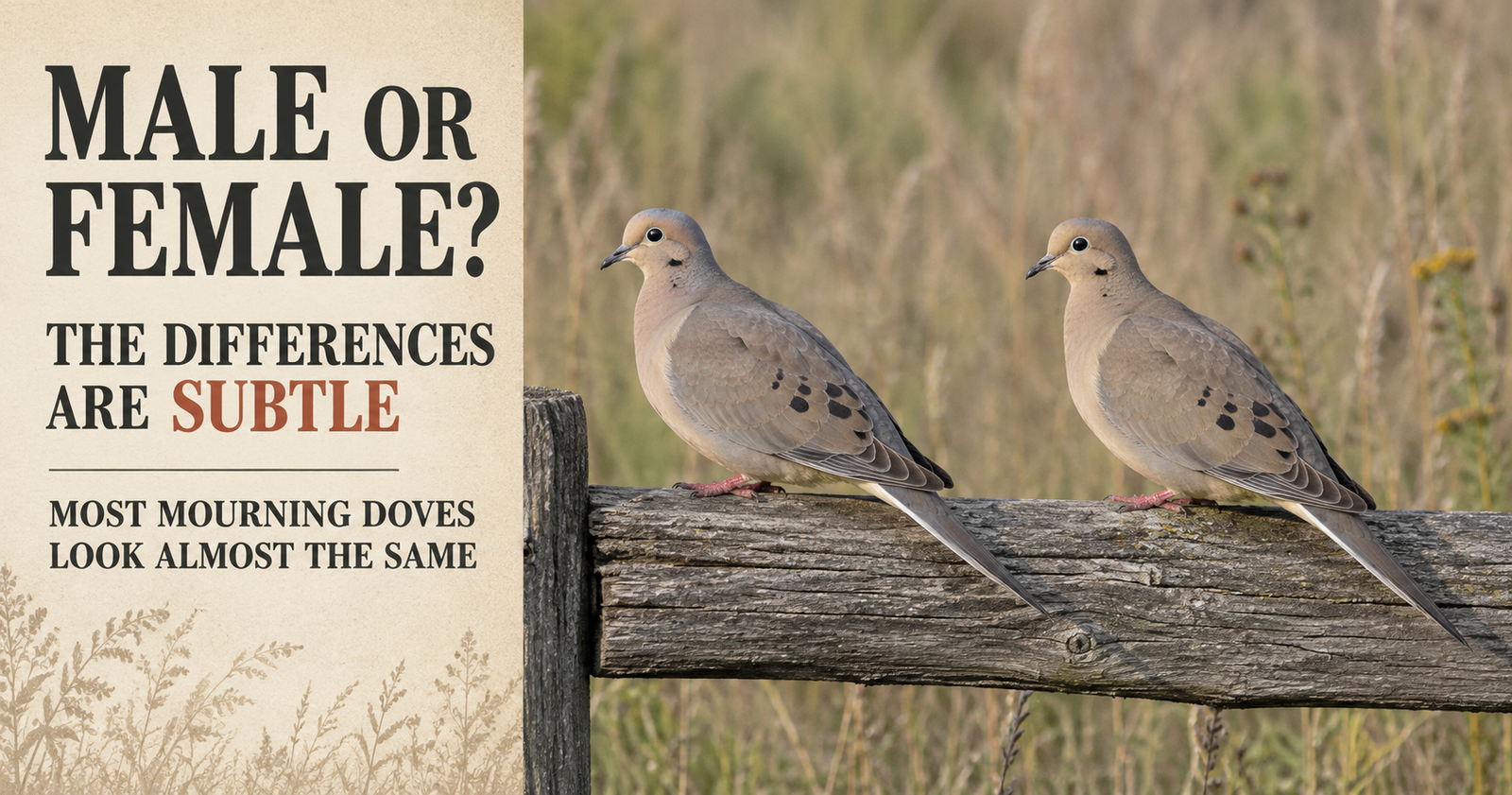
Perching birds have a tendon mechanism that helps their toes grip the branch when their legs bend under their body weight.
Audubon explains that when a perched songbird settles down, pressure on the heel tightens a tendon that closes the toes firmly around the twig. The grip can remain secure while the bird sleeps.
So a cardinal doesn’t have to consciously spend the entire night thinking:
Don’t let go. Don’t let go. Don’t let go.
Its anatomy does much of the work.
Cornell also notes that this gripping mechanism helps branch-roosting birds remain secure during bad weather.
That’s a pretty impressive sleeping system for an animal sitting several feet above the ground.
Do Cardinals Sleep in Their Nests?
Normally, no.
This is probably the biggest misconception I see when people think about where backyard birds go at night.
We look at a bird nest and naturally compare it to our own house.
There’s Mom’s house.
There’s Dad’s house.
Everybody goes home at bedtime.
But a cardinal nest doesn’t function that way.
For Northern Cardinals, the nest is built for reproduction. It’s where eggs are laid, incubated, and where nestlings spend their first days after hatching.
Cornell reports that cardinal nests are generally used only once.
Once the young leave, the family doesn’t keep returning to that little cup every evening.
The nest did its job.
Does the Mother Cardinal Sleep in the Nest?
During incubation and while caring for very young nestlings, the situation is different.
The female spends considerable time on the nest because she’s incubating eggs and later tending young.
That can include nighttime periods.
But she’s there because there’s an active nesting attempt, not because the nest is her permanent bedroom.
Once nesting is finished, she doesn’t need to keep returning to that old nest.
That’s an important distinction.
If you discover a cardinal nest in June and later notice nobody using it, that doesn’t mean the family disappeared because something went wrong.
The babies may simply have fledged and the nest may no longer be needed.
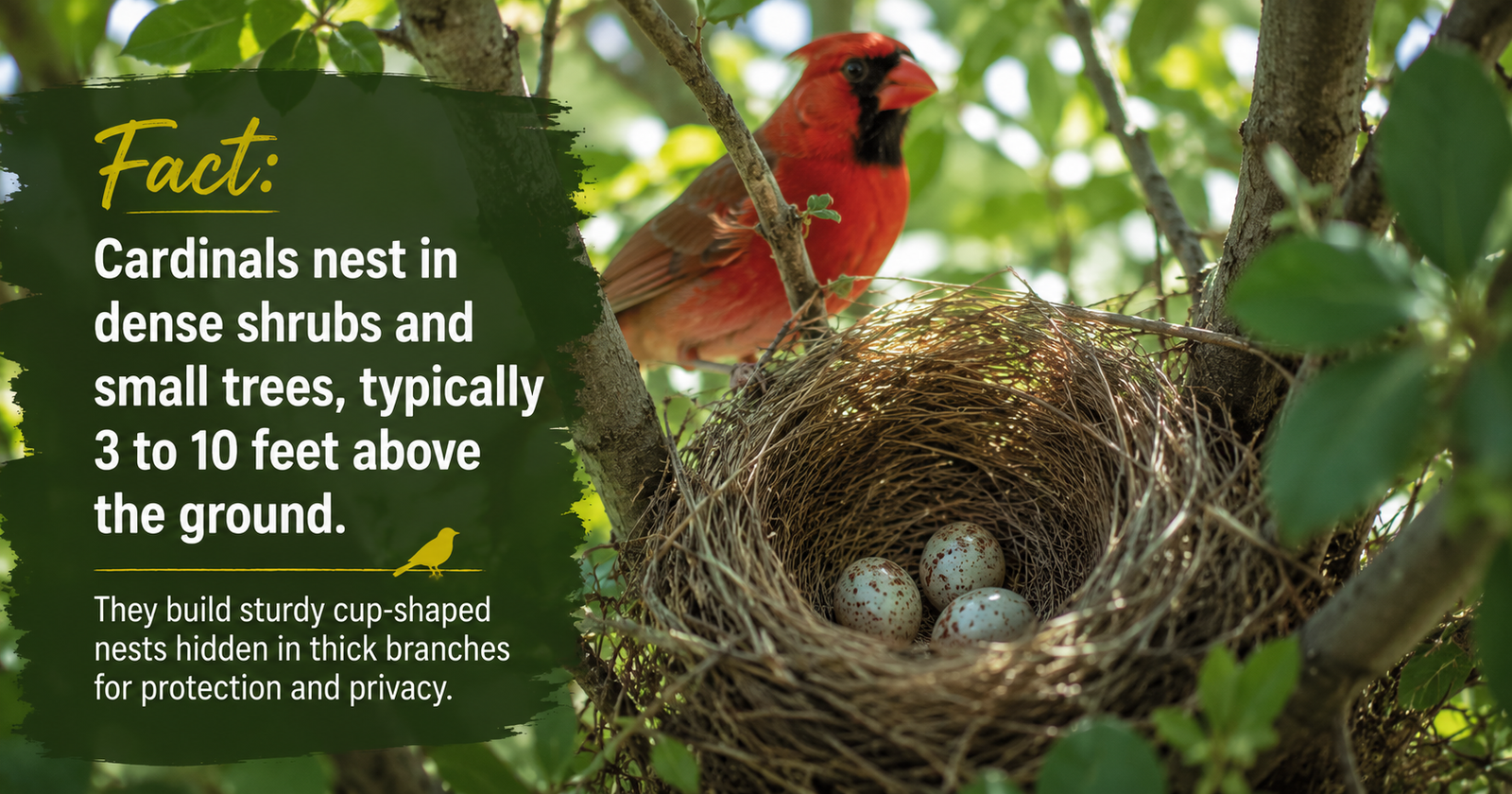
Our guide to where cardinals build their nests and the places people often overlook explains how these surprisingly small nests are hidden inside dense vegetation.
Do Male Cardinals Sleep in the Nest?
The male doesn’t normally climb into the nest beside the female and babies for a family sleepover.
The female performs the incubation, while the male plays other important roles around the nesting territory.
Both parents later feed the nestlings.
At night, the male can roost elsewhere in nearby protected vegetation.
This is another reason we need to stop thinking about a nest as a house.
A male cardinal can be closely bonded with his mate, defend their territory, feed her during courtship, help feed their young, and still sleep on a completely different branch.
Bird family life doesn’t have to look like ours.

Where Do Cardinals Sleep During Winter?
Winter makes a protected roost especially valuable.
Cardinals don’t normally migrate away when cold weather arrives. They’re permanent residents throughout their range.
That means a cardinal living somewhere with snow, freezing temperatures, and bitter winter wind has to deal with those conditions overnight.
Dense vegetation can provide shelter from exposed conditions.
During storms, Cornell notes that branch-roosting birds such as cardinals tend to perch on thick branches close to the trunk, particularly on the side best protected from wind and rain.
That’s a much better spot than sitting completely exposed at the end of a bare branch.

If you’ve wondered why cardinals are still outside when temperatures plunge, our guide explaining where cardinals really go in winter gets into how these year-round residents adjust when the seasons change.
Do Cardinals Sleep in Evergreen Trees?
They certainly can use evergreens and other dense trees for shelter.
Think about what an evergreen provides during winter.
A deciduous tree can lose nearly all of its leafy cover.
An evergreen may still provide thick foliage capable of breaking wind and concealing a sleeping bird.
But I wouldn’t tell someone that cardinals only sleep in evergreen trees.
They don’t.
Dense shrubs, thickets, hedges, and other protected vegetation can all provide useful roosting locations.
What matters more is the protection the site offers.

Do Cardinals Sleep in Bushes?
Yes, dense shrubs and bushes can provide exactly the type of protected environment cardinals use.
This shouldn’t be particularly surprising if you’ve spent much time watching them.
Cornell notes that Northern Cardinals frequently sit low in shrubs and trees and are often difficult to see away from feeders because of their affinity for dense tangles.
A cardinal that can disappear into a shrub at noon can certainly disappear into one at bedtime.
That’s part of what makes dense vegetation so valuable.
It isn’t useful only during nesting season.
Do Cardinals Sleep in Hedges?
A thick hedge can potentially provide suitable roosting cover, especially if it has dense interior branches and foliage.
This is one reason I don’t automatically consider every overgrown-looking portion of a bird-friendly yard something that needs to be trimmed into submission.
To us, a dense hedge may look messy.
To a cardinal, that dense structure can mean:
cover
concealment
protected perches
nesting possibilities
places to escape predators
shelter from weather
Bird-friendly landscaping doesn’t always look perfectly manicured.
Sometimes the spots we want to “clean up” are exactly the places birds are using.
Do Cardinals Sleep in Birdhouses?
Northern Cardinals aren’t cavity nesters.

They build open-cup nests in dense vegetation rather than raising their young inside typical birdhouses. Cornell describes cardinal nests as cups wedged into forks of branches in shrubs, saplings, or vine tangles. Once you understand where these open-cup nests are built, cardinal egg appearance can provide another clue when you spot one.
So putting up a standard nest box isn’t the normal way to provide a cardinal with a bedroom.
Some cavity-nesting birds do use cavities and roost boxes for shelter.
Cornell specifically distinguishes those birds from branch-roosting species such as cardinals.
If your goal is helping cardinals, vegetation is generally much more relevant than a little wooden birdhouse.
Do Cardinals Use Roosting Boxes?

I wouldn’t buy or build a roosting box specifically expecting Northern Cardinals to use it. The nesting question is answered separately in whether cardinals use birdhouses, which distinguishes a cardinal's open nest from a box used by cavity-nesting birds.
Cornell notes that roost boxes can benefit birds that typically nest in boxes, such as bluebirds, chickadees, titmice, nuthatches, and small woodpeckers. Cardinals, on the other hand, are among the birds that normally roost on branches.
That’s an important distinction if you’re spending money to make your yard more bird-friendly.
A product can be wonderful for one bird and almost irrelevant to another.

For cardinals, I’d prioritize good vegetation, food, water, and appropriate cover long before buying them a special sleeping box.
Do Cardinals Sleep in the Same Place Every Night?
They may repeatedly use a good general roosting area, but I wouldn’t assume an individual cardinal sits on the exact same twig every single night.
Conditions change.
Weather changes.
Predator activity changes.
Seasonal vegetation changes.
Social behavior changes.
A sheltered spot that’s excellent on a calm summer evening may not be the best choice during a winter storm.
Cardinals are also mobile animals rather than creatures assigned to one permanent sleeping address.
It’s completely reasonable for them to favor an area without using one exact perch forever.
Do Cardinal Pairs Sleep Together?
Cardinal pairs may remain associated outside the breeding season, but that doesn’t necessarily mean a male and female cuddle together on one branch every night.
During breeding season, cardinals commonly move around in pairs. During fall and winter, their social behavior changes substantially and they can gather into flocks ranging from about a dozen to several dozen birds.
Their nighttime proximity can therefore depend on season and circumstances.
I’d be careful with claims that cardinal couples always sleep side by side.
It’s a nice story.
That doesn’t make it a reliable rule.
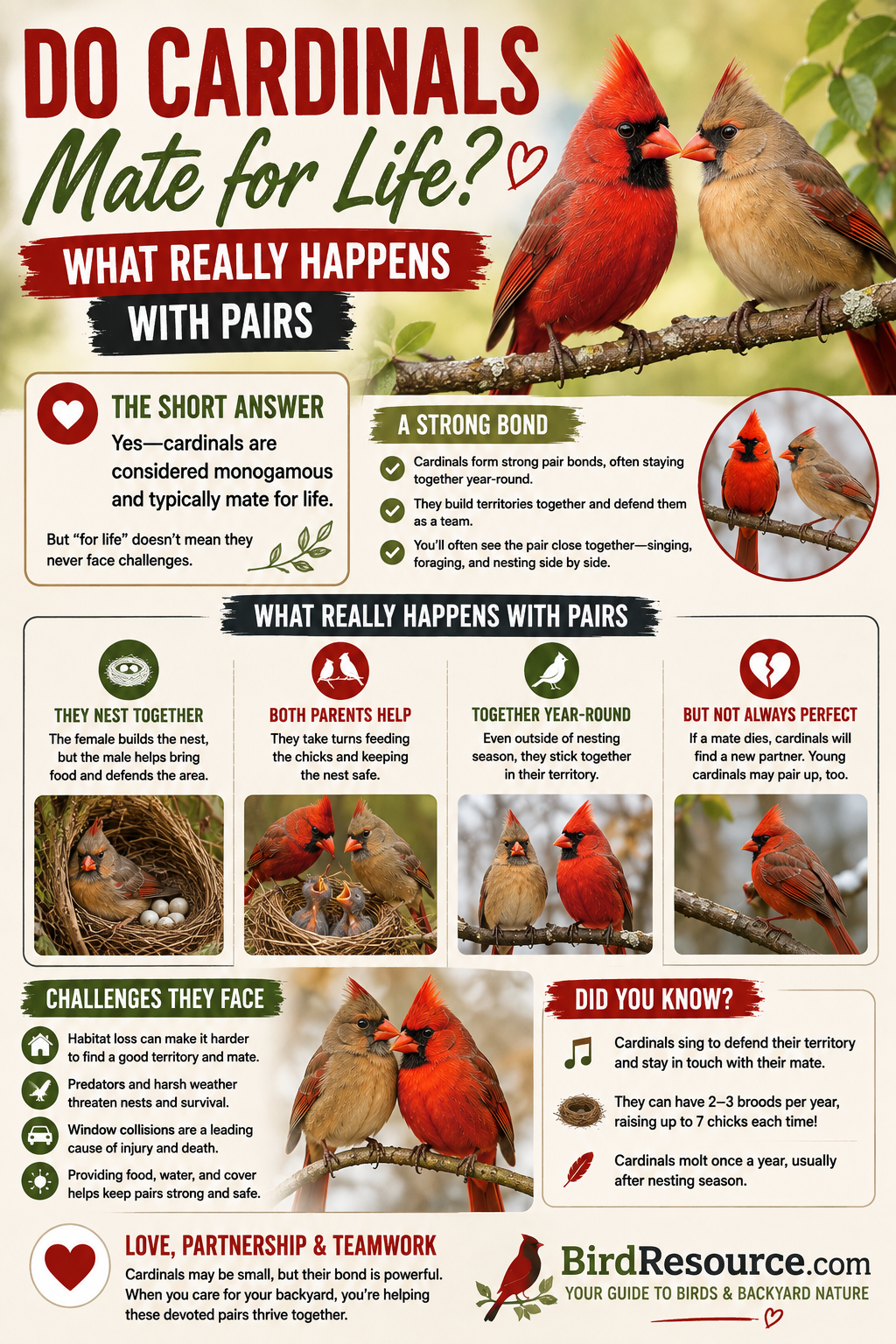
The actual relationship between male and female cardinals is more complicated, which is why our guide to whether cardinals really mate for life looks beyond the romantic version of their pair bonds.
Do Cardinals Sleep Alone?
They can roost individually, near a mate, or around other birds depending on the circumstances.
During winter, cardinals become much more social than they are when fiercely defending breeding territories.
Cornell reports fairly large fall and winter cardinal flocks, and recent Cornell feeder observations have shown multiple cardinals gathering together near dusk.
But gathering near a feeder before dark doesn’t necessarily mean every bird flies into one shrub and sleeps shoulder to shoulder.
The important point is that cardinal social behavior changes with the season.
There’s no single sleeping arrangement that describes every bird every night.
What Time Do Cardinals Go to Sleep?
There’s no universal cardinal bedtime like 7:42 p.m.
Their activity follows the natural light cycle.
As daylight fades, feeding activity winds down and birds begin moving toward places where they’ll spend the night.
Interestingly, Northern Cardinals can remain active surprisingly late.
Cornell notes that they’re often among the last birds lingering at feeders before dusk, just as they’re frequently among the earliest feeder visitors in the morning.
So if you’re trying to figure out where your backyard cardinals sleep, late evening can offer clues.
Don’t chase them.
Just watch from a distance.
Notice which direction they go after their final feeder visits.
You may discover they disappear into the same dense section of your yard night after night.
Why Do Cardinals Eat Right Before Dark?
A bird is about to go through an entire night without normal daytime foraging.
During cold weather especially, maintaining enough energy to survive the night matters.
It’s therefore not surprising that cardinals can be active feeders late in the day.
Cornell’s FeederWatch observations describe Northern Cardinals as some of the last birds lingering before dusk.

That late-afternoon feeding can also create one of the best cardinal-watching opportunities. A camera-equipped option such as a smart feeder for observing cardinals can help you watch those visits without disturbing the birds.
If you keep seeing them shortly before dark, pay attention to what happens afterward.
The birds may give you a pretty good hint about where their roosting cover is located.
What Time Do Cardinals Wake Up?
Early.
Northern Cardinals can be among the earliest birds active around feeders, and Cornell describes them as frequent early-morning arrivals.

During breeding season, their songs can also be among the first obvious bird sounds of the morning. If that morning activity includes repeated trips to the glass, cardinal territorial behavior at windows explains the territorial behavior behind it.
That creates a neat daily rhythm.
Feed late.
Disappear into protective vegetation.
Spend the night perched.
Then emerge around dawn and begin feeding and communicating again.
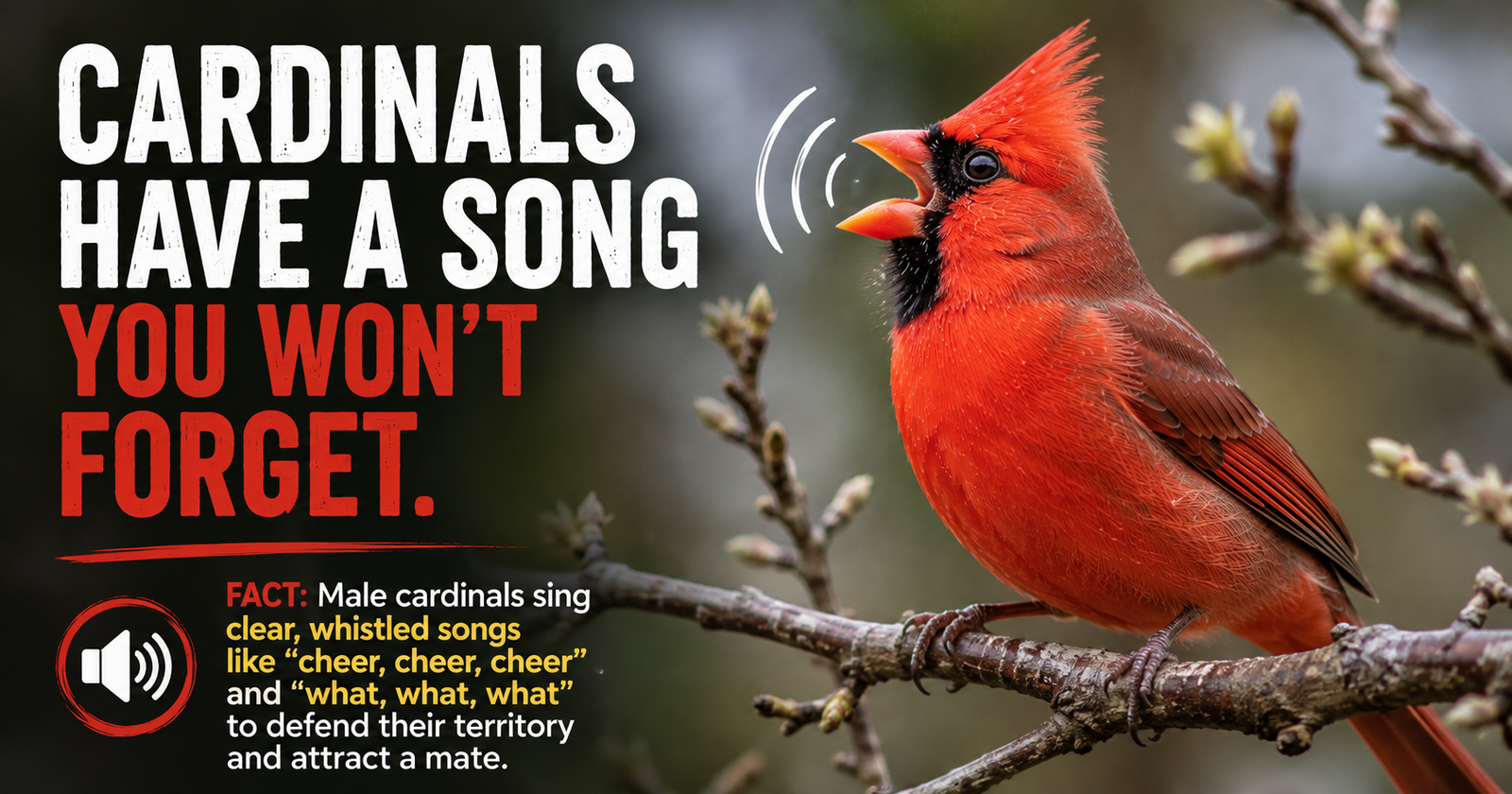
If you’ve heard those loud whistles before you’ve even gotten out of bed, our guide to cardinal songs and calls explains the classic whistles, metallic chip call, and the surprising fact that female cardinals sing too.
Do Cardinals Sleep All Night?
Cardinals are primarily daytime-active birds, so nighttime is their main resting period.
That doesn’t mean we should picture a bird experiencing eight uninterrupted hours of deep sleep exactly like a person in bed.
Wild animals have to remain responsive to their surroundings.
Weather changes.
Branches move.
Predators can approach.
Other birds may shift positions.
A cardinal’s nighttime life is therefore more complicated than simply switching off at sunset and switching back on at sunrise.
But broadly speaking, darkness is when these daytime songbirds settle into their roosts and rest.
Do Cardinals Sleep With Their Eyes Open?
Bird sleep is fascinating, and some bird species are capable of forms of sleep involving one brain hemisphere at a time.
But I wouldn’t turn that broader bird ability into a claim that your backyard cardinal routinely spends the whole night sleeping with one eye open.
For the everyday backyard question, the more useful thing to understand is that cardinals remain perched while resting and have physical adaptations that allow them to grip a branch securely.
Not every unusual ability documented somewhere in the bird world automatically applies in exactly the same way to every species.
Do Cardinals Tuck Their Heads Under Their Wings?
You’ve probably heard the phrase “head under its wing.”
The actual position can look a little different.
Audubon describes sleeping songbirds turning their heads over their backs and tucking their bills into their feathers.
This creates that familiar rounded sleeping-bird appearance.
During cold conditions, feathers also provide critical insulation.
So when a cardinal fluffs itself into what looks like a red ball with a face, there is more happening than the bird simply trying to look comfortable.
Feathers are part of its cold-weather survival system.
How Do Cardinals Stay Warm While Sleeping?
Feathers are the big advantage.
A bird can fluff its feathers and trap layers of insulating air close to its body.
Choosing a protected roost also helps reduce exposure.
That’s why the location of the sleeping perch matters so much.
Imagine two possibilities during a freezing windy night.
One cardinal sits on an exposed branch at the outside edge of a tree.
Another is tucked close to the trunk inside dense vegetation protected from much of the wind.
Those are very different sleeping environments.
Cornell specifically notes that branch-roosting birds facing storms tend to choose thick branches close to trunks on protected sides of trees.
A good roost is part of the survival strategy.
Where Do Cardinals Sleep During a Storm?
They seek protection.
Cornell says branch-roosting birds including cardinals tend to perch on thick branches close to tree trunks and favor the side sheltered from wind and rain.
That’s exactly what I’d expect from a bird trying to reduce exposure.
Dense vegetation can break wind.
Interior branches can provide greater protection than exposed outer limbs.
A strong grip keeps the bird attached to its perch.
And feathers provide insulation against cold conditions.
The cardinal isn’t weatherproof.
It has simply evolved a pretty impressive set of tools for getting through bad nights.
Where Do Cardinals Go During Heavy Snow?
Usually somewhere protected rather than somewhere far away.
Remember, Northern Cardinals are nonmigratory.
A snowstorm doesn’t cause them to suddenly fly hundreds of miles south. Cornell and Audubon both describe them as year-round residents.
Instead, local behavior changes.
They can spend more time inside sheltered vegetation.
They may reduce unnecessary activity during particularly harsh conditions.
And once conditions allow, they return to feeding.
That brilliant male appearing against fresh snow isn’t a visitor that just arrived from somewhere else.
He may have spent the storm hidden fifty feet away.
Can Cardinals Sleep Outside Below Freezing?
Yes.
They do it routinely throughout colder portions of their range.
Northern Cardinals occur year-round into southeastern Canada, where winter temperatures certainly don’t remain above freezing.
Their ability to survive those nights depends on several things working together:
adequate food
insulating feathers
appropriate shelter
behavioral adaptations
good physical condition
That doesn’t mean extreme weather is harmless.
Cold can still be dangerous, especially when combined with wind, poor food availability, or illness.
But a healthy cardinal is much better equipped for winter nights than its tiny body might make you think.
Should I Leave My Porch Light On for Cardinals?
No special nighttime lighting is necessary for healthy wild cardinals.
They evolved around natural cycles of daylight and darkness.
Artificial light at night can alter the natural environment rather than improving it.
If you want to help cardinals overnight, I’d put my effort into something much more useful:
protect the vegetation they actually use.
A dense shrub provides genuine physical shelter.
A porch light doesn’t.
Sometimes helping wildlife means providing the habitat it needs rather than trying to make its world operate more like ours.
Should I Put Food Out for Cardinals at Night?
There’s generally no reason to create a special nighttime feeding routine.
Cardinals feed during daylight and can visit feeders early in the morning and late in the evening.

Keeping a properly maintained feeder available means the food is already there when they become active. If you are choosing food for that feeder, birdseed intended for cardinals may be a practical option to consider.
What matters more is offering appropriate food and keeping the feeding area reasonably clean.
Northern Cardinals readily eat birdseed and particularly favor sunflower seed.

Our complete guide to what cardinals eat covers their feeder favorites, natural foods, insects, fruit, and how the diet of young cardinals differs from that of adults.
Can I Make My Yard Better for Sleeping Cardinals?
Absolutely.
And you don’t need to build a cardinal hotel.
Think vegetation.
Dense native shrubs can be tremendously useful.
Evergreens can provide year-round cover.
Thickets and hedges create protected interior spaces.
Shrubby edges provide both daytime and nighttime habitat.
Cornell specifically recommends leaving undergrowth around the backyard or edges of the property as useful cardinal habitat.
That’s something I think gets overlooked when people try to attract birds.
We focus on what birds eat because feeders are easy to see.
But birds need somewhere to go when they’re not eating.

Our guide to attracting cardinals and keeping them coming back looks at the complete habitat picture, including food, water, vegetation, nesting cover, and the things that can make a yard much more useful than a feeder alone.
Should I Trim Dense Shrubs Where Cardinals Sleep?
You can maintain landscaping without turning every shrub into a hollow decorative ball.
If you know birds are actively nesting, avoid unnecessary disturbance around the nest.
Outside active nesting situations, thoughtful pruning is completely different from eliminating all dense cover.
I like looking at a yard from the bird’s perspective.
Is there somewhere to hide?
Somewhere protected from wind?
Somewhere to escape a hawk?
Somewhere a fledgling can disappear?
Somewhere to sleep?
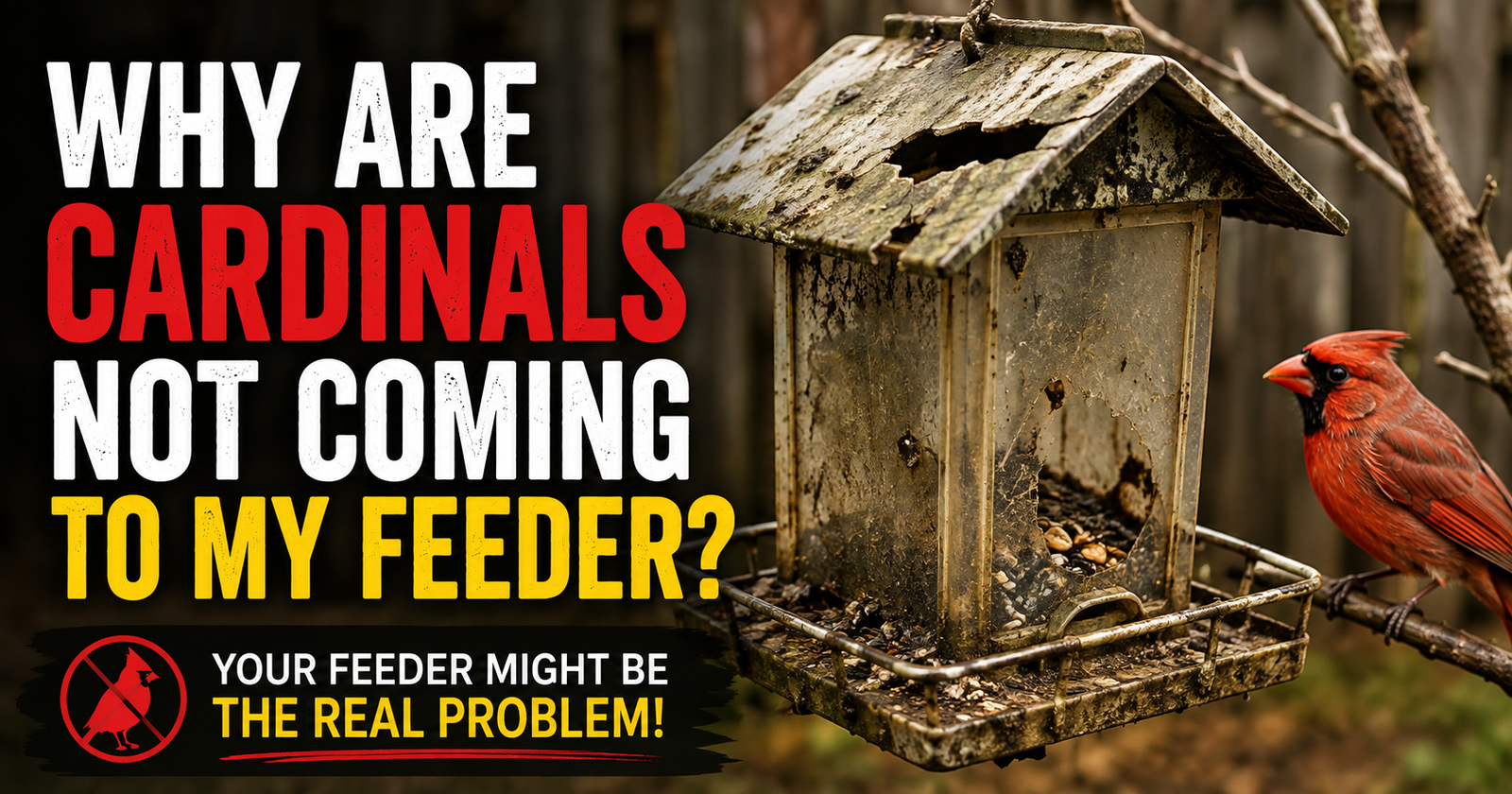
A perfectly open yard with one beautiful feeder may attract a cardinal for lunch while offering very little reason for it to spend the rest of its day there. The same habitat clues can also help explain why cardinals may leave a feeder even when the feeder itself has not changed.
Do Baby Cardinals Sleep in the Nest?
Very young nestlings do.
That’s their entire world at first.

Northern Cardinal chicks hatch extremely undeveloped, with closed eyes and sparse down. They remain in the nest for only about 7 to 13 days before fledging.
During that nestling period, the nest provides the place where they remain while their parents care for them.
Then everything changes very quickly.
They leave.
And once they become fledglings, they begin living outside the nest even though they aren’t yet independent.
That’s where people often become worried.
Where Do Baby Cardinals Sleep After Leaving the Nest?
Fledglings use vegetation and protected perches outside the nest while continuing to receive parental care.
Don’t expect them to fly back into the old nest every evening.
Once they’ve fledged normally, that transition is underway.
The youngster may spend time surprisingly low in shrubs or vegetation because its flight skills are still developing.
It can look vulnerable because it is vulnerable.
But vulnerable doesn’t automatically mean abandoned.
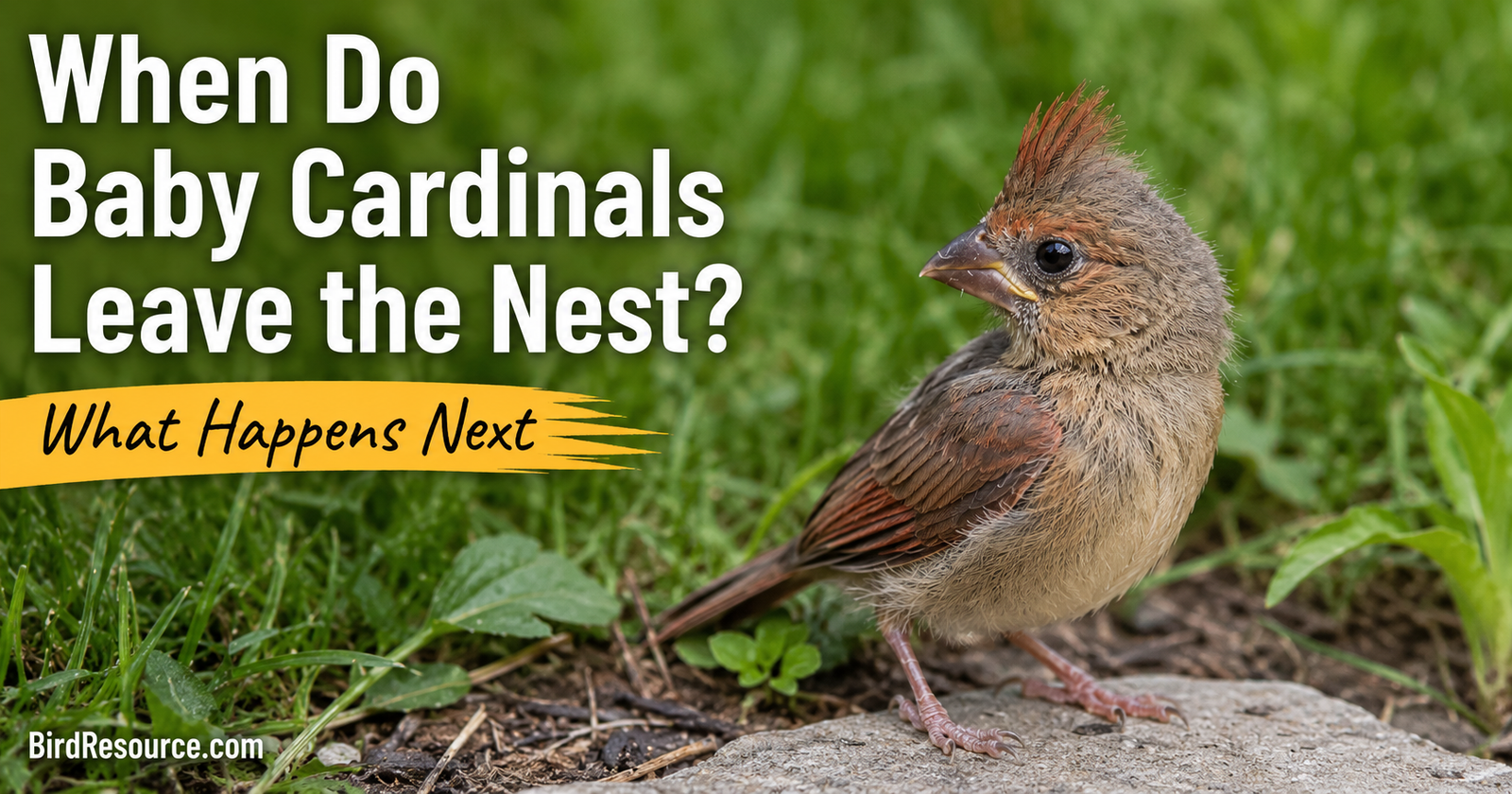
Our guide to when baby cardinals leave the nest and what happens next goes much deeper into fledgling behavior, parental feeding, poor early flight, and when a young cardinal actually needs human help.
Do Cardinals Sleep Near Their Babies?
Parents remain involved with fledglings after they leave the nest, but that doesn’t require the entire family to sleep packed together in one location.
Young birds begin spreading through vegetation.
Parents continue locating and feeding them.
The male can take a particularly active role with fledglings while the female begins another nesting attempt. Audubon notes this overlap between fledgling care and another nesting cycle.
So you can have a surprisingly complicated cardinal family spread across a fairly small area.
Mom may be preparing for another nest.
Dad may be feeding fledglings.
The fledglings may be tucked into vegetation.
And none of them necessarily needs the old nest anymore.
Do Cardinals Sleep Near Bird Feeders?
They might if suitable cover happens to be nearby, but the feeder itself isn’t necessarily determining the roost.
This is one reason feeder placement can be more important than simply hanging one wherever it’s easiest for us to see.
A yard with feeders plus nearby shrubs and trees gives birds quick access to cover.
A feeder standing alone in a wide-open lawn is a very different environment.
Cornell describes cardinals as birds that forage on or near the ground and spend substantial time in low shrubs and trees.
The feeder is only one piece of their daily habitat.
Why Can’t I Find My Cardinals After Dark?
Because their nighttime strategy works.
Think about the contrast.
During the day, an adult male may perch somewhere conspicuous and sing.
At night, being conspicuous offers very little advantage.
The bird settles into protected vegetation.
Movement decreases.
Singing largely stops.
Light disappears.
And suddenly one of the brightest birds in North America becomes incredibly difficult to find.
That’s a feature, not a failure.
A sleeping cardinal doesn’t need you, a hawk, a cat, or anything else knowing exactly which branch it’s sitting on.
Do Cardinals Make Noise While They Sleep?
Nighttime is nothing like the loud morning performance you hear during breeding season.
Cardinals are daytime songbirds.
Their familiar whistles and chip calls are associated with active communication, territorial behavior, nesting, and other daytime activity.
Once birds settle into nighttime roosts, the yard can become remarkably quiet.
Then dawn arrives.
And sometimes the cardinal seems determined to make up for those quiet hours immediately.
If you’ve learned its voice, those first whistles can tell you the bird survived the night before you’ve even spotted it.
Why Does My Cardinal Disappear Every Evening and Return Every Morning?
Because your yard may be part of its daily feeding area without being the exact spot where it sleeps.
A cardinal can visit your feeder regularly and then move into thicker vegetation elsewhere to roost.
That could be twenty feet away.
It could be across the yard.
It could be somewhere beyond your property.
Then morning arrives and the bird returns to feed.
Cardinals are permanent residents, but resident doesn’t mean stationary.
They still move around their local environment throughout the day.
The Best Cardinal Bedroom Probably Doesn’t Look Like One
If you were designing a bird bedroom from a human perspective, you might imagine a little enclosed wooden house.
Four walls.
A roof.
A tiny entrance.
Maybe even some nesting material inside.
That’s perfect for certain cavity-roosting species.
It’s not what a cardinal needs.
A cardinal’s nighttime shelter can simply be a well-protected branch buried inside thick vegetation.
No nest.
No birdhouse.
No little bed.
Just a perch, feathers, shelter, and one remarkable set of feet holding tight while the bird sleeps.
That’s why I think understanding bird behavior changes the way we look at our yards.
That ordinary hedge beside the fence isn’t necessarily just landscaping.
To a cardinal, it might be the safest bedroom on the property.
Common Questions About Where Cardinals Sleep
Where do cardinals sleep every night?
Northern Cardinals generally roost perched in sheltered trees, shrubs, thickets, and other dense vegetation. Audubon specifically identifies dense trees and shrubs as typical sleeping locations for songbirds such as cardinals.
Do cardinals go into a nest at night?
Not normally. An active female may remain on the nest during incubation and early nesting, but old cardinal nests aren’t permanent sleeping homes. Cornell notes that cardinals usually don’t use their nests more than once.
Do cardinals sleep in birdhouses?
Cardinals aren’t cavity nesters and don’t normally depend on birdhouses for sleeping. They’re branch-roosting songbirds that use protected vegetation.
Where do cardinals sleep when it’s raining?
They seek sheltered perches. Cornell notes that branch-roosting birds such as cardinals tend to choose thick branches near the trunk on the side protected from wind and rain during storms.
Where do cardinals sleep when it snows?
They remain in their year-round range and seek protected roosts in vegetation. Cardinals don’t normally migrate away for winter.
Do male and female cardinals sleep together?
They may remain near one another depending on season and circumstances, but there isn’t a reliable rule that a mated pair always sleeps side by side on the same branch.
How do cardinals keep from falling out of trees while sleeping?
Perching birds have a tendon system that helps close their toes securely around a branch when they settle their weight onto the perch.
What time do cardinals go to bed?
They settle toward roosting areas around dusk, although cardinals can remain active at feeders quite late. Cornell notes they’re often among the last feeder visitors before dark.
What time do cardinals wake up?
They can become active very early. Cornell feeder observations describe Northern Cardinals as commonly among the first birds to arrive in the morning.
Can I give cardinals somewhere safe to sleep?
One of the most useful things you can provide is good vegetation. Dense shrubs, hedges, thickets, evergreens, and other protective growth can give cardinals the sheltered perches they actually use.
And once you know that, you may never look at that thick old shrub outside your window quite the same way again.
The cardinal you watch disappear into it every evening may not simply be passing through.
It may be going to bed.
Caleb Hartwell is the Bird Identification & Behavior Contributor for BirdResource.com, where he helps backyard birdwatchers understand what familiar birds are actually doing, from the songs we hear at sunrise to nesting, feeding, fledglings, seasonal behavior, and where those same birds disappear after dark.