

If a cardinal keeps flying at your window, pecking the glass, or coming back to the same window over and over, the bird usually isn’t trying to get inside your house. In most cases, it sees its own reflection and thinks another cardinal has entered its territory.
That explains why the behavior can seem so relentless. From the cardinal’s point of view, the “other bird” refuses to leave. Every time the real cardinal moves closer, raises its crest, or becomes more aggressive, the reflection does exactly the same thing.
Northern Cardinals are particularly well known for this behavior, and both males and females can do it.
I wouldn’t ignore repeated window attacks if there’s an easy way to stop them. Even though this is different from a bird accidentally crashing full-speed into glass, repeatedly fighting a reflection wastes time and energy and can potentially result in injury.
Fortunately, the solution is usually pretty straightforward: stop the cardinal from seeing a convincing reflection, preferably by treating or covering the outside surface of the problem window.
If you’re trying to learn more about the bird itself, our Northern Cardinal identification and behavior guide covers the species in much more detail. Here, I want to concentrate specifically on why this strange window behavior happens and what you can actually do about it.
Why Cardinals Keep Attacking Windows
The basic problem is that the cardinal doesn’t understand that the bird in the glass is itself.
During territorial periods, another cardinal appearing nearby can represent competition.
A male may defend an area against another male. Females can defend territories against other females as well. When either bird encounters a strong reflection in a window, glass door, vehicle mirror, or other shiny surface, that reflection can look enough like a real intruder to trigger a territorial response. Understanding cardinal territorial behavior can put this window response in the broader context of how birds defend space.
The cardinal approaches.
The reflection approaches.
The cardinal postures.
The reflection postures.
The cardinal attacks.
The reflection appears to attack right back.
Nothing the bird does makes its “rival” leave.
That’s why a cardinal can become fixated on one window and return repeatedly.
Why Cardinals Attack Windows More in Spring
If this suddenly starts happening around spring, the timing makes sense.
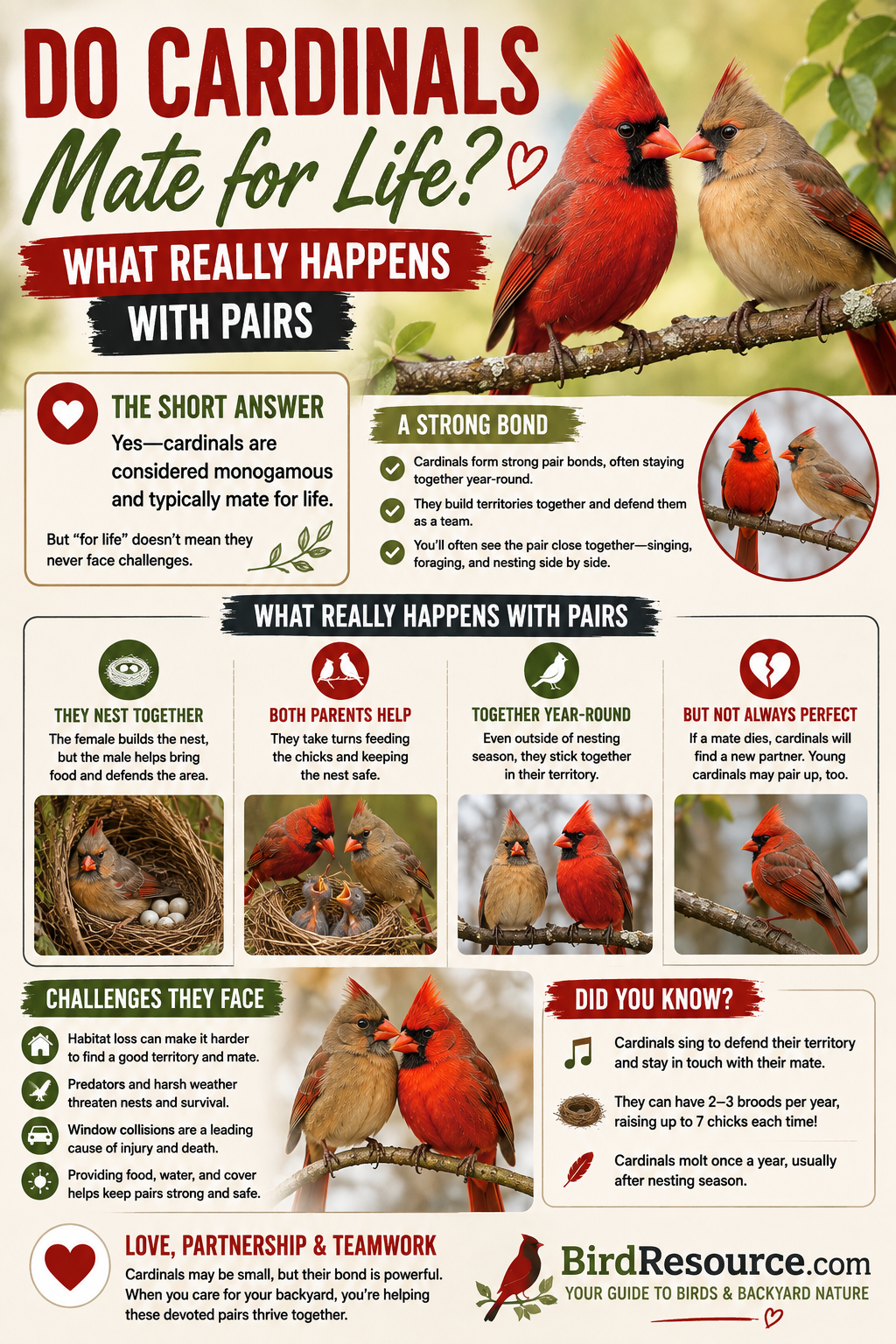
Spring and early summer overlap with the period when Northern Cardinals are establishing territories, pairing, nesting, and raising young. Territorial behavior can become particularly intense during this part of the year. The pairing stage is explored in more detail in our guide to pairing, nesting, and raising young.
A reflection that might not provoke the same reaction at another time can suddenly look like a serious competitor.
This also explains why a cardinal may have lived around your house for months without bothering the windows and then seemingly become obsessed with one.
The window didn’t necessarily change.
The bird’s motivation did.
As breeding-related territorial behavior decreases, reflection attacks often decrease too.
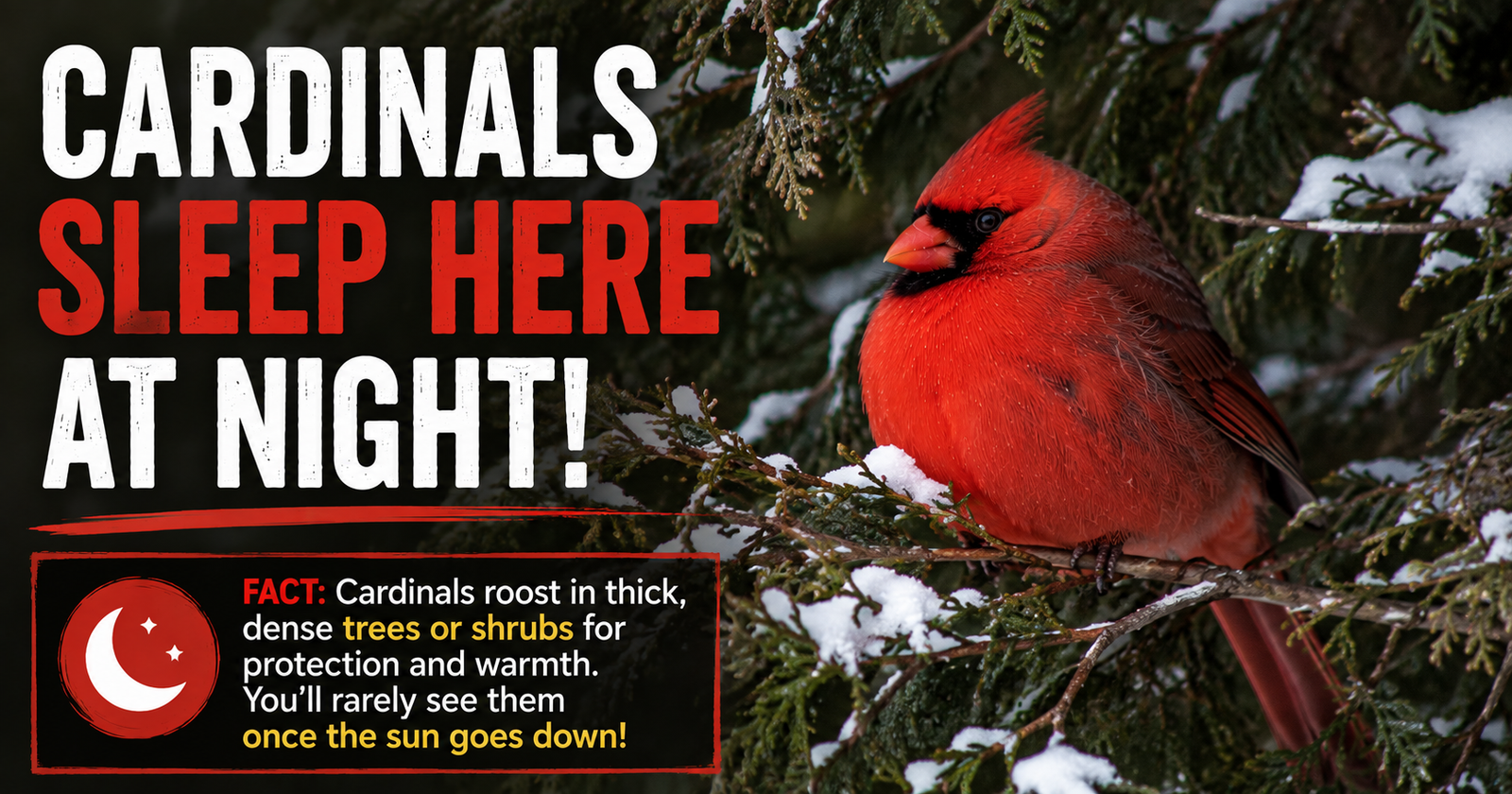
That doesn’t mean every cardinal follows exactly the same schedule. Individual birds vary, nesting seasons differ somewhat with location and conditions, and especially persistent birds can continue the behavior longer than you might expect. Those individual differences also matter when considering how cardinals spend the night.
But if someone tells me, “Every spring this cardinal starts attacking my window,” territorial reflection aggression would be one of the first explanations I’d consider.
Male Cardinals Aren’t the Only Ones That Do It
The bright red male tends to get blamed for cardinal window attacks, probably because he’s so easy to notice.
But female Northern Cardinals attack reflections too.
That’s an important distinction because territorial behavior isn’t limited to males.
If the bird repeatedly hitting your window is predominantly warm brown with reddish coloration in the wings, crest, and tail, you may be watching a female Northern Cardinal defending her territory against what she thinks is another female.
The sex of the bird doesn’t change the basic solution.
You still need to address the reflection.
What Does a Cardinal Think It Sees in the Window?
We can’t know exactly what an individual bird is thinking in the human sense, but its behavior gives us a useful biological explanation. For more context on distinguishing documented patterns from certainty about individual birds, see how behavioral claims are qualified.
The reflected image has all the visual characteristics of another cardinal.
It moves at exactly the same time.
It adopts matching postures.
And it never backs down.
Imagine the problem from the bird’s perspective. Territorial displays normally influence what another bird does. A rival might retreat, move away, or otherwise change its behavior.
A reflection can’t do that.
Every escalation is perfectly matched.
That helps explain why the cardinal may keep returning instead of quickly “figuring out” that nothing is there.
Why Does the Cardinal Attack the Same Window Every Day?
Once a cardinal discovers a strong reflection at a particular window, that location can continue presenting the same apparent threat.
The bird leaves.
Later it comes back.
And there’s the intruder again.
From our perspective, it’s obviously the same reflection. From the cardinal’s perspective, the territorial problem hasn’t been resolved.
Certain windows can create much stronger reflections than others because of their orientation, surrounding vegetation, lighting, and what is behind the glass.
That can produce a strange situation where you have 15 windows on your house but the cardinal seems obsessed with only one or two.
Those particular panes may simply produce the most convincing reflection under the conditions when the bird visits.
Why Is a Cardinal Pecking My Window Early in the Morning?
Morning can be an especially active time for territorial songbirds.
Light conditions can also affect how reflective your windows appear.
Depending on which direction the window faces, what’s outside it, and the relative brightness inside and outside your home, the reflection may become particularly noticeable during certain parts of the day.
So if your unwanted cardinal alarm clock starts tapping the bedroom window every morning, I wouldn’t assume the bird has somehow chosen that time specifically to bother you.
You may have a combination of normal morning bird activity and a window that produces an especially convincing reflection under morning light.
Treating the reflection can be much more effective than trying to change the bird’s daily routine.


Why Does the Cardinal Fly at the Window Over and Over?
This can look more serious than simple pecking.
A cardinal may perch nearby, fly toward the glass, make contact or flutter against it, retreat, and then repeat the process.
Again, the territorial explanation fits.
The bird is attempting to confront or drive away the perceived rival.

Repeated attacks can consume time and energy the cardinal could otherwise spend feeding, caring for young, maintaining its territory, or performing other normal activities. Understanding cardinal-friendly foods puts those everyday feeding needs in context.
There’s also a possibility of injury when a bird repeatedly makes contact with a hard surface.
That’s why I prefer actually solving the reflection problem rather than assuming the bird will eventually get bored.
Cardinal Window Attacks Are Different From Accidental Window Strikes
This distinction is extremely important.
A cardinal deliberately approaching the same window repeatedly because it sees its reflection is displaying reflection aggression.
An accidental window collision is different.
Birds may see reflected trees, sky, or vegetation in glass and perceive what looks like open habitat. They can then fly directly toward the reflection at normal flight speed and strike the glass.
Birds can also see through certain windows to vegetation or open space on the other side and attempt to fly through.
Those collisions can be extremely dangerous and potentially fatal.
Signs of a Territorial Reflection Attack
A cardinal may:
Peck repeatedly at the glass.
Hover or flutter against the window.
Return to the same window repeatedly.
Perch nearby between attacks.
Focus on mirrors or particularly reflective areas.
Continue the behavior over multiple days.
Signs of an Accidental Window Collision
You may hear a sudden hard impact.
The bird may hit the window once at considerable speed.
It may fall to the ground.
It may appear stunned, injured, unable to fly normally, or unresponsive.
You might find a feather or dusty body imprint on the glass.
The difference matters because a territorial bird is deliberately confronting an image, while a collision victim may have suffered significant trauma.
If a bird has actually crashed into a window and appears injured, that’s no longer simply a behavior problem.

How to Stop a Cardinal From Attacking Your Window
The most effective approach is to make the reflection stop looking like another cardinal.
And there’s one detail I would emphasize:
Work on the outside of the glass whenever possible.
The reflection exists on the exterior surface from the bird’s perspective. Putting something inside the room can sometimes change what the bird sees, but it may not eliminate the outside reflection.
Here are the approaches I would consider.
Cover the Problem Area on the Outside
If the cardinal is attacking one relatively small window, temporarily covering the outside can be one of the simplest solutions.
The covering doesn’t have to be permanent.
The goal is to break up or eliminate the reflection long enough for the territorial fixation to stop.
Paper, fabric, an appropriate exterior window covering, or another temporary material can work as long as it actually prevents the bird from seeing a convincing reflected cardinal.
It may not be beautiful for a few days, but neither is listening to a cardinal fight your bedroom window at sunrise every morning.
Use an Exterior Pattern Across the Glass
A properly applied exterior pattern can make the glass visibly different to birds.
Dots, stripes, appropriate window film, screens, or other bird-safe window treatments can break up reflections and make the surface easier to recognize as a barrier.
Coverage matters.
One tiny sticker in the middle of a large window doesn’t magically make the rest of the reflective glass disappear.
If the goal is broader collision prevention rather than temporarily stopping one territorial cardinal, patterns should be applied densely enough across the exterior glass that birds don’t perceive large open areas between the markings.
Use an Exterior Screen
An exterior screen can help in two ways.
It can reduce the reflection, and it can provide a physical buffer between the bird and the hard glass.
This can be particularly useful for a window that repeatedly causes bird problems rather than a single short-lived cardinal incident.
Temporarily Block a Car Mirror
Cardinals don’t limit this behavior to house windows.
A side mirror on a parked vehicle can create an exceptionally clear bird-sized reflection.
If a cardinal repeatedly attacks your car mirror, covering the mirror while the vehicle is parked may solve the immediate problem.
A temporary mirror cover, bag, cloth, or other secure covering can prevent the bird from seeing its reflection.
Obviously, remove anything covering the mirror before driving.
Why Closing the Curtains May Not Work
Closing curtains or blinds can sometimes alter the appearance of a window, but it doesn’t necessarily eliminate the exterior reflection.
That’s the important part.
A bird outside isn’t seeing the window the way you see it from inside your house.
Depending on lighting, the outside surface can still behave like a mirror.
This is why exterior treatments are generally more reliable for reflection aggression.
If you close the blinds and the cardinal keeps attacking, don’t assume the bird is somehow seeing through them.
It may still be seeing itself reflected on the outside of the glass.

Will Window Decals Stop a Cardinal?
They can help when used correctly, but I wouldn’t expect one little decorative decal to solve every window problem.
For bird-window safety more broadly, the goal is to make the glass visibly obvious across the area a bird might otherwise attempt to fly through.
A sparse pattern leaves large portions of glass untreated.
For a cardinal attacking its own reflection, you specifically need to disrupt the reflected image where the bird is focusing its attacks.
If the bird simply moves six inches to the side and discovers another perfect cardinal reflection, the problem isn’t really fixed.
Do Fake Owls Stop Cardinals From Attacking Windows?
I wouldn’t make a plastic owl my first choice.
Visual scare devices can sometimes produce a temporary response, but birds can become accustomed to stationary objects that never actually behave like predators.
More importantly, a fake owl doesn’t address the reason the cardinal is attacking.
The reflection is still there.
Removing or disrupting the reflection tackles the actual trigger instead of trying to frighten the cardinal away from an otherwise attractive territory.
Should I Scare the Cardinal Away?
Constantly running outside to chase the bird away is unlikely to be the best long-term solution.
You might make it leave temporarily, but the reflection remains.
Once the cardinal returns to its territory and sees the “intruder” again, the whole cycle can start over.
I’d rather change the window than spend the next several weeks trying to out-stubborn a territorial cardinal.
How Long Will a Cardinal Keep Attacking a Window?
There’s no exact number of days that applies to every bird.
Reflection aggression is especially common during the breeding season and often subsides as territorial intensity changes. Some birds may stop after days or weeks, while particularly persistent individuals can continue much longer.
If you do nothing, you’re essentially waiting for the bird’s motivation or circumstances to change.
If you eliminate the reflection, you’re removing the trigger directly.
That’s why I’d intervene if the same bird is repeatedly spending significant amounts of time fighting the glass.
Will the Cardinal Hurt Itself?
Repeated reflection attacks aren’t necessarily the same high-speed impacts involved in accidental window collisions, but they still aren’t something I’d encourage.
A cardinal repeatedly striking, pecking, or fluttering against a hard surface could potentially injure itself, and prolonged territorial fighting wastes energy.
There’s another practical concern.
While the cardinal is spending time confronting an imaginary rival, it isn’t performing other normal activities.
That may include feeding, maintaining its territory, interacting with its mate, or helping care for young.
The safest approach is simply to make the reflection disappear.
Why Does the Cardinal Attack My Window but Not My Neighbor’s?
Windows don’t all reflect equally.
The direction a window faces, sunlight, shade, nearby trees, shrubs, landscaping, exterior color, interior lighting, and even the time of day can change what appears on the glass.
Your window may happen to create a particularly clear reflection right in an area the cardinal already considers part of its territory.
Your neighbor’s window might not.
This is another reason I’d focus on the specific problem glass rather than trying to discourage cardinals from using your entire yard.
The bird isn’t necessarily attracted to your house.
It may simply have discovered one very convincing “rival” living in your window.
Why Is a Cardinal Attacking My Car?
The same territorial behavior can happen with vehicles.
Side mirrors are obvious trouble spots because they create a clear reflection at approximately bird height.
Cardinals may also react to reflective windows, shiny trim, chrome, or other surfaces where they can see themselves.
A parked vehicle can therefore become a temporary territorial battleground.
If the attacks happen primarily when the car is parked at home, temporarily covering the particular mirror or reflective surface can be remarkably simple compared with trying to keep the bird away from the entire vehicle.
Why Does the Cardinal Attack Multiple Windows?
A particularly territorial bird may move from one reflective surface to another.
From the cardinal’s perspective, it may appear that rivals are showing up all over its territory.
If covering one window simply causes the bird to move immediately to another, look at the house from outside during the time of day when attacks usually occur.
You may discover that several windows are producing strong reflections.
Treating only the exact spot where you first noticed the behavior might not be enough.
Does a Cardinal Attacking the Window Mean There Is a Nest Nearby?
Not necessarily.
The behavior tells you the cardinal is responding territorially to a reflection. It doesn’t reveal the exact location of a nest.
A nest could be somewhere in the broader area, particularly during breeding season, but you shouldn’t assume it’s directly outside that particular window.
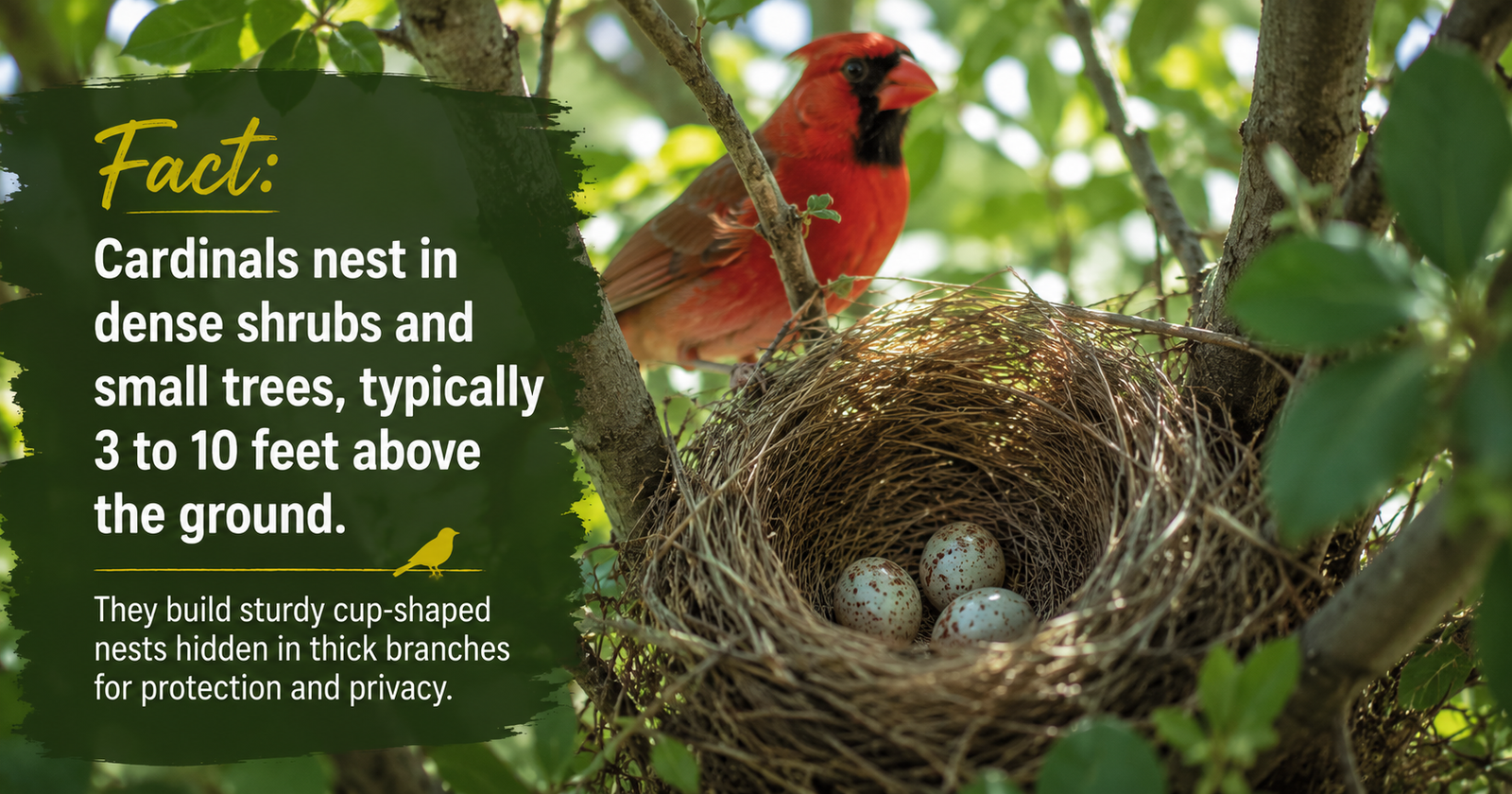
Northern Cardinals commonly nest in dense shrubs, vines, thickets, and other vegetation that provides concealment. That concealment can make a nest surprisingly difficult to spot, as explained in cardinal nesting sites in dense vegetation.
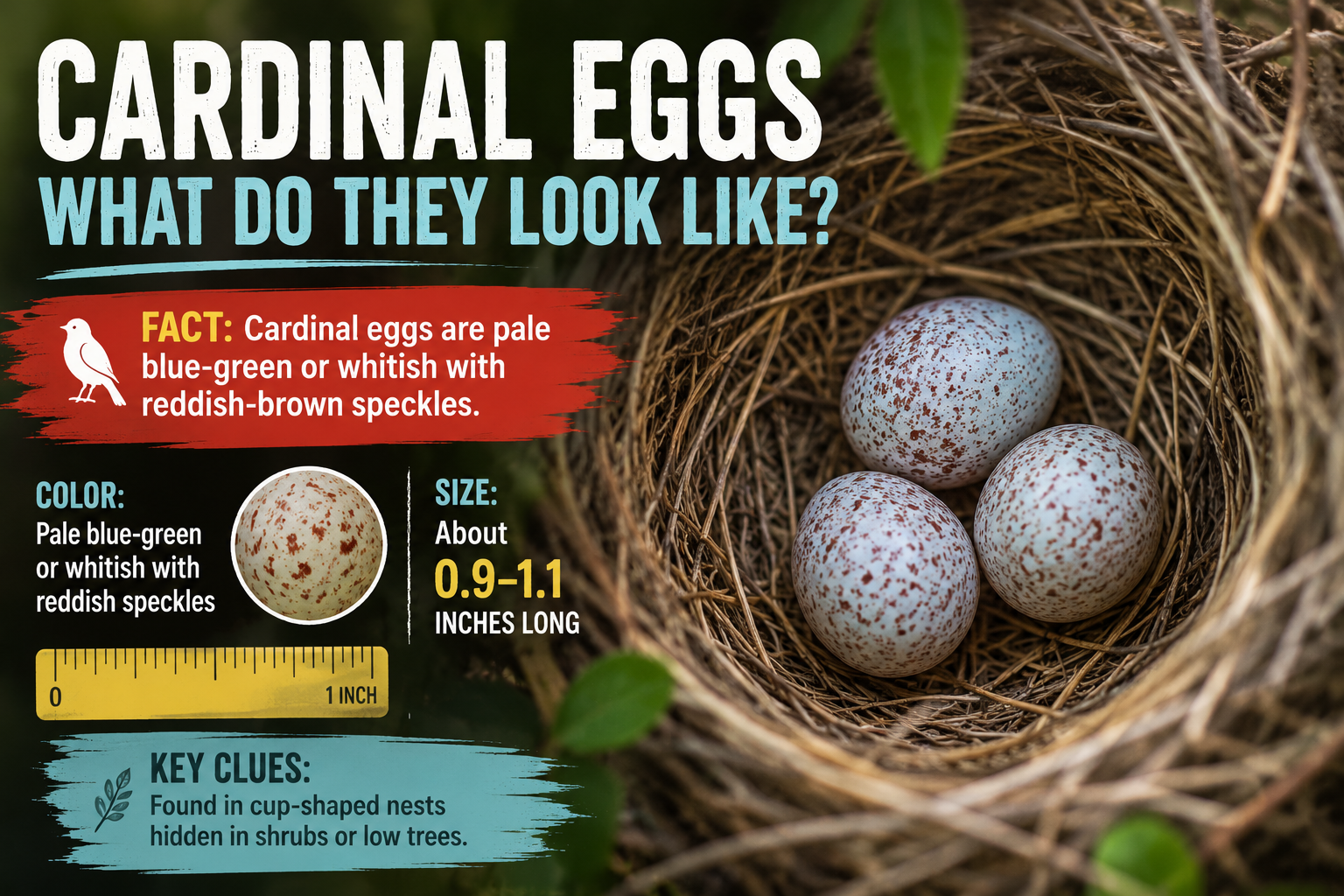
If you happen to discover an active nest, give it space rather than repeatedly approaching it while trying to investigate the window behavior. For a careful overview of identifying cardinal eggs safely, observation from a distance is the safest approach.
Is the Cardinal Trying to Get Inside My House?
Usually not when you’re seeing repeated territorial attacks.
A cardinal that pecks, flutters, retreats, returns, and focuses on its reflected image is generally confronting what it perceives as another bird.
That’s very different from intentionally trying to enter your house.
The distinction becomes easier to see if you step outside and look at the glass from approximately the bird’s direction.
Sometimes the reflection is so strong that you’ll immediately understand what is attracting its attention.
Why Does a Cardinal Look Through My Window Without Attacking?
Not every cardinal near a window is displaying reflection aggression.
Birds routinely perch on windowsills, investigate their surroundings, search for food, respond to movement, or simply use structures around homes as convenient perches.
Behavior matters.
A bird sitting calmly near the glass isn’t the same situation as one repeatedly pecking, posturing, fluttering, and returning to confront its reflection.
I wouldn’t turn every cardinal that looks toward a window into a territorial emergency.
Look at what the bird is actually doing.
Can the Same Cardinal Come Back Next Year?

Northern Cardinals are generally year-round residents rather than long-distance seasonal migrants, so cardinals can remain in the same general region throughout the year.
That makes it possible for a territorial window problem to recur seasonally.
However, seeing a cardinal attack the same window the following spring doesn’t prove from casual observation that it’s the exact same individual.
If your window consistently produces a strong reflection, it may simply remain attractive to territorial cardinals.
A more permanent bird-friendly window treatment can make sense if the problem happens repeatedly.
Don’t Confuse Reflection Fighting With Dangerous Glass
A cardinal obsessively fighting itself can be frustrating, but there’s a larger window issue worth understanding.
Birds don’t perceive glass barriers the same way humans do.
A window reflecting open sky and trees can look like somewhere a bird can safely fly. Clear glass can also create the appearance of an open flight path to vegetation on the other side.
Those situations can lead to high-speed collisions and serious injuries.
So while you’re fixing the one window your cardinal is attacking, it’s worth looking around the rest of your home for large reflective or transparent areas that could create collision hazards for other birds.
This is one place where our broader Backyard Birding resources can become increasingly useful as we build out practical guides for making the spaces around our homes safer and more useful for birds.
What to Do If a Cardinal Actually Crashes Into the Window
If you hear a hard impact and find a cardinal on the ground, don’t automatically assume you’re dealing with the harmless-looking reflection behavior described above.
The bird may have suffered a genuine window collision.
A bird can have significant internal or neurological injuries even when there isn’t an obvious broken wing or visible blood.
If the cardinal appears injured, unable to fly normally, disoriented, or otherwise impaired after a collision, contact a licensed wildlife rehabilitator for guidance rather than trying to diagnose or treat the bird yourself.
BirdResource.com is an informational resource, not a wildlife rehabilitation service or veterinary practice.

Preventing another collision should also become a priority because a dangerous window can affect many different birds, not just the individual you found. Window strikes are just one of the hazards cardinals face throughout life that can shorten a wild bird's life.
The Simplest Way I’d Handle a Cardinal Attacking My Window
If I had a cardinal repeatedly attacking one of my windows, I wouldn’t spend much time trying to scare the bird away or figure out how to make it “realize” that the reflection isn’t another cardinal.
I’d walk outside during the time the attacks normally occur and look at the window from the bird’s side.
If I could clearly see reflections of vegetation, sky, or myself, I’d temporarily cover or disrupt the exterior reflection where the cardinal is attacking.
Then I’d watch what happens.
If the attacks stop, I’ve identified the problem.
If the bird moves to another part of the same window, I’d increase the covered area.
If it moves to another reflective window or mirror, I’d address that surface too.
That’s much more practical than trying to change a wild bird’s territorial instincts.
The cardinal isn’t being stupid, angry at your family, asking to come inside, or delivering some mysterious message through the glass.
It’s doing something that makes sense within its normal territorial behavior.
It just happens to have picked a fight with an opponent that can never leave.
Common Questions About Cardinals Attacking Windows
Why does a cardinal attack my window every morning?
Morning bird activity combined with the lighting and reflection on that particular window may make the behavior especially noticeable at the same time each day. During breeding season, a territorial cardinal can return repeatedly to a reflection it perceives as a rival.
Why is a female cardinal attacking my window?
Female Northern Cardinals can defend territories and attack their reflections just as males can. A mostly brown cardinal repeatedly fighting the glass may therefore be an adult female rather than an immature male. When that distinction is unclear, immature male explains the appearance clues that separate young cardinals from adult females.
Why is a cardinal attacking my side mirror?
The bird can see a clear reflection in the mirror and interpret it as another cardinal. Temporarily covering the mirror while the vehicle is parked can remove the apparent rival. Always remove the covering before driving.
Will the cardinal eventually stop attacking the window?
Often, yes. Reflection aggression frequently decreases as breeding-season territorial intensity changes. But an individual bird can remain persistent, so eliminating the reflection is usually preferable to waiting it out.
Should I move my bird feeder because a cardinal is attacking the window?
Not automatically. A cardinal fighting its reflection and a bird accidentally colliding with a window are different problems.
If you’re experiencing actual high-speed window strikes around a feeder, feeder placement and broader window-safety measures deserve attention. If one cardinal is deliberately confronting its reflection, address that reflection first.
Does a cardinal tapping on a window mean someone died?
There are many cultural beliefs and personal interpretations associated with cardinals, including connections with deceased loved ones.
Biologically, though, repeated tapping and attacking during territorial periods has a straightforward explanation: the cardinal commonly sees its reflection and responds as though another bird is present.
A person can still attach personal meaning to seeing a cardinal while recognizing the natural explanation for the window behavior.
Can I stop a cardinal without hurting it?
Yes. You don’t need to trap, handle, or harm the bird.
Changing the reflective surface is the key. Exterior coverings, screens, appropriate patterns, and other methods that prevent a clear reflection can solve the problem without interfering directly with the cardinal.
And that’s really what I want people to remember when this starts happening: don’t fight the cardinal. Fix the reflection.
Caleb Hartwell is the Bird Identification & Behavior Contributor for BirdResource.com, where he helps explain the sometimes strange things birds do around our homes and yards using practical, research-based information that everyday birdwatchers can put to use.