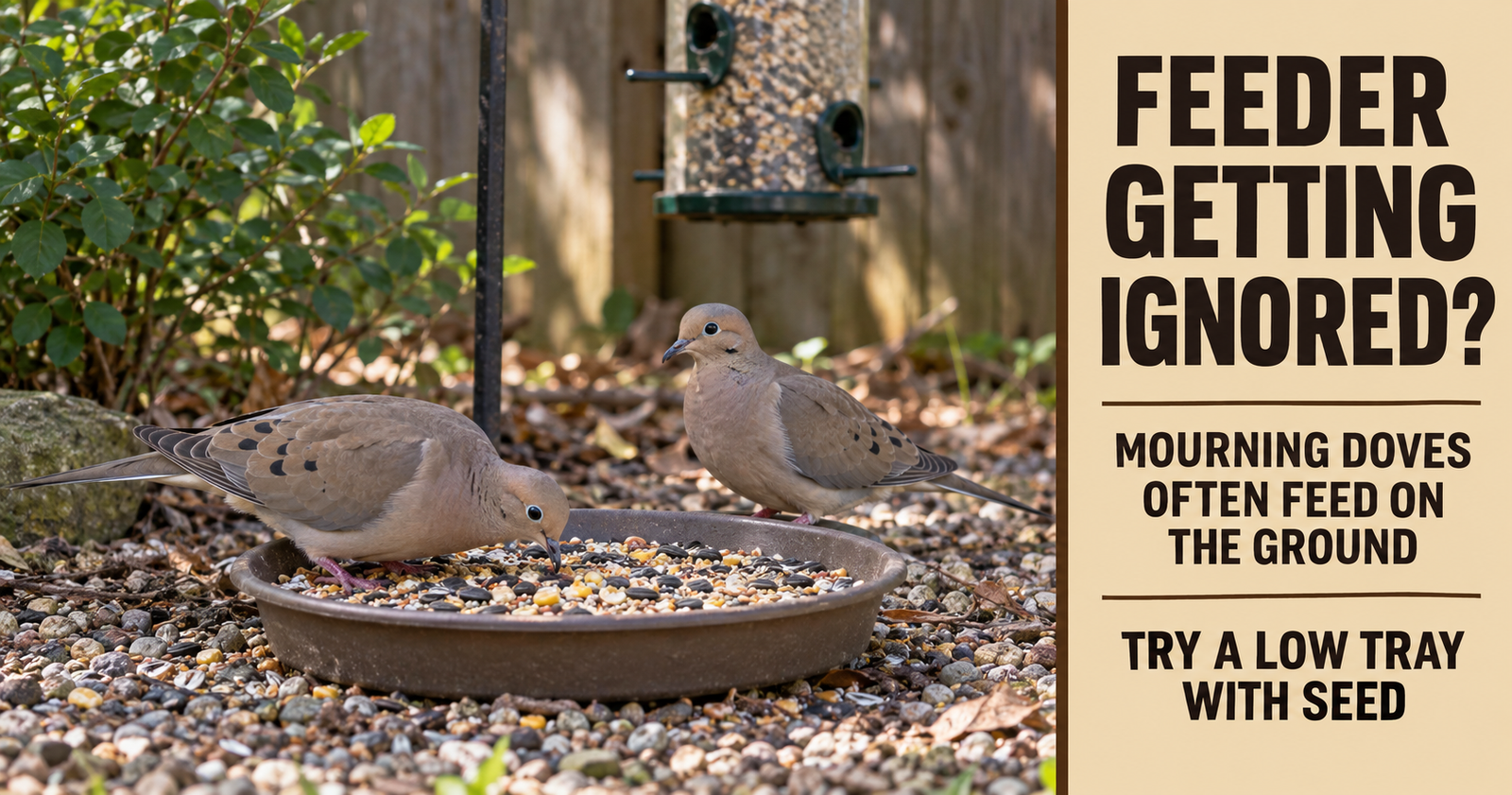
You can have Mourning Doves sitting on the power line above your yard every morning and still never see one actually use your bird feeder.
That doesn’t mean they haven’t noticed it.
Your feeder may simply be asking a Mourning Dove to eat like the wrong kind of bird.
Mourning Doves aren’t chickadees hanging sideways from tiny feeder ports. They’re not woodpeckers clinging to a suet cage either.
They’re ground-feeding birds.
Watch one naturally and you’ll usually see it walking across relatively open ground, picking up visible seeds one after another. That ground-foraging pattern is one of several distinctive traits explained in this Mourning Dove feeding behavior.
That’s the clue.
If I wanted to turn Mourning Doves from occasional flyovers into regular backyard visitors, I wouldn’t start by buying more random birdseed.
I’d start by making the food easy for a dove to reach the way a dove naturally eats.
Cornell recommends scattering millet on the ground or offering seed on a platform feeder. It also recommends dense shrubs or evergreen trees for nesting and even mentions nesting cones as an option for breeding pairs. You can see those recommendations in the Cornell Lab’s backyard tips for Mourning Doves.
Food gets them down into the yard.
Water, safe feeding space, perches, and nesting cover give them reasons to keep using it.
First, Look Under the Feeder You Already Have
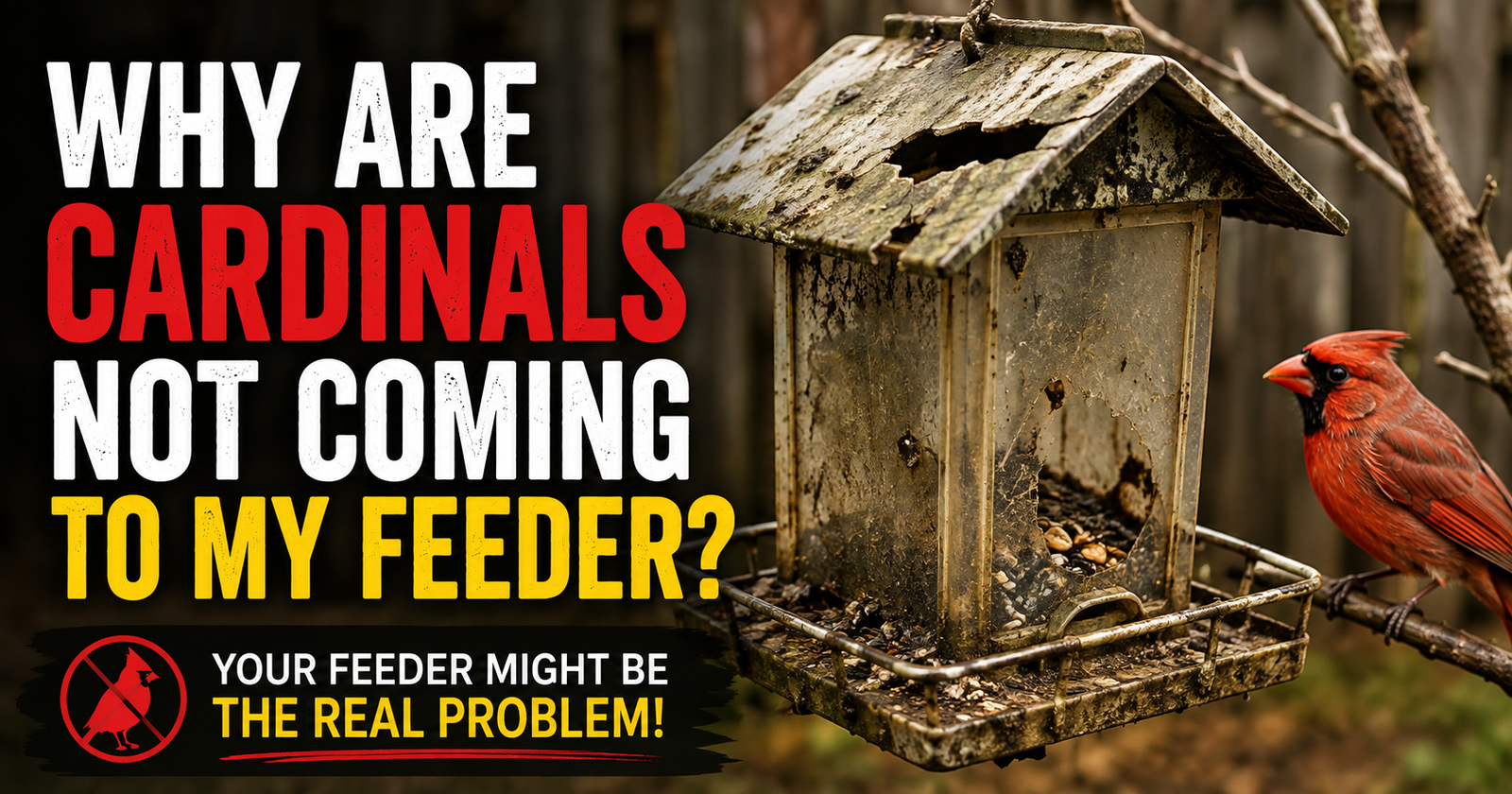
Before changing anything, I’d watch what’s happening underneath your current bird feeder.
This can tell you a lot.
Mourning Doves commonly eat seeds that other birds knock onto the ground. The Missouri Department of Conservation’s Mourning Dove guide even notes that while doves don’t always feed directly from conventional bird feeders, they commonly glean seed from underneath them.
So if you’ve got Mourning Doves walking around beneath a hanging feeder, congratulations.
You’ve already attracted them.
The birds are telling you what part of your setup they prefer.
Instead of trying to convince them to balance on the feeder above, I’d make the feeding area below more useful.
Give Them Somewhere Flat to Eat
A platform feeder is one of the simplest upgrades I like for Mourning Doves.
There’s room to land.
There’s room to stand.
There’s room to walk around and pick up seed.
That matches the bird much better than a tiny perch.
Cornell recommends platform feeding, and Audubon describes Mourning Doves as primarily ground foragers that often eat beneath elevated feeders. (allaboutbirds.org) (audubon.org)
A low feeding tray can work too.
The important part isn’t buying something labeled DOVE FEEDER.
Look at the actual feeding surface.
If a plump, robin-sized bird can comfortably land, stand, turn around, and pick up seeds, you’re moving in the right direction.
Open Ground Matters More Than Most People Realize
Here’s something I think is much more useful than the usual advice to “put out birdseed.”
Mourning Doves don’t want to dig through a jungle to find dinner.
Their feet aren’t particularly good at scratching through thick vegetation or heavy debris.
MU Extension’s Missouri Mourning Dove habitat guide explains that doves prefer feeding on relatively open ground where seeds are accessible because their feet are poorly adapted for scratching through dense vegetation or stubble.
That means two yards can contain exactly the same seed and get very different results.
One has:
thick grass,
deep mulch,
dense groundcover,
and seed disappearing underneath everything.
The other has a clean, open area where a dove can land, see around itself, and immediately find food.
I’d expect the second setup to be much more comfortable for a Mourning Dove.
Don’t Turn the Feeding Area Into a Bare Desert Either
Open doesn’t have to mean completely exposed.
There’s a balance.
A Mourning Dove wants to see the ground and find food, but it’s still a prey animal.
Hawks are real.
Outdoor cats are real.
The bird needs to be able to notice danger and escape.
So I like open feeding space with useful trees or shrubs nearby, rather than seed buried inside dense vegetation or scattered across a huge lawn with absolutely nowhere nearby to retreat.
This is one of those situations where watching the birds is more useful than following an exact measurement from an article.
Where do they land before approaching?
Where do they fly when startled?
Which side of the feeding area do they seem most comfortable using?
Your Mourning Doves can help you fine-tune the setup.
Put Out Food They Actually Want
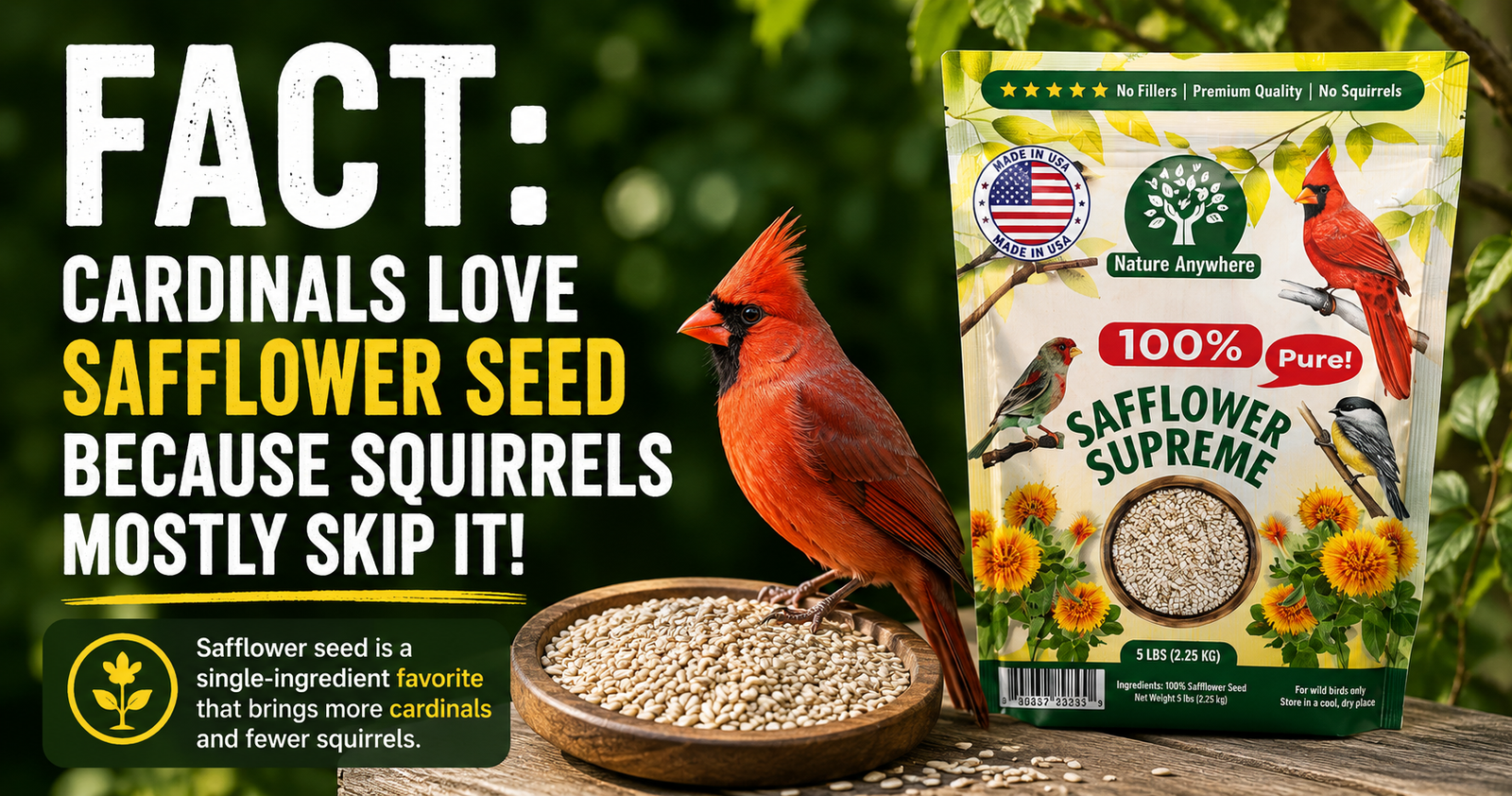
If I were starting specifically for Mourning Doves, I’d try millet.
Cornell specifically recommends millet for attracting them, while Missouri habitat guidance describes millets as especially palatable to doves.
Sunflower seed can work.
Cracked corn can work.
Other grains and seeds can work too.
But I wouldn’t buy an enormous bag simply because a dove is pictured on the front.
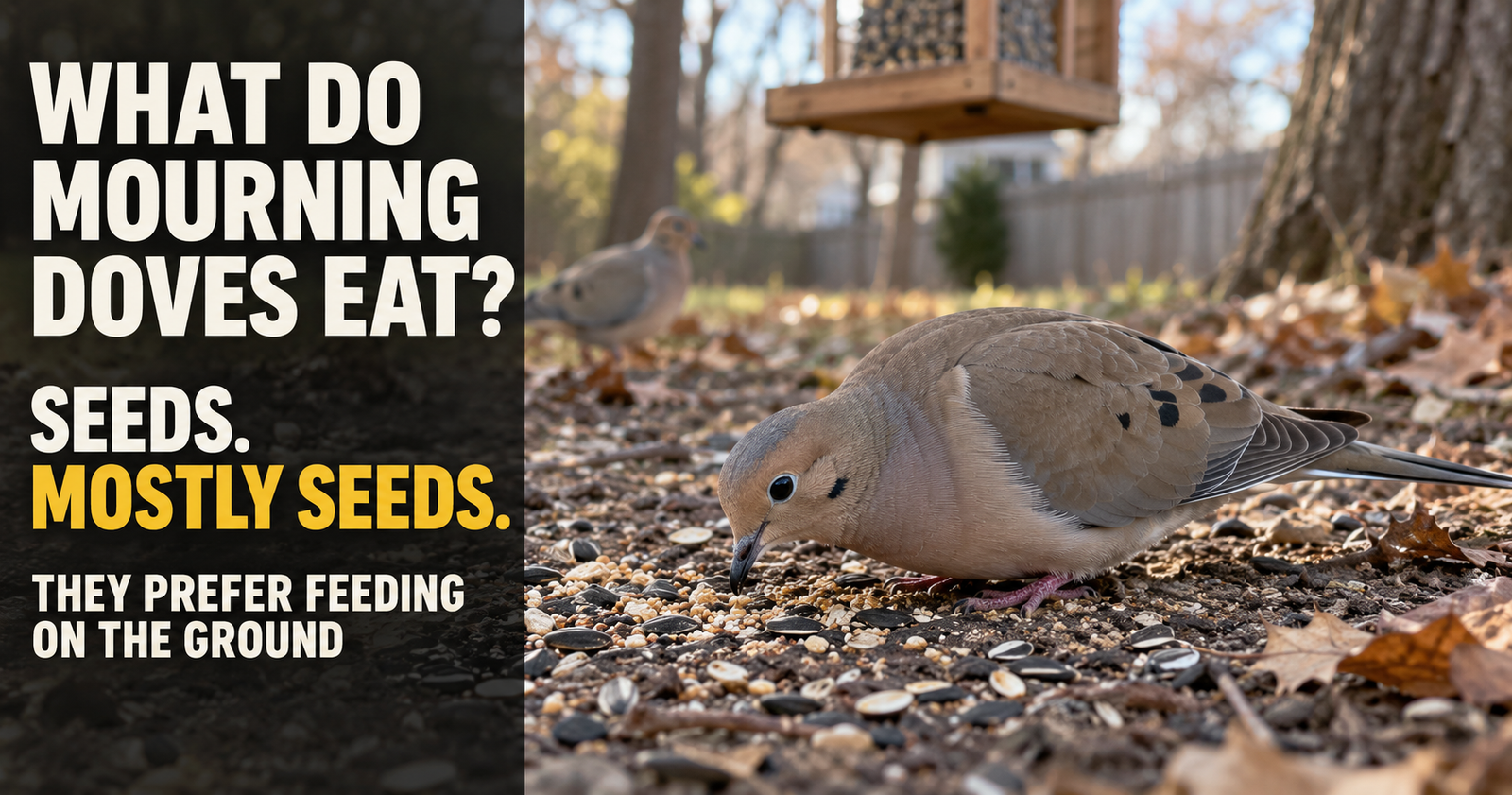
Our guide to what Mourning Doves actually eat explains their seed-heavy diet and the strange reason they can seem to vacuum seeds off the ground so quickly.
Start with a good seed.
Then watch what disappears.
A Little Seed Can Tell You More Than a Giant Pile
I wouldn’t dump ten pounds of seed on the ground hoping every Mourning Dove in the county finds it.
Start smaller.
Put out an amount the birds can reasonably use.
Watch which species show up.
Watch which seeds get eaten.
Look at what’s left behind.
If millet disappears and another ingredient accumulates untouched, that’s useful information.
It also keeps old food from building up.
Wet seed sitting on the ground underneath bird droppings isn’t an attraction I’d want to create.
More birdseed isn’t automatically better bird feeding.
Fresh Water Gives Them Another Reason to Stop
Mourning Doves regularly use water.
And if you ever get the chance to watch one drink closely, pay attention.
Doves and pigeons can drink with their bill down in the water rather than repeatedly scooping a little water and tipping the head backward like many other birds.
That means you may see a dove take what looks like a long continuous drink.
MU Extension notes that Mourning Doves need accessible fresh water and commonly use ponds, streams, lakes, puddles, and other available sources.
In a backyard, a clean birdbath can fill that role.
I want shallow, accessible water with enough open space around it that a ground-oriented bird isn’t stepping directly into an ambush.
Don’t Hide the Birdbath in Thick Plants
Putting a beautiful birdbath deep inside thick landscaping might look good to us.
I’d think about the dove.
A bird drinking at ground level has its head down.
That’s a vulnerable position.
I want it to be able to look up and see what’s happening around the water.
Nearby trees and shrubs can provide escape cover.
But dense vegetation pressed directly against the bath can give predators somewhere to hide.
This is especially important anywhere outdoor cats are common.
Cornell specifically warns that Mourning Doves spend considerable time on the ground and are particularly vulnerable to prowling cats.
Outdoor Cats Can Undo Everything Else You Get Right
You can offer perfect millet.
Perfect water.
Perfect open ground.
And a perfect platform feeder.
If a cat is regularly crouched underneath the shrubs beside it, Mourning Doves have a pretty good reason not to relax there.
Keep your own cats indoors.
If neighborhood cats visit, pay attention to where they hide and approach the feeding area.
I wouldn’t intentionally create a ground-feeding station directly beside a perfect cat ambush point.
Mourning Doves spend a lot of time on the ground because that’s how they’re built to feed.
Unfortunately, that also puts them exactly where terrestrial predators can reach them.
Give Them Somewhere to Sit Before They Come Down
One thing I notice about Mourning Dove habitat is how often good feeding areas have obvious perches nearby.
Trees.
Bare branches.
Fences.
Utility wires.
Doves can sit above an area before dropping down to feed.
MU Extension’s dove habitat guidance specifically identifies trees, shrubs, and power lines as important roosting and perching sites near feeding areas.
You don’t need to install a telephone wire across your backyard.
But existing open branches, fence rails, and other appropriate perches can make the property more usable.
Sometimes attracting birds is less about adding another product and more about recognizing what you already have.
Oak Trees Aren’t the Big Attraction Here
This is an important difference from our Blue Jay setup.
For Blue Jays, oak trees and acorns are a huge deal.
For Mourning Doves, I’d think more about seed-producing plants and accessible ground beneath them.
Grasses and other seed-producing plants can provide natural food.
Agricultural landscapes can provide grain.
Weedy areas can produce seeds that look worthless to us but are perfectly good dove food.
This is why I wouldn’t make the entire yard sterile and then expect one feeder to replace everything nature used to provide.
Make the Yard Useful for Nesting Too
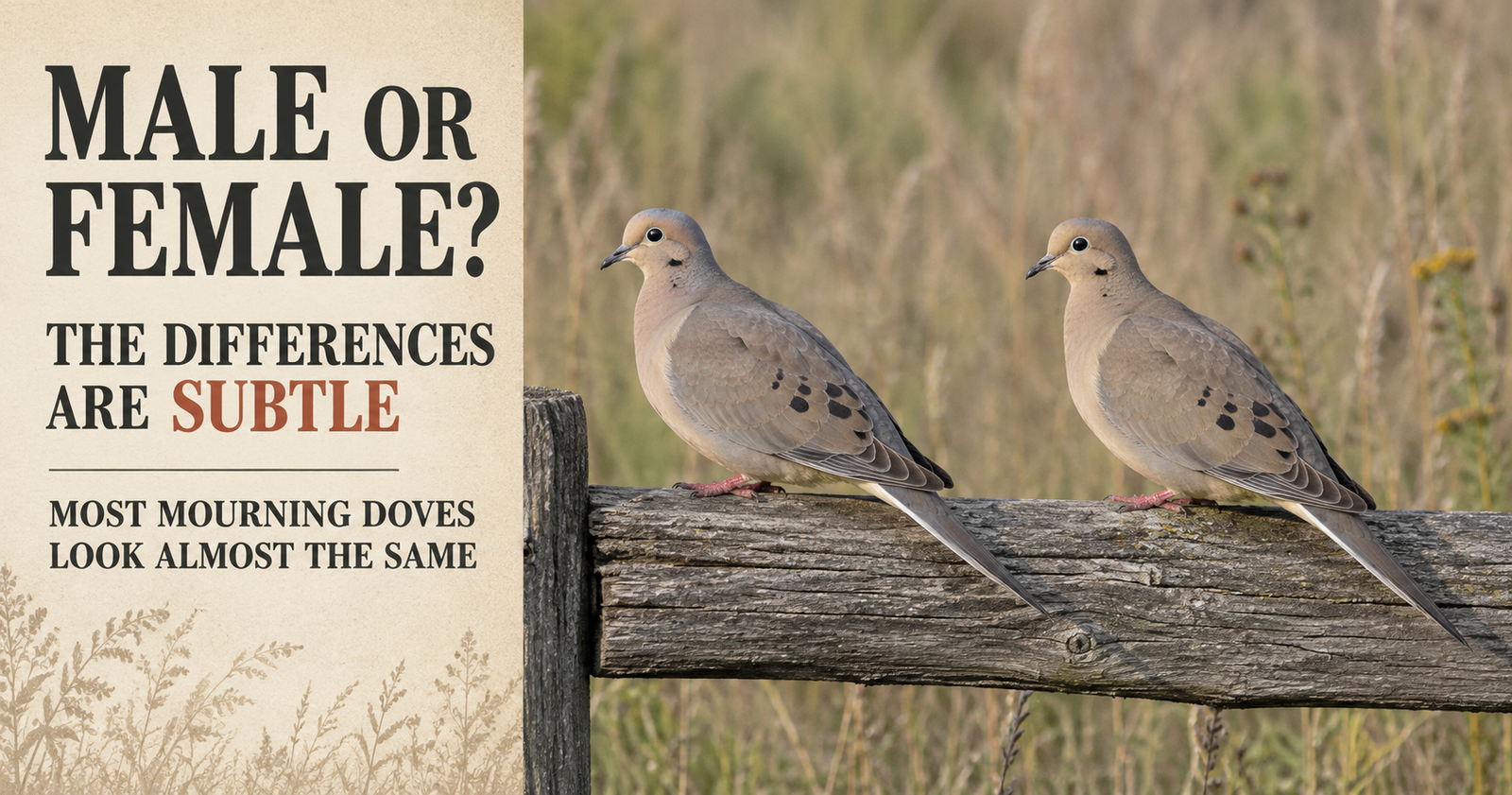
If Mourning Doves already feed around your property, you may eventually get lucky enough to have a pair nest nearby. Once a pair settles nearby, these subtle clues can help you tell male and female Mourning Doves apart.
Cornell recommends dense shrubs and evergreen trees as potential nesting habitat.
Mourning Doves aren’t especially demanding architects.
They build simple open platforms from twigs and stems and can choose some locations that look ridiculous to us.
Trees and shrubs are normal.
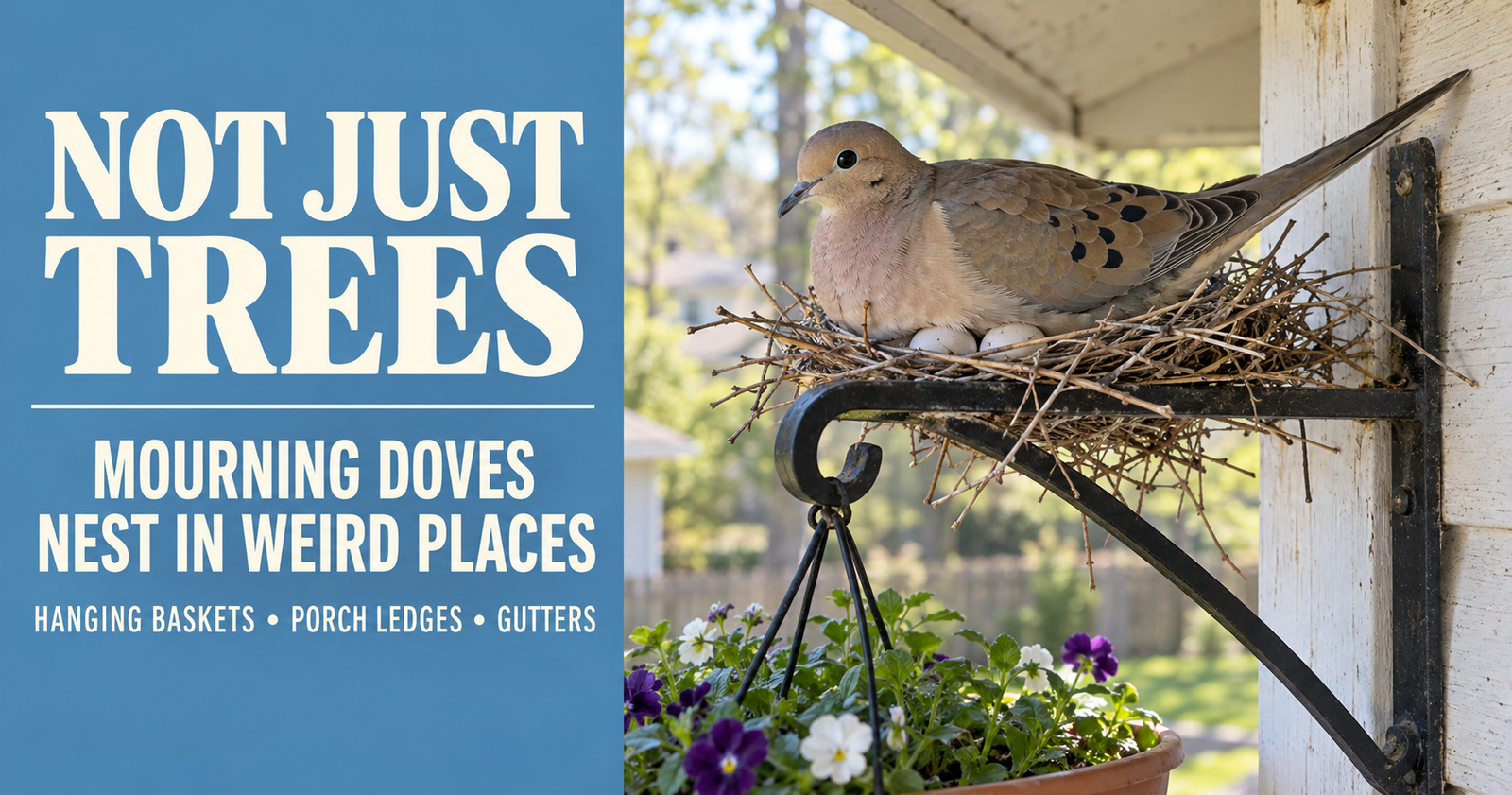
But they may also use gutters, eaves, ledges, abandoned equipment, and other human-made structures.
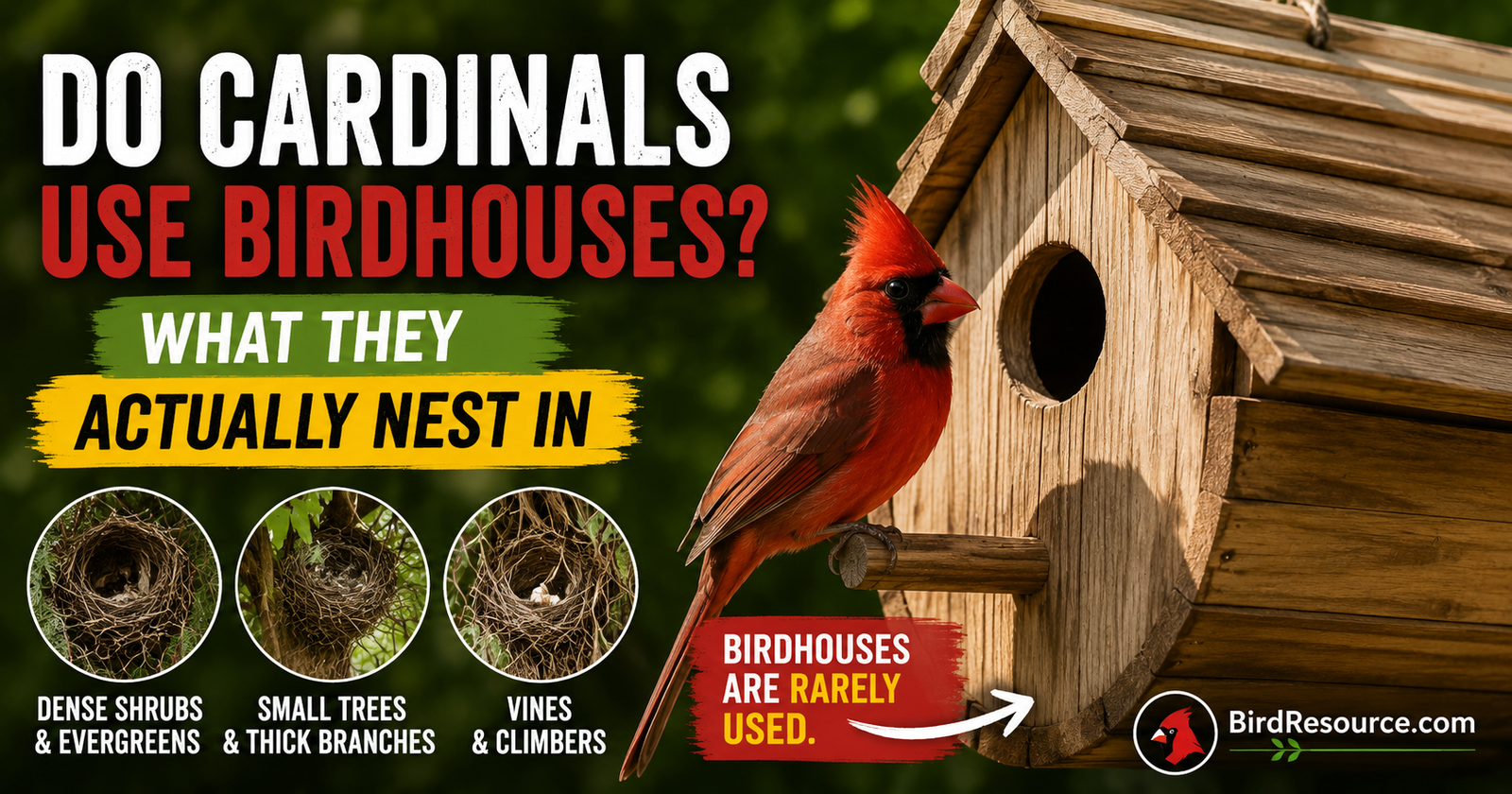
So don’t expect an enclosed birdhouse to be the answer.
We’ll cover nesting separately because attracting a dove to eat and giving a pair somewhere to raise young are related but different goals.
A Nesting Cone Can Be Worth Trying
This is one of the more interesting Mourning Dove-specific additions.
Cornell suggests that people interested in attracting a breeding pair can consider putting up a nesting cone before breeding season.
That’s much more biologically sensible than putting out a traditional enclosed birdhouse and calling it a dove house.
Mourning Doves naturally build open nests.
A nesting cone or open platform supports that style rather than asking the bird to become a cavity nester.
This is also where we’ll eventually have a very natural product article if we find a nesting platform I actually feel comfortable recommending.
Why Aren’t Mourning Doves Coming to My Yard?
If you know they’re around the neighborhood, I’d look at the property from ground level.
Is there appropriate seed?
Can they reach it?
Is there somewhere open enough to feed?
Is a cat patrolling the area?
Is the only bird feeder a tiny hanging tube?
Is there accessible water?
Are there useful perches nearby?
Does the yard provide any shrubs or trees?
The problem may not be that Mourning Doves dislike your yard.
Your yard may simply not be offering food in a way they naturally use.
That’s much easier to fix than trying to somehow “call” Mourning Doves into a property.
What If Mourning Doves Only Eat Under My Feeder?
I’d consider that a success.
Seriously.
Don’t get hung up on making the bird stand on the feeder itself.
If a Mourning Dove appears every morning and cleans up millet underneath your feeder, you’ve attracted a Mourning Dove.
The bird doesn’t care which piece of equipment gets credit.
If you want a cleaner setup, add a platform or ground tray.
But I wouldn’t keep replacing feeders just because the dove prefers eating underneath them.
Its behavior makes perfect sense.
Don’t Keep Moving Everything Around
Once birds begin using a feeding area, I like consistency.
That doesn’t mean you can never change anything.
But if I changed the seed Monday, moved the feeder Tuesday, relocated the birdbath Wednesday, and cut down the nearby shrub Thursday, I’d have no idea which change mattered.
Start with the obvious improvements.
Appropriate seed.
Accessible feeding surface.
Water.
Safety.
Then give the birds time.
Mourning Doves are common birds, but they’re still wild animals making their own decisions.
My Simple Mourning Dove Setup
If I wanted to attract Mourning Doves without turning my yard into a bird-feeding science project, here’s what I’d do.
I’d put millet or another appropriate seed on a wide platform or clean ground-feeding tray.
I’d make sure the surrounding ground wasn’t buried under dense vegetation.
I’d provide a clean, shallow water source.
I’d keep cats away.
I’d preserve useful nearby trees and shrubs.
Then I’d watch.
If the doves already sitting on neighborhood wires start dropping into the yard, I wouldn’t immediately change a thing.
Sometimes simple works because simple matches what the bird was already looking for.
Common Questions About Attracting Mourning Doves
What is the fastest way to attract Mourning Doves?
Offer seed they like, particularly millet, on clean open ground or a broad platform feeder. If Mourning Doves already live nearby, making food easy to access is one of the simplest changes you can make.
What birdseed attracts Mourning Doves?
Millet is an excellent choice. Mourning Doves also eat sunflower seed, cracked corn, grains, and many naturally occurring seeds.
What kind of feeder do Mourning Doves prefer?
Ground feeding and broad platform feeders fit their natural behavior particularly well.
Why won’t Mourning Doves use my hanging feeder?
The feeder may simply be awkward for a large ground-feeding bird. Check underneath it. Your doves may already be eating the seed that falls to the ground.
Do Mourning Doves use birdbaths?
Yes. Mourning Doves need fresh water and can readily use an accessible backyard birdbath.
Should I scatter seed directly on the ground?
You can, but keep the feeding area clean and avoid allowing old wet seed and droppings to accumulate. A low ground tray can provide similar access with easier cleanup.
What plants attract Mourning Doves?
Seed-producing grasses and other plants can provide natural food, while dense shrubs and evergreen trees can provide nesting and shelter opportunities.
Do Mourning Doves use birdhouses?
Not conventional enclosed birdhouses. They’re open-nesting birds. Nesting cones or suitable open platforms are much closer to their natural nesting style.
How do I keep Mourning Doves coming back?
Reliable food helps, but I’d also provide fresh water, safe open feeding space, nearby perches, and useful trees or shrubs. Think about the whole yard rather than one feeder.
If They’re Already on the Power Line, You’re Close
That’s the part I’d remember.
If Mourning Doves are already sitting above your yard, cooing from nearby trees, or walking along the road, you don’t need to somehow convince them to move into the neighborhood.
They’re already there.
You just need to make your yard easier to use.
Put the food where a ground-feeding bird can actually reach it.
Give the dove room to see what’s happening around it.
Keep water available.
Don’t let a cat turn the feeding station into a trap.
And don’t assume the fanciest hanging feeder is automatically the best one.
Sometimes attracting Mourning Doves is as simple as looking underneath the feeder you already own and realizing the birds have been showing you what they wanted all along.
Mason Reed is the Backyard Birding & Habitat Contributor for BirdResource.com, where he helps everyday birdwatchers make their yards more useful to the birds already living around them by paying attention to how those birds actually feed, drink, nest, and behave.