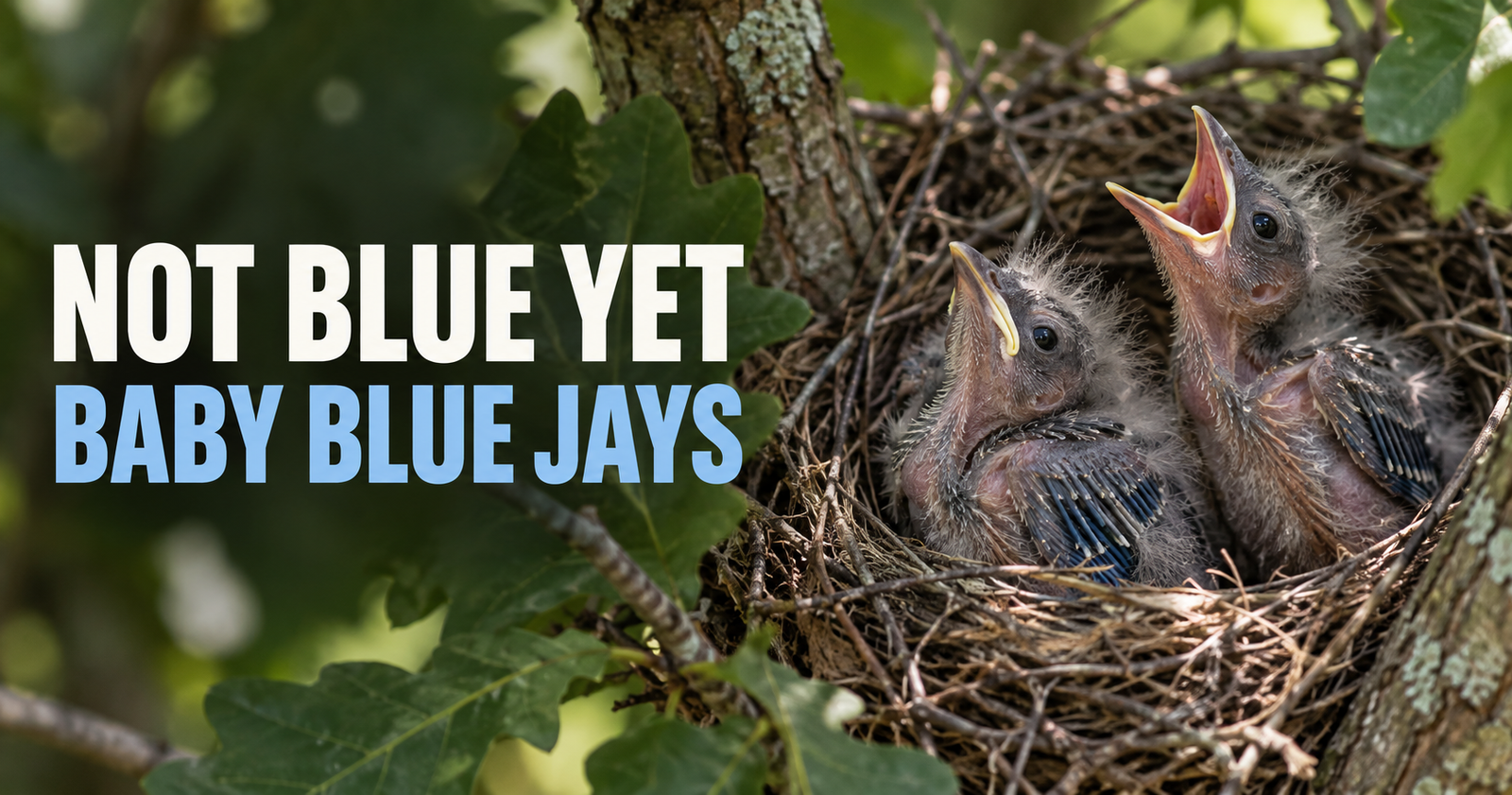
A baby Blue Jay can be surprisingly difficult to identify if you’re expecting a tiny version of the familiar blue-and-white adult.
That’s definitely not what comes out of the egg.
Newly hatched Blue Jays are naked, helpless little birds with closed eyes. Over the next few weeks they change dramatically, eventually becoming feathered youngsters that begin looking much more like the Blue Jays we recognize.
Cornell reports that Blue Jay nestlings remain in the nest for about 17 to 21 days. Even then, leaving the nest doesn’t mean they’re finished growing or suddenly independent. Young Blue Jays normally remain with their parents and continue being fed for at least a month, sometimes as long as two months.
That’s important because one of the most common ways people encounter a baby Blue Jay is outside the nest.
You see a strange young bird sitting on a low branch.
Maybe it’s hopping around the ground.
It doesn’t fly particularly well.
It keeps begging.
And there’s no parent standing beside it.
It can look like an abandoned baby that desperately needs rescuing.
Quite often, it doesn’t.
The first thing I want to figure out is which stage of development the bird has actually reached.
What Does a Newly Hatched Blue Jay Look Like?
A Blue Jay hatchling looks nothing like the adult bird.
Cornell describes newly hatched Blue Jays as naked and helpless, with their eyes closed and a red mouth lining.
There’s no beautiful blue crest.
No bold black necklace.
No long blue tail.
No crisp black-and-white wing pattern.
At this stage, the baby is completely dependent on its parents.
It can’t fly.
It can’t find its own food.
It can’t regulate its life the way an older bird can.
If you find a bird this undeveloped outside the nest, you’re dealing with a very different situation from finding a fully feathered fledgling hopping underneath a tree.
That’s why simply saying “I found a baby Blue Jay” isn’t enough to determine what should happen next.
What Does a Blue Jay Nestling Look Like?
As the baby grows, feathers begin developing and its appearance changes quickly.
A nestling may have a mixture of exposed skin, developing feather shafts, down, and increasingly recognizable feathers depending on its age.
As fledging approaches, the bird becomes substantially feathered and much more obviously jay-like.
But it’s still a nestling while it’s developing inside the nest.
This stage lasts surprisingly little time.
Blue Jays generally spend only about 17 to 21 days as nestlings before leaving the nest.
In roughly three weeks, the bird goes from a naked, closed-eyed hatchling to something capable of leaving the nest and beginning life among the branches.
That’s an incredible amount of development packed into a very short period.

What Does a Fledgling Blue Jay Look Like?
This is the baby Blue Jay you’re most likely to encounter outside the nest.
A fledgling is substantially feathered and can look quite similar to an adult at first glance.
You’ll begin seeing recognizable Blue Jay characteristics:
blue wings and tail,
white and grayish underparts,
dark markings,
a developing crest,
a sturdy jay-like bill,
and the general body shape of an adult.
But something often looks a little off.
The youngster can appear fluffier.
The plumage may not look as crisp.
The tail and overall proportions may seem less polished.
Its behavior can be awkward.
And the mouth can provide another useful clue. Young birds commonly retain visible fleshy gape edges around the base of the bill, particularly when they’re still actively begging.
But the biggest giveaway may not be its appearance at all.
It may be what the bird is doing.
Fledgling Blue Jays Can Look Helpless
This is where people understandably become worried.
You find a feathered young Blue Jay sitting on a branch only a few feet above the ground.
It isn’t flying away.
You walk closer.
Still nothing.
Maybe it hops awkwardly.
Maybe it flutters to another branch.
Maybe it opens its mouth and starts begging.
It can look like something is terribly wrong.
But fledgling birds are beginners.
They’ve left the nest without mastering everything an adult knows how to do.
Flight improves after fledging.
Foraging improves.
Coordination improves.
Their parents continue helping them during this transition.
A fledgling isn’t supposed to behave like an experienced adult Blue Jay on its first day outside the nest.
Baby Blue Jays May Leave the Nest Before You Expect
Blue Jay fledging is particularly interesting because youngsters can begin wandering before the entire brood officially leaves.
Cornell reports that individual nestlings may move as far as about 15 feet from the nest one to three days before the brood fledges.
This creates exactly the situation that causes people to think they’ve found an abandoned bird.
There’s a young jay outside the nest.
It’s begging.
No parent is feeding it at that exact moment.
Surely something went wrong.
Not necessarily.
Cornell specifically notes that parents may withhold food from wandering youngsters until they return toward the nest during this stage.
So the bird that looks abandoned may actually have adventurous-baby syndrome.
It wandered away before Mom and Dad wanted it to.
How Can I Tell a Nestling From a Fledgling Blue Jay?
Look primarily at feather development and mobility.
A nestling is still in the stage where it belongs in the nest. A younger nestling may have exposed skin, sparse feathering, or obvious developing feathers and won’t be capable of normal fledgling movement.
A fledgling is substantially feathered.
It can generally perch, hop, flutter, or make short flights.
It may look awkward, but it’s mobile.
That’s the distinction I care about most when deciding whether a young bird outside the nest may actually need help.
A feathered fledgling sitting underneath a tree is not automatically an emergency.
A nearly naked hatchling lying on the ground is a very different situation.
Why Is a Baby Blue Jay on the Ground?
There are several possibilities.
It may be a normal fledgling that’s still developing its flight skills.
It may have fluttered down from a low branch.
It may be moving through the area while its parents remain nearby.
Or a younger bird may genuinely have fallen or left the nest prematurely.
This is why I’d look at the bird rather than simply looking at its location.
Ground = abandoned isn’t a reliable rule.
If the youngster is substantially feathered, alert, able to stand or hop, and otherwise behaving like a fledgling, its parents may still be caring for it.
Give the family space before deciding intervention is necessary.
Why Won’t the Baby Blue Jay Fly Away From Me?
Because it may not be very good at flying yet.
A fledgling has reached the developmental stage where leaving the nest is normal, but that doesn’t mean it has adult-level flight skills.
Imagine learning to walk and immediately being expected to run through an obstacle course.
That’s roughly the problem.
The bird needs practice.
Short flights become longer.
Landings improve.
Balance improves.
Its ability to navigate branches develops.
A young bird remaining relatively still while you approach isn’t necessarily tame or injured.
It may simply have limited options.
That’s another reason I wouldn’t walk right up to a healthy fledgling just to see how close it lets me get.
Do Parent Blue Jays Stay With Their Babies?
Absolutely.
Blue Jay family bonds continue well beyond the nest.
Cornell reports that young Blue Jays remain with and continue receiving food from their parents for at least a month after fledging and sometimes for two months.
That’s a long period of continued parental care.
So the young bird outside your window isn’t suddenly expected to figure everything out alone because it left the nest yesterday.
Mom and Dad are still involved.
They may be finding food.
Watching from nearby.
Calling.
Moving among several youngsters.
Or waiting for you to leave before approaching.
That’s why I don’t judge abandonment based on a five-minute observation.
Why Don’t I See the Parents?
Because you’re looking at one small moment in the bird’s day.
The parents aren’t required to sit beside their youngster continuously.
They’re finding food.
Watching for danger.
Moving among young birds.
And sometimes they’re waiting for you to move away.
Standing six feet from a fledgling while wondering why Mom hasn’t returned can create the exact situation you’re worried about.
Back away.
Give the bird some space.
Watch from farther away.
You may suddenly discover that the parents were nearby the entire time.
What Do Baby Blue Jays Eat?
Young Blue Jays receive food from their parents.
Their diet can include insects and other foods appropriate to their developmental needs.
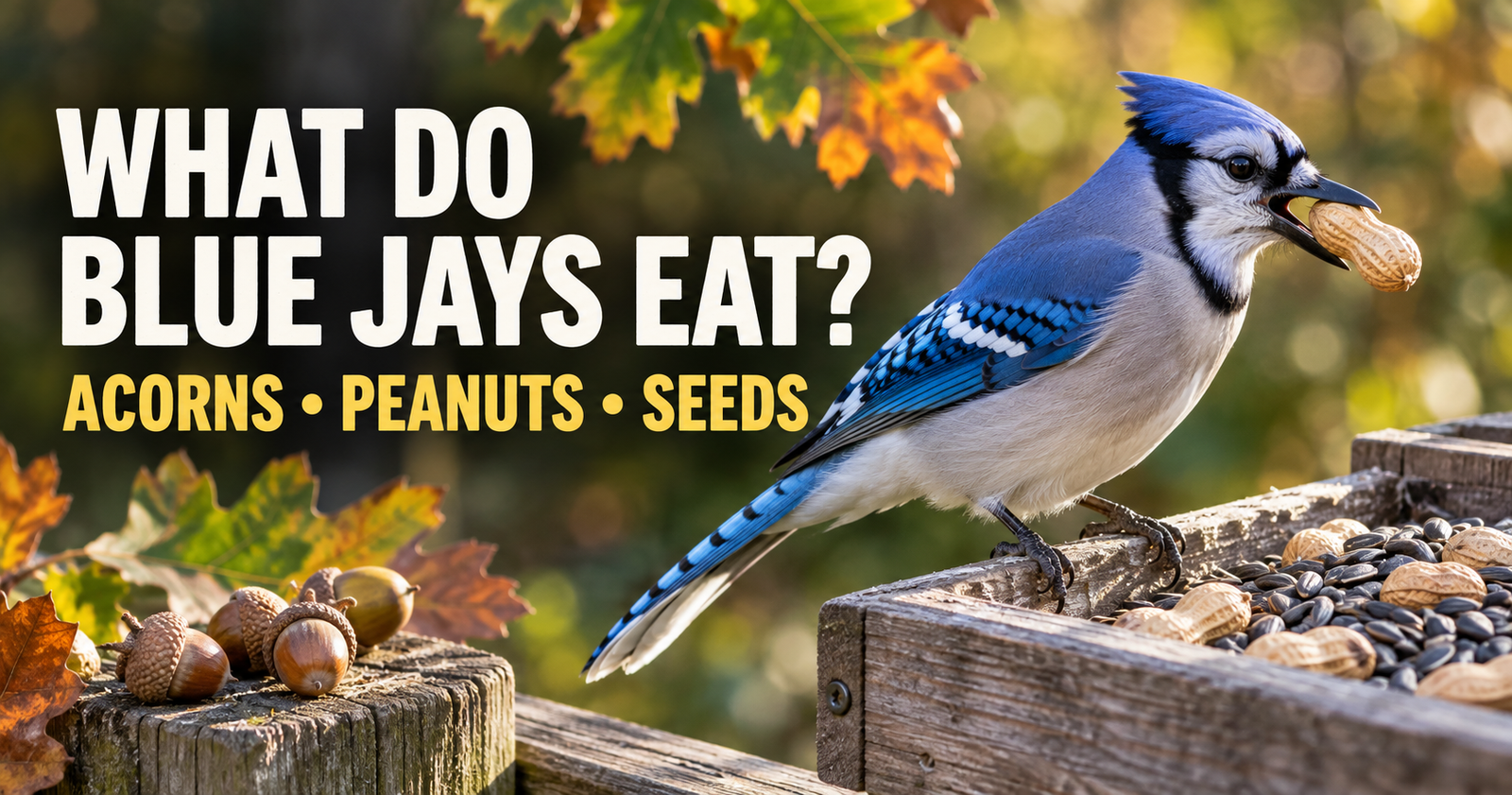
Adult Blue Jays have an extremely broad diet containing acorns, nuts, seeds, fruits, grains, insects, and other foods, but a newly fledged bird isn’t simply expected to fly over to the feeder and live on peanuts.
The parents handle food delivery while the youngster gradually develops its own foraging skills.
That’s another reason I don’t recommend trying to improvise a baby-jay diet in the kitchen.
The parents already know what they’re doing.
Do Both Blue Jay Parents Feed Their Babies?
Yes.
Both parents participate in raising the young, although their roles change throughout the nesting cycle.
Only the female incubates the eggs.
During incubation, the male brings her food.
For approximately the first 8 to 12 days after hatching, Cornell reports that the female broods the nestlings while the male supplies food for both her and the babies. After that, the female begins gathering more food too, although the male continues providing a substantial amount.
So raising Blue Jays is very much a family operation.
That’s one reason watching an active nest from a respectful distance can be so fascinating.
Why Is a Baby Blue Jay Begging Constantly?
Because begging works.
Young birds use begging behavior to communicate their demand for food.
That can include vocalizations, body movements, and opening the mouth toward a parent.
A begging fledgling isn’t automatically starving.
It may simply be behaving exactly like a growing Blue Jay behaves when a parent appears.
And Blue Jays aren’t exactly famous for being quiet adults.
Their youngsters aren’t necessarily going to whisper politely either.
If a young jay appears otherwise healthy and parents are still visiting, begging is part of normal family life.
What Does a Juvenile Blue Jay Look Like?
As the fledgling matures, it increasingly resembles an adult.
The recognizable Blue Jay pattern becomes much clearer.
You’ll see the familiar combination of:
blue upperparts,
white and grayish underparts,
black markings,
barred wings,
blue tail,
and crest.
At this stage, behavior and subtle plumage characteristics may still reveal immaturity, but you’re no longer looking at something that appears dramatically different from an adult.
This is one reason people sometimes don’t realize they’re watching a young Blue Jay.
It already looks surprisingly convincing.
Then it starts begging from an adult standing beside it.
That gives the game away.
Is a Small Blue Jay Always a Baby?
No.
Size can fool you.
Distance can fool you.
Posture can fool you.
Feathers can fool you.
Male and female Blue Jays also overlap heavily in size, so a slightly smaller-looking bird isn’t automatically female or juvenile.
Instead, look at the complete picture.
Plumage.
Feather development.
Bill and gape.
Tail.
Behavior.
Interaction with adults.
Begging.
Flight ability.
Those clues together are much more useful than simply deciding the smallest jay must be the baby.
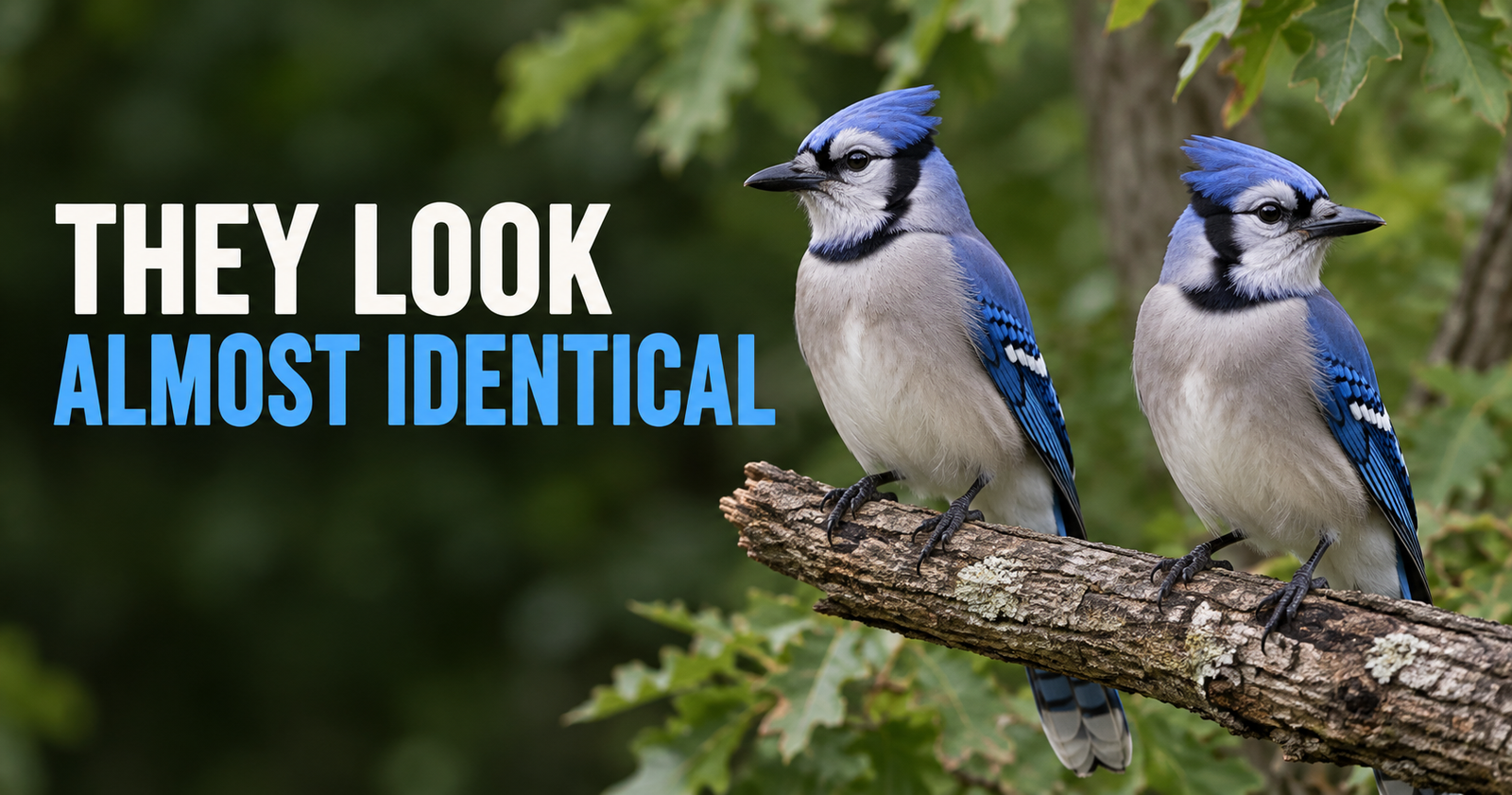
If you’re trying to separate adult sexes instead, our male vs female Blue Jay guide explains why appearance alone usually isn’t enough.
Can Baby Blue Jays Have a Crest?
Yes, young Blue Jays develop the characteristic crest as they feather out.
But don’t expect every youngster to look exactly like the dramatic adult illustrations you see online.
Blue Jays can raise and lower their crests.
Even adults can flatten the crest enough that their head shape changes considerably.
So crest size alone isn’t a reliable age test.
Use it as one clue among many.
Why Does a Baby Blue Jay Look Gray?
Young plumage can look softer and less striking than the crisp appearance of a mature adult.
Lighting makes an enormous difference too.
Remember that Blue Jay blue is structural coloration.
Cornell explains that the actual pigment in Blue Jay feathers is melanin, which is brown. Microscopic feather structures scatter light in a way that creates the blue appearance we see.
Change the light and those feathers can look surprisingly dull.
So a grayish-looking young bird isn’t automatically unhealthy or a different species.
Baby Blue Jay vs Adult Blue Jay
An adult usually has a much more finished appearance.
The plumage looks crisp.
The tail is fully developed.
Flight is strong.
Movements are confident.
The bird feeds independently.
A fledgling may look fluffier and less coordinated and may continue begging from nearby adults.
Behavior is one of my favorite clues.
If the “adult-looking” Blue Jay suddenly begins fluttering its wings and begging another Blue Jay for food, you’ve probably found your youngster.
Baby Blue Jay vs Bluebird
These are completely different birds.
A young Blue Jay will eventually develop the large-bodied, crested appearance associated with jays.
An Eastern Bluebird is much smaller and belongs to the thrush family.
Their nesting behavior differs dramatically too.
Blue Jays build open-cup nests in trees.
Bluebirds are cavity nesters and readily use appropriately designed nest boxes.
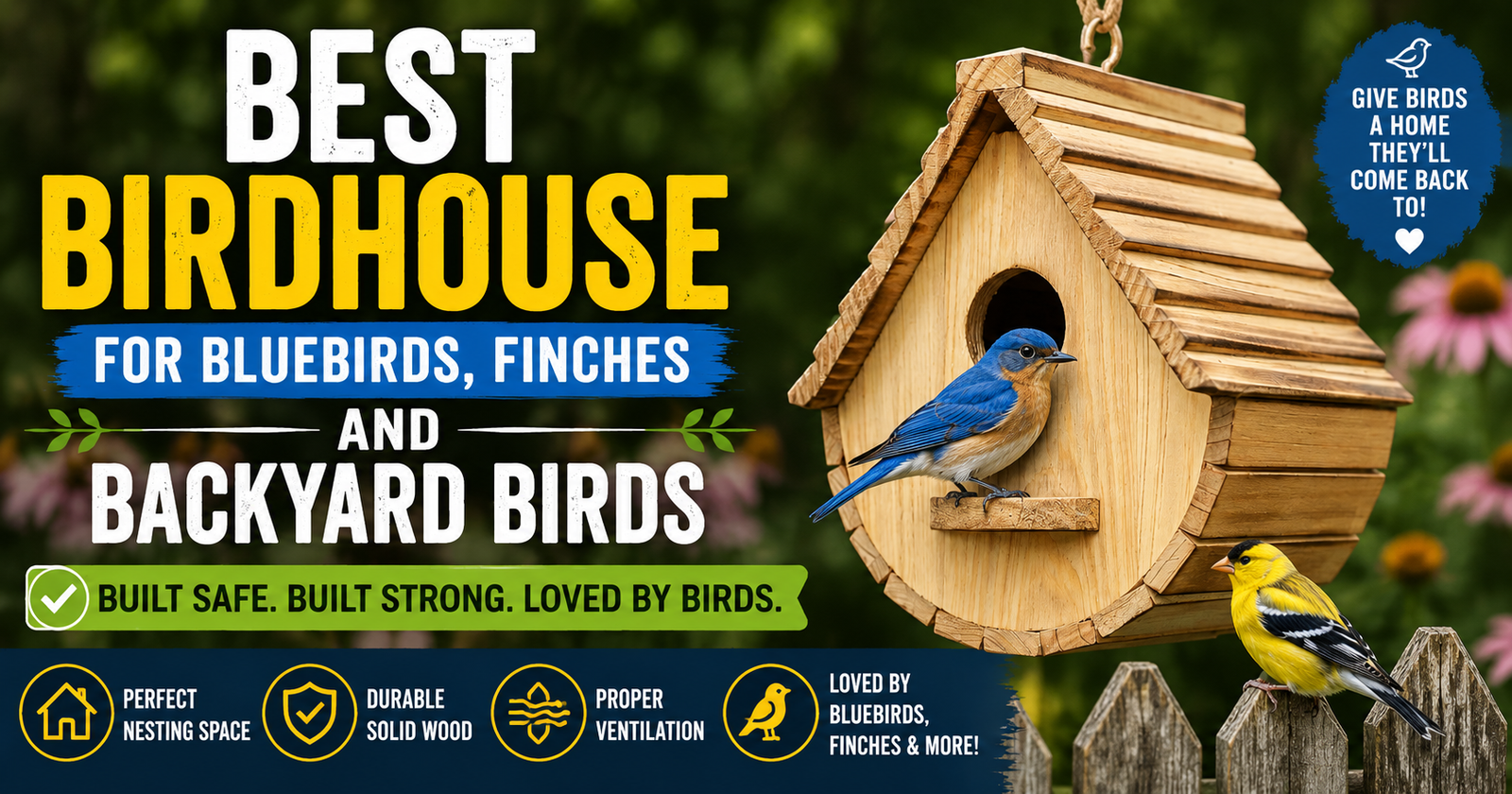
That’s why the wooden birdhouse guide for bluebirds and other backyard birds applies much more naturally to bluebirds than Blue Jays.
The word blue in both names doesn’t make them closely related.
Baby Blue Jay vs Scrub-Jay
Location becomes especially useful here.
Several North American jay species have blue plumage.
Scrub-jays lack the prominent crest associated with Blue Jays and have different plumage patterns.
But a young bird can make identification harder because juvenile plumage and awkward proportions may obscure the features you’re expecting.
Look at:
geographic range,
crest,
wing pattern,
tail,
body shape,
adult birds nearby,
and vocalizations.
If the youngster is repeatedly being fed by unmistakable adult Blue Jays, that’s a pretty strong clue.
Should I Put a Baby Blue Jay Back in the Nest?
It depends entirely on its developmental stage.
A healthy fledgling that has naturally left the nest usually shouldn’t be stuffed back inside simply because it looks young.
It may come right back out.
A much younger nestling that has fallen prematurely is different.
Cornell specifically notes that Blue Jay nestlings sometimes wander away shortly before normal fledging and that parents may resume feeding when the youngster is restored to or near the nest.
So first identify what you’re dealing with.
Don’t make the rescue decision before making the age decision.
Will Blue Jays Abandon a Baby If I Touch It?
The old idea that parent birds automatically abandon a baby because a human touched it isn’t a good reason to leave a genuinely displaced nestling in danger.
But that doesn’t mean you should handle healthy young birds unnecessarily.
If a fledgling is exactly where it belongs, leave it alone.
If a nestling genuinely needs to be returned to a reachable nest, brief necessary handling isn’t automatically going to make its parents reject it.
The goal should always be minimum necessary intervention.
What If I Can’t Reach the Nest?
If you’re dealing with a true nestling rather than a fledgling and can’t safely return it, that’s when I’d seek advice from a licensed wildlife rehabilitator.
Don’t climb dangerously high into a tree.
Don’t improvise a long-term pet bird situation.
And don’t start force-feeding random foods.
Professional wildlife rehabilitators deal with exactly these situations and can tell you what makes sense based on the bird’s condition and circumstances.
When Does a Baby Blue Jay Actually Need Help?
A young Blue Jay deserves more concern if it has an obvious injury, is bleeding, cannot stand, appears severely weak, has been attacked by a cat, or is clearly an underdeveloped nestling outside the nest.
A healthy feathered fledgling hopping around near its parents is different.
That’s why I keep coming back to the same question:
Nestling or fledgling?
Getting that right prevents a lot of unnecessary rescues.
What If a Cat Caught the Baby Blue Jay?
Take that seriously.
A bird can have injuries that aren’t immediately obvious after contact with a cat.
This isn’t a situation where I’d simply put the youngster back underneath the tree and assume everything is fine because I don’t see blood.
Keep the bird away from the cat and contact a licensed wildlife rehabilitator for guidance.
And if fledglings are active around your yard, keep cats indoors and dogs controlled around the area.
Young birds are especially vulnerable during those first days outside the nest.
Should I Feed a Baby Blue Jay?
Normally, no.
If the bird is a healthy fledgling, its parents should be feeding it.
If it’s injured or genuinely orphaned, a wildlife rehabilitator should guide its care.
Improvised feeding can cause problems.
Don’t assume that because adult Blue Jays love peanuts, a tiny baby should have peanuts pushed into its mouth.
Developmental needs differ.
The safest food delivery system for a healthy baby Blue Jay is the one nature already provided:
its parents.
Should I Give a Baby Blue Jay Water?
Don’t pour water into a young bird’s mouth.
Bird anatomy makes improper water administration dangerous.
A healthy fledgling receiving normal parental care doesn’t need you attempting to hydrate it manually.
If a bird appears dehydrated, injured, or genuinely orphaned, that’s another reason to contact a wildlife rehabilitator rather than improvising treatment.
Do Baby Blue Jays Return to the Nest After Fledging?
Once Blue Jays have properly fledged, I wouldn’t expect them to return to the nest and continue living there.
The nest has done its job.
Cornell reports that Blue Jay broods generally leave when the young are around 17 to 21 days old. By the end of their second day outside the nest, the youngsters are usually already more than 75 feet away.
That’s a pretty fast transition.
But there’s an important wrinkle with Blue Jays.
Young jays sometimes begin wandering away from the nest one to three days before the entire brood actually fledges.
Cornell reports that these adventurous youngsters may travel as far as 15 feet from the nest. They can beg loudly and look abandoned, but their parents may actually be waiting for them to return to the nest before feeding them.
That’s very different from a fully fledged young Blue Jay that has legitimately left the nest.
So before trying to put a young jay back, you need to determine what stage you’re actually seeing.
What If a Baby Blue Jay Leaves the Nest Too Early?
This is one of the situations where returning the youngster to or near the nest may sometimes be appropriate.
Cornell specifically notes that young Blue Jays can wander before normal fledging age and appear abandoned. If one of these premature wanderers can be restored to or near the nest, the parents can resume feeding it.
But that doesn’t mean every young Blue Jay found outside a nest should be put back.
A normally fledged bird is different.
Cornell’s NestWatch recommends leaving a healthy, fully feathered fledgling alone because its parents are likely nearby and continuing to care for it.
So I’d look at the bird before doing anything.
Is it fully feathered?
Alert?
Able to hop?
Able to perch?
Able to make short flights?
Those characteristics point much more toward a fledgling.
A sparsely feathered, poorly developed youngster that can’t effectively move or perch is much more likely to be a nestling.
Why Is a Baby Blue Jay Sitting on the Ground?
Because fledgling birds aren’t immediately excellent flyers.
This is probably one of the most important things to understand before trying to rescue one.
A young Blue Jay can leave the nest and still be awkward.
It may hop.
Flutter.
Climb onto low branches.
Sit quietly in vegetation.
Spend time on or near the ground.
Cornell’s NestWatch specifically warns that fledglings often appear helpless even though they’re behaving normally. Their parents remain nearby and continue feeding them.
So:
young bird + ground = emergency
isn’t a reliable rule.
Look at the bird’s condition and developmental stage.
How Long Do Blue Jay Parents Feed Their Babies After Fledging?
This is where Blue Jays really stand out.
Parental care continues for quite a while.
Cornell reports that young Blue Jays remain with and are fed by their parents for at least a month after leaving the nest, and sometimes for as long as two months. There’s considerable variation in how quickly individual youngsters become independent.
That’s much longer than someone might assume after seeing a nearly adult-sized young jay flying around.
The bird can look pretty capable and still be dependent on Mom and Dad.
Flight isn’t the same as independence.
A young Blue Jay still has to learn where to find food, how to recognize danger, how to interact with other jays, and how to function as a wild bird.
That takes time.
Do Both Blue Jay Parents Care for Fledglings?
Yes.
Blue Jays have strong family bonds, and parental care doesn’t suddenly stop when the youngsters leave the nest.
Both parents participate in raising the brood.
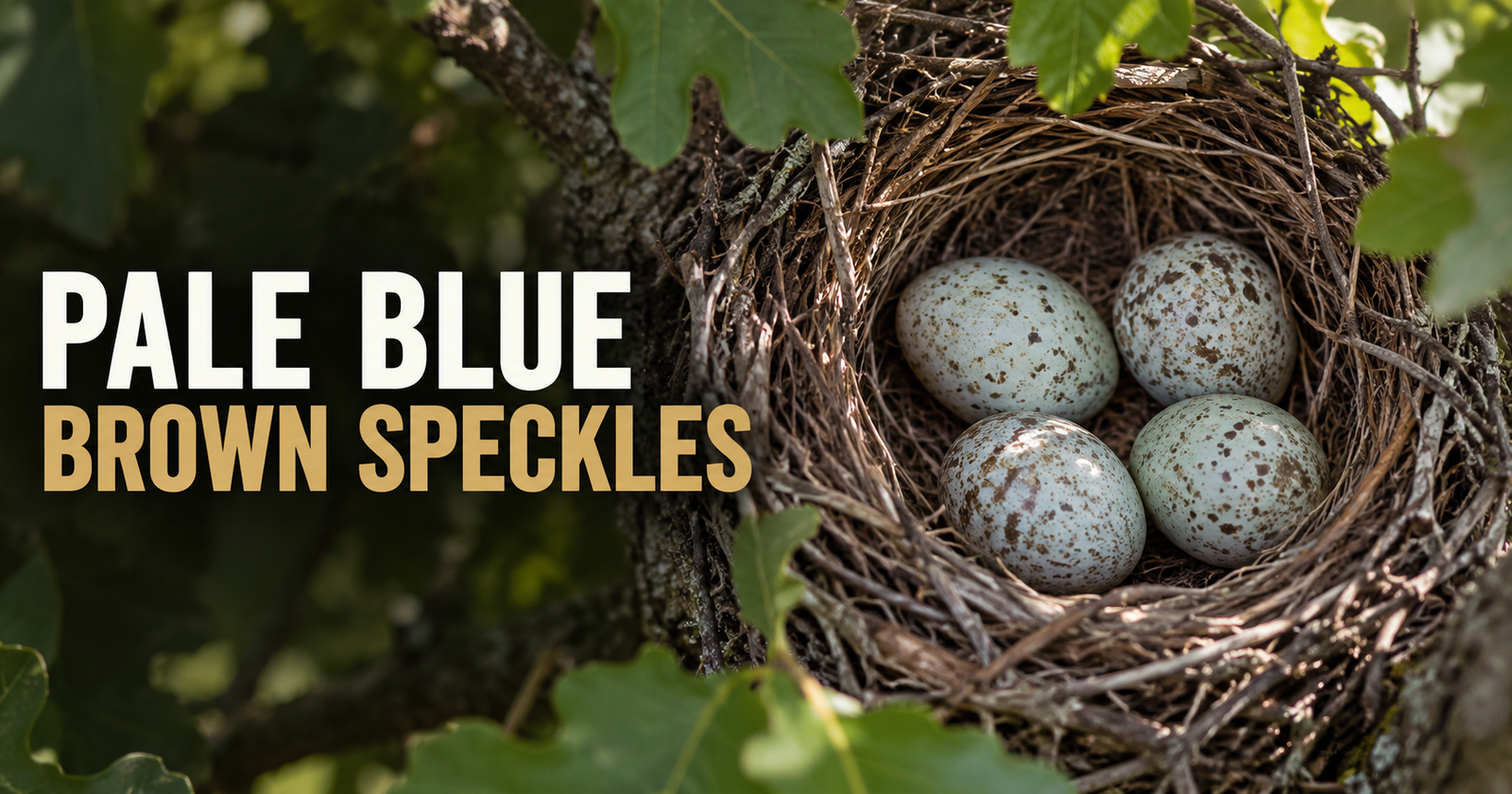
Earlier in the nesting cycle, the female incubates while the male supplies food. After the babies hatch, both parents eventually participate in food gathering, although Cornell notes that the male can continue providing more food than the female. For the earlier stage of that cycle, the Blue Jay egg and nest clues guide explains what readers may see before hatching.
After fledging, the family can remain together while the young continue developing.
So if you see several slightly awkward Blue Jays following adults through the trees, you may be watching an entire family group.
Why Is a Baby Blue Jay Following an Adult Everywhere?
Food is probably a major reason.
Young birds learn very quickly that parents mean meals.
A fledgling may follow an adult, beg, flutter its wings, vocalize, and generally make itself difficult to ignore.
That doesn’t mean the youngster can’t fly.
It means it isn’t completely self-sufficient yet.
This is also why I wouldn’t assume a nearly full-sized Blue Jay begging from another jay must be sick.
Juvenile birds can reach a surprisingly adult-like size while still behaving very much like babies.
Sometimes behavior gives away age better than body size.
What Does a Fledgling Blue Jay Sound Like?
Young Blue Jays can be noisy beggars.
That’s another reason people notice them.
You may hear repeated calls while the youngster follows parents or waits for food.
And because Blue Jays are already an extremely vocal species, a family group can make a yard considerably louder.
Don’t interpret repeated begging as proof that the parents disappeared.
The youngster is communicating.
Its parents may be nearby collecting food or tending another sibling.
If you stand directly beside the fledgling waiting to see whether an adult returns, you may actually discourage the parents from approaching.
Give them room.
How Can I Tell If a Baby Blue Jay Is Really Abandoned?
This is much harder than simply waiting five minutes and deciding Mom isn’t coming back.
Parents don’t remain beside fledglings every second.
They have to find food.
They may have several young birds scattered around.
They may also hesitate to approach while you’re standing close.
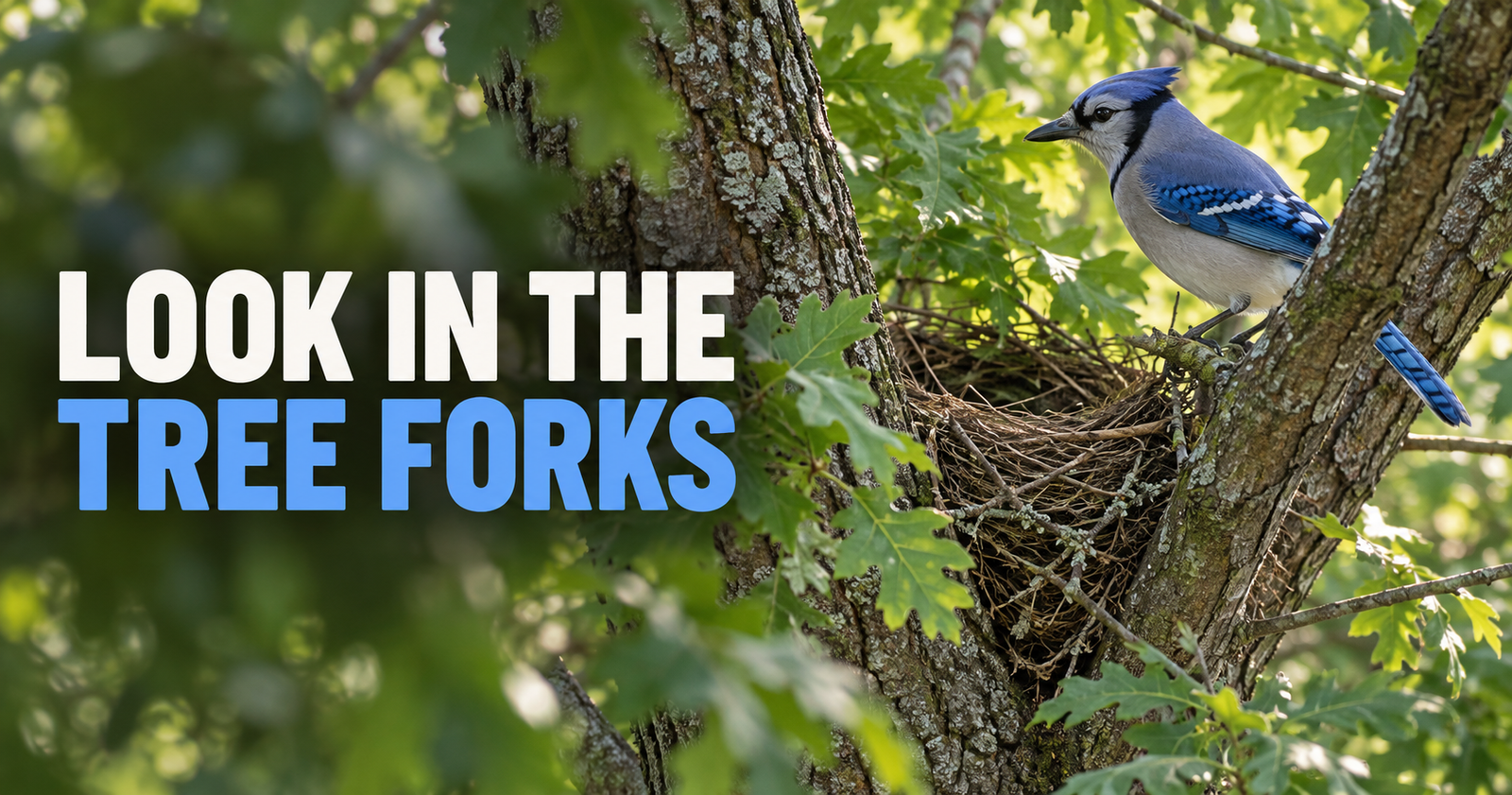
Cornell’s NestWatch recommends watching from a distance rather than hovering near a young bird because your presence can prevent the parents from returning.
If the fledgling is healthy, alert, fully feathered, and moving normally, I’d give the family space.
True abandonment is much less common than people think.
When Does a Baby Blue Jay Actually Need Help?
There are situations where intervention is appropriate.
A bird with an obvious serious injury needs help.
A youngster known to have been attacked by a cat needs professional attention.
A very young nestling that has fallen prematurely may need to be returned to the nest when that’s safely possible.
A bird that’s weak, unable to stand, or clearly injured should be evaluated by a licensed wildlife rehabilitator.
But a healthy fledgling sitting underneath a tree usually doesn’t need to be taken home.
Cornell’s NestWatch specifically recommends leaving fledglings alone and contacting a federally certified wildlife rehabilitator or wildlife veterinarian when a young bird is genuinely injured.
Should I Feed a Baby Blue Jay I Found?
No.
I wouldn’t try to become its parent.
Young birds have specific nutritional requirements, and feeding the wrong food can cause serious problems.
Cornell’s NestWatch specifically advises against trying to feed a found baby bird yourself.
That includes all the homemade rescue foods people suggest online.
Bread.
Milk.
Crackers.
Random birdseed.
Pet food shoved into its mouth.
None of those should be your automatic response.
If the bird is a healthy fledgling, its parents should feed it.
If it’s genuinely injured or orphaned, contact a wildlife rehabilitator.
Should I Give a Baby Blue Jay Water?
Don’t pour water into its mouth.
Cornell’s NestWatch specifically warns against force-feeding water to young birds. Young birds normally receive the moisture they need through the food provided by their parents.
Trying to drip or pour water into a bird’s mouth can create additional problems.
Again, this is where doing less is often better.
Healthy fledgling?
Leave it with its parents.
Injured bird?
Contact a professional.
What If My Cat Caught a Baby Blue Jay?
That changes the situation.
A bird that’s been caught by a cat may have injuries you can’t easily see.
Don’t assume everything is fine simply because the bird flies a short distance afterward or isn’t visibly bleeding.
Contact a licensed wildlife rehabilitator for guidance.
And if fledgling birds are active around your property, keep cats indoors and dogs controlled around the area.
Fledglings already have limited flight skills.
They don’t need an additional predator waiting underneath the tree.
Will Blue Jay Parents Reject a Baby If I Touch It?
No, the old idea that parent birds automatically abandon babies because they smell human scent is a myth.
Cornell’s NestWatch specifically addresses this and notes that parent birds don’t recognize their young by human scent in that way.
That doesn’t mean you should handle fledglings for fun.
Leave healthy birds alone.
But if a true nestling has fallen and needs to be returned to a reachable nest, briefly handling it isn’t going to make the parents reject it because you touched it.
Should I Move a Fledgling Blue Jay Somewhere Safer?
Usually, I’d leave it where it is.
If there’s an immediate danger, such as the bird sitting directly in a road or another obviously hazardous spot, a very short move to nearby cover may sometimes make sense.
But don’t carry it across the neighborhood because another tree looks nicer.
Its parents know where the youngster is.
Keeping the bird in the immediate area makes it easier for the family to remain connected.
If there’s no immediate danger, let the parents handle it.
Can I Move a Blue Jay Nest?
Not if it’s active.
Cornell’s NestWatch advises leaving active nests containing eggs or young where they are until the birds have fledged. Moving even an active nest a short distance can cause serious problems because the adults expect the nest to remain where they left it.
Active native bird nests are also protected under federal law in the United States.
So if Blue Jays build somewhere inconvenient, the best solution is usually patience.
The nesting period doesn’t last forever.
Don’t Approach a Blue Jay Nest Right Before Fledging
This is particularly important.
Young birds close to fledging can leave prematurely when frightened.
Cornell’s NestWatch specifically recommends avoiding close nest checks once youngsters are fully feathered and approaching the expected fledging period.
Imagine spending weeks watching a Blue Jay nest only to accidentally cause the babies to scatter because you wanted one more close photograph.
That’s exactly what we don’t want.
As the young get older, observe from farther away.
How Long Until a Young Blue Jay Is Independent?
There’s no single day when a young Blue Jay suddenly switches from dependent baby to completely independent adult.
It’s gradual.
Cornell reports parental feeding for at least a month after fledging and sometimes up to two months.
During that period, the youngster becomes increasingly capable.
Flight improves.
Foraging improves.
It learns where food is found.
It learns how to interact with other jays.
Parental feeding gradually becomes less important.
Eventually, that noisy fledgling following Mom and Dad around is functioning on its own.
Do Young Blue Jays Stay With Their Family?
For a while, yes.
Blue Jays have notably strong family bonds, and the young remain associated with their parents after leaving the nest.
That’s one reason you may see multiple Blue Jays moving together later in the season.
Not every group of jays is necessarily a family, but parents and their recently fledged youngsters can remain associated while the young continue developing.
Once you know what juvenile behavior looks like, these family groups become much easier to recognize.
When Do Juvenile Blue Jays Start Eating on Their Own?
Independence develops gradually after fledging.
Young Blue Jays begin learning to find and handle food while they’re still receiving parental help.
You may see a juvenile investigating foods on its own and then turn around and beg from a parent minutes later.
That’s normal.
Learning to forage doesn’t mean parental feeding immediately stops.
Eventually, the youngster becomes capable of finding enough food without Mom and Dad supplying meals.
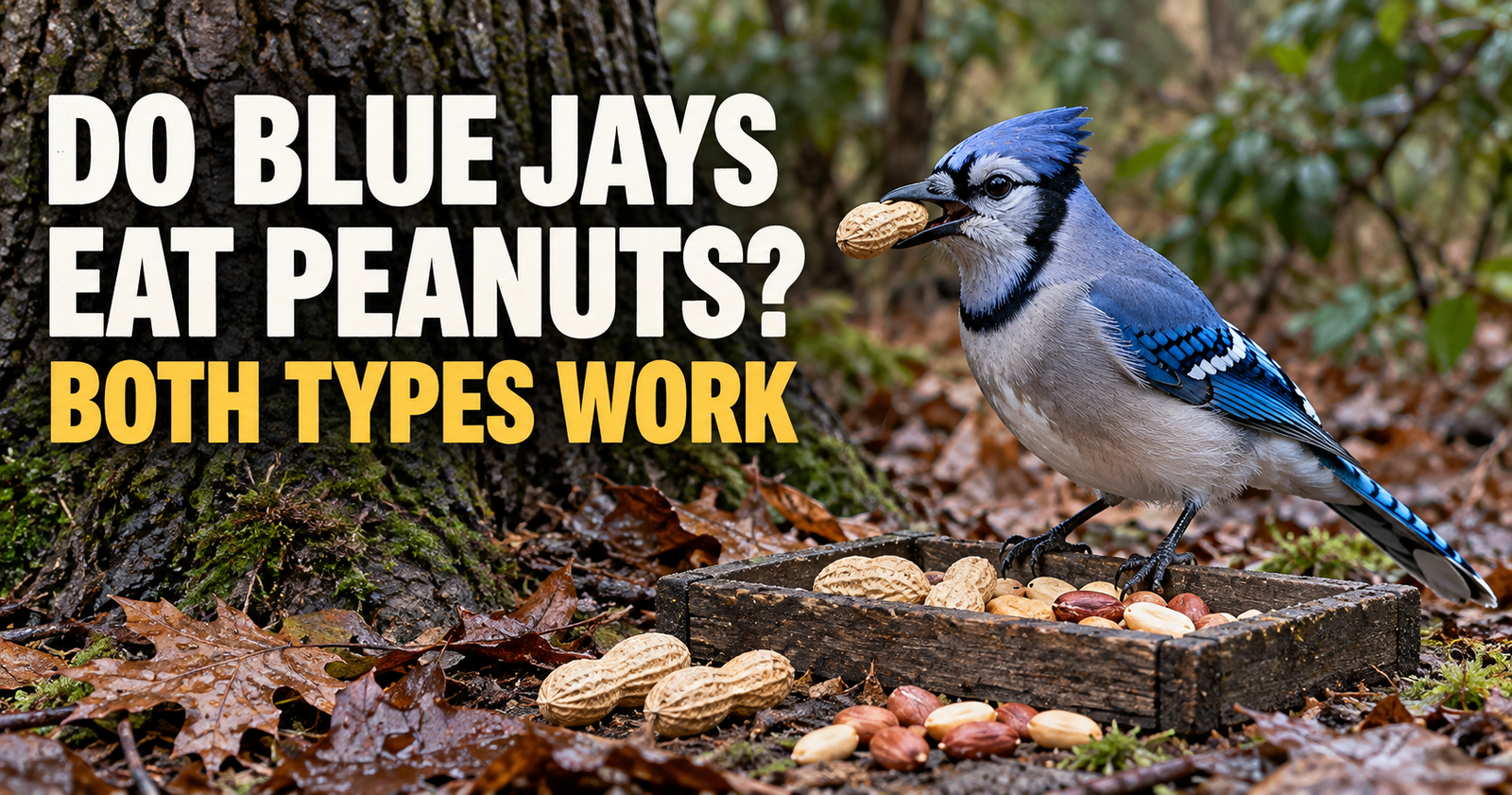
Do Baby Blue Jays Eat Peanuts?
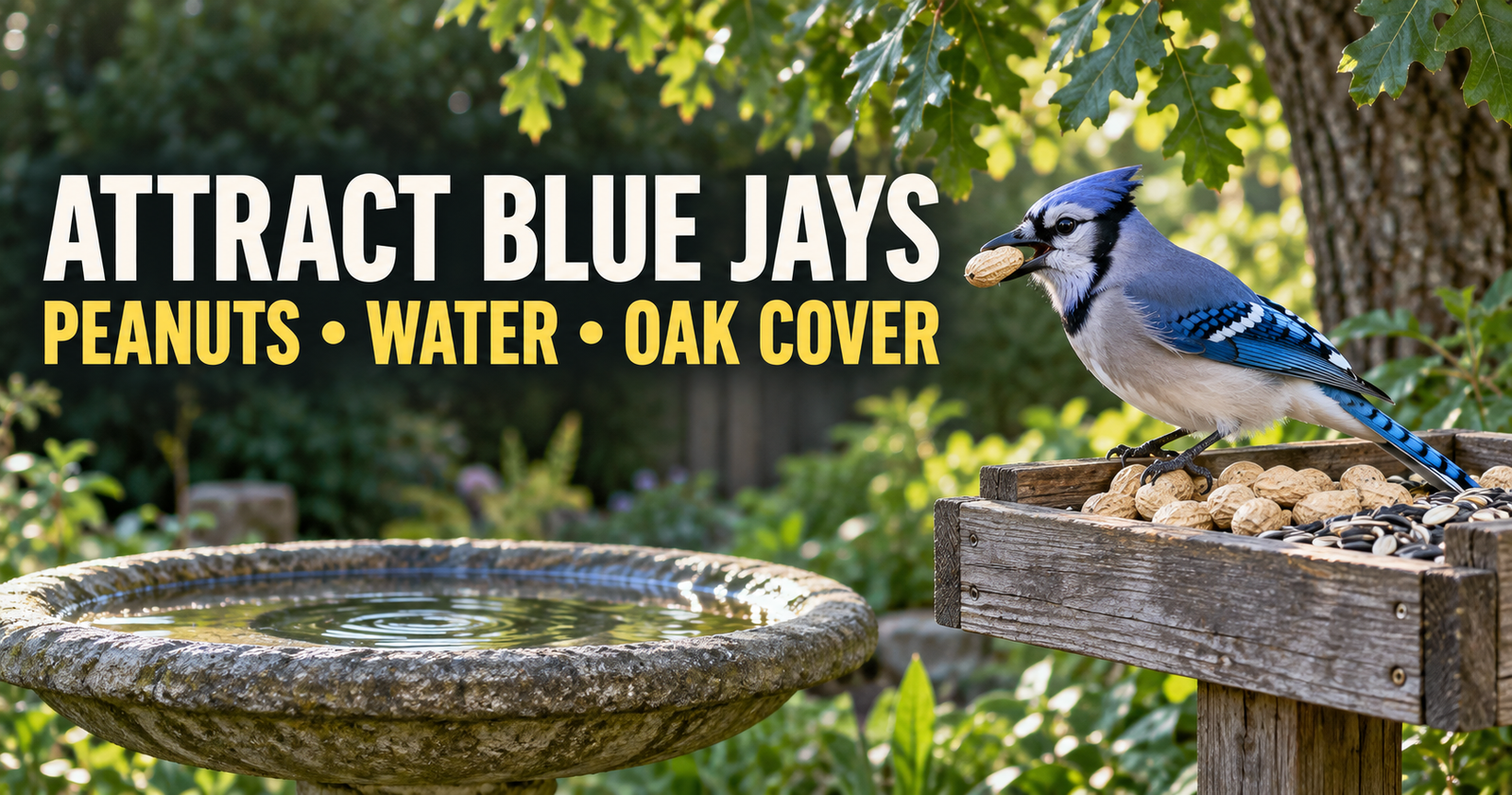
Young Blue Jays eventually grow into the same broad omnivorous diet adults use, but I wouldn’t try feeding a fledgling peanuts directly. Once they are independent, readers can explore how attracting adult Blue Jays with food without offering food directly to fledglings.
Let its parents determine what it receives while it’s dependent.
Adult Blue Jays are famous for taking peanuts, nuts, seeds, insects, and numerous other foods.
But a young bird’s nutritional needs and ability to handle foods change as it develops.
We’ll cover peanuts much more deeply in our Blue Jay feeding content.
For a fledgling still being cared for, the parents are the feeding experts.
Why Does a Juvenile Blue Jay Keep Begging When It Can Already Fly?
Because flying and feeding yourself are two different milestones.
A youngster can have functional wings while still relying heavily on its parents.
Think about everything it has to learn.
Where food is.
How to handle different foods.
Which animals are dangerous.
Where to seek cover.
How to communicate with other jays.
How to navigate its surroundings.
Getting airborne is only one part of becoming independent.
That’s why you can see an apparently capable young Blue Jay still loudly demanding dinner from an adult.
When Do Baby Blue Jays Get Their Full Adult Plumage?
Young Blue Jays become increasingly adult-like as they develop, and by the time they’re moving around outside the nest they can already look surprisingly similar to adults.
That’s one reason behavior becomes so useful for identifying juveniles.
Begging.
Following parents.
Awkward movement.
Persistent food solicitation.
Those clues may tell you you’re watching a young bird even when the plumage isn’t dramatically different.
And unlike Northern Cardinals, where immature bill and plumage differences can be quite noticeable, Blue Jay juveniles don’t give us such an easy visual shortcut.
Can You Tell Whether a Baby Blue Jay Is Male or Female?
Not reliably by ordinary backyard observation.
Adult male and female Blue Jays already look remarkably similar.
Juveniles don’t suddenly make the job easier.
I’d focus on identifying the bird as a juvenile Blue Jay rather than trying to assign sex from plumage, body size, or behavior.
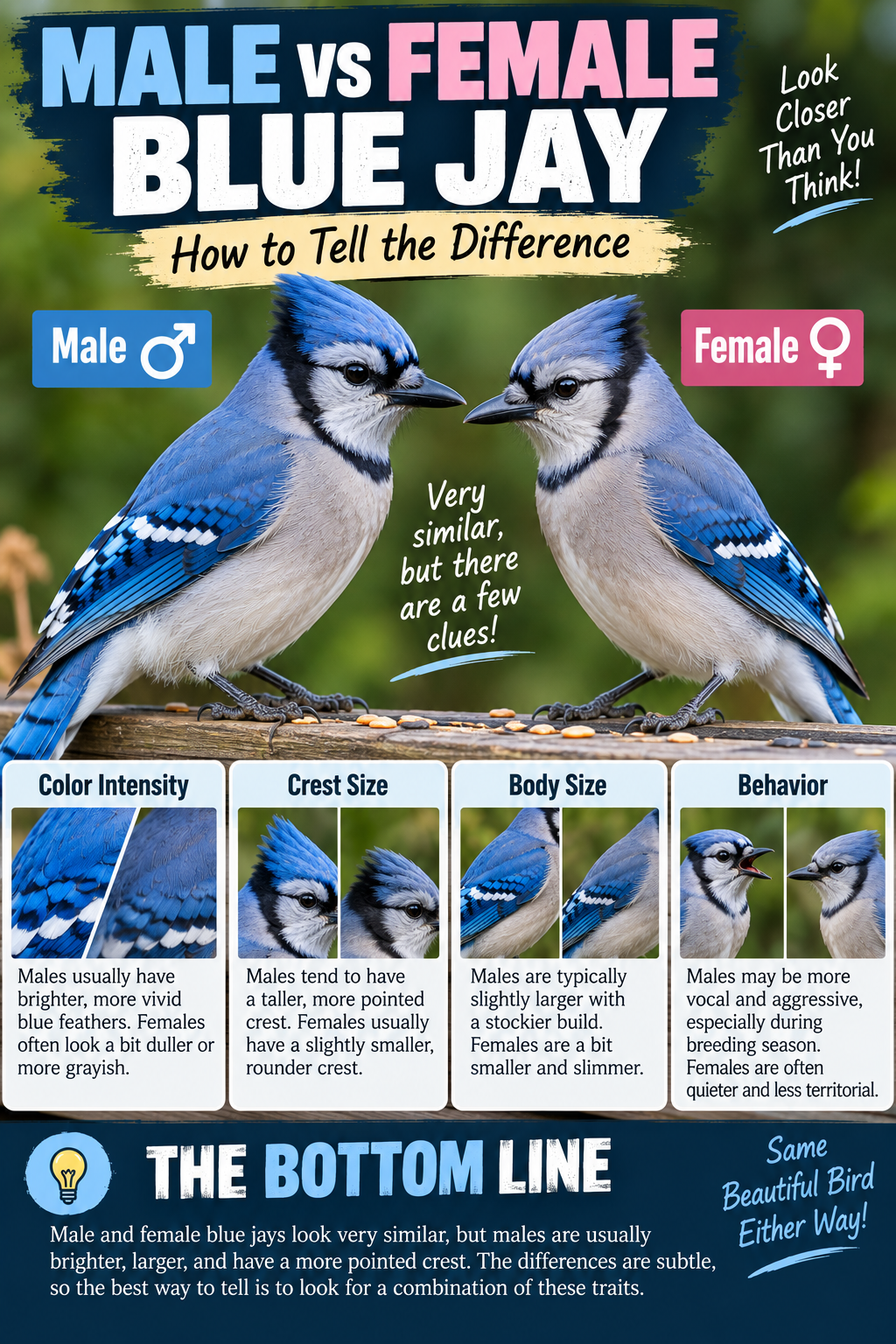
Our male vs female Blue Jay guide explains why sexing this species visually is so difficult even once they’re adults.
Why Do Baby Blue Jays Look So Different in Photos?
Age is part of it.
A hatchling, nestling, fledgling, and older juvenile are all “baby Blue Jays” in casual conversation, but they can look dramatically different.
Feather development changes quickly.
Lighting changes blue coloration.
A frightened bird may raise its crest.
A relaxed youngster may flatten it.
One photograph may show a nearly naked nestling.
Another may show a fully feathered fledgling that looks almost adult-sized.
Both captions might simply say:
Baby Blue Jay.
That’s why developmental stage matters more than the generic word “baby.”
An Empty Blue Jay Nest Doesn’t Automatically Mean Something Went Wrong
This is worth remembering if you’ve been following a nest from a distance.
One day there are several large nestlings.
Then suddenly the nest is empty.
It’s easy to fear the worst.
But if the young were around normal fledging age, they may simply have left.
Cornell reports that the brood usually leaves together at around 17 to 21 days old.
Listen around the surrounding trees.
Watch for adults carrying food.
Look for awkward young jays following their parents.
The family may still be surprisingly close even though nobody is sitting in the nest anymore.
Common Questions About Baby Blue Jays
What does a baby Blue Jay look like?
The appearance depends heavily on age. Hatchlings are naked and helpless with closed eyes, while older nestlings develop feathers rapidly. Fledglings are substantially feathered and increasingly resemble adults but can still look softer, scruffier, and more awkward.
How long do baby Blue Jays stay in the nest?
Blue Jay nestlings generally remain in the nest for about 17 to 21 days.
Do Blue Jay babies leave the nest before they can fly?
They may leave while their flight skills are still developing. Young jays can also wander short distances from the nest shortly before normal fledging, which is one reason apparently abandoned youngsters sometimes cause concern.
Do Blue Jay parents feed babies after they leave the nest?
Yes. Cornell reports that young Blue Jays remain with and receive food from their parents for at least a month after fledging and sometimes for two months.
Do baby Blue Jays return to the nest at night?
Once normally fledged, I wouldn’t expect them to return to the nest as a permanent sleeping place. They move away from the nest while remaining under parental care.
What should I do if I find a baby Blue Jay on the ground?
First determine whether it’s a nestling or fledgling. A healthy, fully feathered fledgling should generally be left alone because its parents are likely nearby. A sparsely feathered nestling may need help returning to its nest when safely possible.
Can I feed a baby Blue Jay?
Don’t try to feed a found baby bird yourself. An incorrect diet can cause serious harm. Healthy fledglings should remain with their parents, while injured or genuinely orphaned birds should be referred to a licensed wildlife rehabilitator.
Can I give a baby Blue Jay water?
Don’t force water into its mouth. Young birds normally receive water through the foods their parents provide, and force-feeding water can be dangerous.
Will Blue Jay parents abandon a baby because I touched it?
No. The idea that parent birds reject their young because of human scent is a myth.
How long do Blue Jay fledglings stay with their parents?
They may remain with and receive food from their parents for one to two months, with considerable variation among individuals.
Why is a baby Blue Jay following an adult and screaming?
It may be begging for food. Young Blue Jays continue depending on their parents after fledging even while their flight skills are developing.