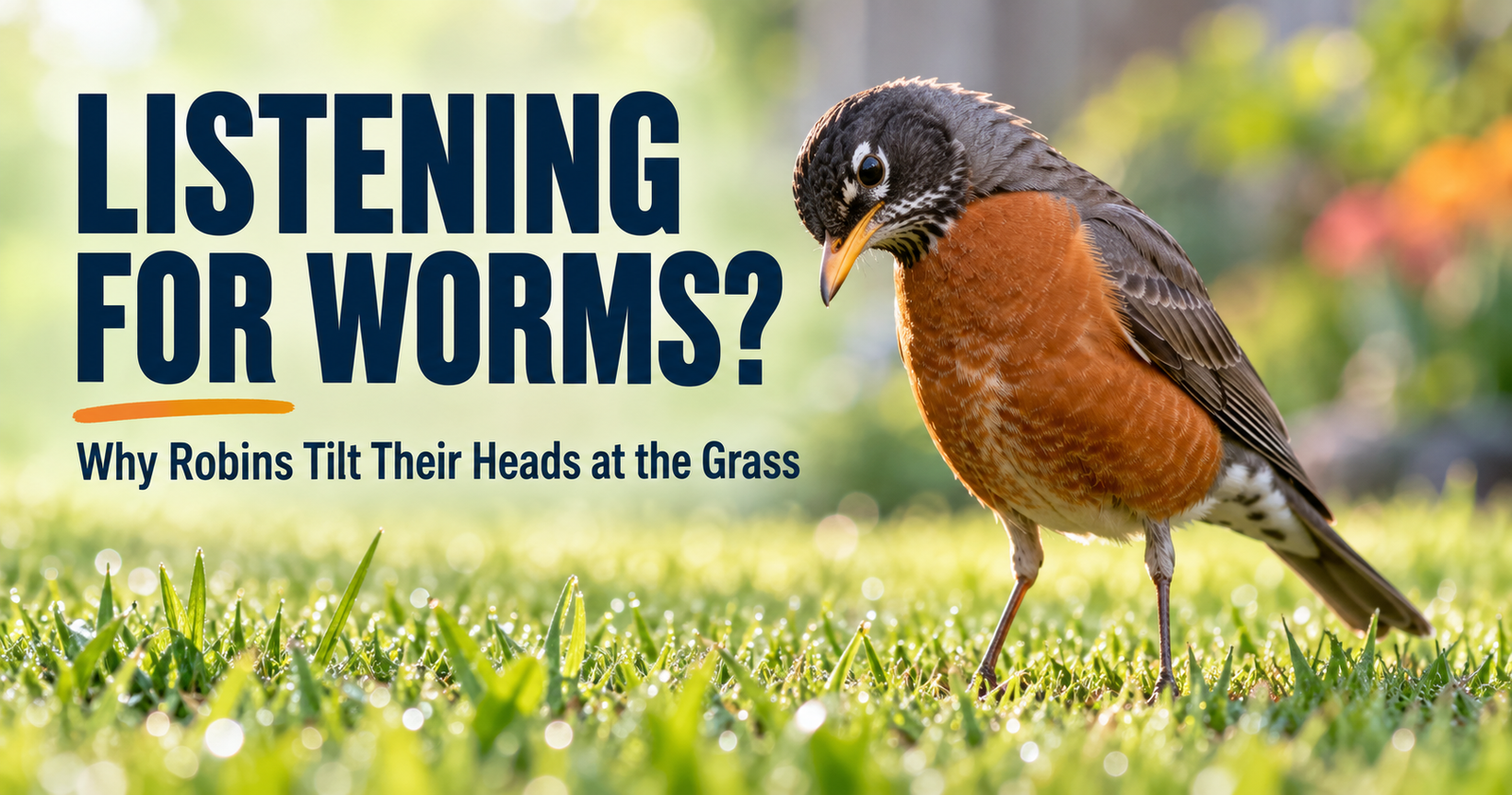
I was watching a robin work its way across the grass when I finally noticed how strange its routine actually was.
Run.
Stop.
Tilt its head sideways toward the ground.
Wait.
Run again.
Then suddenly it stabbed its bill into the lawn.
I’d seen robins do this plenty of times without thinking much about it.
But that sideways head tilt got me wondering.
What in the world is the bird doing?
I’d always heard that robins listen for worms underground.
It made sense.
Head toward the grass.
Pause.
Find worm.
Except the more I looked into it, the less satisfied I became with that explanation.
Because a robin isn’t necessarily putting its ear toward the ground.
It may be putting an eye in a better position to see what it’s hunting.
And once I understood how a robin’s eyes are positioned, that weird sideways stare at the lawn started making a lot more sense.
I Started Watching the Stop More Than the Run
The running is what catches your attention first.
Robins don’t casually shuffle across a lawn like Mourning Doves underneath a feeder.
They’ll make these quick little bursts.
Run several steps.
Freeze.
Look.
Run again.
Cornell describes American Robins foraging on lawns by running and stopping abruptly while searching for earthworms and other prey.
Once I noticed that rhythm, I stopped thinking of the robin as randomly wandering around.
It looked more like:
move to a new viewing spot, inspect, move again.
The pause is doing something.
That’s where the bird seems to gather information.

Then the Robin Turns Its Head Sideways
This is the part that really made me curious.
If I want to look at something on the ground, I normally look straight down at it.
A robin often does something different.
It turns its head.
One side of its face points toward the grass.
That looks like listening because we’re used to putting an ear toward something we’re trying to hear.
But bird eyes aren’t positioned like ours.
Humans have forward-facing eyes.
A robin’s eyes sit much farther toward the sides of its head.
So turning sideways can bring one eye into a better position for inspecting something below.
That’s a very different explanation from:
It’s putting its ear closer to the worm.
So Can Robins Actually Hear Worms?
This is where I don’t think the answer should be oversimplified.
Robins absolutely have hearing.
They use sound constantly.
But the classic idea that every head tilt means a robin is pinpointing a worm entirely by sound is too neat.
Experiments on American Robin foraging have found strong evidence that visual cues are important when locating buried earthworms.
Researchers have tested robins with different sensory cues available and found they can use visual information associated with worms underground.
So when I see that head tilt now, my first thought isn’t:
He’s listening.
It’s:
He’s inspecting.
That doesn’t mean sound can never contribute.
It means I wouldn’t reduce a robin’s hunting ability to one sense.
The Grass Itself May Give the Worm Away
This is the part I hadn’t really considered before.
A worm doesn’t have to be sitting completely exposed on top of the lawn for a robin to get visual information.
Something moving just underneath the surface can disturb:
soil,
grass,
dead leaves,
tiny pieces of vegetation,
or the opening of a worm burrow.
Those movements might be incredibly subtle to us.
But we’re standing several feet above the ground and usually aren’t staring at one square inch of lawn with the attention of a hungry robin.
The bird is.
That changes things.
Maybe the robin isn’t seeing the entire worm.
Maybe it’s seeing evidence that something underneath is moving.
I Tried Looking at the Lawn From the Robin’s Perspective
This is where the behavior became more interesting to me.
Stand upright and look at the grass.
It just looks like grass.
Now get lower.
Don’t actually put your face in the dirt, but look across the surface instead of straight down from above.
Suddenly little movements become easier to notice.
Grass blades move.
Shadows change.
Tiny insects cross openings.
Leaves twitch.
The surface isn’t nearly as still as it looked from standing height.
A robin lives much closer to that level.
And it has a bird’s visual system rather than ours.
That makes me wonder how much activity is happening in a lawn that I’m simply incapable of noticing from the porch.
Why Doesn’t the Robin Just Stand Still and Watch?
This was my next question.
If vision helps find worms, why all the running?
Why not choose one spot and stare?
I think the run-stop pattern makes sense when you consider viewing angles.
Move several feet and you’ve changed what you can see.
Different grass.
Different soil.
Different shadows.
Different angle.
Then stop long enough to inspect.
If nothing looks promising, move again.
It’s basically searching a grid without actually having a grid.
The robin isn’t mowing the lawn in perfectly straight lines.
But it is repeatedly changing observation points.
Rain Makes the Whole Thing Easier to Notice
Everybody associates robins and worms with rain.
And for good reason.
After rain, earthworms may be closer to or on the surface, depending on conditions.
Wet soil can also make worms easier to pull out.
That’s when I’d really watch a robin closely.
Does it spend less time inspecting each spot?
Does it capture worms more frequently?
Does it use the same run-stop-head-tilt pattern?
Those are the kinds of observations I’d rather record than simply saying:
Robins like rain because worms come out.
There’s more behavior happening in between.
Mowing the Lawn Might Accidentally Make Hunting Easier
This is something I’d genuinely like to compare.
A freshly cut lawn gives a robin a much clearer view of the ground than tall grass.
Short vegetation could make movement at the soil surface easier to detect.
Mowing can also disturb insects and other small animals.
So if I noticed robins suddenly appearing after mowing, I wouldn’t assume they were attracted to the lawn mower itself.
I’d wonder whether I had just made hunting easier.
That’s a simple observation someone could test without manipulating a bird at all.
Watch before mowing.
Watch afterward.
Count how many robins use the lawn.
See what they’re actually catching.

Robins Aren’t Only Looking for Worms
This is another thing the worm stereotype hides.
American Robins eat plenty of other things.
They forage for insects and other invertebrates too.
Later in the year, fruit can become extremely important.
So every time I see a robin studying the ground, I shouldn’t assume:
earthworm.
It may be searching for another small animal entirely.
That’s another reason the head tilt is interesting.
It’s better to think:
The robin is examining a possible food source
rather than assigning a worm to every stare.
The Stab Happens Fast
This is probably my favorite part to watch.
The robin looks almost hesitant while searching.
Run.
Stop.
Look.
Wait.
Then suddenly there’s no hesitation at all.
The bill goes into the ground.
Sometimes it comes back empty.
Sometimes there’s a worm.
And sometimes the real work starts after the worm appears.
A worm anchored in a burrow doesn’t necessarily slide out easily.
The robin may pull, pause and reposition before getting it free.
That’s another behavior I’d film rather than photograph.
A still picture misses the whole sequence.
I’d Record the Misses Too
This is something I think gets overlooked whenever people observe animals hunting.
We remember success.
Robin pulls worm.
Great photo.
But how often does it stab the ground and get nothing?
That tells us something too.
If I wanted to turn this into a genuine backyard observation, I’d watch one robin for ten minutes and record:
number of ground strikes,
number of worms or other prey captured,
how often it tilted its head beforehand,
and whether conditions were wet or dry.
Then repeat on another day.
Now we’ve got something more interesting than:
I saw a robin eat a worm.
We’ve got a tiny look at how successful the hunting strategy actually is.
I’d Love to Compare Wet Grass With Dry Grass
This would be my next observation.
Same general lawn.
Similar time of day.
One session after rain.
Another after several dry days.
I wouldn’t expect the results to prove some universal truth about robins.
One yard and a handful of observations can’t do that.
But it could reveal something interesting about the birds using that particular property.
Do they make more captures after rain?
Spend more time on the lawn?
Search different areas?
Eat different prey?
That’s the kind of firsthand information I’d rather add to BirdResource over time.
Does the Robin Hear Anything Underground?
Possibly.
I wouldn’t say hearing plays absolutely no role.
Bird sensory systems are complicated, and animals often combine information from multiple senses.
But evidence for visual detection means we shouldn’t keep repeating the old story as though a robin simply presses an ear toward the ground and waits for a worm to make noise.
The head tilt makes visual sense too.
And to me, that’s actually more impressive.
The bird may be noticing tiny visual disturbances in the grass that I wouldn’t recognize even if I knew exactly where to look.
Why Does the Robin Sometimes Freeze Completely?
I think this is where patience becomes part of hunting.
Movement can make it harder to notice other movement.
Stop your own body.
Now subtle changes in the environment become easier to detect.
I can’t claim that’s exactly what every robin is thinking.
But from an observation standpoint, the pattern is hard to miss.
Move.
Freeze.
Inspect.
Strike.
The bird’s pauses don’t look like wasted time anymore.
They look like part of the hunt.
What About Robins Cocking Their Heads in Trees?
This is why context matters.
A head tilt doesn’t always mean the bird is hunting worms.
Birds change head position to inspect all kinds of things.
A robin perched in a tree might be looking at another bird, watching a person, examining food or simply changing its viewing angle.
The behavior only becomes a worm-hunting clue when it occurs within the larger ground-foraging sequence.
That’s why I don’t like translating one bird movement into one fixed meaning.
Bird behavior works more like a sentence.
You need the surrounding words.
Common Questions About Robins Finding Worms
Why do robins tilt their heads at the ground?
The head tilt can position one eye for a better view of the ground. Robins use visual information while searching for earthworms and other prey.
Are robins listening for worms?
They have excellent hearing, but research shows visual cues play an important role in finding worms. The familiar sideways head position shouldn’t automatically be interpreted as listening.
Can robins see worms underground?
They may detect subtle visual signs of movement near the soil surface rather than literally seeing a complete worm through solid dirt.
Why do robins run and then stop on lawns?
The run-stop pattern allows them to move between feeding spots and pause to inspect the ground for prey.
Why are robins everywhere after rain?
Wet conditions can bring earthworms closer to the surface and make them easier for robins to find and extract.
Do robins only eat worms?
No. They also eat insects and other invertebrates, and fruit becomes an important part of their diet during parts of the year.
Why do robins like short grass?
Short grass can make ground foraging easier because birds can move freely and inspect the soil surface with less vegetation blocking their view.
Now I Watch the Head Instead of the Worm
Before I started paying attention, the interesting moment was always the end.
Robin pulls up worm.
There it is.
Now I think the interesting part happens ten seconds earlier.
The run.
The sudden stop.
That sideways look.
The pause where the bird seems to be staring at absolutely nothing.
Then the strike.
What looked like a robin randomly hopping around my lawn starts looking like a very deliberate hunting routine.
And the funniest part is that the old explanation I grew up hearing may have caused me to misunderstand the most obvious clue.
I thought the robin was turning its head to hear better.
Now I look at that eye pointed toward the ground and wonder what the bird can see that I can’t.
Hollis Pembroke is a Backyard Bird Behavior Contributor for BirdResource.com, where he writes about the ordinary bird moments that become a lot less ordinary once you stop and watch what happens before and after them.