
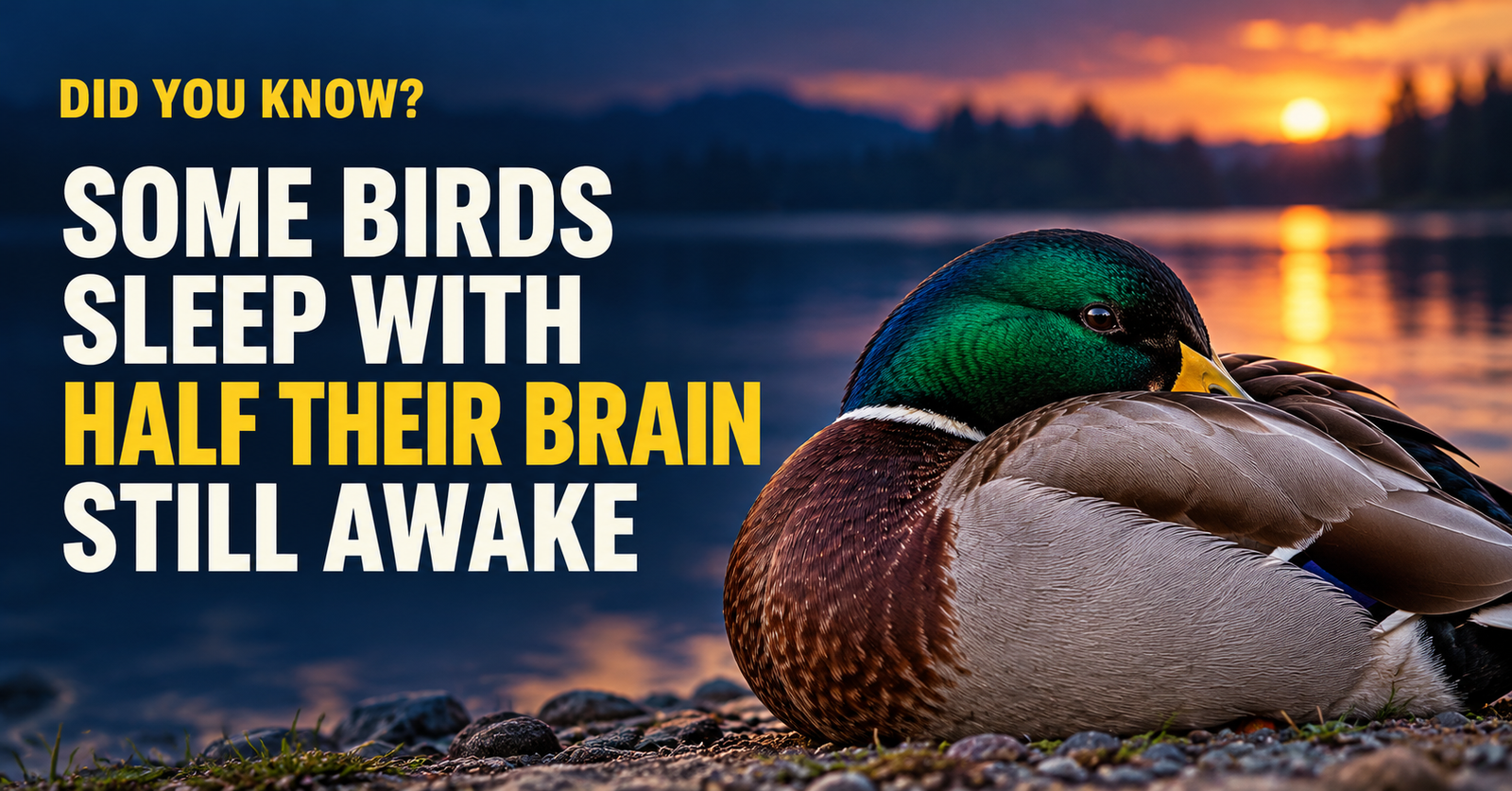
I’ve watched sleeping birds plenty of times without thinking there was anything particularly strange happening.
Head tucked into the feathers.
Body puffed up.
Eyes closed.
Pretty much what I’d expect from an animal that’s asleep.
Then I learned that some birds can do something I can’t imagine being able to do myself.
They can put half of their brain to sleep while the other half stays awake.
One eye closes.
The other can remain open.
The sleeping half gets some rest while the awake half continues monitoring what’s happening around the bird.
Scientists call it unihemispheric slow-wave sleep.
At first I assumed this was one of those bird facts that gets exaggerated every time it gets repeated online.
Then I started digging into the actual research.
It’s real.
And somehow, sleeping with half a brain isn’t even the strangest part.
Scientists have recorded birds doing it while flying.
One Eye Open Can Actually Mean Half the Brain Is Awake
This is the part I had to understand first.
Bird brains have two hemispheres.
During ordinary sleep, both sides can sleep.
But certain birds can shift into a different state where slow-wave sleep occurs predominantly in only one hemisphere.
The other side remains awake.
And here’s the interesting connection.
Each eye is primarily connected to the opposite side of the brain.
So when one hemisphere sleeps, the eye associated with that sleeping side can close.
The other eye stays open while the opposite hemisphere remains alert.
Cornell describes this as a way some birds can rest while still remaining ready to respond to danger.
That’s not the same thing as me lying in bed with one eye cracked open because I heard a noise.
Part of the bird’s brain is actually in a sleep state.


Ducks Made This Much Easier for Me to Picture
Imagine several ducks sleeping together.
The birds in the middle are surrounded by other ducks.
The bird on the outside edge isn’t.
Which bird has more reason to keep watch?
The one exposed to whatever might approach from outside the group.
Researchers have actually found this kind of pattern in Mallard ducks.
Ducks positioned at the edge of a sleeping group were more likely to use asymmetric sleep and keep the outward-facing eye open toward possible danger. Birds protected by neighbors were more likely to sleep with both eyes closed.
That blew me away.
The bird’s position in the group can influence how it sleeps.

I’d Never Look at the Duck on the End the Same Way
Before learning this, a row of sleeping ducks was just a row of sleeping ducks.
Now I’d look at the edges.
Is the outside bird keeping one eye open?
Which direction is that eye facing?
What are the birds in the middle doing?
I’d never claim I could diagnose brain activity just by watching eyelids.
You need actual brain recordings to prove sleep state.
But once you know the behavior exists, a sleeping flock becomes considerably more interesting.
The bird on the edge isn’t necessarily getting the same kind of rest as the bird surrounded by friends.
Why Would Evolution Produce Such a Weird Way to Sleep?
Because sleep is dangerous.
Think about what sleeping normally requires.
You stop paying attention.
Your reaction time changes.
Your eyes close.
For a small animal that might become somebody else’s dinner, that’s a serious vulnerability.
Birds can’t simply decide:
I’ll skip sleeping forever.
Sleep serves important biological functions.
So unihemispheric sleep offers an extraordinary compromise.
Rest part of the brain without completely disconnecting from the world.
A review of unihemispheric sleep describes predator vigilance as one of its major functions in birds.
You’re asleep.
But you’re also not entirely asleep.


Then Scientists Put Brain Recorders on Frigatebirds
This is where the story gets almost unbelievable.
For years, scientists knew certain birds could remain airborne for extremely long periods.
That created an obvious question.
When do they sleep?
One idea was that birds might sleep with half their brain while continuing to fly.
It sounded plausible.
But plausible isn’t proof.
Scientists needed to measure what the brain was actually doing.
So researchers equipped Great Frigatebirds with miniature devices capable of recording electrical brain activity while the birds flew over the ocean.
The birds remained in flight for up to 10 days.
And the recordings finally answered the question.
They slept while flying.
The Frigatebirds Slept With One Half and Both Halves
This surprised me even more.
I expected the answer to be:
One half sleeps.
One half flies the bird.
Simple.
That isn’t quite what researchers found.
The frigatebirds did use unihemispheric sleep while flying.
But they also occasionally entered sleep involving both hemispheres at the same time.
They were literally flying while both sides of the brain showed sleep activity.
That’s one of those facts that makes me realize how differently another animal can experience something as familiar as sleep.
They Didn’t Sleep While Flapping
This detail makes the whole thing easier to understand.
The frigatebirds primarily slept while soaring and circling in rising air currents.
They didn’t sleep while actively flapping their wings.
That makes intuitive sense.
Soaring requires much less active effort than powered flight.
The bird can use moving air to remain aloft while reducing how much physical work it has to perform.
I’d picture it less like somebody falling asleep while sprinting and more like a driver briefly handing some control over to a system that requires less active input.
Except there’s no autopilot computer.
The bird itself somehow maintains flight.
The Open Eye Appears to Watch Where the Bird Is Going
Researchers noticed something particularly interesting when frigatebirds circled in rising air.
During asymmetric sleep, the open eye tended to face the direction the bird was turning.
That suggests the awake hemisphere may help the bird monitor where it’s going while the other side sleeps.
I can’t imagine doing the human equivalent.
Half my brain asleep.
One eye closed.
Still moving through the environment.
Yet the bird can remain thousands of feet above the ocean and continue traveling.

Here’s the Part That Surprised Researchers
If frigatebirds can sleep while flying, you might expect them to get a fairly normal night’s sleep in little airborne chunks.
They don’t.
Researchers measured an average of only about 0.69 hours of sleep per day while flying.
That’s roughly 42 minutes.
On land, the same birds slept much more.
During flight, they got only around 7% of the sleep they normally obtained on land.
That means the really shocking ability may not be sleeping while flying.
It may be functioning for days while barely sleeping at all.
Forty-Two Minutes of Sleep During a Day Sounds Miserable
I can’t imagine how I’d function.
One night with terrible sleep and I’m feeling it the next morning.
These birds can remain over the ocean for days while operating on tiny amounts of sleep.
Then they somehow continue:
navigating,
flying,
responding to other birds,
dealing with weather,
and presumably making decisions about where they’re going.
Researchers specifically noted that this challenges our assumptions about how much sleep an animal requires to maintain performance.
It doesn’t mean humans should start trying to survive on 42 minutes.
We’re not frigatebirds.
It means sleep biology can be much stranger than the human version we’re familiar with.
Some Birds May Even Take Tiny Naps During Migration
Long-distance migration creates another sleep problem.
Many songbirds migrate at night.
That’s exactly when they’d normally be sleeping.
So what happens?
Research on migratory birds has documented incredibly short daytime sleep episodes, sometimes lasting only seconds.
One EEG study found sleep-like daytime episodes averaging around 12 seconds in a nocturnal migrant. Some involved unihemispheric sleep.
Twelve seconds.
That’s barely enough time for me to decide whether I’m comfortable.
For a migrating bird, it can apparently count as a nap.
I Started Wondering About Birds Sleeping Around My Yard
Obviously, I’m not going to strap EEG equipment to a backyard duck.
But knowing this changes what I’d watch.
If I found waterfowl resting together, I’d pay attention to flock position.
Bird in the middle.
Bird on the edge.
One eye closed.
Both eyes closed.
Head tucked.
Head raised.
I’d also watch what happens when something approaches.
Does the outside bird react first?
Does everybody wake at once?
Again, I can’t prove unihemispheric sleep from casual observation.
But I can observe the behaviors that make the adaptation useful.
Sleeping Birds Aren’t Completely Helpless Anyway
Even birds that aren’t using half-brain sleep don’t necessarily sleep like we imagine.
Cornell notes that birds tend to sleep in relatively short bouts and can awaken quickly when disturbed by predators, neighbors, or cold conditions.
That makes sense.
A wild bird doesn’t have:
a locked front door,
a mattress,
a thermostat,
and eight guaranteed predator-free hours.
Sleep has to fit into an environment where something could change at any moment.
Their Feet Solve Another Sleeping Problem
Here’s something I always wondered about as a kid.
Why doesn’t a sleeping bird fall off the branch?
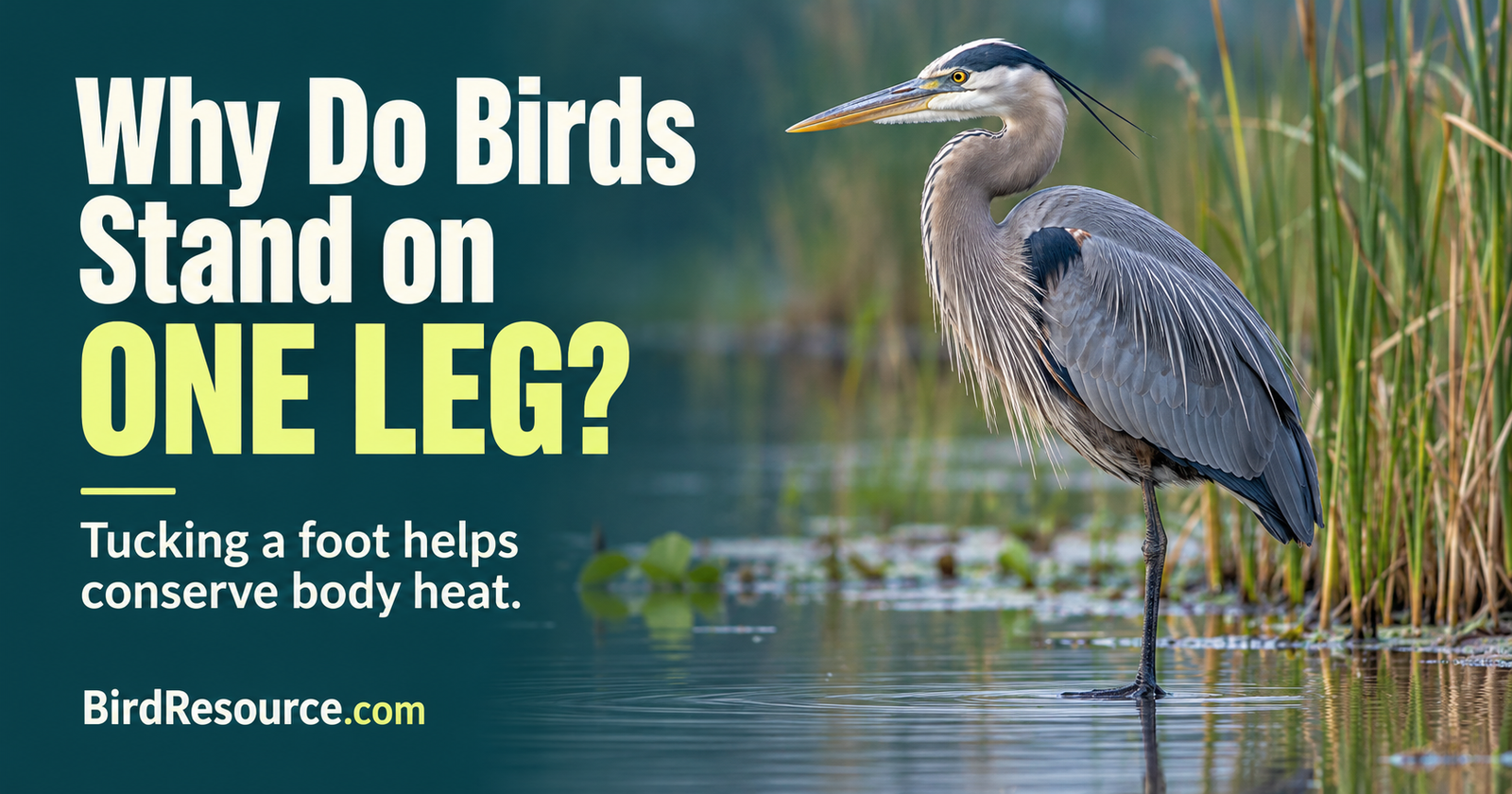
Perching birds have anatomy that allows their feet to maintain a secure grip while resting. That same resting behavior is explored in why birds rest on one leg, including when a tucked foot is normal and when it may signal trouble.
When they settle onto a perch, tendons help the toes grip around the branch.
Cornell describes this as producing an extremely secure hold while the bird rests.
So the bird has solutions at both ends.
Its feet help keep it attached to the branch.
And in certain species, its brain can keep part of itself watching for danger.
That’s a pretty impressive sleep setup.
Not Every Bird Sleeps With Half Its Brain
This is important because the fact can get exaggerated.
You sometimes see:
Birds sleep with one eye open.
As though every robin in every tree spends the entire night with half its brain awake.
That’s not accurate.
Unihemispheric sleep has been documented in certain bird species and situations.
Birds can also sleep with both hemispheres.
And even frigatebirds that demonstrated unihemispheric sleep during flight sometimes slept with both hemispheres simultaneously.
The remarkable fact isn’t that birds always sleep this way.
It’s that some of them can.
Common Questions About Birds Sleeping With One Eye Open
Do birds really sleep with one eye open?
Some species can. During unihemispheric slow-wave sleep, one brain hemisphere sleeps while the other remains more awake, and the eye connected to the awake hemisphere can stay open.
Why do birds sleep with one eye open?
One major advantage is remaining alert to predators while still getting some sleep.
Do ducks sleep with one eye open?
Mallard ducks have been documented using asymmetric sleep, particularly when positioned at the exposed edge of a sleeping group.
Can birds sleep while flying?
Yes. Scientists recorded Great Frigatebirds sleeping while flying over the ocean, providing direct EEG evidence of sleep in flight.
Can birds fly while both sides of their brain are asleep?
Great Frigatebirds were recorded briefly engaging in sleep involving both hemispheres while in flight, although asymmetric sleep was particularly important while flying.
How much do frigatebirds sleep while flying?
In the landmark study, flying frigatebirds averaged only about 0.69 hours of sleep per day, far less than when they were on land.
Do all birds sleep with one eye open?
No. Birds use different sleep strategies, and unihemispheric sleep is not something every bird constantly uses.
Now One Open Eye Means Something Completely Different to Me
Before I knew any of this, a bird resting with one eye open looked like a bird that simply hadn’t fallen asleep yet.
Now I know that isn’t necessarily true.
Part of its brain might genuinely be sleeping.
The other part may still be monitoring the world.
And in the most extreme case we’ve actually measured, a frigatebird can do this while soaring high above the ocean during a flight lasting days.
That’s the kind of bird fact that sounds made up until somebody actually puts electrodes on a bird’s head and proves it.
Sometimes the strangest thing about birds isn’t what we can see them doing.
It’s what’s happening inside their brains while they’re doing it.
Emmett Calder is a Bird Facts Contributor for BirdResource.com, where he digs into the strange, documented abilities of birds that sound impossible until scientists actually measure them.