
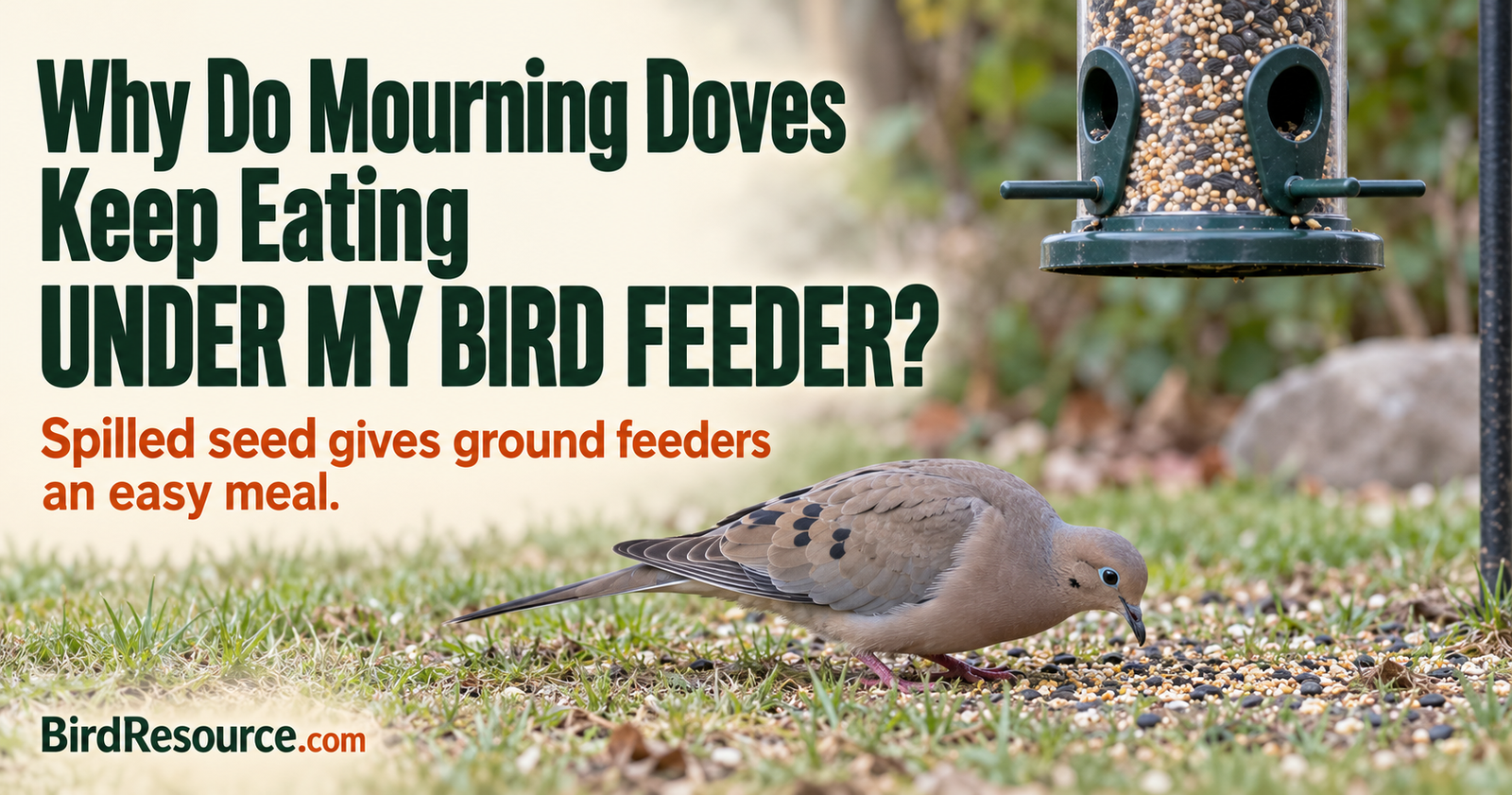
If you’ve ever watched a Mourning Dove walking underneath your bird feeder while perfectly good seed sits above its head, you might wonder what the bird is thinking.
The feeder is right there.
The food is right there.
Other birds are eating from it.
Yet the dove keeps walking around on the ground, picking up whatever falls.
Here’s the interesting part.
That Mourning Dove isn’t necessarily struggling to figure out your feeder. It may be eating exactly where it prefers.
Mourning Doves are natural ground feeders. Their bodies, feet, and feeding behavior are better suited to walking across open ground and picking up seeds than hanging from tiny feeder perches.
According to the Cornell Lab’s Mourning Dove guide, these birds regularly forage on the ground and readily eat seed scattered beneath feeders.
But I think there’s a more useful question worth asking.
Could a simple change to the feeding setup get Mourning Doves eating somewhere cleaner and easier to watch?
That’s what I’d want to find out.
Your Hanging Feeder Might Already Be Working Perfectly
Before replacing anything, I’d watch what’s happening underneath the feeder.
Imagine a typical backyard setup.
A chickadee lands and starts picking through sunflower seeds.
A finch knocks a few seeds loose.
A cardinal cracks a seed and drops part of the shell.
Meanwhile, two Mourning Doves are walking underneath, picking up whatever edible pieces reach the ground.
The birds above are using the feeder.
The doves below are using the same food source.
Everybody is eating, just on different levels.
This is why I wouldn’t assume Mourning Doves dislike a particular seed simply because they won’t land on the feeder holding it.
The problem might be access rather than food preference.
Mourning Doves Aren’t Built Like Chickadees
Watch how a chickadee approaches a feeder.
It can land on a tiny perch, grab something, and fly away.
Now watch a Mourning Dove.
It has a fuller body, relatively small head, and feet better suited to standing and walking than clinging to narrow feeding ports.
The University of Missouri Extension’s Mourning Dove habitat guide explains that Mourning Doves have relatively weak feet for scratching and prefer feeding on open ground where seeds are exposed.
That’s an important detail.
They’re not built to scratch through thick debris like chickens.
They generally pick up seeds they can already see and reach.
So a bird feeder that works beautifully for finches may be completely awkward for a dove.
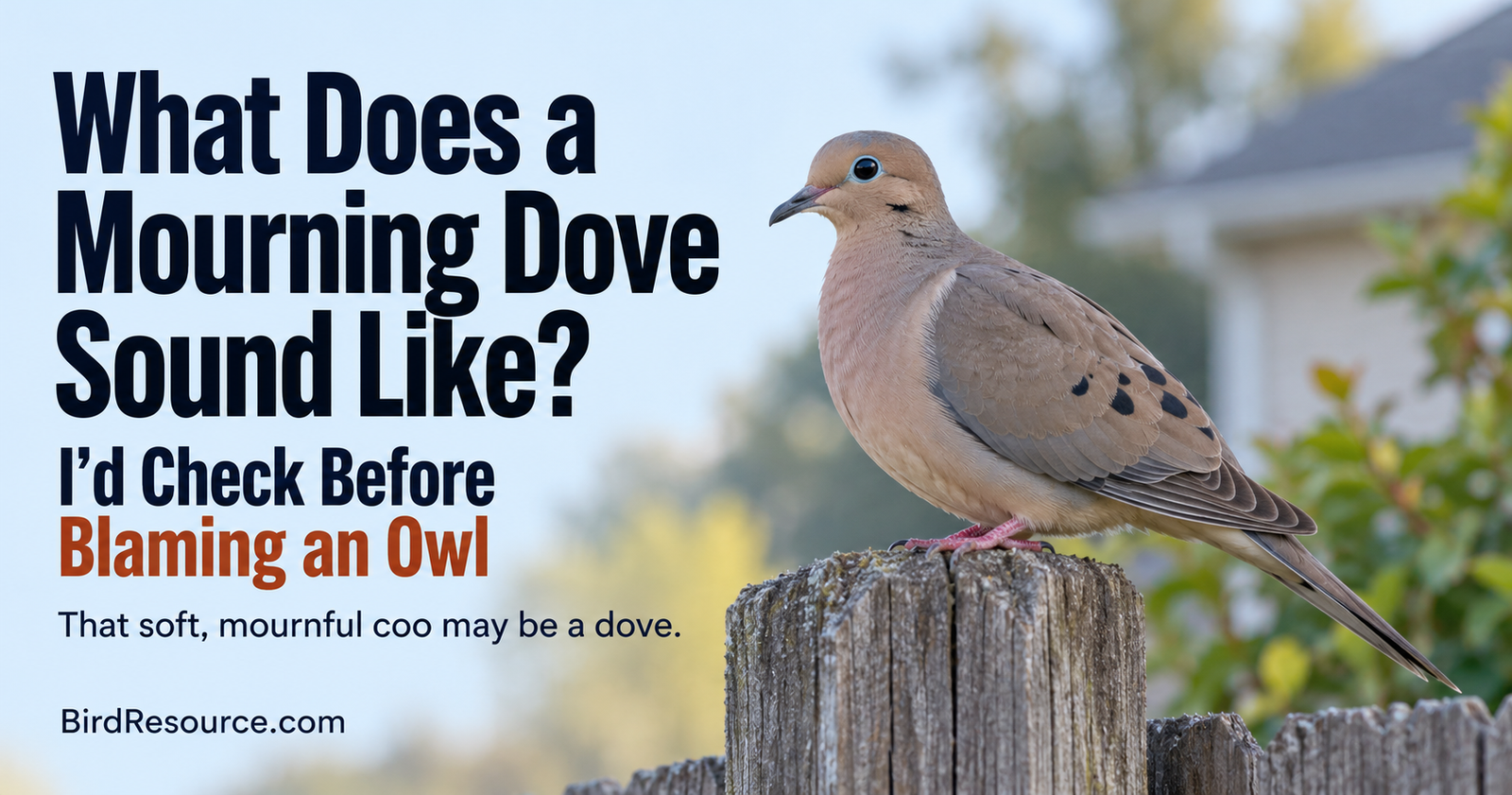
Why They Keep Walking Back and Forth
Sometimes Mourning Doves look like they’re inspecting every square inch underneath a feeder.
There’s a reason for that.
They’re searching for exposed seeds.
And unlike birds that sit on a perch cracking one sunflower seed after another, Mourning Doves can swallow suitable seeds whole.
Those seeds enter an expandable storage area called the crop.
The bird can collect a substantial meal relatively quickly, then leave to digest it somewhere safer.
Cornell documents an extraordinary Mourning Dove that had 17,200 bluegrass seeds stored in its crop.
That’s a remarkable amount of food for one small bird.
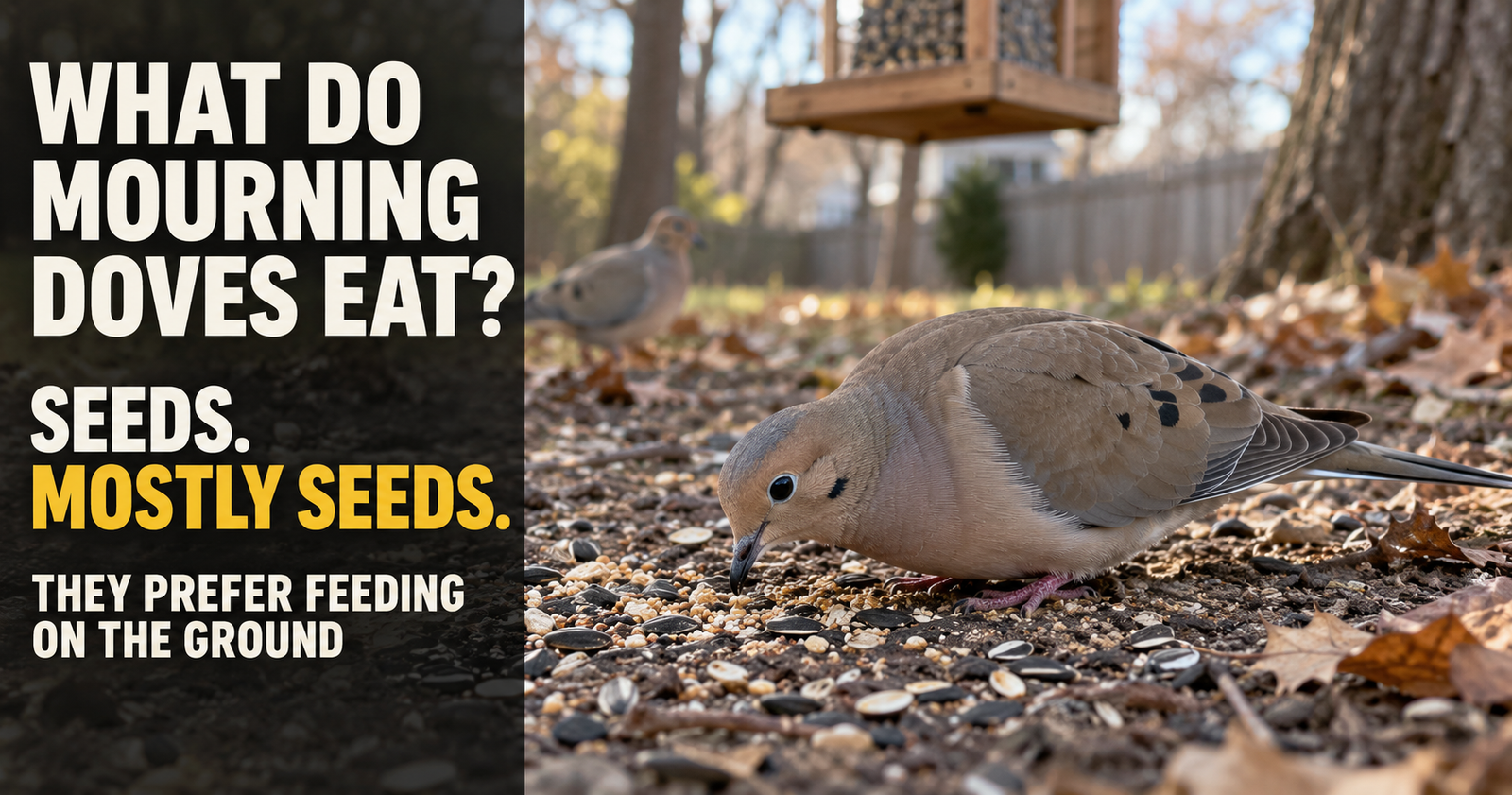
Our guide to what Mourning Doves actually eat explains their seed-heavy diet and how that unusual digestive system works.
The Backyard Feeder Test I’d Try First
Rather than buying another feeder immediately, I’d try a simple comparison.
The goal wouldn’t be to prove that every Mourning Dove prefers one feeding method.
I’d want to learn what the birds visiting one particular yard actually do.
First, Keep the Existing Feeder
I wouldn’t move the original feeder.
Changing its location would introduce another variable.
Instead, I’d leave everything where it normally sits and observe the Mourning Doves for a couple of days.
I’d record three things:
- How many Mourning Doves visit during a 20-minute observation?
- Do they attempt to land on the hanging feeder?
- How much time do they spend searching underneath it?
I’d observe around the same time each day.
That would give me a basic picture of their normal behavior before changing anything.
Next, Add a Shallow Ground Tray
I’d place a clean, shallow feeding tray in an open area near the existing feeder.
Not directly beneath the messiest part of the hanging feeder.
I’d want somewhere I could easily remove old food and clean the surface.
Then I’d add a small amount of white proso millet.
Why millet?
Because Cornell specifically recommends millet for Mourning Doves, and it works well with their natural feeding style.
I’d keep the amount modest rather than dumping a huge pile outside.
Then Watch What Changes
For the next three mornings, I’d observe the same feeding area for 20 minutes.
I’d record whether Mourning Doves:
- Visit the new tray.
- Continue feeding underneath the hanging feeder.
- Spend more time at one location.
- Avoid the tray completely.
I’d also note whether squirrels, sparrows, or other animals interfere.
That matters because a tray full of millet disappearing overnight doesn’t automatically mean Mourning Doves ate it.
The goal is to observe actual dove behavior, not simply measure missing seed.
What I’d Expect to Happen
Based on how Mourning Doves naturally feed, my prediction would be that some birds would investigate the open tray once they discovered it.
I would also expect them to continue searching underneath the hanging feeder.
Why?
Because both locations offer accessible food.
The birds aren’t necessarily going to abandon one feeding spot simply because another becomes available.
But here’s what I wouldn’t predict confidently.
I wouldn’t assume the tray would attract more Mourning Doves immediately.
I wouldn’t assume they’d prefer millet over every other available seed.
And I wouldn’t assume a bird avoiding the tray on the first day means the experiment failed.
Wild birds can take time to investigate changes.
These are expectations based on established Mourning Dove behavior, not results from a completed backyard experiment.
One Mistake That Could Ruin the Test
I’d be careful about changing too many things at once.
Suppose I installed a new feeder, moved the birdbath, switched birdseed, and trimmed the nearby shrubs on the same afternoon.
Then Mourning Dove activity doubled.
What caused it?
I wouldn’t know.
That’s why I prefer simple backyard comparisons.
Change one important thing.
Observe.
Record what happens.
Then decide whether another change is worth making.
This approach may not be laboratory science, but it can produce useful firsthand observations when the setup and results are documented accurately.
Don’t Forget About the Ground Itself
A Mourning Dove may ignore an otherwise suitable feeding area if the ground is difficult to use.
Thick grass can hide seeds.
Deep mulch can bury them.
Dense vegetation can make walking and searching awkward.
Mourning Doves generally prefer relatively open areas where they can find food without digging.
That doesn’t mean I’d strip all the vegetation out of my yard.
I’d simply choose a clean feeding location where the birds can walk comfortably and see what’s around them.
The One Problem With Feeding Doves on the Ground
Ground feeding is natural.
But a dirty feeding area can become a problem.
Old seed gets wet.
Bird droppings accumulate.
Uneaten food can spoil.
Rodents may discover the leftovers.
And birds gathering around contaminated food can spread disease.
The Cornell Project FeederWatch feeder-cleaning recommendations emphasize keeping the ground beneath feeders clean and removing accumulated seed waste and droppings.
That’s why I’d rather use a washable feeding tray than continually scatter more seed onto the same dirty patch of ground.
I’d remove leftovers regularly, especially after rain.
A clean feeding station matters more than keeping it constantly overflowing with food.
What If the Doves Ignore the New Tray?
I wouldn’t immediately throw it away.
First, I’d check whether Mourning Doves actually visited while I was watching.
Then I’d consider the location.
Is the tray exposed to predators?
Is a cat regularly walking nearby?
Is it surrounded by tall vegetation?
Does the tray have slippery sides or an awkward surface?
Are other birds dominating it?
If everything looks reasonable, I’d give the setup a little more time.
But I wouldn’t keep adding food indefinitely to a tray nobody uses.
After several days, I’d reassess.
Sometimes a feeding setup looks perfect to us but doesn’t fit the birds using that particular yard.
What If They Prefer the Ground Anyway?
Then I’d accept that.
The purpose of attracting backyard birds isn’t forcing them to use equipment the way we imagined.
If Mourning Doves consistently choose clean, open ground instead of an elevated platform, that tells me something useful about those visitors.
I might keep a low tray.
I might adjust the feeding location.
Or I might simply maintain a cleaner area underneath the existing feeder.
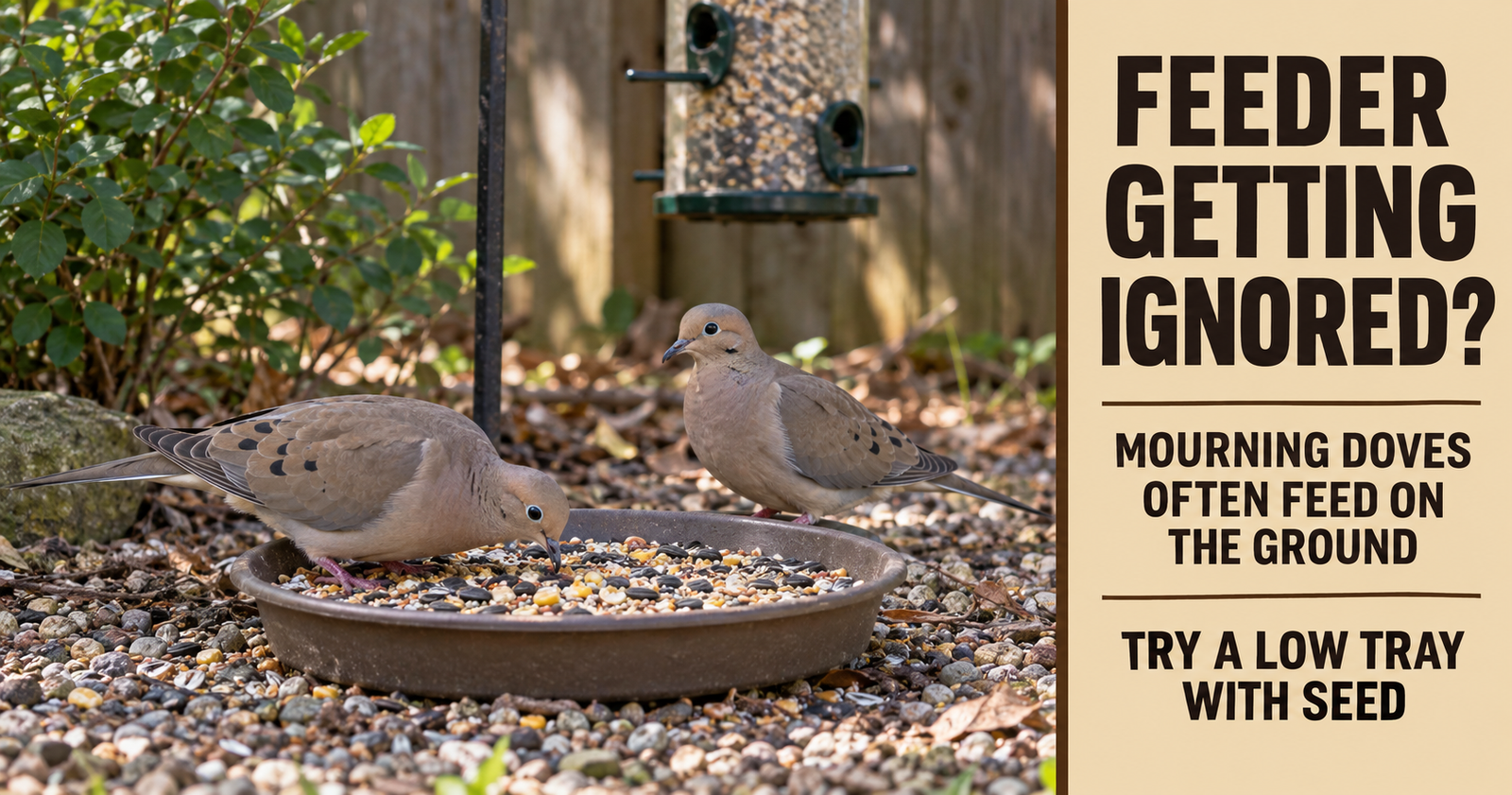
Our guide to attracting Mourning Doves when they ignore your feeder covers the larger habitat picture, including water, cover, feeder placement, and safety.
A Raised Platform Might Be Worth Trying Next
If the ground tray attracts doves but becomes difficult to keep clean, I’d consider a broad raised platform.
Not a tiny hanging tube.
A platform with enough room for a Mourning Dove to land, stand, and walk around.
The Project FeederWatch guide to feeder styles explains that platforms positioned near the ground can attract doves, sparrows, and other ground-feeding species.
I’d look for a design with drainage and surfaces that are easy to clean.
The goal would be giving Mourning Doves a comfortable feeding surface without creating another place for wet seed and droppings to accumulate.
Common Questions About Mourning Doves Under Feeders
Why do Mourning Doves eat underneath bird feeders?
Because Mourning Doves naturally forage on the ground. Fallen seeds provide an easy food source that matches their normal feeding behavior.
Why won’t Mourning Doves land on my hanging feeder?
The perches may be too small or awkward for their body size. Mourning Doves generally do better with open platforms, ground trays, or accessible seed on clean ground.
Are Mourning Doves only eating leftover birdseed?
Not necessarily. They’re eating accessible food in a location that suits them. Seeds falling from other feeders simply create another feeding opportunity.
What seed should I put on the ground for Mourning Doves?
White proso millet is an excellent starting choice. Mourning Doves also eat sunflower seeds, cracked corn, and many naturally occurring seeds.
Will a platform feeder attract Mourning Doves?
It can. A broad platform gives them room to land and feed comfortably, especially when positioned in a suitable location.
Is it safe to scatter birdseed on the ground?
It can be done, but cleanliness matters. Avoid letting old wet seed, hulls, and droppings accumulate. A washable ground tray may make maintenance easier.
What I’d Watch Tomorrow Morning
If Mourning Doves were regularly walking underneath my feeder, I wouldn’t rush to replace everything.
I’d grab a chair, sit somewhere the birds couldn’t easily see me, and watch for 20 minutes.
I’d pay attention to where they land.
Which seeds they pick up.
Whether they ever attempt to use the feeder above them.
And whether they seem comfortable feeding in that location.
Then I’d try one small change and compare what happened.
That’s the kind of backyard birdwatching I find most useful.
Not guessing what birds want based on a product label.
Not assuming every bird should use the same feeder.
Watching what the birds actually do, making one sensible adjustment, and seeing whether it helps.
And if those Mourning Doves keep walking underneath the feeder after everything I’ve tried?
I wouldn’t call that a failure.
I’d call it a pretty good reminder that the birds know how they prefer to eat.
Mason Reed is the Backyard Birding & Behavior Contributor for BirdResource.com, where he helps everyday birdwatchers understand feeding behavior, compare backyard setups, and make practical changes based on what birds actually do rather than what a product package promises.