
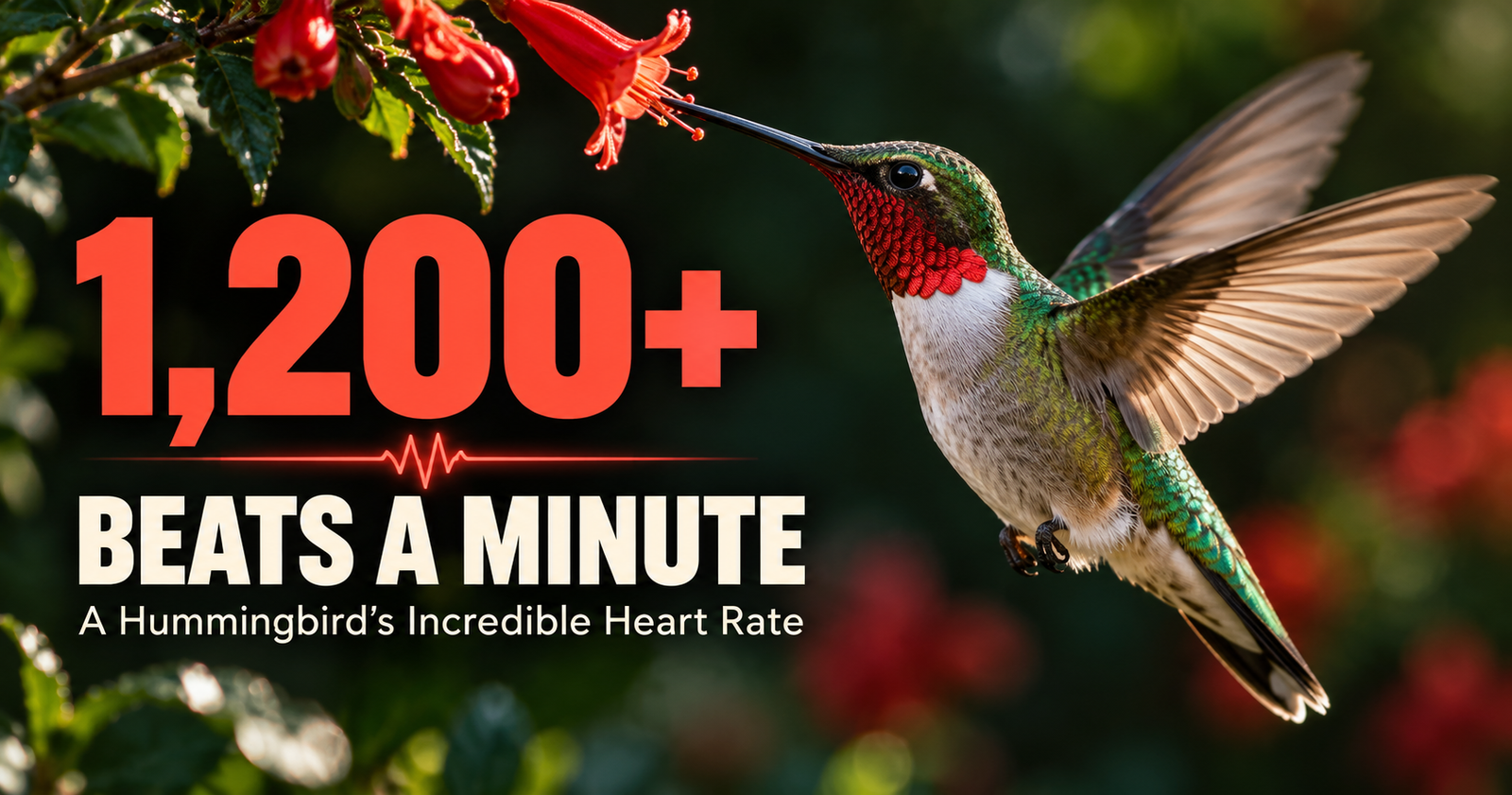
I was watching a hummingbird hover around a feeder when I started thinking about what had to be happening inside that tiny body.
The wings were basically a blur.
It stopped in midair.
Shot backward.
Moved sideways.
Hovered again.
Then disappeared so fast that my eyes barely followed it.
I’ve watched hummingbirds plenty of times without really thinking about the machinery required to make that happen.
Then I looked up their heart rate.
More than 1,200 beats per minute during flight.
I actually checked that number twice because it sounded ridiculous.
According to the Smithsonian’s National Zoo, a Ruby-throated Hummingbird’s heart can beat around 225 times per minute while resting and more than 1,200 times per minute in flight.
That’s about 20 heartbeats every second at the upper end.
Try counting:
one Mississippi…
A hummingbird’s heart may have beaten around twenty times before you finish saying it.
And somehow that’s not even the strangest thing its heart can do.
1,200 Heartbeats a Minute Is Hard to Even Picture
Numbers this large stop meaning much unless I compare them with something familiar.
A normal resting adult human heart commonly beats somewhere around 60 to 100 times per minute.
A flying hummingbird can blow past 1,000.
That means its heart can be working more than ten times faster than ours.
But there’s an obvious reason.
Look at what the bird is doing.
Hummingbirds don’t simply flap their wings and glide for long stretches.
They hover.
They accelerate.
They brake.
They fly backward.
They make incredibly precise adjustments while remaining almost stationary in front of a flower.
The Smithsonian reports that hummingbird wings can beat around 70 times every second during direct flight and exceed 200 beats per second during dives.
All of that requires energy.
And energy requires oxygen and fuel to reach hard-working muscles incredibly quickly.
That tiny heart has a massive job.


I Started Wondering What 20 Beats Per Second Would Feel Like
You couldn’t count them individually.
Put two fingers against your wrist and imagine trying to feel twenty separate pulses before one second passes.
It would essentially feel continuous.
That gave me a completely different perspective on the hummingbird sitting quietly on a branch after leaving the feeder.
From the outside, the bird may look calm.
Inside, its body is operating on a scale that’s difficult for us to comprehend.
And when it launches again, everything ramps up.


A Hummingbird’s Heart Is Huge for Its Body
Not huge in absolute size, obviously.
The entire bird can weigh less than a nickel.
But relative to the hummingbird’s body, the heart is enormous.
The UC Davis Hummingbird Health and Conservation Program reports that a hummingbird’s heart can account for about 2.5% of its total body weight.
That’s another detail that made me look differently at these birds.
There’s almost no room to waste.
A hummingbird has:
powerful flight muscles,
a disproportionately large heart,
extremely rapid breathing,
and a metabolism capable of supporting one of the most demanding styles of flight in the animal world.
It looks delicate.
Physiologically, it’s an absolute machine.
The Heart Isn’t Racing Like That All Day
This is an important distinction.
When people hear 1,200 beats per minute, it’s easy to imagine a hummingbird’s heart running at that speed constantly.
It doesn’t.
Heart rate changes with activity.
Smithsonian puts the resting heart rate of a Ruby-throated Hummingbird at around 225 beats per minute.
That’s still incredibly fast compared with ours.
But it’s nowhere near the maximum reached during flight.
And hummingbirds actually spend considerable time perched between feeding and territorial activity.
Once I started paying attention to that, I noticed how easy it is to miss the resting part of a hummingbird’s life.
The flying bird grabs your attention.
The hummingbird sitting silently on a thin branch can almost disappear.


I Started Looking for Where They Rest
This became something I’d actually watch for.
A hummingbird visits a feeder.
Leaves.
Where does it go?
Instead of immediately looking back at the feeder waiting for another visit, I’d follow the bird with my eyes as far as possible.
Sometimes it may disappear into a nearby tree or shrub and perch.
That makes sense when you consider how expensive flight is.
Arizona State University’s Ask A Biologist notes that hummingbirds spend substantial time perched between meals because flight burns so much energy.
The hummingbird lifestyle isn’t:
fly constantly.
It’s more like:
perform incredibly expensive bursts of activity, refuel constantly, then conserve energy whenever possible.
Then Night Comes and Everything Changes
This is where the hummingbird heart story becomes almost unbelievable.
During the day, we’re talking about a bird whose heart can exceed 1,200 beats per minute.
At night, some hummingbirds can enter torpor.
Torpor is a deep energy-saving state.
Body temperature drops.
Metabolism slows dramatically.
Breathing slows.
And so does the heart.
The Smithsonian describes hummingbirds as masters of torpor because their extremely high metabolic demands make conserving energy overnight so important.
Other references report hummingbird heart rates during deep torpor dropping below 50 beats per minute.
Think about that range.
More than 1,200 during intense flight.
Potentially below 50 during torpor.
Same bird.
Same heart.
That’s Like Having Two Completely Different Animals
This is the fact that sticks with me.
A hummingbird in daylight looks almost incapable of slowing down.
Everything about it screams speed.
Wingbeats.
Heart rate.
Feeding.
Chasing other hummingbirds.
Sudden direction changes.
Then nighttime can turn that same animal into something that looks almost shut down.
Cornell researchers describe torpid hummingbirds as cold and barely responsive, with breathing sometimes pausing for several seconds before a series of deeper breaths.
If I found a hummingbird in that condition without knowing about torpor, I’d probably assume it was dying.
But that dramatic slowdown may be exactly what keeps it alive until morning.
Why Doesn’t a Hummingbird Just Sleep Normally?
Because being a hummingbird is incredibly expensive.
A tiny animal loses body heat rapidly because it has a large surface area relative to its body mass.
Now combine that with an extraordinarily fast metabolism.
During daylight, nectar and insects keep fuel coming in.
At night, the bird isn’t feeding.
Hours without food become a serious problem when your body burns energy that quickly.
Torpor is essentially an extreme energy-saving mode.
Lower the body temperature.
Slow the heart.
Slow breathing.
Reduce metabolism.
Spend less fuel making it through the night.

Morning Must Be an Incredible Transformation
This is the part I’d love to witness closely.
Imagine the bird near dawn.
Its body has spent the night operating at a fraction of normal daytime intensity.
Then it has to warm up.
Heart rate increases.
Breathing increases.
Body temperature rises.
Muscles become ready for flight again.
And before long, that same bird is hovering in front of a flower with its heart racing hundreds upon hundreds of times each minute.
Arizona State describes hummingbirds warming themselves as they emerge from torpor before returning to their high-energy daytime routine.
It’s basically a tiny biological engine starting itself every morning.
A Cold Morning Makes Me Look at the Feeder Differently
Knowing this makes early-morning feeder activity more interesting.
A hummingbird coming out of torpor may need energy.
Fast.
That first feeding opportunity matters.
I’m not saying every hummingbird visiting at sunrise spent the night in deep torpor. Torpor use varies with species, temperature, energy reserves, and other conditions.
But I understand the urgency differently now.
The bird isn’t visiting sugar water because it has a sweet tooth.
Nectar is fuel.
And hummingbirds burn through fuel at an incredible rate.

Hummingbirds Can Cross the Gulf of Mexico Without Stopping
Here’s another fact that doesn’t seem compatible with such a tiny body.
Ruby-throated Hummingbirds migrating across the Gulf of Mexico can fly for roughly 18 to 20 hours continuously.
The Smithsonian describes this nonstop crossing and notes that hummingbirds build fat reserves to power the journey.
Think about what that means for the heart.
Hours of sustained flight.
No tree to land in.
No feeder halfway across.
No flower floating in the Gulf.
Just a tiny bird maintaining flight until land finally appears.
I have a hard time looking at a Ruby-throated Hummingbird as fragile after learning that.
Small?
Absolutely.
Fragile?
That’s a harder argument to make.
They Actually Gain Weight Before Making the Trip
This is one of those rare times when putting on a huge amount of body fat is a survival strategy.
Before migration, hummingbirds can substantially increase their body weight by storing fat.
That fat becomes fuel.
The bird essentially carries its gas tank inside its body.
Then it burns through those reserves during migration.
UC Davis notes that hummingbirds may store roughly half their body weight in fat in preparation for migration.
Imagine a person intentionally adding half their body weight before a long trip because there would be nowhere to eat along the way.
That’s basically the scale we’re talking about.
The Heart Has to Feed Some Serious Flight Muscles
Another number surprised me.
UC Davis reports that approximately 25% to 30% of a hummingbird’s body weight can be flight muscle, compared with roughly 15% for other birds on average.
That helps explain where all that oxygen and sugar are going.
The bird isn’t carrying unnecessary weight.
A huge portion of its body is devoted to the machinery of flight.
Those muscles need blood.
Blood needs pumping.
And suddenly a heart racing beyond 1,000 beats per minute doesn’t seem quite as absurd.
It seems necessary.
Their Wings Aren’t Just Flapping Faster Than Other Birds
Hummingbird flight is mechanically unusual too.
They can generate power during both portions of the wing stroke.
That’s part of what allows sustained hovering.
They can also fly backward, something no other bird can do in the same sustained controlled way.
That’s another reason I think hummingbird facts sound exaggerated until you start connecting them.
Heart rate.
Metabolism.
Flight muscles.
Wing mechanics.
Feeding frequency.
Torpor.
Migration.
They’re not isolated weird facts.
They’re all pieces of the same extreme lifestyle.
I Would Love to Compare Feeder Visits Before and After a Cold Night
This would make a fascinating real-world BirdResource observation.

I’d choose a hummingbird feeder that gets regular traffic. A camera feeder such as Kiwibit feeder camera could make those brief hummingbird visits easier to observe.
Then I’d record visits during the first hour after sunrise.
I’d note:
temperature,
number of visits,
how long birds feed,
whether they perch nearby,
and whether activity changes after warmer versus colder nights.
I wouldn’t claim the results proved torpor use.
We couldn’t know that simply from feeder visits.
But it could reveal whether morning feeding behavior changes with overnight conditions.
That’s the kind of observation that turns a cool hummingbird fact into something we can actually watch happening outside.
I’d Also Watch for the Perch Nobody Notices
Everyone photographs hummingbirds hovering.
I’d try to photograph one resting.
A hummingbird sitting quietly on a tiny bare branch tells another part of the story.
That bird may have just been operating at one of the highest metabolic intensities found among vertebrates.
Now it’s conserving energy.
A photograph of that quiet moment beside the fact that its heart can exceed 1,200 beats per minute would almost be more interesting to me than another hovering picture.
Common Questions About Hummingbird Heart Rates
How fast does a hummingbird’s heart beat?
A Ruby-throated Hummingbird’s heart can beat around 225 times per minute at rest and more than 1,200 times per minute during flight, according to the Smithsonian.
How many times does a hummingbird’s heart beat per second?
At 1,200 beats per minute, that’s approximately 20 beats every second.
Why is a hummingbird’s heart rate so fast?
Hummingbirds have extremely high metabolic demands, especially during hovering and flight. Their muscles require rapid delivery of oxygen and energy.
Does a hummingbird’s heart slow down when it sleeps?
It can slow dramatically during torpor, an energy-saving state used by hummingbirds under certain conditions.
How slow can a hummingbird’s heartbeat get?
During deep torpor, hummingbird heart rates can fall below 50 beats per minute.
Do hummingbirds go into hibernation?
Not in the normal seasonal sense. They can enter torpor, a shorter hibernation-like state that dramatically reduces metabolism, body temperature, breathing, and heart rate.
How long can a hummingbird fly without stopping?
Migrating Ruby-throated Hummingbirds can make an approximately 18 to 20-hour nonstop flight across the Gulf of Mexico.
Now the Humming Sound Isn’t the Most Impressive Thing to Me
That’s what changed after I started digging into this.
A hummingbird flies past and everybody notices the wings.
They’re impossible not to notice.
The blur.
The hovering.
That distinctive hum.
But now I think about what’s happening where I can’t see it.
Inside that tiny chest is a heart capable of racing beyond 1,200 beats every minute.
Then night comes.
The bird may enter torpor and slow its entire body dramatically just to conserve enough energy to make it until morning.
Then the sun rises.
The engine starts again.
Feed.
Fly.
Hover.
Fight.
Migrate.
Repeat.
All inside an animal light enough to sit comfortably on the tip of a finger.
That’s why I don’t think hummingbirds need exaggerated facts to make them interesting.
The real numbers already sound impossible.
Landon Briar is a Bird Facts Contributor for BirdResource.com, where he digs into the numbers and strange biology behind familiar birds that become considerably harder to call ordinary once you know what’s happening inside them.