
You can learn to recognize a Northern Cardinal without ever seeing the bird.
In fact, once you get familiar with their voice, you may start realizing just how many cardinals have been hiding around you all along. For another way to notice visits you might otherwise miss, the a feeder with bird-visit alerts reviews a smart feeder that can send alerts to your phone.
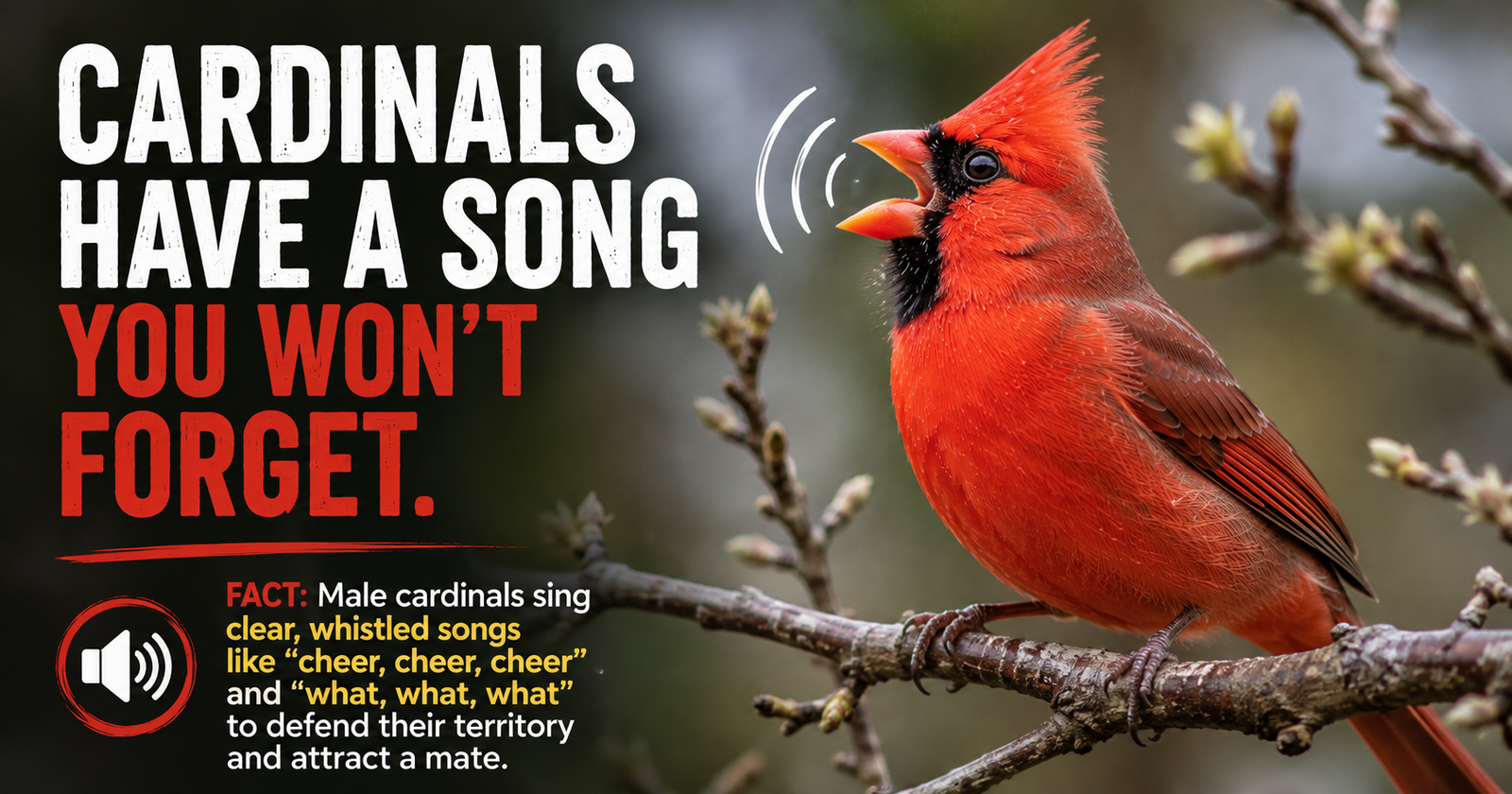
Their song is loud, clear, and whistled. Some phrases sound almost as if the bird is saying “cheer, cheer, cheer” or “birdie, birdie, birdie.” Then there’s the completely different sound I hear all the time around thick shrubs: a sharp, metallic chip.
That chip is one of my favorite cardinal identification clues because you can hear it when the bird itself is almost impossible to find. Sound-based clues are one part of the broader process covered in our Bird Identification guides.
But there’s something even more surprising about cardinal sounds.
If you’ve always assumed the brilliant red male is doing all the singing, you may have been giving him credit for some of the female’s work.
Female Northern Cardinals sing too.
And she doesn’t necessarily sing exactly like him. Cornell notes that a female can produce songs that are longer and slightly more complex than her mate’s.
Once you start listening instead of only looking for red feathers, Northern Cardinals become much easier to find.
What Does a Cardinal Sound Like?
The classic Northern Cardinal song consists of a series of loud, clear whistles.
These notes may be down-slurred or have two distinct parts, and a song typically lasts only about 2 to 3 seconds. The whistles may speed up before ending with a slower trill.
Trying to turn bird sounds into English words is never perfect, but it can be incredibly useful when you’re first learning them.
Cardinal songs are commonly described as sounding something like:
cheer, cheer, cheer
or:
birdie, birdie, birdie
You may also hear phrases people interpret as what-cheer, purty-purty-purty, or sweet-sweet-sweet. Audubon describes several of these recognizable variations.
Don’t worry about memorizing one exact phrase.
Cardinals have a repertoire.
Instead, learn the quality of the voice.
It’s clear.
It’s whistled.
It’s strong.
And once your ears lock onto that cardinal sound, it becomes surprisingly recognizable.


Listen for the Cardinal You Can’t See
Cardinals spend a lot of time in exactly the kind of vegetation that makes birdwatching frustrating.
Thick shrubs.
Brushy edges.
Vine tangles.
Low branches.

Cornell specifically notes that cardinals can be inconspicuous away from backyard feeders because of their preference for dense vegetation. Their piercing chip notes are one of the best ways to locate birds hidden in those tangles. If you want to make those visits more likely, attract cardinals to your yard with suitable food, water, and protective cover.
I’ve found this is a much better approach than staring into a bush hoping something red moves.
Hear the chip.
Stop.
Watch the vegetation.
Then look for movement.
You may suddenly notice the cardinal that had probably been watching you the entire time.

Our Northern Cardinal identification and behavior guide gives you the visual clues to use once you finally locate the bird.
What Is the Cardinal Chip Sound?
The chip is probably the cardinal call I’d want every backyard birdwatcher to recognize.
It’s short.
Sharp.
Metallic.
And very different from the flowing whistles of the cardinal’s song.
Cornell describes the loud metallic chip as the Northern Cardinal’s most commonly heard call, even though scientists have described at least 16 different cardinal calls.
Once you recognize that chip, you’ll hear it in all kinds of situations.
Sometimes a cardinal seems to be practically shouting it.
Other times you hear an occasional chip coming from somewhere deep inside a hedge.
That little sound can reveal a bird you never would have noticed visually.
Why Do Cardinals Make a Chip Sound?
Here’s where things get interesting.
The chip doesn’t have one single meaning.
Northern Cardinals use it in several situations.
Cornell reports that cardinals make this call when warning intruders away from a territory, when predators are nearby, as females approach their nests, when adults carry food toward a nest, and even when parents are encouraging nestlings to leave.
So hearing:
CHIP!
doesn’t translate perfectly into one English sentence.
Context matters.
A male repeatedly chipping at another cardinal near his breeding territory may be communicating something quite different from a parent quietly moving through vegetation near its young.
Bird sounds aren’t just noises.
They’re communication.

Cardinal Song vs Cardinal Call
These terms are often used interchangeably in casual conversation, but there’s a useful difference.
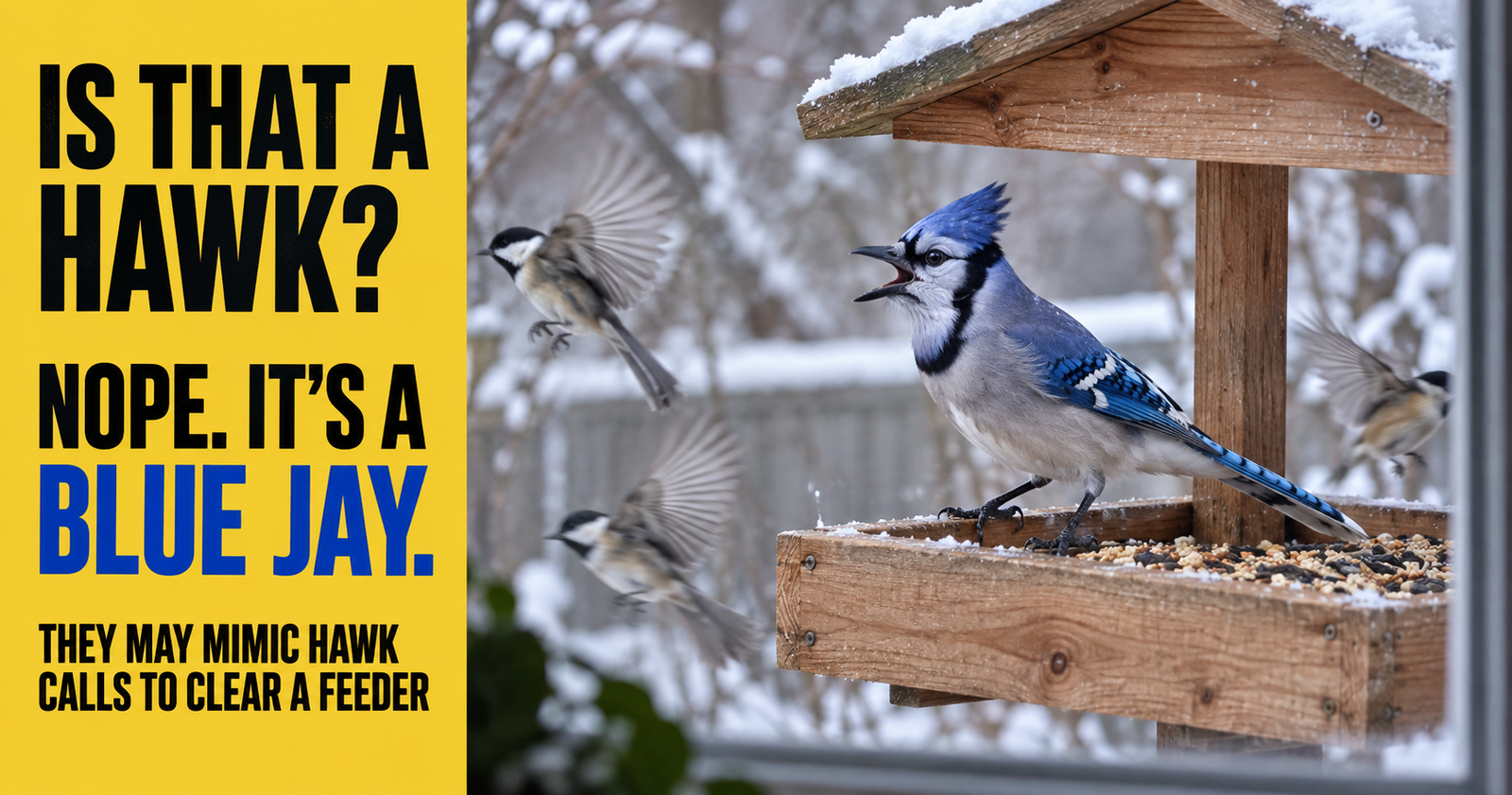
The song is the longer, more musical series of whistles.
The calls tend to be shorter sounds used in different everyday situations.
So:
“cheer-cheer-cheer” = song
“chip!” = call
That’s simplified, but it’s a useful starting point.
Once you recognize both, you’ve essentially learned two completely different ways to locate a Northern Cardinal.
You can hear the beautiful whistled song from surprisingly far away.
Or you can hear one tiny metallic chip coming from the shrub six feet in front of you.
Do Female Cardinals Sing?
Yes.
And this is one of my favorite Northern Cardinal facts because it surprises so many people.
Both male and female Northern Cardinals sing.
Female song is relatively unusual among the familiar North American songbirds many people encounter, which makes the cardinal particularly interesting. Cornell notes that the female sings alone and can also sing in duet with her mate.
So if you hear a beautiful cardinal song and then finally find the singer, don’t be surprised if the bird is brown rather than brilliant red.
You didn’t identify the sound incorrectly.
You found a singing female.
What Does a Female Cardinal Sound Like?
A female cardinal’s song can sound very similar to the male’s because the pair may share song phrases.
But Cornell notes something especially interesting: the female’s song can be longer and slightly more complex than the male’s.
That completely flips the assumption that the male must be doing all the impressive singing.
Females can produce those same clear, whistled cardinal-type phrases.
Cornell’s Bird Academy describes the female as being just as capable a singer as the male.
If you’re trying to identify the bird visually after hearing it, remember that an adult female is mostly pale brown with warm reddish coloring in her crest, wings, and tail. She also has the heavy reddish-orange bill characteristic of adult cardinals.
Why Do Female Cardinals Sing?
Female cardinal song isn’t simply background music.
It can serve a purpose within the pair.
One of the most fascinating examples happens during nesting.
Cornell notes that females may sing while sitting on the nest, potentially communicating information to the male about when he should bring food.
Think about that for a second.
She’s sitting inside a concealed nest.
He’s somewhere outside.
And they’re communicating vocally.
The bright red male doesn’t have to continuously approach the nest just to figure out what’s happening.
The pair can exchange information through sound.

That adds another layer to the behaviors we covered in our guide to what really happens between cardinal pairs.
Do Male and Female Cardinals Sing Together?
They can.
Female Northern Cardinals have been documented singing in duet with males.
A mated pair can also share song phrases.
That’s one reason cardinal vocal behavior is much more interesting than simply:
Male sings to attract female.
Yes, male song plays an important role in breeding and territorial behavior.
But cardinal communication continues between paired birds, around nests, while feeding, and while caring for young. Our guides to bird behavior explore communication and other everyday questions about different species.
Their vocal world is considerably richer than the song we hear from the patio.
Why Do Male Cardinals Sing?
Male song is strongly associated with territory and breeding.
A singing male is essentially making himself very noticeable.
He may perch prominently and broadcast those whistles across the surrounding area.
Spring and early summer are particularly active singing periods. Cornell notes that males may sing throughout the year, but singing peaks during spring and early summer.
That’s exactly when territorial behavior becomes especially important.
A male has a breeding territory.
Other males need to know it’s occupied.
Potential mates need to know he’s there.
And apparently every sleeping human in the neighborhood needs to know too.

Why Do Cardinals Sing So Early in the Morning?
Cardinals can be among the first obvious singers of the morning.
Cornell describes their sweet summer whistles as some of the first sounds heard in the morning.
Early morning is an important period for bird song generally, especially during breeding season.
Conditions can be good for sound transmission, and birds are beginning a new day of territorial and breeding activity.
For us, it creates one of the easiest opportunities to learn the cardinal’s voice.
Open a window on a spring morning before traffic, lawn equipment, and normal neighborhood noise get going.
Listen for those strong repeating whistles.
Once you recognize them, you’ll probably start hearing cardinals before you’ve even gotten out of bed.
What Time of Year Do Cardinals Sing the Most?
Spring and early summer are the big periods.
Cornell reports that male cardinals may sing throughout the year, but their singing reaches its peak during spring and early summer.
That timing lines up perfectly with breeding.
Pairs are forming or maintaining bonds.
Territories matter.
Nesting activity increases.
Communication becomes particularly important.
This also explains why the cardinal that seemed unbelievably loud every morning in April may become much less noticeable later.
The bird didn’t necessarily leave.
Its behavior changed.
Do Cardinals Sing in Winter?
Yes, cardinal song isn’t strictly limited to spring.
Males can sing throughout the year.
But winter cardinal behavior looks very different from spring behavior.
Northern Cardinals don’t normally migrate, and during fall and winter they can become much more social rather than maintaining the same intense breeding-season territorial behavior.
That means you may still hear vocalizations while the social context around them changes.

Our guide explaining where cardinals really go during winter gets into that seasonal change, including why several cardinals may suddenly tolerate one another around the same feeding area.
Why Is a Cardinal Singing Outside My Window?
Sometimes the answer is wonderfully simple.
There’s a cardinal outside your window.
Your yard may be part of its territory.
The bird may have selected a nearby tree or shrub as a useful singing perch.
And because cardinal songs are loud and clear, a bird that isn’t particularly close can sound as though it’s practically sitting on your windowsill.
If this happens repeatedly during spring, pay attention to the surrounding yard.
You may have a resident pair.

That can eventually mean courtship, nest building, eggs, and young cardinals surprisingly close to your house. If you're hoping to support that process, cardinal nesting habits explains what kind of nesting habitat cardinals actually use.
Why Is a Cardinal Chirping Over and Over?
First, figure out whether you’re hearing a song or a call.
Repeated clear whistles may simply be normal singing.
Repeated sharp chip calls deserve more context.
Is another cardinal nearby?
Is a cat moving through the yard?
Are you standing near dense vegetation containing a nest?
Are fledglings hiding nearby?
Cornell reports that the cardinal’s chip call is used in territorial situations, around predators, near nests, during food deliveries, and during interactions with young.
So repeated chipping may be worth paying attention to.
The bird could be telling you that something is happening.
Do Cardinals Make Alarm Calls?
Yes.
The chip call can function as an alarm when predators are nearby.
This is another reason I don’t automatically walk toward a cardinal every time I hear one chipping repeatedly.
If the bird becomes increasingly agitated as I approach a particular shrub, I’d consider whether there’s a nest or young bird nearby.
Sometimes the best birdwatching decision is backing away.
You don’t have to find the source of every alarm.
The cardinal may be communicating exactly what it wants you to know:
Something is too close.
What Does a Cardinal Sound Like Near Its Nest?
You may hear chip calls around nesting activity.
Cornell notes that females can make the metallic chip while approaching the nest, and both sexes may use calls while carrying food to nestlings.
That creates an interesting identification opportunity.
You may never actually see the nest.
Instead, you notice the same female repeatedly entering a thick shrub.
Then you hear chips.
Later, you see an adult carrying an insect into the same area.
At that point, the birds are giving you plenty of clues without you ever having to push branches apart.
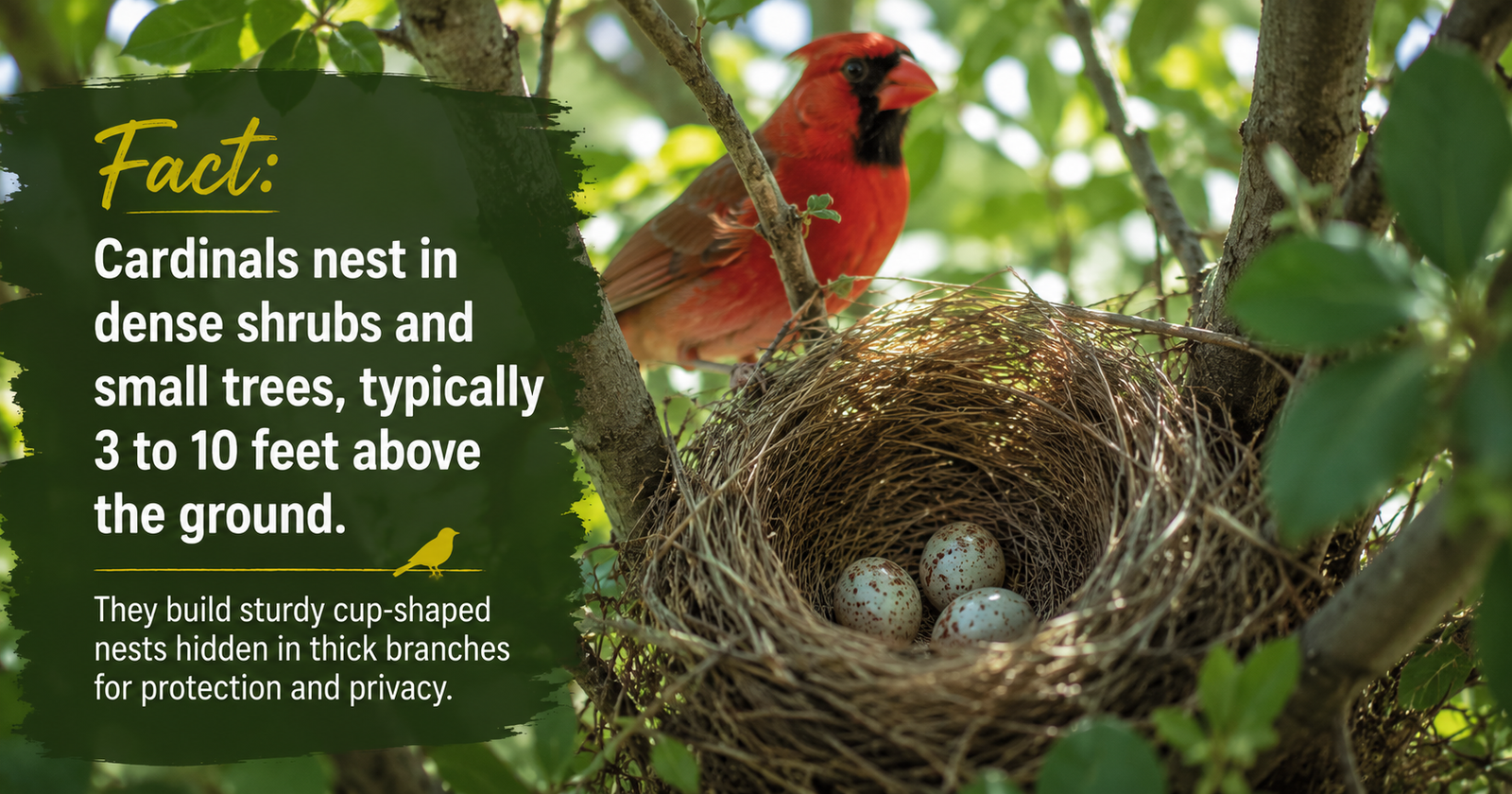
Our guide to where cardinals hide their nests explains why these nests can be so difficult to see even when they’re surprisingly close to your house.
Do Baby Cardinals Make Sounds?
Absolutely.
Baby birds aren’t exactly known for quietly waiting for lunch.
Nestlings communicate with their parents, and fledglings continue using sounds as they move into vegetation outside the nest.

Cornell’s Bird Academy describes soft chipping communication between cardinal parents and young as a way of coordinating movement through vegetation without unnecessarily broadcasting their exact location to predators. Food is another important part of this stage, especially the cardinal food needs during nesting that parents must meet while raising young.
That’s fascinating because it shows just how different bird communication can be depending on the situation.
A territorial song can be loud and conspicuous.
Family communication can be much quieter.
Sometimes the entire point is not to announce yourself to the neighborhood.
Why Is a Baby Cardinal Chirping?
Hunger is one obvious possibility.
Young birds use vocal communication with their parents and can beg for food.
But again, context matters.
A fledgling sitting alone and calling isn’t automatically an abandoned baby.
Its parents may be nearby gathering food.
Young cardinals continue receiving parental care after leaving the nest, so hearing one calling from a shrub or low branch can be completely normal.

Our guide to what happens after baby cardinals leave the nest explains why these awkward brown youngsters may appear alone even while their parents are still actively caring for them.
Do Cardinals Have Different Calls for Different Situations?
Yes.
This is one of the reasons I don’t like describing the cardinal as having “one call.”
Cornell notes that scientists have described at least 16 calls for Northern Cardinals.
The metallic chip is simply the one most people are likely to recognize.
Cardinals also use a softer note that Cornell describes as sounding something like took when one member of a pair is about to feed the other.
So there’s a whole vocabulary happening around us that most people never notice.
You don’t need to memorize 16 cardinal calls to enjoy watching them.
Learning the major song and chip call gets you surprisingly far.
Can Cardinals Mimic Other Birds?
Northern Cardinals aren’t famous mimics in the way Northern Mockingbirds are.
Their recognizable songs come from their own vocal repertoire rather than being built around extensive imitation of other species.
That doesn’t mean every cardinal sounds identical.
Song phrases vary.
Individual birds have repertoires.
Regional variation can occur.
And converting bird sounds into words like “cheer” or “birdie” is always approximate.
So don’t reject a cardinal identification just because it didn’t sing the exact phrase you memorized.
Listen for the overall characteristics of the sound.
How Do Cardinals Make Their Sounds?
Birds don’t produce their songs exactly the way humans produce speech.
We use a larynx.
Birds use a specialized vocal organ called the syrinx, located where the airway branches toward the lungs.
The cardinal’s syrinx has two sides capable of producing sound independently. Cornell’s Bird Academy explains that a cardinal can actually switch between sides during a whistle, allowing it to create remarkably smooth sweeps across different frequencies.
That’s happening inside a bird weighing only around an ounce and a half.
It’s easy to hear a cardinal whistle and think:
“Pretty bird.”
The actual mechanics behind that whistle are incredible.
How Loud Is a Cardinal?
Cardinal song can carry remarkably well, especially when a bird chooses an exposed singing perch.
There isn’t one useful decibel number I’d attach to every cardinal because perceived loudness depends on distance, surroundings, the particular vocalization, and recording conditions.
What matters for identification is that their songs tend to sound clear, strong, and penetrating rather than faint or muffled.
The chip call can also be surprisingly sharp.
That’s why a hidden cardinal can make itself extremely obvious acoustically while remaining completely invisible visually.
Can You Identify a Cardinal by Sound Alone?
Yes, once you’re familiar enough with its vocalizations.
Birding by ear is incredibly useful for Northern Cardinals because they spend so much time in dense vegetation.
Cornell actually recommends learning their piercing chip note as a way to find cardinals hiding in tangles.
I wouldn’t expect someone to become perfect after hearing one recording.
Listen repeatedly.
Then listen outside.
Connect the sound with an actual bird whenever possible.
Eventually, your brain stops going:
“What bird is making that?”
and starts going:
“Cardinal.”
almost automatically.
Cardinal vs Robin Sound
American Robins and Northern Cardinals can both be prominent backyard singers, particularly around dawn, but their songs have different structures and qualities.
The Northern Cardinal tends to produce clear repeated whistles that can sound like recognizable short phrases.
An American Robin’s song is often described as a series of more varied, caroling phrases.
Instead of trying to memorize written descriptions forever, listen to verified recordings of each species and compare them directly.
After enough repetition, the distinction becomes much easier.
Cardinal vs Tufted Titmouse Sound
This comparison can trip people up.
Tufted Titmice are also loud backyard birds capable of repeating clear whistled phrases.
Depending on the particular songs being given, a beginner can absolutely hear one and think cardinal.
The best approach is learning several vocalizations from each species instead of memorizing one English translation.
And whenever possible, verify the singer visually.
After you connect a sound to the correct bird several times, identification becomes much easier.
Cardinal vs Carolina Wren Sound
Carolina Wrens are another bird that can make you wonder how something so small produces so much sound.
Their songs are powerful, repetitive, and very noticeable around homes and yards.
But the quality and rhythm differ from the Northern Cardinal’s clearer whistled phrases.
Again, written translations only take us so far.
The more backyard species you learn by ear, the less every loud morning bird starts sounding like “some kind of cardinal.”
Is There a Bird That Sounds Like a Cardinal?
Definitely.
Depending on where you live and which particular cardinal phrase you’re hearing, several birds can create confusion.
Tufted Titmice are one.
Carolina Wrens can fool beginners.
Other whistling songbirds can occasionally produce phrases that make you stop and reconsider.
That’s why I don’t identify birds from one syllable alone when I can avoid it.
Listen to the entire phrase.
Listen for repetition.
Pay attention to habitat.
Then try to find the singer.
Bird identification works best when sound, appearance, location, and behavior all point toward the same answer. This is consistent with Bird Resource's research approach, which favor careful, evidence-based explanations over a single isolated clue.
Why Does My Cardinal Sound Different From Recordings Online?
Because cardinals aren’t little MP3 players.
They don’t all sing one identical recording.
Individual variation exists, and a bird can know multiple song types.
You may also be hearing a different portion of the bird’s repertoire than the recording you listened to.
Distance changes sound.
Buildings reflect it.
Vegetation muffles it.
Wind interferes with it.
Phone microphones change it.
And human attempts to turn whistles into phrases like “birdie” are subjective in the first place.
Use recordings to learn the pattern and quality, not to demand an exact audio match every time.
Do Cardinals Sing When They’re Angry?
“Angry” is a human word that can oversimplify bird behavior, but cardinals absolutely vocalize during territorial encounters.
The metallic chip can be used when warning intruders away from a territory.
During breeding season, cardinals can become intensely territorial.
That’s also when they sometimes make the bizarre mistake of treating their own reflection as another bird.
A male may repeatedly confront a window or mirror because the “intruder” refuses to leave.

If you’re hearing a cardinal vocalizing while repeatedly striking glass, our guide to why cardinals attack windows and how to stop it explains what’s actually happening and how to break the reflection.
Do Cardinals Sing When They’re Happy?
We have to be careful here.
It’s tempting to hear a beautiful cardinal singing on a sunny morning and say:
“He’s happy!”
Maybe the bird is doing perfectly well.
But song has biological functions involving territory, courtship, pair communication, and other social behavior.
We can’t simply translate a beautiful sound into a human emotion because that’s how it makes us feel.
That’s something I want to keep consistent throughout BirdResource.com.
We can enjoy birds without pretending we know exactly what they’re thinking.
Sometimes the scientifically accurate explanation is more interesting anyway.
Why Does a Cardinal Keep Making the Same Sound?
Repetition is normal.
Bird song frequently involves repeating phrases, and Northern Cardinal songs can consist of repeated syllables.
A male advertising his territory isn’t trying to entertain himself with a constantly changing playlist.
Repeating a recognizable signal works.
Calls can repeat too.
A cardinal responding to a predator or territorial situation may continue chipping while that situation remains unresolved.
If you’re the thing standing near its nest and the bird keeps chipping at you, consider taking the hint.
What Does a Cardinal Sound Like at Night?

Northern Cardinals are primarily active during daylight, so hearing classic cardinal song in the middle of the night would be less typical than hearing it around dawn or during daytime. Their quiet nighttime behavior makes more sense when you know where cardinals rest overnight.
Around artificial lighting or during unusual conditions, bird activity doesn’t always follow a perfectly clean schedule.
But if you’re hearing a mysterious repeated bird sound at 2 a.m., I wouldn’t assume Northern Cardinal simply because cardinals live in your yard.
Nighttime birds deserve their own identification process.
Owls, nightjars, migrating birds, and even non-bird animals can create sounds people mistakenly attribute to familiar daytime species.
What’s the Easiest Cardinal Sound to Learn?
For me, I’d learn two.
First:
The loud whistled song.
Think along the lines of cheer-cheer-cheer or birdie-birdie-birdie.
Second:
The sharp metallic chip.
Those two sounds cover a huge amount of everyday cardinal activity.
The song can alert you to a bird singing from farther away.
The chip can expose a cardinal hiding almost directly beside you.
Once those sounds become familiar, you’ll probably start finding more cardinals without changing anything about where you bird.
You simply learned how to listen.
The Cardinal You Hear May Not Be the Cardinal You Expect
There’s something I love about learning cardinal sounds.
At first, most people identify the species almost entirely by color.
Bright red bird?
Male cardinal.
Brown bird with red accents and a crest?
Female cardinal.
Then you start listening.
Suddenly, the bird doesn’t have to be visible.
You hear a whistle from somewhere beyond the yard and know a cardinal is there.
You hear a metallic chip buried in a hedge and start looking for movement.
And eventually you hear that beautiful whistled song, follow it to the source, and find something you weren’t expecting.
A female.
That’s when cardinal identification becomes much more than recognizing a red bird.
You’re starting to recognize how the bird communicates.
Common Questions About Cardinal Sounds
What is the most common cardinal sound?
The classic song consists of loud, clear whistles, while the metallic chip is the most commonly heard cardinal call. Cornell notes that scientists have described at least 16 different calls for the species.
What words sound like a cardinal song?
Common interpretations include phrases resembling cheer-cheer-cheer and birdie-birdie-birdie. Audubon also describes sounds resembling what-cheer, purty-purty-purty, and sweet-sweet-sweet.
Do female cardinals chirp?
Yes. Female cardinals use calls and also sing full songs. Female Northern Cardinals are accomplished singers and may even duet with their mates.
Is it rare for a female cardinal to sing?
Female song is unusual enough among familiar North American songbirds to surprise many people, but singing is normal behavior for female Northern Cardinals. Cornell notes that females can sing while sitting on the nest.
What does a cardinal warning call sound like?
The familiar warning or alarm vocalization is a sharp, metallic chip. Cardinals use this call in several contexts, including when predators are nearby.
Why is a cardinal making a clicking or ticking sound?
What you’re describing may be the cardinal’s short metallic chip call, especially if the sound is sharp and repeatedly coming from dense vegetation. Try to visually locate the bird before assuming the identification.
Do cardinals sing all year?
Males may sing throughout the year, although singing is strongest during spring and early summer.
Do cardinals sing before sunrise?
They can be very early singers, and Cornell describes cardinal whistles as among the first bird sounds heard on summer mornings.
Why is a cardinal chirping at me?
It may not literally be directing the call “at you,” but if a cardinal begins repeatedly chipping when you approach dense vegetation, consider whether you’re near a nest, fledgling, or other area the bird considers important. Cardinals use chip calls in territorial, predator, nesting, and family contexts.
What’s the best way to learn a cardinal’s song?
Listen to several verified recordings rather than memorizing one written phrase. Cornell’s Northern Cardinal sound library includes multiple songs and calls from the Macaulay Library, which makes it useful for hearing the natural variation between birds.
Listen to real Northern Cardinal songs and calls at Cornell
Then go outside and try to connect the recording with an actual bird.
That’s where it sticks.
Soon enough, you may hear those first clear whistles in the morning and know exactly who’s outside before you ever open the blinds.
Caleb Hartwell is the Bird Identification & Behavior Contributor for BirdResource.com, where he helps everyday birdwatchers identify the birds around them by more than color alone, from songs and calls to nesting, feeding, seasonal movements, fledglings, and the behaviors that reveal what a bird is actually doing.