
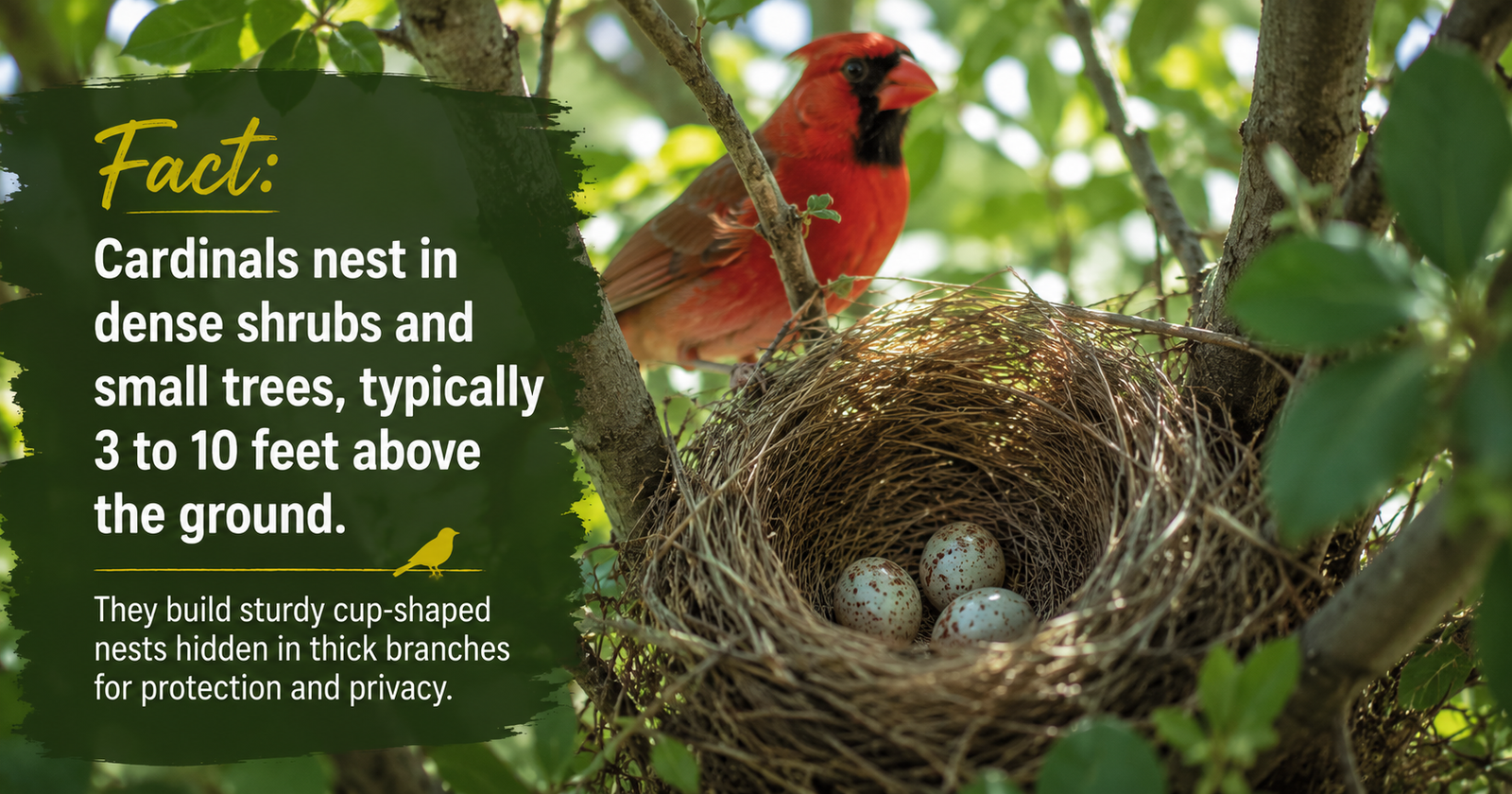
Northern Cardinals don’t need a towering tree or a traditional birdhouse to raise a family. In fact, a cardinal nest can be surprisingly close to your house and still go completely unnoticed.
The place I’d look first isn’t high in the treetops.
I’d look inside thick shrubs, tangled vines, brambles, hedges, and small trees where leaves and branches make it difficult to see very far into the vegetation.
That’s exactly what cardinals want.
Their nest is an open cup rather than an enclosed cavity, so hiding it inside dense growth provides valuable protection. Northern Cardinal nests are commonly positioned only a few feet above the ground, although they can be considerably higher. The nest is separate from the sheltered nighttime perch described in where cardinals sleep at night.
And if you’ve been watching a male and female repeatedly disappear into the same bush, there’s a chance you’ve already found the general neighborhood of their nest without realizing it.
Where Do Northern Cardinals Usually Build Their Nests?
Northern Cardinals typically nest in dense shrubs, small trees, saplings, brambles, or tangles of vines.
The nest itself is usually wedged into a fork formed by small branches and surrounded by foliage.
Cornell reports Northern Cardinal nests from about 1 to 15 feet above the ground.
That’s a huge clue for anyone trying to understand cardinal nesting behavior.
People naturally look upward when they think about bird nests. With cardinals, I’d spend much more time examining the structure of dense vegetation at eye level and below the lower tree canopy.
You might have a cardinal nest only five feet from the ground.
You could walk past it every morning and never see it.

Why Are Cardinal Nests So Hard to Find?
Cardinals aren’t trying to give us a good view.
The female selects a location surrounded by enough vegetation to conceal herself, her eggs, and eventually her nestlings.
That means the best cardinal nest site can look frustratingly terrible from a photographer’s perspective.
Branches cross in front of it.
Leaves block your view.
Vines create a tangled mess.
The nest seems buried inside the plant instead of conveniently sitting on an exposed branch.
That’s the point.
Cardinals are open-cup nesters, and concealment is part of their protection.

Our broader Northern Cardinal identification and behavior guide is useful if you’re trying to determine whether the birds repeatedly entering your shrubs really are cardinals before assuming you’ve discovered a nest.


How High Off the Ground Is a Cardinal Nest?
A Northern Cardinal nest can be surprisingly low.
Cornell gives a typical documented range of approximately 1 to 15 feet above ground, while Audubon’s species account describes nests as usually hidden in dense shrubs, vines, or low trees and commonly around 3 to 10 feet high.
So there isn’t one magic height where you should look.
A nest at chest height can be perfectly normal.
So can one considerably higher.
What’s often more revealing than height is cover.
If I were choosing between an exposed branch eight feet up and an extremely dense shrub four feet up, the shrub looks much more like typical cardinal nesting habitat.
Do Cardinals Nest in Bushes?
Absolutely.
Bushes and shrubs are some of the most characteristic places to find Northern Cardinal nests.
Cardinals particularly favor dense growth where the nest can disappear behind leaves and branches.
Cornell lists many plants used for nesting, including dogwood, honeysuckle, hawthorn, rose bushes, blackberry brambles, grape, redcedar, spruce, pine, elm, sugar maple, and box elder.
I wouldn’t interpret that as a shopping list, though.
You don’t need one particular species of shrub before cardinals can nest in your yard.
The structure and concealment provided by the vegetation are extremely important.

Do Cardinals Nest in Hedges?
They can.
A thick hedge can provide exactly the type of dense branching and foliage cardinals use for nesting.
This is why I’d be cautious with aggressive hedge trimming during nesting season when you know cardinals are active around the property.
If a female keeps slipping into the same section of hedge, don’t immediately grab the trimmers and start investigating.
Watch from a distance first.
Repeated trips into one concealed location can tell you much more than pulling branches apart to look for a nest.
Do Cardinals Nest in Vines?
Yes.
Dense vine tangles can make excellent cardinal nesting locations.
Cornell specifically includes vine tangles among common nest placements and lists grape and honeysuckle among plants used by nesting cardinals.
Again, this fits the larger pattern.
Cardinals aren’t searching for a particular plant name printed on a nursery tag.
They’re looking for a place that provides the structure and concealment needed to support and hide an open-cup nest.

Do Cardinals Nest Close to Houses?
They certainly can.
Northern Cardinals are extremely comfortable in suburban landscapes, gardens, parks, woodland edges, and other environments around people. Cornell describes them as common in backyards and ornamental landscaping as long as appropriate dense vegetation is available.
That means a cardinal doesn’t necessarily need to disappear deep into a forest to nest.
The dense shrub beside your porch may offer exactly what it needs.
A vine-covered fence can potentially provide useful structure.
A thick landscaping bed along the side of a house can be more attractive than we’d expect.

Our guide to making a yard attractive to Northern Cardinals explains why vegetation, food, water, and protective cover work together much better than simply hanging a feeder and hoping a pair decides to stay.
Do Cardinals Build Nests in Trees?
Yes, but usually think small trees and dense foliage, not necessarily a nest perched high in a giant mature tree.
Cardinals can use saplings and various tree species when they provide an appropriate fork and enough surrounding cover.

Their preference for lower, brushier vegetation is one reason a cardinal nest can feel very different from the big exposed nests people notice high overhead. Once you locate a hidden nest, what cardinal eggs look like can provide another set of clues while you observe from a respectful distance.
You may be looking too high.

What Does a Cardinal Nest Look Like?
A Northern Cardinal nest is an open cup.
And there’s more going on inside that little cup than its somewhat rough exterior suggests.
The female constructs the nest in layers.
Cornell describes a four-layer structure beginning with coarse twigs, followed by a leafy mat, grapevine bark, and finally an interior lining of grasses, stems, rootlets, and pine needles.
The finished nest is generally about 2 to 3 inches tall and around 4 inches across, with an inner diameter near 3 inches.
It’s not enormous.
Once it’s tucked into dense foliage, it can virtually disappear.
Who Builds the Cardinal Nest?
The female does most of the actual construction.
The male may bring her nesting material, but she’s the primary builder.
Watching her work is pretty impressive.
Cornell describes the female crushing twigs with her bill until they’re pliable, then turning inside the developing nest to bend the material around her body and push it into a cup shape with her feet.
In other words, her own body helps determine the shape of the nest.
That little cup isn’t simply a random pile of sticks wedged into a bush.
It’s deliberately constructed.
Does the Male Cardinal Help Build the Nest?
Yes, although his role is smaller.
The male sometimes brings nesting material to the female while she handles most of the construction.
His involvement with the breeding cycle becomes even more obvious later.

He may feed the female during courtship and around incubation, helps defend the territory, and joins her in feeding their young. Territory defense can sometimes extend to reflective surfaces, leading to territorial window attacks.

Our article about how cardinal pairs actually stay together and raise a family goes much deeper into those male and female roles.
The nest may be primarily her construction project, but raising a brood becomes a two-parent operation.
How Long Does It Take a Cardinal to Build a Nest?
Usually several days.
Cornell reports a construction period of approximately 3 to 9 days.
Before construction even begins, the pair can spend time investigating potential locations.
About a week or two before the female starts building, she may visit possible nest sites while the male follows. The birds can call back and forth and even carry nesting material while evaluating locations.
So if you see a cardinal carrying little pieces of vegetation, pay attention to where it goes.
You may be watching the earliest stages of nesting.
What Materials Do Cardinals Use for Their Nests?
Cardinals aren’t ordering standardized construction materials.
They work with what’s available.
Typical materials include twigs, leaves, bark, grasses, stems, rootlets, and pine needles. Cornell notes that bits of human trash occasionally make their way into the coarse outer structure too.
I wouldn’t intentionally put out string, yarn, fishing line, dryer lint, or other potentially hazardous materials in hopes of helping them.
Natural nesting materials already exist throughout a healthy yard.
Sometimes the most helpful thing we can do is simply stop cleaning every last twig and dry plant stem out of the landscape.
Do Cardinals Use Birdhouses?
This is one of the biggest misunderstandings about attracting nesting cardinals.
Northern Cardinals do not normally nest in traditional enclosed birdhouses.
They’re open-cup nesters rather than cavity nesters.
A bluebird-style box with a round entrance hole isn’t what a cardinal naturally seeks.
If someone is selling a product labeled as a “cardinal birdhouse,” I’d look carefully at what they’re actually promising before buying it specifically for Northern Cardinals.
If your goal is nesting habitat, dense shrubs and vegetation are far more important.
Will Cardinals Use a Nesting Shelf?
You may see open nesting shelves marketed toward cardinals and other open-cup nesting birds.
Could a bird potentially use one? Sure.
Would I tell you that installing one is the secret to getting cardinals to nest beside your house? No.
Their normal nesting strategy already works perfectly well when suitable vegetation exists.
I’d put my effort into habitat first.

A good shrub can potentially provide nesting cover, shelter, insects, and sometimes natural food. Those benefits are closely connected to the foods cardinals find naturally, which can help make a yard more valuable throughout the year.
A wooden shelf mostly provides a wooden shelf.
Do Cardinals Reuse the Same Nest?
Usually not.
Cornell specifically notes that Northern Cardinals generally do not use their nests more than once.
This surprises people because cardinals can raise multiple broods in one breeding season.
It would seem much easier to return to the perfectly good nest they already built.
But that’s generally not what happens.
The female typically builds another nest for a subsequent nesting attempt.
That means one cardinal pair can potentially leave several old nests around the same general territory over time.
Why Don’t Cardinals Reuse Their Nests?
An old songbird nest isn’t necessarily a valuable piece of real estate.
It has already been exposed.
Predators may have discovered its location.
Parasites may be present.
The structure may have deteriorated after holding growing nestlings and being exposed to weather.
Cornell ornithologist Kevin McGowan has also explained the broader advantage small birds gain by not repeatedly returning to a nest site predators may already know about.
Building again requires work, but hiding the next brood somewhere new has obvious advantages.
Do Cardinals Return to the Same Area to Nest?
They can remain within an established territory even though they don’t normally reuse the exact nest.
That’s an important distinction.
Same yard doesn’t mean same nest.
A pair with good habitat may continue nesting in the general area while selecting different shrubs, branches, or tangles for individual nesting attempts.
So finding an abandoned cardinal nest doesn’t mean the birds have permanently left your property.
They may be building another one surprisingly close by.
How Many Eggs Are in a Cardinal Nest?
Northern Cardinals typically lay 2 to 5 eggs per clutch, according to Cornell.
Audubon describes three to four as common while likewise noting a range of two to five.
The eggs themselves are light-colored with darker markings.
We’re giving what cardinal eggs look like its own identification guide next because egg color, size, markings, incubation, and similar-looking eggs deserve more than a paragraph here.
More importantly, nobody needs to push foliage aside and disturb an active nest just to count the eggs.
How Long Do Cardinals Sit on Their Eggs?
Incubation lasts roughly 11 to 13 days, with the female performing the incubation.
That’s remarkably quick when you think about it.
Less than two weeks after incubation begins, tiny helpless hatchlings can be inside that cup.
Then development speeds up even more.
Cardinal nestlings remain in the nest only about 7 to 13 days before reaching the fledgling stage.
An active cardinal nest can therefore change dramatically in a matter of weeks.
What Happens After the Cardinal Eggs Hatch?
The parents suddenly have a lot of mouths to feed.
Both male and female Northern Cardinals feed their nestlings, and the youngsters receive primarily insects.
Those babies begin life in a completely helpless condition.

At hatching they’re mostly naked, their eyes are closed, and only sparse grayish down covers portions of the body.
A little over a week later, they may be preparing to leave the nest.
That’s an astonishing transformation.
Our guide to identifying baby cardinals at every early stage shows what changes between hatchling, nestling, fledgling, and juvenile stages, including the dark bill that makes young cardinals easier to separate from adult females.
How Long Do Baby Cardinals Stay in the Nest?
Usually around 7 to 13 days after hatching according to Cornell, while Audubon describes young commonly leaving around 9 to 11 days.
That can seem incredibly early.
A fledgling leaving the nest isn’t equivalent to an adult bird suddenly becoming independent.
The parents continue caring for it.
Young cardinals may spend time low in shrubs or even on the ground while their flight abilities continue developing.

This is why discovering a feathered young cardinal outside a nest doesn’t automatically mean it fell out and needs to be put back. The timing and behavior behind this transition are explained in feathered young cardinal outside a nest.
Do Cardinals Have More Than One Nest Each Year?
They can.
Northern Cardinals commonly make multiple nesting attempts during a breeding season.
Sources differ somewhat in how they characterize typical brood numbers. Cornell lists 1 to 2 broods, while Audubon’s field guide describes 2 to 3 broods per year, rarely 4.
Rather than pretending nature follows a fixed number, the useful takeaway is this:
One successful nest doesn’t necessarily end the breeding season for a cardinal pair.
They may do it all over again.
And they’ll generally build another nest.
When Do Cardinals Nest?
The exact timing varies across their large geographic range.
Cardinals living in the southern United States don’t experience spring on the same schedule as birds farther north.
Broadly, nesting activity ramps up in spring and can continue well into summer as pairs make additional attempts.
This is why I pay attention to behavior rather than relying on one calendar date.
A female repeatedly carrying plant material into a shrub is giving you a much stronger local clue than a generic statement saying “cardinals nest in April.”
How Can I Tell If Cardinals Are Nesting in My Yard?
You may notice the birds’ behavior before you ever see the nest.
Watch for a female repeatedly entering the same dense area.
Look for nesting material being carried.
Listen for increased territorial singing.
Later, watch for adults carrying insects toward one particular shrub or hedge.
Once nestlings hatch, food deliveries can become surprisingly frequent.
You don’t have to locate the exact cup.
Sometimes knowing there’s probably a nest in that shrub is enough.
Should I Look Inside a Cardinal Nest?
I wouldn’t make a habit of it.
Finding a nest creates an understandable urge to see the eggs or babies.
But repeatedly approaching, touching vegetation, moving branches, or standing directly over the nest can disturb the birds and potentially make the nest more conspicuous.
Enjoy it from farther away.

Binoculars can give you a much better view of the parents without putting your face into their nursery. For watching birds away from the nest without approaching them, a smart feeder camera is another option; our smart feeder camera option reviews one example.
If you’re photographing nesting birds, the photograph isn’t worth stressing the family.
Can I Move a Cardinal Nest?
An active native bird nest isn’t something I’d casually relocate because it’s inconvenient.
Northern Cardinals are protected under the federal Migratory Bird Treaty Act in the United States, and active nests containing eggs or dependent young should be left alone.
If an active nest creates a genuine safety or unavoidable property issue, don’t improvise.
Seek guidance from the appropriate wildlife authority before taking action.
Most of the time, the easiest answer is simply patience.
Cardinal nesting happens fast.
What If a Cardinal Builds a Nest Somewhere Inconvenient?
This happens.
A shrub beside a busy walkway suddenly becomes a nursery.
A vine you planned to trim has a female sitting inside it.
The hedge desperately needs cutting right when eggs appear.
When possible, I’d postpone the work.
Cardinal incubation lasts less than two weeks, and the nestling period is similarly short.
That doesn’t mean the fledglings instantly disappear once they leave, but the period when the actual nest is active can pass surprisingly quickly.
Sometimes doing nothing for a few weeks is the easiest wildlife solution you’ll ever have.
Should I Trim a Bush With a Cardinal Nest?
Not while the nest is active.
Even if you don’t directly touch the nest, removing surrounding foliage can destroy the concealment the birds selected in the first place.
Remember why that nest was difficult to see.
The leaves and branches around it are part of what makes the location useful.
I’d wait until nesting is finished before doing major pruning around that particular site.
And because cardinals may make another nesting attempt elsewhere nearby, keep an eye out before cutting heavily into dense vegetation during breeding season.
What If I Find an Empty Cardinal Nest?
An empty nest doesn’t necessarily mean something bad happened.
If the young successfully fledged, the nest has done its job.
Cardinals generally don’t reuse it, so there’s no need to preserve every abandoned nest forever in hopes they’ll move back into the exact cup.
If it’s out of the way, leaving it alone is fine.
If you’re doing normal pruning well after you’re confident the nest is inactive, an old nest isn’t the permanent home of a cardinal family.
Remember:
Birds don’t use nests the way humans use houses.
The nest exists primarily for reproduction.
How Do I Encourage Cardinals to Nest in My Yard?
Forget the birdhouse.
Think vegetation.
Dense shrubs, vine tangles, thickets, hedges, and small trees can provide the concealed structure cardinals seek.
Cornell specifically recommends leaving some backyard undergrowth if you’d like cardinals to nest around your property.
Food and water help make the broader yard useful too.
But if nesting is your goal, cover is critical.
A perfectly open lawn with one feeder may provide dinner.
It doesn’t provide many hidden places to build a nest.
A Cardinal Nest May Be Closer Than You Think
One of the coolest things about Northern Cardinals is how comfortably they can live alongside us while keeping some parts of their lives remarkably well hidden.
The bright red male can be impossible to miss.
He sits on an exposed branch and sings.
He visits the feeder.
He practically announces himself.
Meanwhile, the female can have a little cup nest tucked inside a shrub only a short distance away, and you might walk past it for days without noticing.
That’s not bad luck.
That’s a successful nest location.
If you’re seeing a pair regularly, watch where they go instead of trying to search every branch.
Their movements often tell the story.
And if they repeatedly vanish into one ridiculously thick patch of leaves, resist the temptation to immediately push your way in for a look.
There might be a very good reason they’re being secretive.
Common Questions About Cardinal Nests
What month do cardinals lay eggs?
There isn’t one nationwide month because Northern Cardinals occupy a large range and breeding timing varies geographically and seasonally. Nesting generally begins in spring and can continue through summer with additional nesting attempts.
How high is a cardinal nest?
Northern Cardinal nests are commonly about 1 to 15 feet above the ground, although many are found within the lower portion of that range.
What does a cardinal nest look like?
It’s an open cup built primarily from twigs, leaves, bark, grasses, stems, rootlets, and similar plant material. The finished nest is typically around four inches across and hidden inside dense vegetation.
Do cardinals nest in the same place every year?

They may continue using the same general territory or property, but they usually don’t reuse the exact nest. A new nesting attempt generally means building another nest. Their continued use of the same area also connects to how cardinals use their territory year-round, even though they do not undertake a normal long-distance migration.
Do cardinals use birdhouses?
Not conventional enclosed nest boxes. Northern Cardinals are open-cup nesters that normally build in dense shrubs, vines, saplings, and similar vegetation.
Who makes the cardinal nest?
The female does most of the construction, although the male may bring her nesting material.
Does the male cardinal sit on the nest?
The female performs the incubation. The male contributes in other ways, including territorial defense and bringing food, and both parents feed the nestlings after they hatch.
How long is a cardinal nest active?
Construction can take 3 to 9 days, incubation about 11 to 13 days, and the nestling stage approximately 7 to 13 days.
That means you can go from watching a female carry twigs to seeing fledglings around the yard surprisingly quickly.
What should I do if I accidentally find a cardinal nest?
Give it space.
Don’t repeatedly move branches to check it, don’t touch the eggs or babies, and postpone disruptive pruning around the nest if possible.
Watching the parents from a comfortable distance will usually show you far more interesting behavior anyway.
Will cardinals abandon a nest if I touch it?
The old idea that parent birds automatically abandon their babies because they smell a human isn’t a good reason to panic after accidental contact.
But that doesn’t mean you should handle the nest.
Unnecessary disturbance can create real problems even if human scent isn’t the issue.
Leave an active nest alone and minimize your presence around it.
Where should I look if I think cardinals are nesting nearby?
I’d start with the densest vegetation the birds repeatedly enter, especially shrubs, vines, brambles, hedges, and small trees.
Then I’d stop looking quite so hard.
Watch the adults.
If a female repeatedly slips into the same patch of foliage or you later see adults carrying insects into it, they’ve already given you a pretty convincing answer.
The best cardinal nest in your yard may be the one you never get a perfect look at.
Caleb Hartwell is the Bird Identification & Behavior Contributor for BirdResource.com, where he digs into the details behind the birds people see every day, from hidden nests and fledglings to feeding habits, identification, and the backyard behaviors that make you stop and wonder what they’re actually doing.