

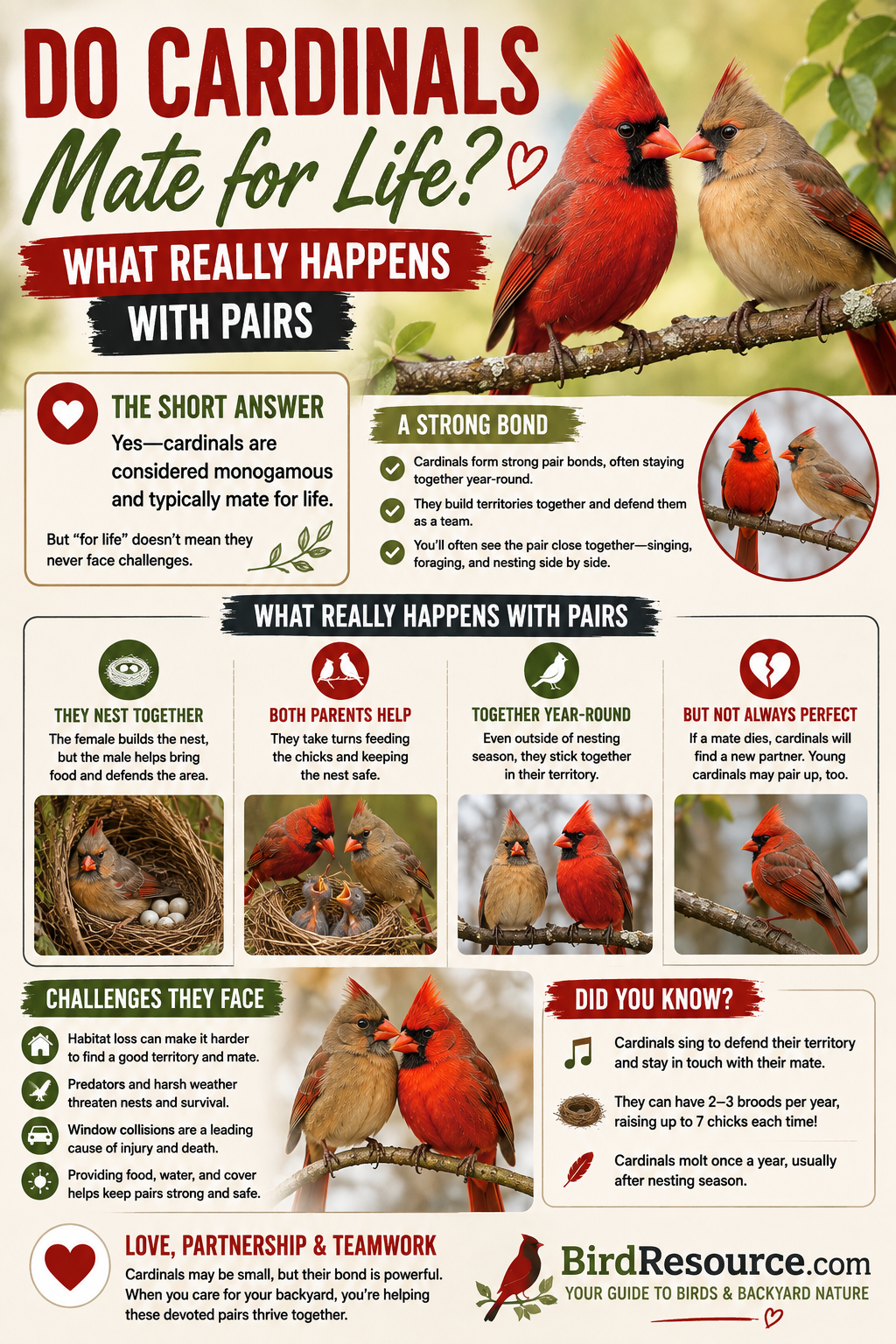
Northern Cardinals can stay with the same mate for multiple breeding seasons, and some pairs remain together through the winter. But saying that cardinals always mate for life goes a little too far.
Cardinals form strong pair bonds, and many pairs do remain together for extended periods. However, pairs can separate between breeding seasons, and a cardinal that loses its mate can pair with another bird. Cornell reports that up to about 20% of Northern Cardinal pairs may split by the following breeding season.
So if someone asks me, “Do cardinals mate for life?” my answer is: sometimes a pair may remain together for years, but cardinals aren’t guaranteed to stay with one mate for the rest of their lives.
That distinction makes their relationships considerably more interesting than the simple “cardinals mate for life” claim that’s repeated so often.
If you’re getting familiar with the species as a whole, our Northern Cardinal identification and behavior guide covers their appearance, habitat, diet, nesting, sounds, and seasonal behavior. Here, I want to concentrate specifically on cardinal pairs and what actually happens between a male and female.
How Long Do Cardinal Pairs Stay Together?
There isn’t one set length of time.
A male and female may remain paired through a breeding season, continue associating through winter, and breed together again the following year. Some pairs can continue that relationship across multiple seasons.
Other pairs separate.
Cornell’s Northern Cardinal life-history information notes that pairs may remain together throughout winter, but up to 20% can split by the next season.
That tells us something important.
Cardinal pair bonds can be long-lasting without necessarily being lifelong.
I think that’s a much better way to describe what people are actually seeing in their yards.

If you’ve watched what appears to be the same male and female around your property for a long time, it’s entirely possible that you’re observing an established pair. But unless the individual birds are marked or otherwise identifiable, it’s difficult to prove that the cardinal beside your feeder this year is the exact same individual you saw there last year. A Kiwibit smart feeder can make it easier to observe recurring feeder visitors without assuming they are the same birds.

Are Cardinals Monogamous?
Northern Cardinals are generally considered socially monogamous.
In practical terms, a male and female form a breeding pair and cooperate in reproduction and raising their young.
That doesn’t mean every detail of cardinal mating fits the human idea of lifelong exclusive partnership.
Social monogamy describes the pair relationship we observe, including territory, courtship, nesting, and parental care. It shouldn’t automatically be translated into “these two birds will remain exclusively together until one dies.”
For backyard birdwatching, though, you’re very likely to encounter cardinals as recognizable male-and-female pairs during the breeding season.
And once you start watching their interactions, the relationship becomes pretty easy to notice.

How Do Cardinals Choose a Mate?
Cardinal courtship involves much more than a male simply showing up beside a female.
Male Northern Cardinals use visual displays, songs, movements, and food during courtship.
A male may position his body to emphasize his bright red plumage, perform short display flights, sing, and interact closely with a prospective mate.
Then comes one of the behaviors cardinals are especially famous for.
The male feeds the female.
He collects a seed or another food item, approaches her, and passes it directly from his bill into hers.
If you happen to see it at the right angle, it looks remarkably like two cardinals kissing.
They aren’t kissing in the human sense.
They’re displaying courtship feeding, and it’s one of the clearest behaviors you can watch between a cardinal pair.
Why Does a Male Cardinal Feed a Female?
Courtship feeding appears to play a role in pair formation and bonding.
The female may even adopt begging-like behavior, including quivering her wings, before accepting food from the male.
There’s a practical side to this behavior too.
A male capable of locating and delivering food is demonstrating something directly relevant to what happens next. Once the pair has young, providing food becomes a major part of raising them.
The male also feeds the female during parts of the breeding cycle.
So that cute “cardinal kiss” at your feeder isn’t simply a random affectionate-looking moment.
It’s tied to reproduction and the pair relationship.
Do Cardinals Really Kiss?
Not in the human sense.
What looks like kissing is usually food being transferred from one bird’s bill to the other’s.
Because the birds face each other and touch bills, the resemblance can be striking.
You might see the male pick up a seed, move toward the female, and place it directly into her bill.
Calling it a “cardinal kiss” is understandable as a casual description, but courtship feeding is the more accurate explanation.
That doesn’t make the behavior any less interesting.
If anything, knowing what you’re watching makes the interaction more meaningful because you’re seeing part of the pair’s actual breeding behavior rather than two birds accidentally touching beaks.
When Do Cardinals Pair Up?
Pair formation and courtship become particularly noticeable as the breeding season approaches.

Northern Cardinals are year-round residents throughout much of their range, so they don’t need to migrate hundreds or thousands of miles back to a breeding territory before forming pairs.
You can potentially see males and females associating during winter, although winter social behavior isn’t identical to the territorial behavior you’ll see as breeding approaches.
As spring gets closer, singing, courtship, territorial defense, and pair interactions become increasingly noticeable.
This is also the time of year when another cardinal behavior starts frustrating homeowners.

A territorial bird may begin fighting what it thinks is another cardinal in a window, car mirror, or other reflective surface. Our guide explaining why cardinals attack windows and how to stop it covers that behavior separately because both males and females can become surprisingly persistent when they mistake their reflection for a rival.

Do Cardinals Stay Together During Winter?
They can.
Northern Cardinal pairs may remain together throughout winter, although their behavior changes outside the breeding season.
Cardinals become less intensely territorial after breeding, and they can join larger groups during fall and winter.
That means seeing a male and female together in January doesn’t necessarily look like watching a territorial breeding pair in May.
The same birds that vigorously defend space during spring can tolerate other cardinals much more readily during winter.
This seasonal flexibility is one reason I don’t like descriptions that make cardinal relationships sound too rigid.
Their social lives change throughout the year.
How Can You Tell If Two Cardinals Are a Pair?
Simply seeing one male and one female close together isn’t absolute proof that they’re a breeding pair.
But repeated interactions can make the relationship much more apparent.
Courtship feeding is an especially strong clue.
You may also see a male and female traveling together, calling back and forth, investigating potential nesting areas, or remaining close to one another during breeding.
Their plumage makes these interactions particularly easy for us to watch because adult males and females look so different.
The male is predominantly brilliant red.
The female is mostly warm brown with reddish coloration in her wings, tail, and crest.
That visual difference makes following the two individuals much easier than it would be in a species where the sexes look nearly identical.
Do Male and Female Cardinals Sing to Each Other?
Both male and female Northern Cardinals sing, which is one of my favorite things about the species.

Female song is less common among temperate North American songbirds than male song, but female cardinals absolutely sing.
Pairs can share song phrases, and vocal communication plays an important role during breeding.
A female may even sing while sitting on the nest.
That means you shouldn’t hear a cardinal singing and automatically assume you’re listening to a male.
If you can actually see the bird, plumage remains the much easier way to determine sex.
The fact that both members of a cardinal pair sing also gives us another layer of interaction to watch beyond the obvious courtship feeding.
What Happens After Cardinals Pair Up?
The pair eventually turns its attention toward nesting.
The male and female may investigate potential nest locations together before construction begins.

Northern Cardinals usually choose dense shrubs, vines, thickets, or small trees that provide good concealment. Those same cover preferences are important when creating cardinal-friendly yard habitat.
The female does most of the actual nest building.
She creates an open cup using materials such as twigs, leaves, bark, grasses, stems, rootlets, and other plant material. The male may bring nesting material, but the female performs most of the construction.
The pair doesn’t simply build a permanent home and live inside it together.
A bird nest is primarily a structure for eggs and developing young. Cardinals don’t use their nest as the equivalent of a house where the pair sleeps together every night.
That’s an important distinction because people often assume paired birds must return to their nest each evening.
Which Cardinal Sits on the Eggs?
The female incubates the eggs.
The male’s role doesn’t disappear while she’s sitting on the nest, though.
He may bring food to the female while she incubates and continues defending the surrounding territory.
Northern Cardinal incubation generally lasts around 11 to 13 days.
Once the eggs hatch, both parents have hungry nestlings to deal with.
And those youngsters grow incredibly quickly.
Do Both Cardinal Parents Take Care of Their Babies?
Yes.
Both parents feed the nestlings.

Young cardinals are helpless when they hatch, but their development moves fast. Within a relatively short period they’re feathered enough to leave the nest and begin the fledgling stage. The transition into the cardinal fledgling stage can happen surprisingly quickly, even though young birds still need parental care.
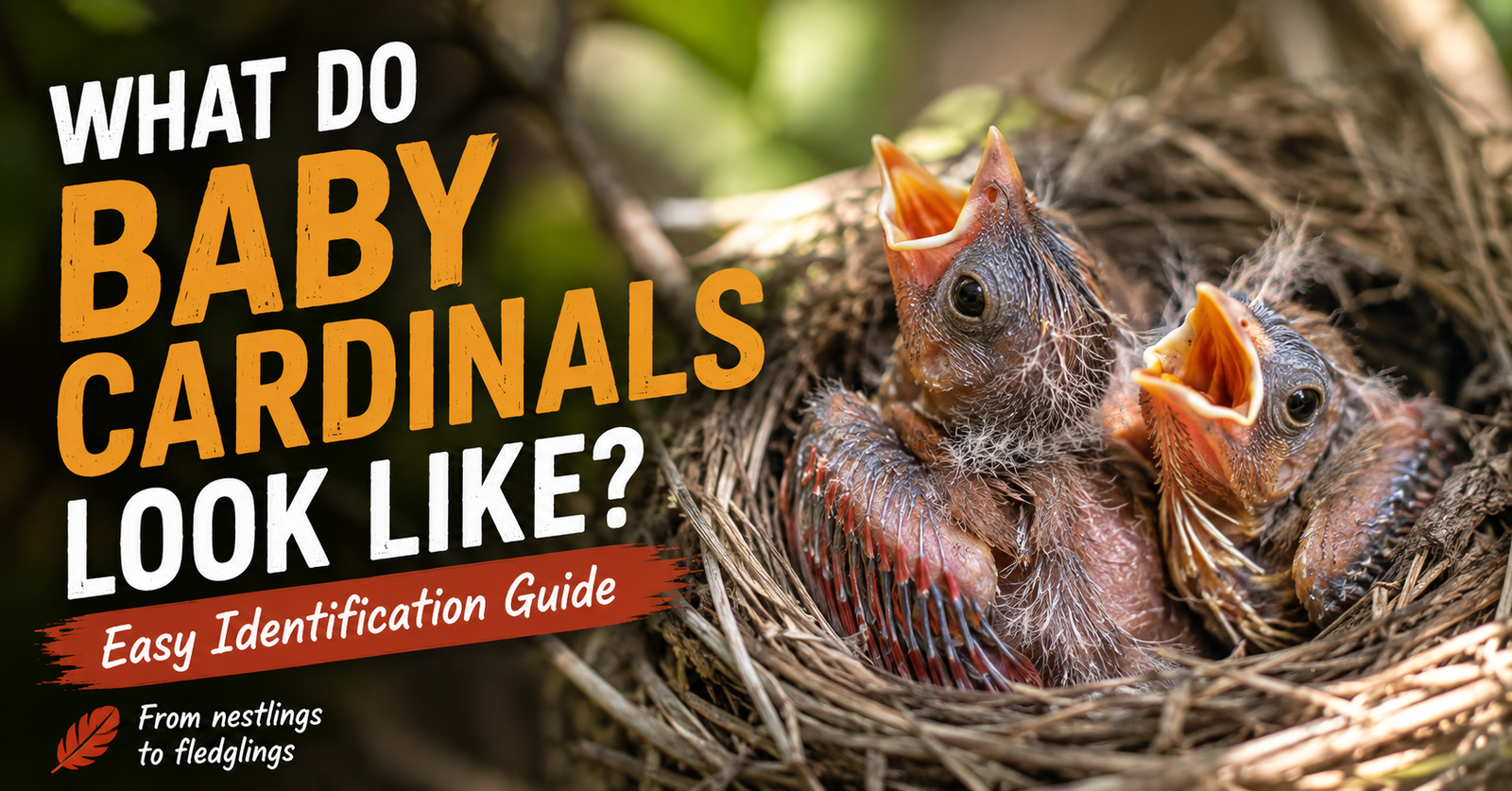
If you’ve ever found a strange brown cardinal with a dark bill hopping through low vegetation, you may have encountered one of these youngsters. Our baby cardinal identification guide shows how the dark juvenile bill, brownish plumage, developing crest, and behavior can help separate a young cardinal from an adult female.
Parental care doesn’t suddenly end when a baby hops out of the nest.
The adults continue feeding fledglings while the young birds develop their flying and foraging abilities.
Male Cardinals Can Take Over Fledgling Duty
This is one of the more interesting parts of cardinal family life.
Northern Cardinals can produce multiple broods during a breeding season.
That creates a logistical problem.
Youngsters from the previous nest may still need parental care at the same time the female is preparing for another nesting attempt.
The male can continue feeding fledglings while the female begins the next nesting cycle.

So if you see a bright red male moving around the yard with one or more brown youngsters following him and begging for food, you may be watching exactly this division of parental responsibilities. A smart feeder can make these family visits easier to observe when they happen outside your usual viewing time; see our camera feeder for observing family visits for a closer look at that approach.
It’s another reminder that the pair bond isn’t simply about mating.
A breeding pair cooperates through multiple stages of raising young.
Do Cardinals Use the Same Nest for Every Brood?
Usually not.

Northern Cardinals generally build a new nest for another nesting attempt rather than repeatedly using one nest throughout the season. When a new nest appears, identifying cardinal eggs can help you understand the pale, speckled eggs it may contain.
That makes sense when you consider how simple an open-cup songbird nest is.
After supporting eggs and rapidly growing nestlings, an old nest may be worn, dirty, exposed to parasites, or no longer ideal.
The female therefore gets busy building again.
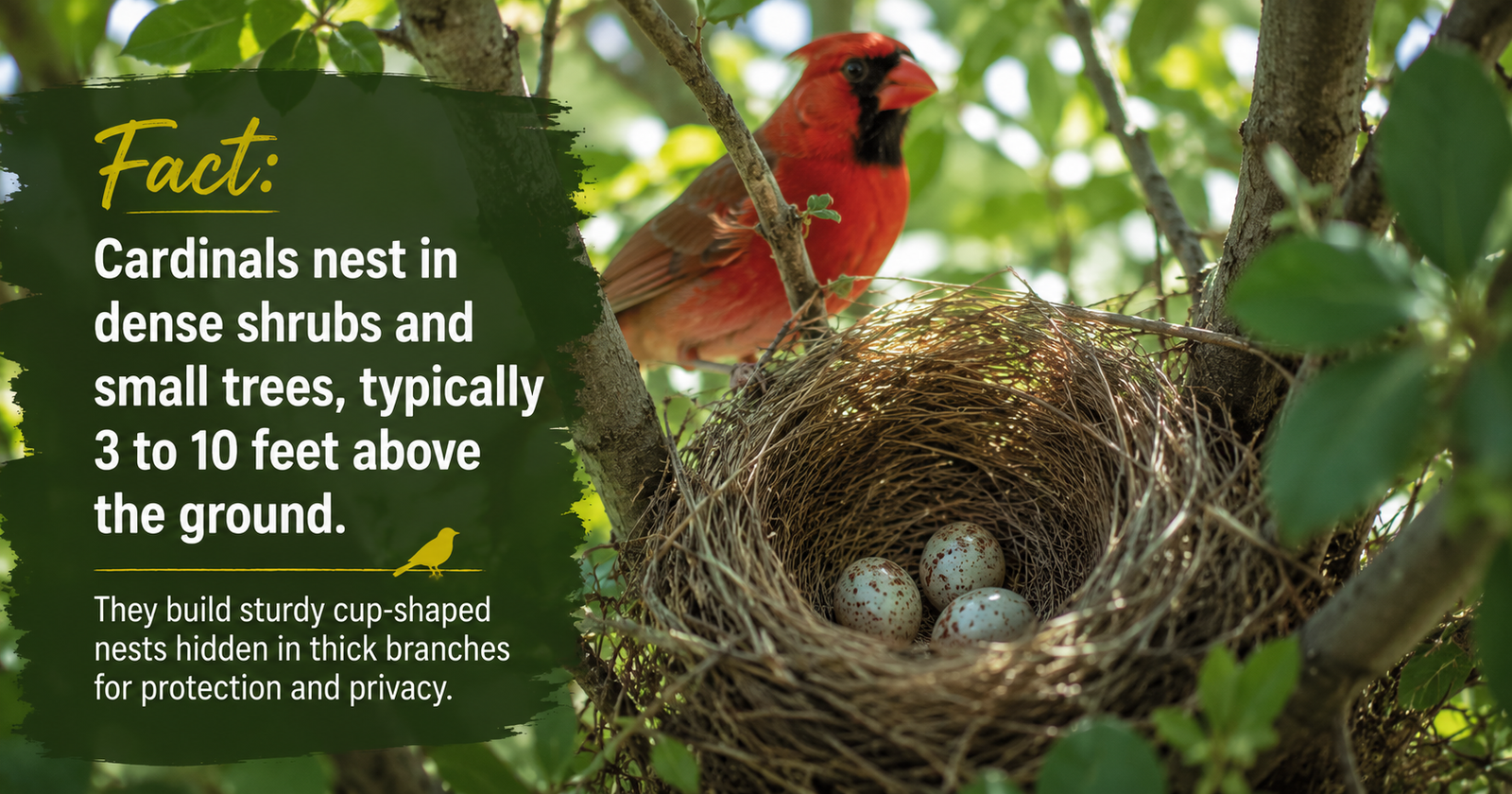
And because cardinals can attempt more than one brood in a season, you may have several different cardinal nests around the same general property without realizing it. To recognize the likely locations, see where those cardinal nests may be hidden.
How Many Babies Do Cardinal Pairs Have?
A typical Northern Cardinal clutch contains roughly two to five eggs.
Not every egg necessarily produces a fledgling.

Eggs can fail to hatch, nests can be lost to predators or severe weather, and young birds face considerable mortality both before and after leaving the nest.
Cardinals can compensate partly by making multiple nesting attempts during a breeding season.
That’s why following one pair through spring and summer can reveal several different stages of family life.
You might first notice courtship feeding.
Then the female disappears into dense vegetation more frequently.
Later, the adults begin carrying insects.
Soon after that, brown fledglings with dark bills appear around the yard.
Then another nesting cycle may begin.
Do Cardinals Have the Same Mate for Every Brood in a Season?
An established breeding pair generally remains together across its nesting attempts during that breeding season.
The same male and female can therefore raise multiple broods together.
That makes it possible for the male to still be caring for fledglings from an earlier nest while the female moves toward another clutch.
Pair changes are more relevant when we start looking across breeding seasons, after a mate disappears, or when a pair bond breaks.
Within an active breeding season, the male and female you’re repeatedly watching around the same territory are likely cooperating through more than one stage of reproduction.
What Happens If a Cardinal’s Mate Dies?
The surviving cardinal can find another mate.
This is one of the clearest reasons the phrase “mate for life” needs some qualification.
A cardinal isn’t biologically committed to remaining alone forever if its previous mate dies.
If one member of an established pair disappears, the surviving bird may remain on the territory and eventually form a new pair bond.
How quickly that happens can vary with the season, availability of potential mates, and individual circumstances.
So if you’ve watched a male and female together for years and suddenly only one appears, the surviving bird isn’t necessarily destined to spend the rest of its life alone.
Another cardinal may eventually take the missing bird’s place in the pair.
Do Cardinals Mourn When Their Mate Dies?
This is where I would be careful about assigning human emotions to bird behavior.
A surviving cardinal may change its behavior after its mate disappears. Birds notice changes in their social environment, and the loss of a pair member obviously changes breeding and territorial circumstances.
But saying that a cardinal is “grieving exactly like a person” goes beyond what we can confidently determine simply from watching one bird in a backyard.
You might see the remaining bird calling, moving around areas previously used by the pair, or behaving differently.
Those observations are real.
The explanation we attach to them needs more caution.
I wouldn’t tell someone they’re wrong for feeling emotional after watching a familiar backyard pair lose one member. I just wouldn’t turn that feeling into a scientific claim about exactly what the surviving bird is experiencing internally.
Will a Cardinal Find a New Mate?
Yes, it can.
If a mate dies or a previous pair bond ends, a Northern Cardinal can pair with another bird.
This may happen while the surviving bird remains in the same general territory.
That creates another challenge for people trying to follow “their” backyard cardinal couple over several years.
Unless the birds have distinctive markings, are banded, or can otherwise be individually identified, a new female may look very similar to the previous female.
The same is true for males.
Seeing a red male and brown female around the same feeder every year doesn’t necessarily prove that the exact same two birds have remained together all that time.
It’s certainly possible.
It’s just difficult to establish from appearance alone.
Do Cardinals Get Divorced?
“Divorce” is actually a term biologists use informally when two living birds that previously formed a breeding pair separate and later breed with different partners.
And yes, that can happen with Northern Cardinals.
Cornell reports that up to about 20% of pairs split by the next breeding season.
That doesn’t mean cardinals are constantly switching partners.
The majority of pairs in that figure remain together.
But it does mean we shouldn’t describe every cardinal pair as permanently bonded for life.
Some partnerships continue.
Others don’t.
Why Would Cardinal Pairs Separate?
There isn’t one simple backyard-observation answer that explains every separation.
Pair relationships can be affected by survival, territory, breeding circumstances, competition, and other factors.
And sometimes what looks to us like a pair “breaking up” may actually involve one bird dying or disappearing.
Without individually marked birds and careful observation, we usually can’t tell exactly what happened.
That’s another reason I’m cautious about stories such as, “The male left his mate for another female.”
Maybe.
But if we’re watching unmarked wild birds from a kitchen window, we probably don’t have enough information to know the entire history.
Are Cardinals Always Seen in Pairs?
No.
Cardinals are frequently associated with pairs during breeding, but you can absolutely see a cardinal by itself.
The bird’s mate may simply be somewhere else.
During nesting, the female may be concealed around a nest while the male is much more visible.
One member of the pair may be feeding while the other is elsewhere.
A bird may also currently be unpaired.
Season matters too.
During fall and winter, Northern Cardinals can gather into groups rather than remaining strictly separated as territorial pairs.
So one cardinal at your feeder doesn’t mean something happened to its mate.
And ten cardinals in the yard don’t mean you’ve suddenly acquired five permanent couples.
Why Do I Keep Seeing a Male and Female Cardinal Together?
There’s a good chance you’re observing a pair, particularly during the breeding season.
Cardinals commonly move around in pairs during that part of the year.
If you repeatedly see the same male and female traveling together, communicating, courtship feeding, or investigating nesting areas, the evidence becomes stronger.
Their different plumage makes this behavior wonderfully easy to watch.
A pair might move through low shrubs together, visit a feeder close together, or call back and forth from nearby vegetation.
Once nesting begins, their routines can change dramatically as the female spends more time around the nest and both birds become occupied with raising young.
Does Seeing Two Cardinals Mean They’re Mates?
Not necessarily.
Two cardinals can be near each other for many reasons.
A male and female together during breeding season may indeed be paired.
But you could also see a parent with a juvenile, multiple birds feeding together outside breeding season, or individuals interacting temporarily.
This is especially important when one of the birds is brown.
An adult female is brownish, but so is a juvenile.
Check the bill.
Adult females have reddish-orange bills. Young cardinals initially have dark grayish or black bills.
That small detail can completely change the story you’re watching.
Why Do Cardinal Couples Look So Different?
Northern Cardinals show strong sexual differences in plumage.
The adult male is predominantly brilliant red with a black facial mask.
The adult female is mostly warm brown or buff with red concentrated more strongly in her crest, wings, and tail.
Both have the characteristic cardinal crest and heavy reddish-orange adult bill.
Because the sexes look so different, a cardinal pair is easy to recognize compared with many songbird species where males and females appear almost identical.
It also creates one of the most familiar backyard bird scenes in America: the brilliant red male beside the more subtly colored female.
Do Cardinals Feed Each Other Outside Courtship?
Food transfer is especially associated with courtship and breeding interactions.
Later, of course, the pair spends an enormous amount of effort delivering food to its offspring.
The context tells you a lot about what you’re seeing.
A bright red male passing a seed to an adult female can be courtship feeding.
An adult placing an insect into the mouth of a brown, dark-billed bird may be feeding a fledgling.
Those interactions can look similar for a split second.
Identifying the recipient makes the difference.
Do Cardinals Sleep Together?
Cardinals don’t normally sleep together inside their nest like a human couple returning to a bedroom.
Outside the nesting context, birds use protected roosting locations for the night.
Dense vegetation can provide shelter from weather and predators.

A male and female may remain in the same general area, but we shouldn’t picture a cardinal pair climbing into its nest every evening and sleeping side by side. Their actual overnight routine is explained in cardinal nighttime roosting habits.
The nest has a specific reproductive purpose.
Once the young have left, that nest isn’t the family’s permanent home.
This is an excellent example of how everyday language about birds can accidentally create the wrong picture of their lives.
Are Cardinals More Loyal Than Other Birds?
I wouldn’t try to rank bird species by “loyalty.”
That word carries human moral meaning that doesn’t translate cleanly into animal behavior.
Northern Cardinals do form substantial social pair bonds. Many pairs remain together across seasons, cooperate in nesting, share parental responsibilities, communicate, and may remain associated during winter.
Those are fascinating behaviors on their own.
We don’t need to turn them into a competition over which bird is the most faithful.
Why Cardinal Pairs Are So Much Fun to Watch
Cardinals give us an unusually clear window into pair behavior because the sexes are easy to distinguish and the birds commonly live around people.
You can watch the male court the female.
You can see him pass her food.
You can hear both sexes sing.
You can watch the female disappear into dense vegetation to build and incubate.
Later, you may see both parents carrying food.
Then suddenly there are brown youngsters hopping through the shrubs.
A few weeks later, the male may still be feeding fledglings while another nesting attempt is underway.
You don’t need to find the nest or interfere with the birds to see any of this.
In fact, watching from a distance is better.
Once you know what the different behaviors mean, a pair of cardinals visiting the yard stops being simply “the red one and the brown one.”
You’re watching an entire breeding cycle unfold.
Common Questions About Cardinal Mates
Do cardinals have only one mate their entire life?
Not necessarily. Northern Cardinals can remain with the same partner for multiple seasons, but pairs can separate, and a bird can find another mate if its previous partner dies or disappears.
What percentage of cardinal pairs stay together?
Cornell reports that up to about 20% of Northern Cardinal pairs may split by the following breeding season. That means many pairs do remain together, but pair continuity isn’t guaranteed.
Do cardinals stay together after their babies leave?

They can. The pair relationship doesn’t automatically end when one brood fledges. Cardinals may attempt another brood during the same breeding season, and pairs can remain associated beyond breeding. Repeated broods also make the adults' changing food needs important, as cardinal food needs during breeding explains.
Do cardinals recognize their mates?
Their coordinated courtship, vocal communication, territorial activity, and breeding behavior clearly require individuals to interact with their partners. However, I’d avoid making claims about cardinal recognition that go beyond what research supports simply because a pair appears familiar with one another.
Will a male cardinal take another mate if the female dies?
A surviving cardinal can form a new pair bond after losing its mate. The same applies when a male dies and a female survives.
Do cardinals mate with their siblings?
Young cardinals disperse and establish their own breeding relationships as they mature. I wouldn’t assume two cardinals around the same yard are siblings, mates, or otherwise related without evidence. Wild populations have numerous potential mates, and family relationships can’t normally be determined just by looking at unmarked adults.
Is a male feeding a female proof they’re a pair?
During the breeding season, courtship feeding between an adult male and female is a very strong sign of pair-related behavior. Make sure the receiving bird is actually an adult female, though. Male cardinals also feed brown juvenile offspring after they leave the nest.
Do cardinal pairs come back to the same yard every year?
Northern Cardinals are nonmigratory throughout much of their range, and established birds can remain in the same general area. That makes repeated appearances entirely possible.
But unless individual birds are identifiable, seeing a male and female in the same yard year after year isn’t enough to prove they’re always the exact same pair.
That’s the distinction I keep coming back to with the question of whether cardinals mate for life. Their pair bonds can be strong and surprisingly long-lasting, but nature doesn’t give every cardinal couple a lifetime guarantee.
Caleb Hartwell is the Bird Identification & Behavior Contributor for BirdResource.com, where he turns detailed bird research into practical guides that help everyday birdwatchers understand the identification, relationships, and behaviors they’re seeing right outside their homes.