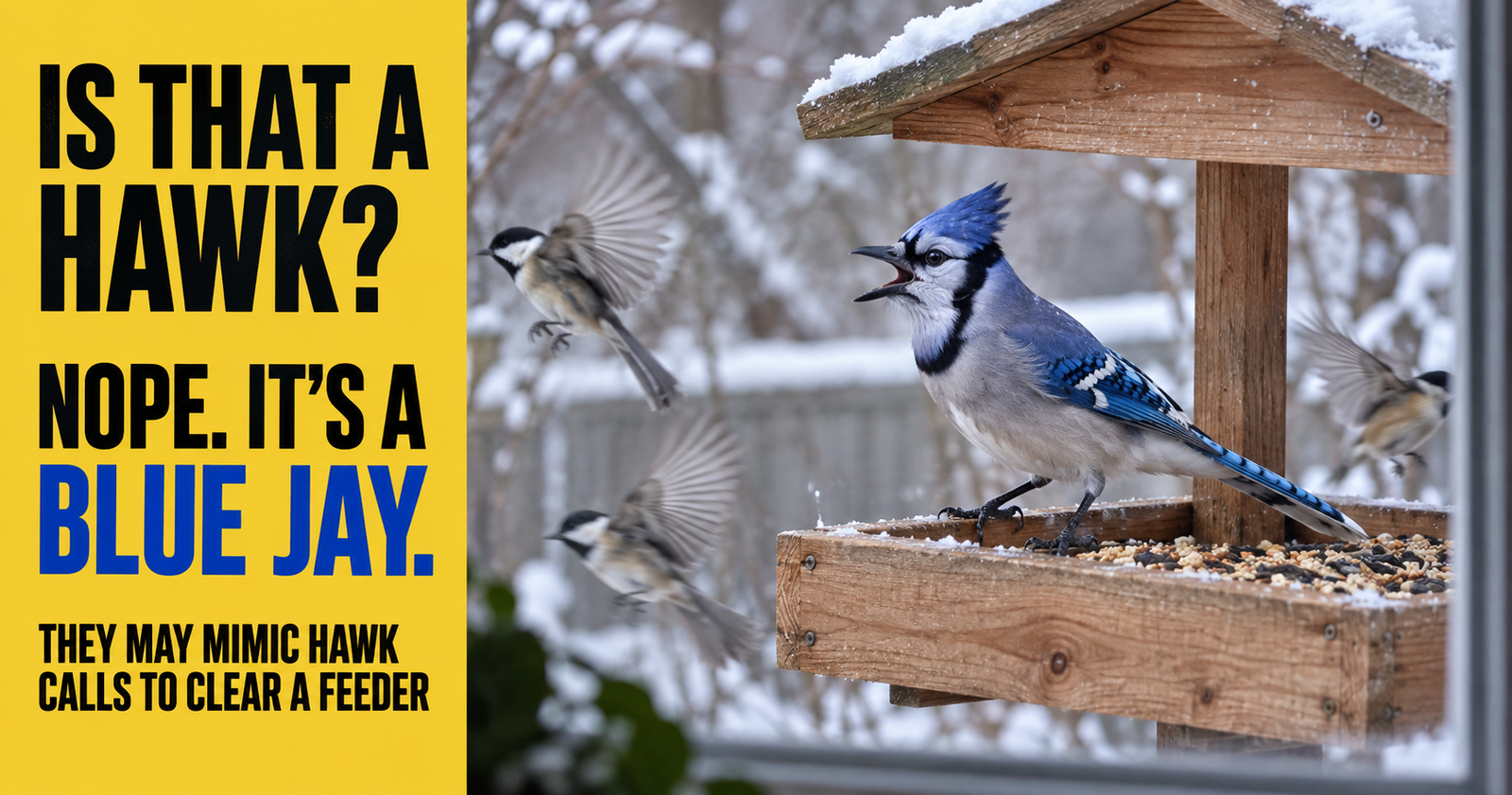
If you hear what sounds like a hawk screaming somewhere around your yard, don’t automatically start searching the sky.
Look for a Blue Jay too.
Blue Jays are remarkably good mimics, and one of their strangest tricks is copying the calls of hawks.
The Cornell Lab’s Blue Jay sound guide specifically notes that Blue Jays frequently imitate Red-shouldered Hawks and sometimes Red-tailed Hawks.
I’ve always found this behavior fascinating because it immediately creates another question:
Why would a Blue Jay want to sound like a bird that could potentially eat it?
There’s no single proven explanation that accounts for every hawk imitation. Blue Jays may use the calls as warnings in some situations, and researchers have also considered whether mimicry can affect other birds around food.
In other words, we know Blue Jays imitate hawks.
Figuring out exactly what the jay is trying to accomplish can be considerably harder.
Which Hawks Do Blue Jays Imitate?
The two names I’d remember are:
Red-shouldered Hawk
and
Red-tailed Hawk.
Cornell reports that Red-shouldered Hawk imitation is especially common, although Blue Jays can also imitate Red-tailed Hawks.
That’s useful because these are familiar raptors across much of the Blue Jay’s range.
If you’ve spent much time outdoors, you’ve probably heard one or both.
And if you’ve learned those hawk calls, a convincing Blue Jay can genuinely fool you.
That’s what makes this different from a bird producing some random hawk-ish scream.
The imitation can be recognizable enough that you go looking for the wrong bird.
Why Would a Blue Jay Copy a Red-shouldered Hawk?
One possibility is warning other Blue Jays about danger.
If a real hawk is nearby, reproducing a hawk-like sound could communicate useful information to other jays.
Cornell specifically mentions this as one possible explanation for the behavior.
That makes intuitive sense.
Blue Jays are highly vocal birds that respond strongly to predators.
They also participate in mobbing behavior when hawks, owls, and other threats are discovered.
A hawk imitation could potentially fit into that larger alarm system.
But that’s not the only possibility.
Could Blue Jays Be Scaring Other Birds Away From Food?
This is the explanation that gets the most attention because it’s such a great story.
Imagine a busy feeding station.
Chickadees are eating.
Titmice are eating.
Maybe several other birds are nearby.
Then:
HAWK!
Everybody scatters.
Except the “hawk” was actually a Blue Jay.
Now the jay has the feeder to itself.
It’s an incredibly clever-sounding strategy.
And Cornell notes that Blue Jays sometimes imitate hawks when approaching feeders, raising the possibility that the call could deceive other birds and give the jay better access to food.
But there’s an important word there:
possibility.
I wouldn’t turn that into:
“Blue Jays imitate hawks specifically to steal everybody else’s food.”
We don’t have enough evidence to assign that motive to every imitation.
Sometimes the bird may be warning.
Sometimes the call may have another social function.
Sometimes food competition could be involved.
The behavior is more interesting when we leave room for what isn’t completely understood.
Does Hawk Mimicry Actually Scare Other Birds?
It certainly can get attention.
Small birds have very good reasons to respond to hawk calls.
A real hawk can kill them.
Ignoring every possible predator warning would be a terrible survival strategy.
But whether other birds consistently mistake a Blue Jay imitation for the real thing is a more complicated question.
Birds aren’t passive little sound-recognition machines.
They have context too.
They can potentially see what’s happening.
They hear other alarm calls.
They watch how surrounding birds behave.
A Blue Jay might fool another bird sometimes without possessing a magical call that clears every feeder on command.
How Can I Tell a Blue Jay From a Real Hawk by Sound?
Sometimes you can’t confidently do it from one call.
That’s the fun part.
Find the bird.
If you hear what sounds like a Red-shouldered Hawk and a Blue Jay is sitting right where the sound originated, you’ve got a pretty good clue.
You can also listen for what happens next.
Does the hawk-like call suddenly transition into a classic Blue Jay jeer?
Do you hear other unmistakable Blue Jay vocalizations from the same location?
Can you see the bird’s bill moving?
Those clues are much stronger than trying to convince yourself you can always distinguish a perfect imitation by ear.
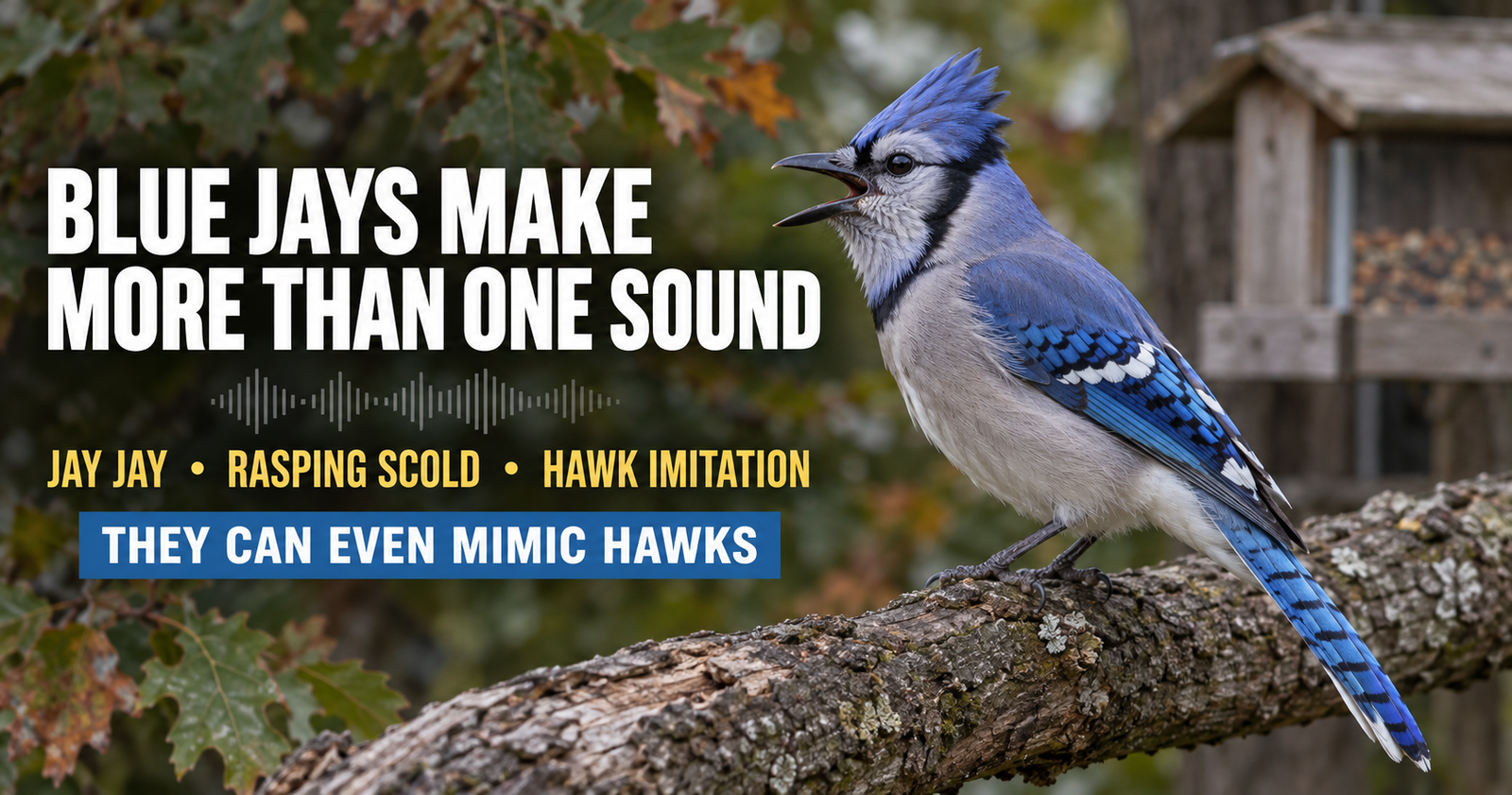
Our guide to Blue Jay calls, screams, whistles, and mimicry covers the rest of their surprisingly large vocabulary.
What Does a Red-shouldered Hawk Actually Sound Like?
Red-shouldered Hawks have a distinctive loud, repeated call that is often rendered something like kee-aah.
It’s the kind of call that carries.
And because Blue Jays commonly share wooded habitats with Red-shouldered Hawks, the jay has plenty of opportunity to hear the real thing.
The Cornell Lab’s Red-shouldered Hawk sound recordings are worth listening to alongside Blue Jay recordings.
Don’t just read descriptions.
Play both.
Once you’ve heard the real hawk and then heard a Blue Jay imitate it, you’ll understand why people get fooled.
Can Blue Jays Mimic Red-tailed Hawks Too?
Yes.
Cornell also documents Blue Jays imitating Red-tailed Hawks, although Red-shouldered Hawk imitation is especially noted.
Red-tailed Hawks have one of the most famous raptor screams in North America.
In fact, their call is so dramatic that movies and television frequently use it as the stereotypical sound for birds of prey.
So if you hear that familiar hawk-like scream around Blue Jays, keep an open mind about who’s actually producing it.
A crest and blue wings would change the identification pretty quickly.
Do Blue Jays Only Mimic Hawks?
No.
That’s another reason I don’t think of hawk imitation as one isolated trick.
Blue Jays are capable of broader vocal mimicry.
Their quieter vocal sequences can include imitations of other birds, and they produce a surprisingly diverse collection of their own sounds too.
Hawk mimicry gets all the attention because it’s dramatic.
“Blue Jay quietly imitates another bird” isn’t nearly as memorable as:
“That Blue Jay just pretended to be a hawk.”
But mimicry fits into a much larger vocal repertoire.
Are Blue Jays the Only Birds That Mimic Hawks?
No.
Bird mimicry occurs in other species too.
Northern Mockingbirds are famous for copying other birds and environmental sounds.
European Starlings are capable mimics.
Other species can imitate calls as well.
What’s especially interesting about Blue Jays is the predator connection.
A Blue Jay imitating a hawk isn’t merely copying another pleasant songbird.
It’s reproducing the sound of an animal that changes how other birds behave.
That potentially gives the call much greater consequences.
Do Blue Jays Mimic Hawks to Protect Their Babies?
It’s possible for Blue Jays to become extremely vocal around nests and young, but I wouldn’t automatically interpret every hawk imitation near a nest as a deliberate strategy to protect babies.
Blue Jays use alarm calls and mob predators.
Both parents also participate extensively in raising young.
So defensive behavior around a nesting area is completely believable.
But assigning a precise purpose to a specific mimic call requires more evidence than simply hearing it near a nest.
This is where I prefer describing what we can actually observe rather than inventing an intention because it makes a good story.
Why Would a Blue Jay Warn Other Birds About a Hawk?
It doesn’t necessarily have to be trying to help every bird in the neighborhood.
If a Blue Jay detects a predator and communicates danger to other Blue Jays, nearby birds can overhear.
That’s common in nature.
One species produces an alarm.
Other species learn that the sound means something dangerous may be nearby.
Everybody benefits from paying attention, even if the original caller wasn’t intentionally performing a public service.
Blue Jays are loud enough that their warnings can be difficult for the rest of the neighborhood to miss.
Blue Jays Will Mob Hawks Too
Mimicry isn’t their only response to raptors.
Blue Jays can participate in mobbing.
Several birds may gather around a hawk or owl, call loudly, follow it, and make its location painfully obvious.
That may seem reckless.
But a predator loses much of its ability to surprise prey once the entire neighborhood knows exactly which branch it’s sitting on.
If several Blue Jays suddenly become focused on one tree and make an enormous amount of noise, I pay attention.
They may have found something.
Do Hawks Eat Blue Jays?
Yes, Blue Jays can become prey themselves.
They’re relatively large songbirds, but they’re still small enough for certain raptors to take.
That makes their interest in hawks much easier to understand.
From our perspective, a hawk passing through the yard may be exciting.
From the Blue Jay’s perspective, it can represent a genuine threat.
That’s why predator recognition, alarm behavior, and mobbing matter.
The jay isn’t being dramatic for entertainment.
Staying aware of predators can mean staying alive.
Why Doesn’t Mimicking a Hawk Attract Real Hawks?
A hawk call isn’t necessarily an invitation saying:
“Free Blue Jay over here.”
Raptor vocal behavior is much more complicated than that.
And Blue Jays don’t spend every minute of every day imitating hawks.
The calls occur within particular behavioral contexts.
It’s also worth remembering that mimicry doesn’t turn the Blue Jay into a hawk.
A real raptor has visual information and its own behavioral priorities.
Nature isn’t operating solely from one sound at a time.
Can Blue Jays Learn Hawk Calls?
Blue Jays hear hawks throughout their environment and have the vocal ability to reproduce those sounds.
Whether we describe every instance as consciously “learning a trick” can become more complicated.
But the practical result is obvious:
A Blue Jay can produce a call remarkably similar to a hawk it encounters within its environment.
That alone tells us something about how flexible Blue Jay vocal communication can be.
These aren’t birds with one genetically programmed scream and nothing else.
Their vocal world is much richer.
Does Every Blue Jay Mimic Hawks?
I wouldn’t expect every individual you encounter to perform hawk imitations where you can hear them.
Just because a behavior belongs to a species doesn’t mean every individual performs it equally often or under the same circumstances.
You may have Blue Jays around your yard for years without knowingly hearing a hawk imitation.
Or you may have one that fools you repeatedly.
That’s another reason I wouldn’t use mimicry as an identification requirement.
A Blue Jay that never imitates a hawk is still a Blue Jay.
Why Do Blue Jays Mimic Hawks at Feeders?
This is where the food-deception idea becomes especially tempting.
Blue Jays are larger than many feeder birds and can already displace smaller species through ordinary competition.
A hawk-like call could potentially make other birds even more cautious.
Cornell notes that hawk mimicry sometimes occurs when Blue Jays approach feeders, which supports the idea that the behavior may sometimes influence competitors.
Still, I wouldn’t assume every feeder imitation is an intentional scam.
Watch what happens.
Do the other birds leave?
Does the jay immediately take over?
Was a real hawk nearby?
Were several Blue Jays already calling?
The context may give you clues.
What Should I Do If Blue Jays Keep Scaring Other Birds?
Usually, nothing drastic.
Blue Jays are native birds using the same resources as other backyard species.

If one feeder becomes dominated by larger birds, spreading food across more than one feeding location can help. A smart feeder such as Kiwibit smart feeder can provide another place to observe activity while you spread feeding locations around the yard.
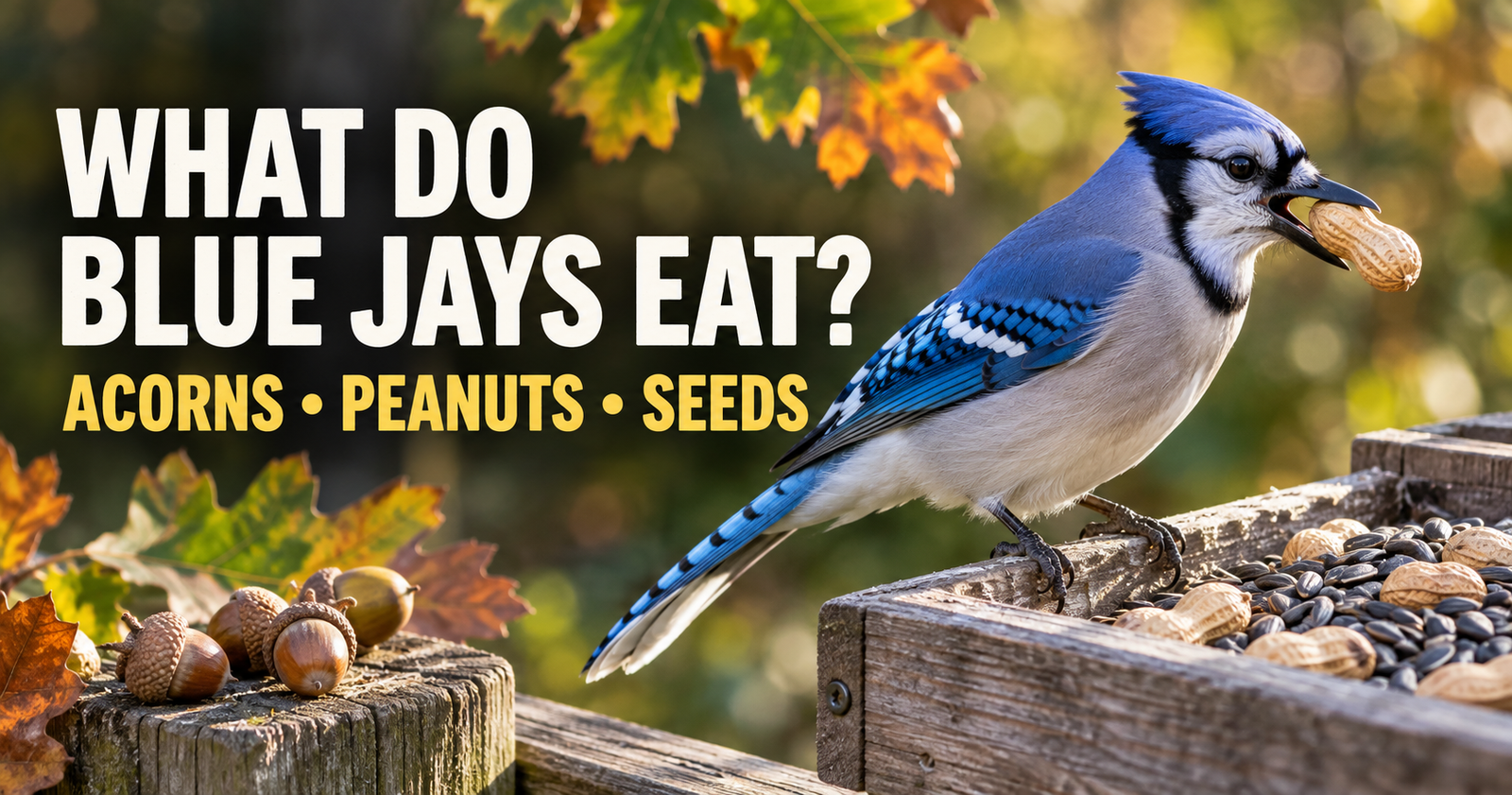
You can offer peanuts in a roomy Blue Jay feeding area and keep smaller-seed feeders elsewhere. That feeding setup makes more sense when you understand Blue Jay feeding choices.

Our guide to attracting Blue Jays explains why I actually like giving these larger birds their own comfortable feeding area.
Trying to eliminate every competitive interaction isn’t realistic.
A backyard feeder is still part of the natural world.
Common Questions About Blue Jays Mimicking Hawks
Do Blue Jays really imitate hawks?
Yes. Blue Jays are documented mimics of Red-shouldered Hawks and sometimes Red-tailed Hawks.
Which hawk do Blue Jays imitate most?
Red-shouldered Hawk mimicry is particularly well documented in Blue Jays.
Why do Blue Jays sound like hawks?
There isn’t one proven explanation for every instance. Possible functions include warning other Blue Jays about a predator and potentially influencing other birds around food.
Do Blue Jays imitate hawks to scare birds away from feeders?
They sometimes imitate hawks while approaching feeders, so this is a plausible explanation in some situations. I wouldn’t assume it’s the purpose of every hawk imitation.
Can a Blue Jay fool you into thinking there’s a hawk nearby?
Absolutely. Their imitations can be convincing enough that locating the actual bird is sometimes the easiest way to settle the identification.
Can Blue Jays imitate Red-tailed Hawks?
Yes. Red-tailed Hawk imitation has been documented, although Red-shouldered Hawk imitation is particularly associated with Blue Jays.
Do Blue Jays copy other birds?
Yes. Their mimicry isn’t limited to hawks, and their overall vocal repertoire contains many sounds beyond the classic Blue Jay scream.
Do Blue Jays warn other birds about hawks?
Blue Jays produce alarm behavior around predators, and other nearby birds can respond to that information. That doesn’t necessarily mean the jay is intentionally trying to protect every other species.
Why are Blue Jays screaming at a hawk?
They may be mobbing it. Loud calling can expose a predator’s location and may encourage it to leave the area.
The “Hawk” Outside Might Be Watching Your Feeder
That’s what makes this behavior so much fun once you know about it.
You hear the scream.
You stop.
You start searching the trees for a hawk.
Then a Blue Jay flies out.
The first time it happens, it feels like the bird tricked you personally.
But that little deception reveals something much more interesting about Blue Jays.
They’re not simply loud.
They’re flexible, complicated communicators capable of producing sounds that can change how other animals react.
So the next time a hawk seems to be screaming somewhere around your backyard, don’t only look for broad wings and a hooked bill.
Check for a blue crest too.
Mason Reed is the Bird Behavior & Identification Contributor for BirdResource.com, where he helps everyday birdwatchers understand the strange calls, feeding habits, nesting behavior, and everyday mysteries happening in their yards.