

Few backyard birds are as easy to notice as a Northern cardinal. A bright red male sitting against bare winter branches can stand out from surprisingly far away, while a female can be much easier to overlook until you recognize her warm brown coloring, red accents, thick bill, and familiar crest.
The Northern cardinal (Cardinalis cardinalis) is a year-round resident across much of the eastern and central United States, with its range extending into parts of Canada, Mexico, and Central America. Unlike many familiar songbirds, cardinals don’t make a long seasonal migration. If you have them around your property in summer, there’s a good chance you can also find them nearby during winter.
There’s much more to identifying a cardinal than simply looking for a red bird. Females look considerably different from males, young cardinals go through their own appearance changes, and there are other birds that can cause confusion depending on where you live. Behavior, habitat, bill shape, crest, and even the sounds a bird makes can all help confirm what you’re seeing.
How to Identify a Northern Cardinal
The combination of a prominent crest, thick bill, fairly long tail, and sturdy songbird body gives the Northern cardinal a distinctive shape.
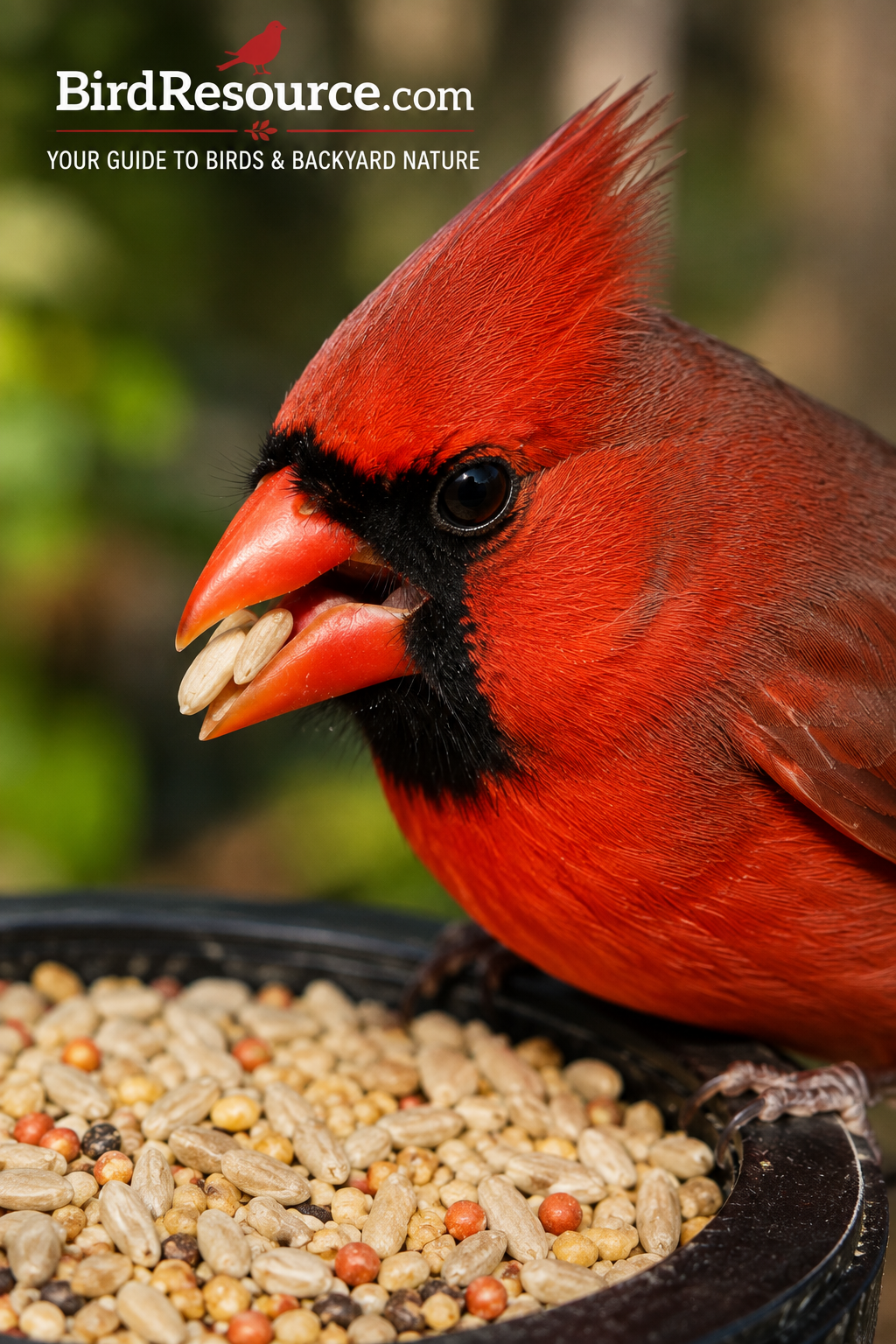
Adult males are the birds most people picture when they hear the word cardinal. They are predominantly brilliant red, with a black facial mask surrounding the bill and extending onto the throat. Their bill is thick, short, and reddish orange.
Females are much less intensely colored, but they aren’t simply dull versions of the male. An adult female is mostly warm buffy brown with reddish coloring that can be especially noticeable on her wings, tail, and crest. She also has a reddish orange bill and dark coloring around the face.
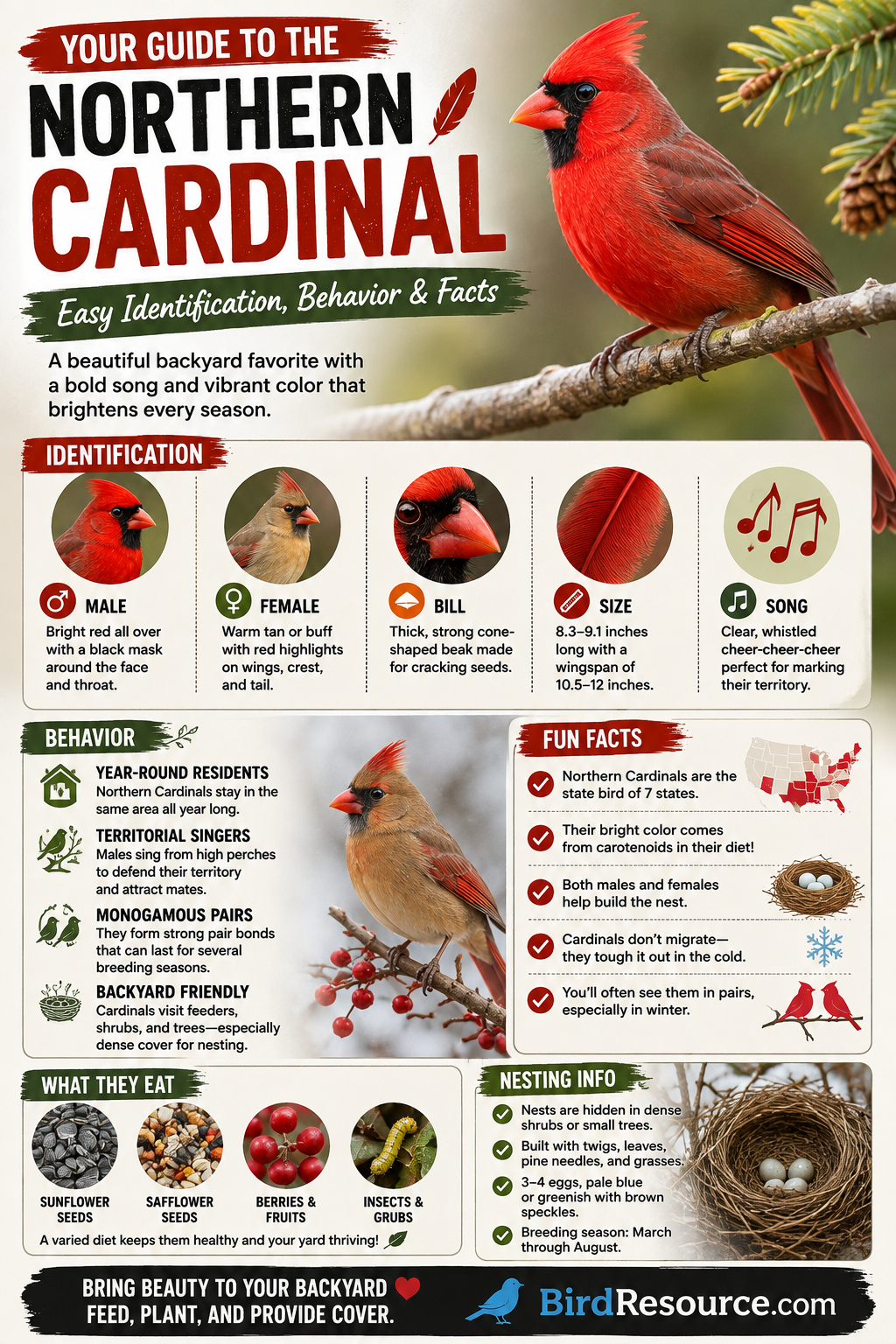
That crest is particularly useful when identifying either sex. A cardinal can raise the feathers into a sharp, obvious point, although the crest doesn’t always stand straight up. A relaxed bird can flatten it considerably.
Cardinals are roughly medium-sized songbirds. Their heavy, cone-shaped bills are built well for handling seeds, and their relatively long tails can be noticeable both while perched and in flight.
Color is useful, but I wouldn’t rely on color alone when identifying an unfamiliar bird. Looking at the entire combination of shape, bill, crest, markings, behavior, and location gives you a much more reliable identification. That approach reflects Bird Resource’s identification standards, which emphasize using multiple relevant clues rather than oversimplifying identification.

Male and Female Cardinals Look Surprisingly Different
The difference between adult males and females is one of the most interesting things about Northern cardinal identification.
The male’s red plumage makes him difficult to miss. A mature female, meanwhile, can blend remarkably well into shrubs, brush, and tangled vegetation. Once you know what to look for, however, her pointed crest, heavy reddish bill, long tail, and reddish highlights make her much easier to recognize.
Both males and females can sing. That’s worth knowing because people sometimes assume a singing cardinal must be male. Female song is particularly notable because singing is much less common among female songbirds in temperate North America than it is among males.
Males and females can also both become territorial. During the breeding season, either sex may react to its reflection in a window or mirror as though another cardinal has entered its territory.
We’ll cover the differences much more closely in our dedicated male versus female cardinal identification guide rather than turning this broader species guide into a duplicate of that topic.
Where Do Northern Cardinals Live?
Northern cardinals are strongly associated with the eastern and central portions of North America, although their distribution has changed over time and expanded northward.
They do particularly well around areas that provide dense shrubs, tangled vegetation, woodland edges, hedgerows, overgrown fields, parks, gardens, and residential landscaping.
That helps explain why cardinals are such familiar backyard birds.
They don’t require untouched wilderness. A suburban yard with shrubs, trees, vegetation along property lines, and nearby cover can provide the type of structure cardinals regularly use.
Dense vegetation is especially important. Cardinals frequently spend time fairly low in shrubs and thickets, even though a singing bird may move to a much more exposed perch.
A cardinal that seems to disappear into a hedge isn’t necessarily leaving the area. These birds can be surprisingly inconspicuous once they move away from an exposed feeder or perch and enter dense vegetation.
Do Cardinals Migrate?
Northern cardinals are considered nonmigratory, or resident, birds.
That means they don’t perform the large seasonal migrations associated with birds such as warblers, orioles, or many hummingbirds. A cardinal living in an area generally remains within the broader region throughout the year.
This is one reason cardinals can be especially noticeable during winter.
A male doesn’t trade his red plumage for a drab winter appearance, and snow or leafless vegetation can make that color stand out dramatically.
The absence of leaves can also make birds easier to spot in shrubs and along woodland edges.
Being nonmigratory doesn’t mean an individual cardinal sits in exactly the same tree or tiny section of a yard every day of its life. Birds still move around locally in response to food, cover, breeding activity, weather, and other conditions.
During fall and winter, cardinals may also become more tolerant of other cardinals and gather in groups that would be less typical during the territorial breeding season.
What Do Northern Cardinals Eat?
Northern cardinals have a varied diet consisting largely of seeds and fruits, along with insects and other small invertebrates.
Their heavy bills are well suited to handling seeds. In natural settings they consume seeds and fruits from a variety of grasses, shrubs, vines, and trees.

They also eat insects such as beetles, grasshoppers, crickets, caterpillars, flies, and other small creatures when available. Spiders and some other invertebrates can be part of the diet as well. For a fuller breakdown of seeds, fruits, insects, and feeder foods, see what cardinals eat.
The balance changes in an important way when cardinals are raising young.
Baby cardinals need protein for rapid growth, so nestlings are fed a diet that relies heavily on insects and other invertebrates rather than simply receiving the same seed-heavy diet people commonly associate with adult birds.

At backyard feeders, sunflower seed is one of the foods strongly associated with Northern cardinals. Their body size and feeding style can make roomy feeding areas easier for them to use than some small, awkward feeder perches. Choosing the right setup is another practical part of roomy feeding areas.
We’re going to give cardinal diet its own full guide because there’s a big difference between answering “What is a cardinal?” and helping someone understand what cardinals eat naturally, what they’ll eat at feeders, what they feed their babies, and which foods are actually useful for attracting them.
Northern Cardinal Behavior
Spend enough time watching cardinals and you’ll quickly see that they aren’t birds that spend all day sitting prominently on an exposed branch.
They commonly forage on or close to the ground and move through low shrubs and vegetation. You’ll often see them hopping rather than walking as they search for food.
Their flight tends to consist of relatively short movements between areas of cover rather than the prolonged soaring associated with large birds.
During the breeding season, cardinals can be strongly territorial.
A male may sing from a conspicuous perch to advertise and defend his territory. Cardinals can also chase other members of their species when defending an area.
Outside the breeding season, that social picture changes. Cardinals that were territorial earlier in the year can gather into groups during fall and winter, sometimes feeding alongside other species.
That seasonal change is a good example of why bird behavior shouldn’t always be described in absolutes. A cardinal’s behavior in a backyard in January may look noticeably different from what happens in the same yard during breeding season.
Why Do Cardinals Attack Windows?
A cardinal repeatedly flying at a window can look confused, trapped, or even unusually aggressive. In many cases, the bird is actually responding to its own reflection.
This behavior is especially associated with the breeding season, when territorial instincts are strong.
The reflected cardinal looks like another bird occupying the territory. Because the real bird doesn’t understand that it’s looking at itself, it may repeatedly approach, peck, or fly toward the reflection.
Both male and female Northern cardinals can do this.

It’s different from a bird accidentally striking a window because it sees reflected sky or vegetation and believes it can fly through the space. Territorial reflection attacks can happen repeatedly at the same window, mirror, or other reflective surface.
We’ll deal with this behavior separately because someone with a cardinal attacking a window usually needs practical help stopping the reflection rather than a general overview of the species.
What Do Cardinals Sound Like?
You may hear a Northern cardinal before you see one.
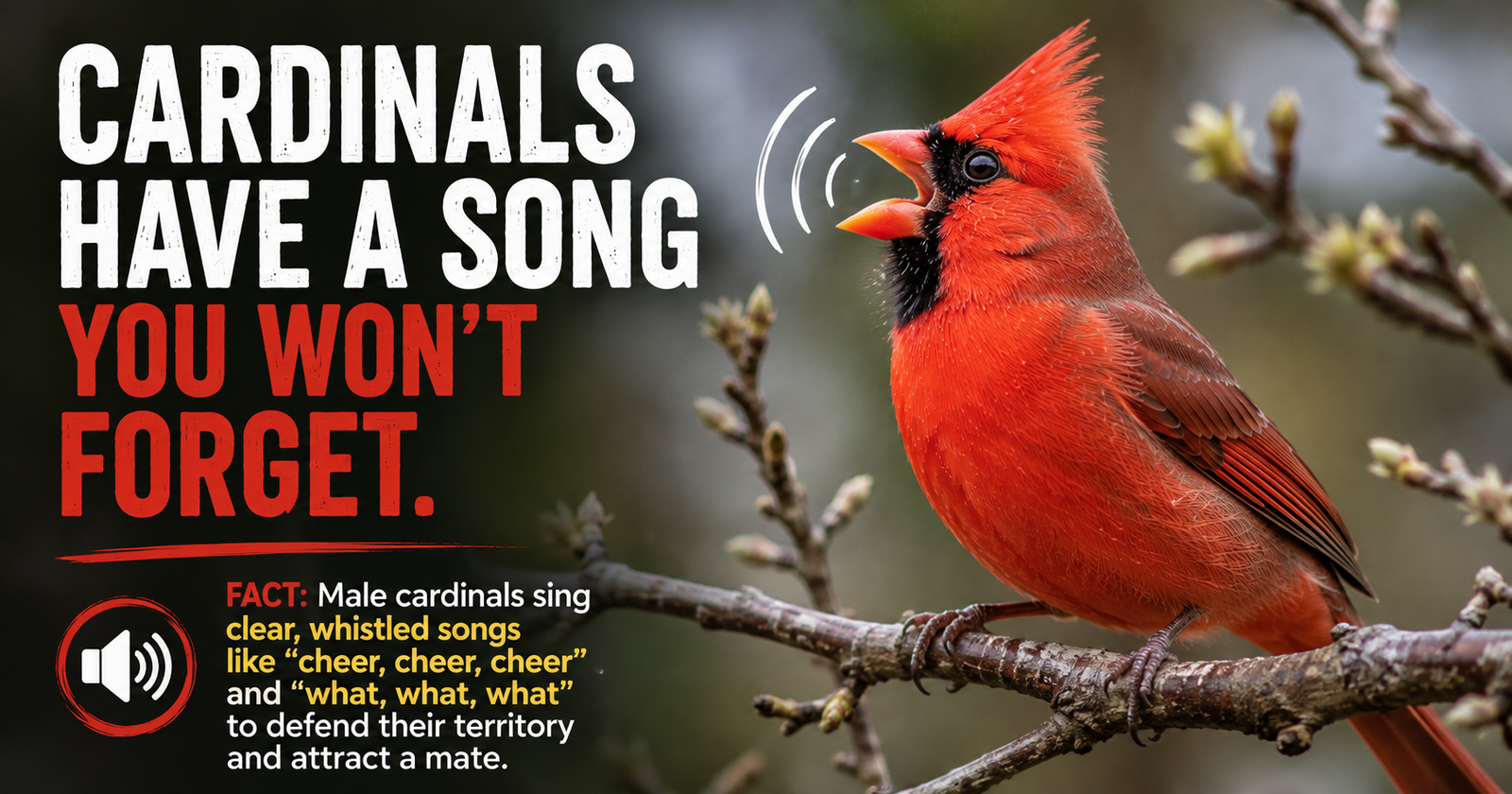
Cardinals have clear, whistled songs composed of repeated phrases, and their vocalizations can carry well through a neighborhood or woodland edge. They also produce a sharp, metallic-sounding chip call that can be extremely useful for locating a bird hidden in dense vegetation.
Learning that chip can change the way you notice cardinals.
A bird that would otherwise remain completely hidden inside a shrub suddenly becomes much easier to detect once you recognize the sound.
Both male and female Northern cardinals sing, which makes them especially interesting among familiar North American backyard songbirds.
Cardinal vocalizations also serve different purposes. Songs can be involved in territory and communication between birds, while calls can function in shorter-range communication and other situations.
Where Do Cardinals Build Their Nests?
Northern cardinals generally choose dense vegetation for nesting.
Nests may be placed in shrubs, small trees, vines, brambles, or tangled vegetation where surrounding leaves and branches provide concealment.
The female does most of the actual nest construction. She builds an open cup using materials such as twigs, bark, leaves, grasses, stems, and other plant material.
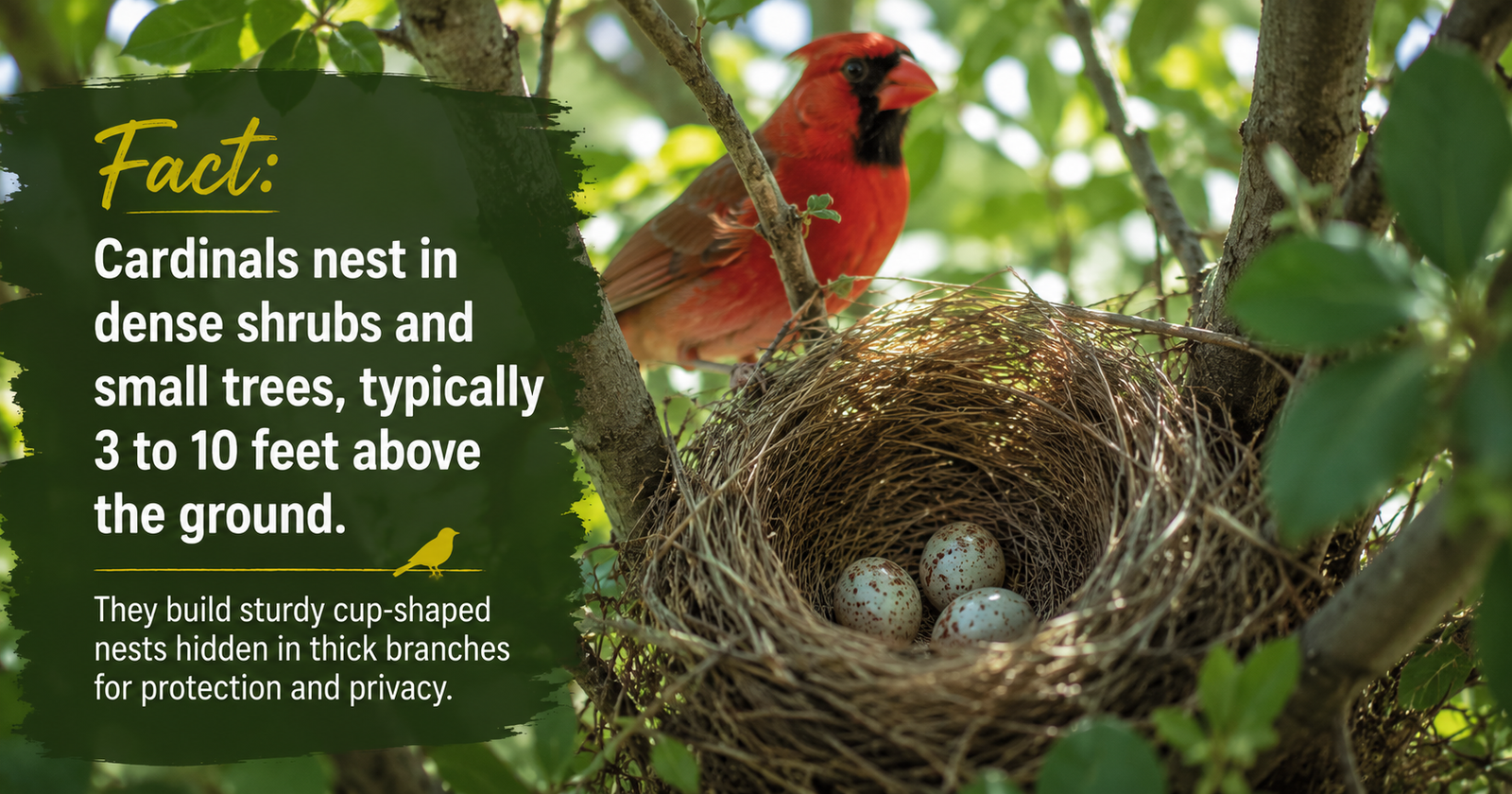
Cardinal nests are generally relatively low rather than being placed high in the canopy like the nests of some other birds. Suitable sites can occur only a few feet above the ground, although placement varies. That low placement is easier to understand when you see where Northern Cardinals nest.
This is one reason aggressively cutting back every dense shrub or vine during nesting season can matter more than homeowners realize. What looks like an overgrown patch of vegetation to us can be valuable nesting cover to a bird.
If you find an active nest, giving the birds space and minimizing disturbance around it is usually the best approach.
What Do Cardinal Eggs Look Like?
Northern cardinal eggs aren’t bright red, despite the bird’s name and the male’s famous coloring.
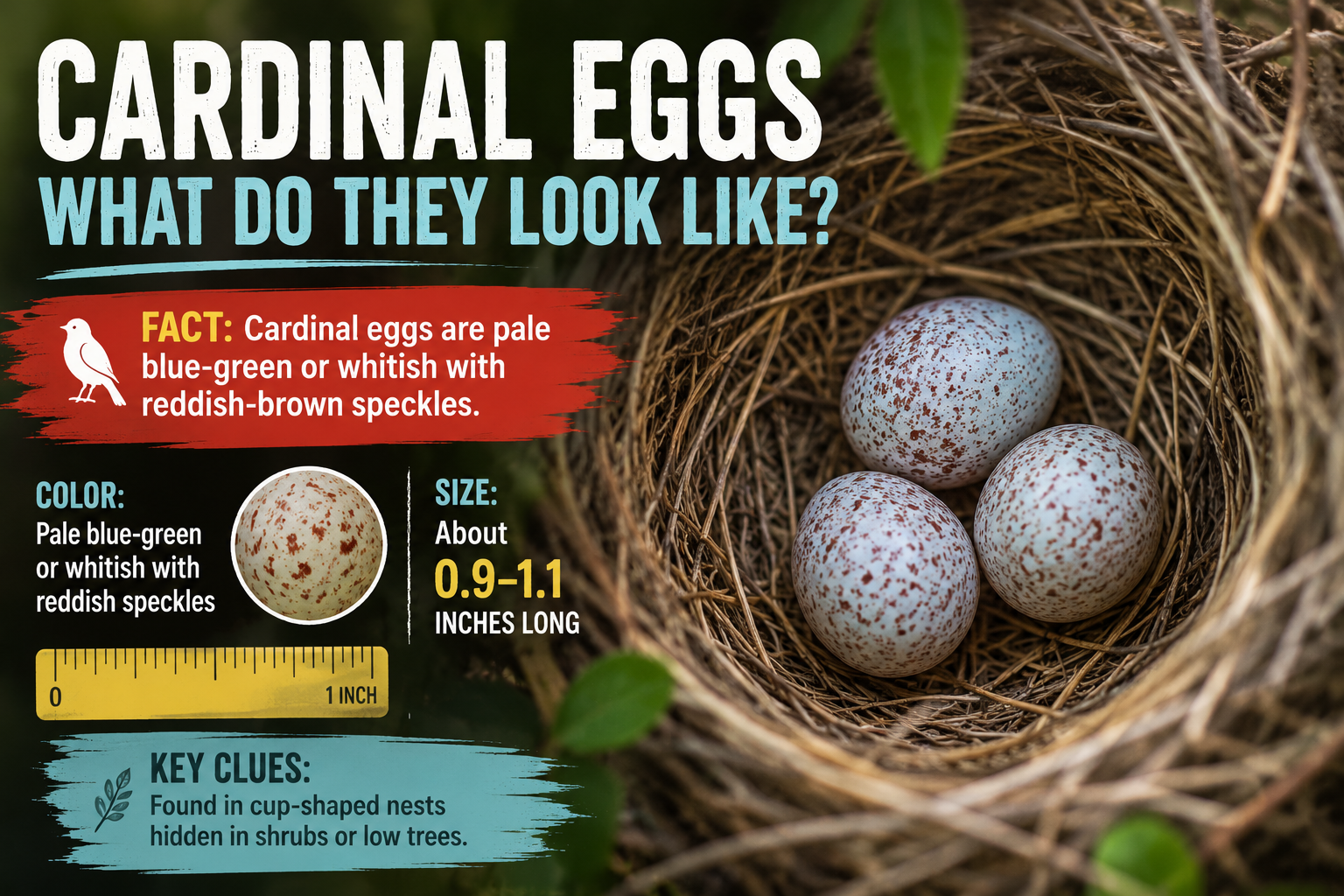
The eggs are generally whitish, buffy, grayish white, or sometimes slightly greenish in overall appearance, with darker speckling or markings. A typical clutch contains several eggs. For details on cardinal egg colors and markings, including their typical size and variation, see the dedicated guide.
The female handles incubation, while the male can bring food to her.
Incubation is relatively short, generally lasting around 11 to 13 days. Once the eggs hatch, the young develop quickly and remain in the nest for only a relatively brief period before fledging.
Because many songbird eggs can look superficially similar, egg color alone isn’t a reliable way to identify an unknown nest. Nest location, construction, adult birds attending the nest, geographic range, and other clues are much more useful when considered together.
| Characteristic | Northern Cardinal |
|---|---|
| Scientific Name | Cardinalis cardinalis |
| Bird Family | Cardinalidae |
| General Size | Medium-sized songbird |
| Male Appearance | Predominantly bright red with a black facial mask |
| Female Appearance | Warm brown with reddish wings, tail, and crest |
| Bill | Thick, conical, and reddish orange in adults |
| Migration | Generally nonmigratory |
| Diet | Seeds, fruits, insects, and other invertebrates |
| Nest Type | Open-cup nest |
| Typical Nest Habitat | Dense shrubs, vines, thickets, and small trees |
| Young Bird Bill | Darker than the reddish orange adult bill |
| Feeder Visitor | Yes |
| Common Feeder Foods | Sunflower and safflower seeds |
| Male Sings | Yes |
| Female Sings | Yes |
What Do Baby Cardinals Look Like?
Newly hatched cardinals look nothing like the familiar red adult male.
Like many songbirds, cardinal hatchlings emerge poorly developed, with closed eyes and very little feathering. They depend completely on their parents for food and warmth.
As they grow feathers and eventually leave the nest, young cardinals begin looking much more recognizable.
One especially useful feature is the bill.
Young Northern cardinals initially have a dark bill rather than the bright reddish orange bill seen on adults. Juveniles also have more subdued brownish plumage, which can make a young cardinal surprisingly confusing the first time someone sees one.
The adult-like bill coloration develops later.
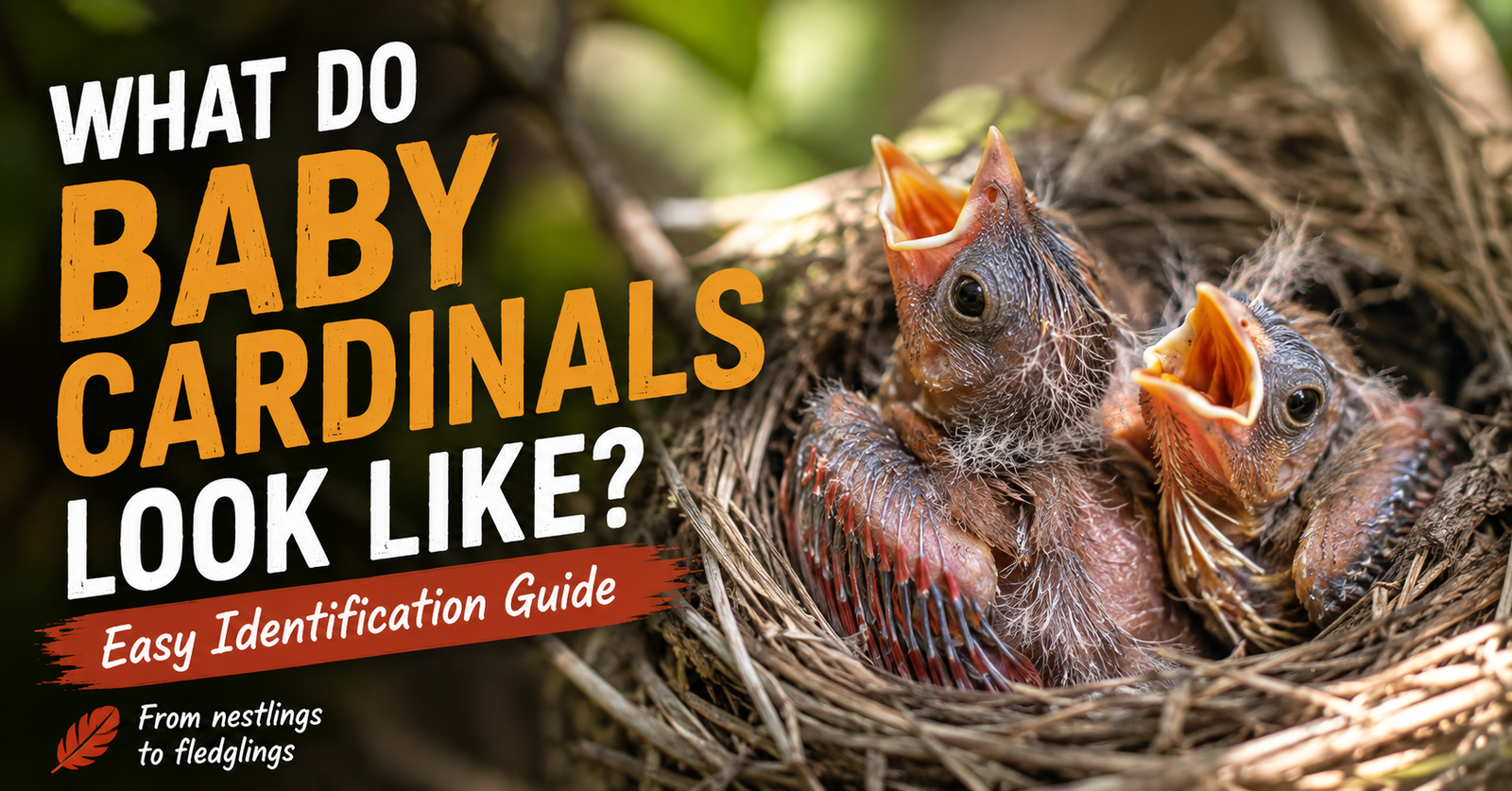
Juvenile identification deserves its own guide because people frequently find young birds around their yards and aren’t sure whether they’re looking at a female cardinal, juvenile cardinal, or completely different species.
How Long Do Cardinals Live?
There’s a big difference between how long a Northern cardinal is biologically capable of living and how long the average wild bird actually survives.
Wild birds face predators, disease, severe weather, collisions, food shortages, and many other hazards throughout their lives. Many young birds never survive long enough to reach old age.

At the other extreme, banding records have documented individual Northern cardinals living well beyond a decade. One exceptionally old recorded wild female reached more than 15 years of age.
That doesn’t mean 15 years should be treated as the normal lifespan of every backyard cardinal.
Exceptional longevity records show what’s possible. They don’t tell us that the bird visiting a feeder should be expected to survive that long.
We’ll keep that distinction important when we build the dedicated cardinal lifespan article later.
What Birds Look Similar to Northern Cardinals?
The Northern cardinal is distinctive across much of its range, but there are still situations where another bird can cause confusion.
One of the most important is the Pyrrhuloxia, particularly in the southwestern United States.
A Pyrrhuloxia also has a prominent crest and a cardinal-like overall shape, but its plumage is much grayer and its bill is noticeably different. Males have red concentrated on particular areas rather than the nearly all-red appearance of an adult male Northern cardinal.
Female cardinals can create more identification challenges than males because their subdued coloring doesn’t immediately scream “cardinal” to an inexperienced observer.
Other reddish birds such as Summer Tanagers or Scarlet Tanagers may occasionally enter the conversation when someone reports seeing a red bird, but body shape, bill shape, crest, markings, habitat, and geographic range can quickly narrow the possibilities.
A cardinal’s combination of a pointed crest and thick, conical bill is especially helpful.
Are Northern Cardinals Rare?
Northern cardinals are not considered rare across most of their established range.
They’re widespread, familiar birds and have adapted well to many human-modified environments. Residential neighborhoods, gardens, parks, brushy edges, and similar landscapes can all provide usable habitat.
Their ability to live around people has helped make the cardinal one of the most recognizable birds in North America.
That familiarity shouldn’t make them boring.

Being able to see a bird regularly gives you a chance to notice details that are easy to miss when you’re simply trying to add a rare species to a checklist. You can watch seasonal behavior change, learn individual calls, notice juveniles appearing, observe pair behavior, and see how the birds use different parts of a yard. A smart feeder can extend that observation when you’re not outside, as this watch birds more closely explains.
Why Northern Cardinals Do So Well Around Backyards
A typical American yard can offer several things a cardinal needs in a relatively small area.

Dense shrubs and landscaping provide cover. Trees and taller shrubs offer singing and observation perches. Weedy edges and natural vegetation can produce seeds and insects. Feeders can provide supplemental food. Thick shrubs, vines, and tangled vegetation may even offer potential nesting sites. If you supplement that natural food with a feeder, safflower seed for supplemental feeding is one cardinal-focused option to evaluate.
A perfectly manicured yard isn’t automatically a better bird habitat.
Cardinals benefit from structural variety, especially vegetation at different heights and enough dense cover to give them places to retreat.
If attracting cardinals is the goal, I’d think beyond simply hanging a feeder.

Food matters, but so do cover, water, nesting opportunities, and the overall way the yard is arranged. A bird needs somewhere to go after it grabs a sunflower seed. If food is part of your plan, you can review this safflower seed for cardinals as one option alongside suitable cover and water.
Northern Cardinals Stay With Us Through the Seasons
One of the best things about Northern cardinals is the opportunity to observe them throughout the entire year.
Spring can bring territorial singing, courtship, nest building, and reflection attacks.
Summer brings nesting activity, adults carrying food, fledglings, and young birds learning to forage.
Fall can bring changes in territorial behavior and increasing tolerance among birds.
Winter strips away much of the vegetation that normally hides cardinals and creates some of the most striking opportunities to see their plumage, particularly the red males.
The birds aren’t simply decorative visitors appearing at a feeder. Their lives are changing throughout the year even when they remain in the same general area.
Once you start recognizing those changes, seeing a cardinal becomes considerably more interesting than simply seeing “the red bird.”
More Northern Cardinal Facts Worth Knowing
Northern cardinals have become so familiar around homes that it’s easy to overlook how interesting they really are. Several characteristics set them apart from other common backyard birds.
Their name comes from the bright red clothing traditionally associated with cardinals of the Roman Catholic Church. The resemblance was strong enough that early European observers applied the cardinal name to these striking red birds.
The Northern cardinal is also the official state bird of seven states: Illinois, Indiana, Kentucky, North Carolina, Ohio, Virginia, and West Virginia. No other bird serves as the state bird of more states.
Cardinals belong to the family Cardinalidae, which includes other colorful North American birds such as grosbeaks and buntings. Their scientific name, Cardinalis cardinalis, reflects just how closely the cardinal identity became attached to the species.
Despite being one of America’s most recognizable birds, the Northern cardinal hasn’t always occupied exactly the same geographic range it does today. Its range expanded northward during the 20th century, with changes in habitat and the availability of food around human settlements likely helping cardinals establish themselves farther north.
Do Cardinals Stay Together as Pairs?
Northern cardinals are generally socially monogamous during the breeding season, with a male and female forming a pair and working together in different parts of reproduction and raising young.
That doesn’t mean every pair should automatically be described as staying together forever.
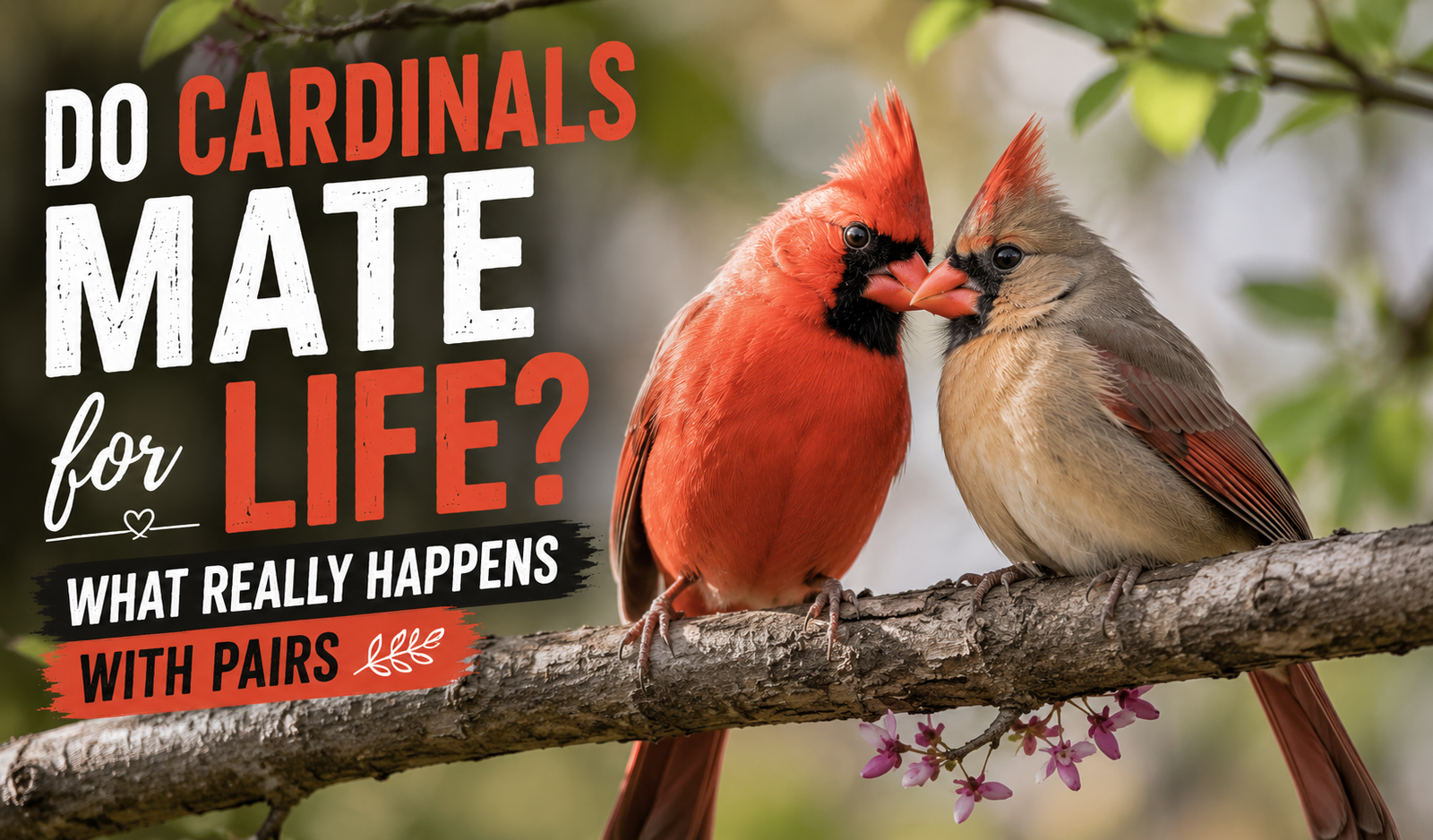
Cardinal pairs can remain associated for extended periods, and the same birds may pair across more than one breeding season. However, pair bonds can change, particularly if one bird dies or disappears.
During courtship, one of the most memorable behaviors is mate-feeding. A male may offer food directly to a female, passing a seed or other food item from his bill to hers.
To someone watching from a distance, the birds can almost appear to be kissing.
There’s a practical purpose behind the behavior. Courtship feeding is part of pair bonding and occurs during a period when the female will soon invest considerable energy into producing eggs, building the nest, and incubating.
Later, the male also plays an important role in feeding the female and helping provide food for the young.
How Many Broods Do Cardinals Have Each Year?
Northern cardinals can raise more than one brood during a breeding season.
Two broods in a year are common, and additional nesting attempts can occur under favorable circumstances. The exact number varies with location, weather, nesting success, food availability, and other conditions.
Their relatively long breeding season helps make multiple nesting attempts possible.
A female may begin another nesting cycle while the male continues helping care for recently fledged young from an earlier brood.
That can make a backyard cardinal family’s summer surprisingly busy.
It also means finding an empty cardinal nest doesn’t necessarily mean the pair has finished breeding for the year. Songbirds generally don’t use nests as permanent homes, and cardinals normally construct a nest for a nesting attempt rather than treating one nest as a year-round residence.
Do Cardinals Use Birdhouses?
Northern cardinals aren’t typical cavity-nesting birds, so a standard enclosed birdhouse isn’t what they’re looking for when choosing a nest site.
They build open-cup nests in vegetation.
Dense shrubs, vines, thickets, brambles, and small trees are much closer to their natural nesting requirements than a traditional wooden nest box with an entrance hole.
This distinction matters when someone wants to attract nesting cardinals. Putting up more birdhouses isn’t necessarily the answer.
A yard containing appropriate dense vegetation may offer considerably more value to a cardinal looking for a nest site.
That doesn’t guarantee a pair will nest there. Birds evaluate numerous characteristics when choosing a location, and what looks ideal to us isn’t always what an individual bird chooses.
Do Cardinals Use Bird Feeders?
Yes. Northern cardinals readily visit bird feeders where suitable foods are available.
Their size and body shape can influence which feeders they use comfortably, though.
Cardinals are larger than chickadees, goldfinches, and many other familiar feeder birds. Tiny perches can make feeding awkward. Platform feeders, hopper-style feeders with adequate room, and other designs providing a comfortable place to perch can work well.
Black oil sunflower seeds are particularly popular with cardinals. Safflower is another seed commonly eaten by them.
Feeder placement can matter too.
A feeder positioned reasonably close to shrubs or other protective vegetation can give cardinals quick access to cover. At the same time, feeders shouldn’t be positioned in ways that make it particularly easy for predators to ambush birds.
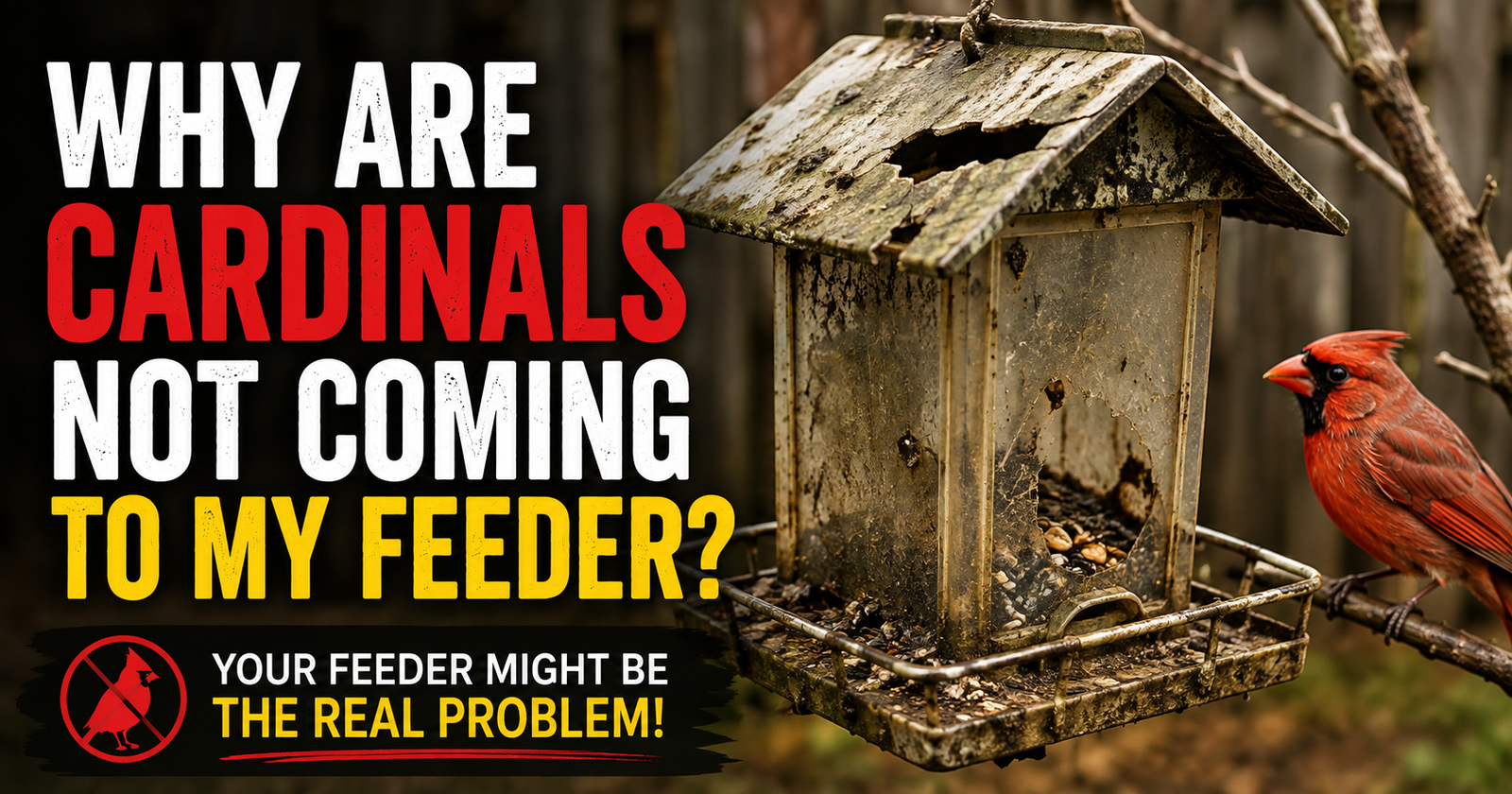
Keeping feeders clean is also important. A busy feeding station concentrates birds in a small area, which makes basic feeder hygiene worthwhile regardless of which species you’re trying to attract.
Do Cardinals Eat From the Ground?
Cardinals frequently forage on or near the ground.
This can explain why you sometimes see a cardinal underneath a feeder rather than actually perched on it. Seeds dropped by other birds can create an easy feeding opportunity below.
Their natural foraging behavior also takes them through low vegetation, leaf litter, and other areas where they can find seeds, fruits, and invertebrates.
Ground feeding isn’t unique to cardinals, of course, and spilled birdseed can create its own problems around a feeding station. Large accumulations can spoil, attract rodents, or create messy conditions.
Seeing a cardinal feeding beneath your feeder, however, isn’t unusual behavior.
What Time of Day Are Cardinals Most Active?
Cardinals are active during daylight, and backyard observers frequently notice them around feeders early in the morning and again later in the day.
There isn’t a single exact time when every cardinal suddenly begins feeding.
Activity changes with season, temperature, weather, food availability, breeding responsibilities, disturbance, and the behavior of the individual birds.
Early morning can be especially productive for listening to cardinal songs. During the breeding season, a male singing from an exposed perch can be considerably easier to locate than a cardinal quietly feeding inside thick vegetation later in the day.
Cardinals may also visit feeding areas relatively late in the afternoon as daylight begins fading.
If you’re trying to figure out whether cardinals live around your property, spending a little time outside around sunrise can reveal birds you barely notice during the busiest part of the day.
Where Do Cardinals Sleep at Night?
Cardinals don’t return to a nest every night to sleep.
This is a common misconception about birds. A nest is primarily a structure for eggs and developing young, not the equivalent of a permanent bird bedroom.
At night, cardinals generally roost in protected vegetation.
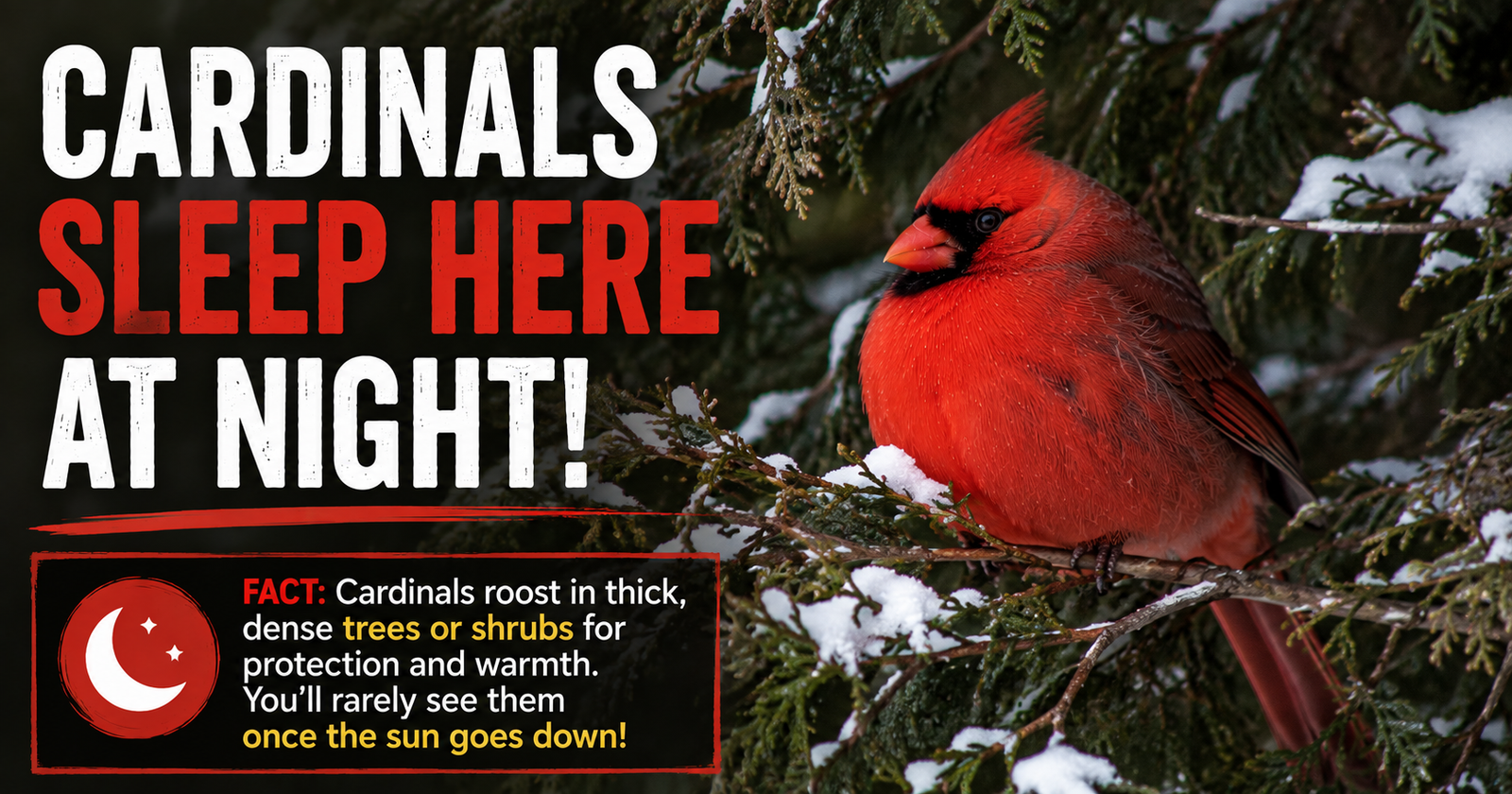
Dense shrubs, thickets, and trees can provide concealment and some protection from weather and predators. The exact location can vary, and an individual bird doesn’t necessarily use one precise branch every night. Those sheltered places can also serve as nighttime roosts, as explained in cardinal roosting locations.
During colder weather, sheltered vegetation becomes particularly valuable.

This is another reason a yard’s habitat can matter even when you’re already providing plenty of food. A feeder gives a cardinal somewhere to eat. It doesn’t give the bird everything else it needs to live. For readers who want to observe visiting birds more closely, this smart feeder for backyard observation is a separate feeder option to consider.
What Eats Northern Cardinals?
Despite their bright coloring and sometimes assertive behavior, cardinals occupy the middle of a much larger food web.
Adult cardinals can be preyed upon by hawks and other predators capable of catching small birds. Domestic and free-roaming cats can also pose a serious threat to birds feeding or moving close to the ground.
Nests face a different set of dangers.
Eggs and nestlings can potentially be taken by snakes, squirrels, chipmunks, other mammals, and certain birds. Which predators matter most varies by habitat and location.
Parents can’t eliminate those risks.
Dense nest placement helps conceal eggs and young, while adults can give alarm calls and react to threats near the nest.
This also helps explain why approaching a nest repeatedly for photographs isn’t a great idea. Even when our intentions are harmless, minimizing disturbance around an active nest is better for the birds.
Are Cardinals Aggressive Toward Other Birds?
Cardinals can be territorial, but describing them simply as aggressive birds misses a lot of context.
Territorial behavior is particularly important during breeding.
A male defending his territory may chase another male. Females can participate in territorial behavior as well. The same bird may behave considerably more tolerantly during another part of the year.
At a feeder, cardinals can sometimes displace smaller birds simply because they’re relatively large and assertive. But they routinely feed around numerous other backyard species without turning every feeder visit into a fight.
Behavior depends on circumstances.
Food availability, feeder size, crowding, season, breeding status, and the individual birds involved can all affect what you see.
Why Are Male Cardinals So Red?
The brilliant red plumage of a male Northern cardinal is produced through carotenoid pigments obtained through the bird’s diet and then processed by its body.
Birds can’t simply manufacture carotenoids from nothing. They ultimately obtain the compounds through foods in their environment.
Plumage coloration can therefore carry biological information.
Researchers have studied the relationship between cardinal coloration, condition, mate selection, and reproductive biology. As with many aspects of animal coloration, the complete story is more complicated than saying that the “reddest bird always wins.”
What we can see easily is the result: an adult male Northern cardinal can produce one of the most intense red appearances of any common North American backyard bird.
Females also possess red coloration, particularly in the crest, wings, and tail, but their overall plumage remains substantially more subdued.
Why Do Cardinals Have Crests?
A cardinal’s crest isn’t just decorative.
Birds can change its position, making the crest more or less prominent depending on what they’re doing. A cardinal that appears to have an enormous pointed crest in one photograph may look almost smooth-headed in another.
The feathers can be raised during heightened states such as alertness or social interactions and lowered at other times.
Because crest position changes, I wouldn’t use the apparent size of the crest by itself to determine a bird’s age, sex, or condition.
For identification purposes, the presence of a crest is far more useful than exactly how upright it happens to be at that moment.
Can Cardinals Recognize People?
It’s tempting to assume that a familiar cardinal visiting the same feeder every morning recognizes the person filling it.
Birds are capable of learning about their surroundings, routines, threats, and food sources, and some bird species have demonstrated impressive abilities to distinguish individual humans.
However, we should be careful about turning a repeated backyard encounter into a stronger claim than the evidence supports.
A cardinal can certainly learn that a particular yard is a reliable place to find food and that ordinary human activity there doesn’t always represent an immediate threat.
Whether the individual cardinal you see each morning specifically recognizes you as an individual person is much harder to establish from casual observation alone.
That’s one of those places where keeping bird behavior grounded is more useful than giving it a human-like explanation simply because the story sounds appealing.
Caleb Hartwell is the Bird Identification & Behavior Contributor for BirdResource.com, where he helps turn detailed bird research into clear, practical guides for identifying familiar birds and understanding what they’re doing around our yards and neighborhoods.