
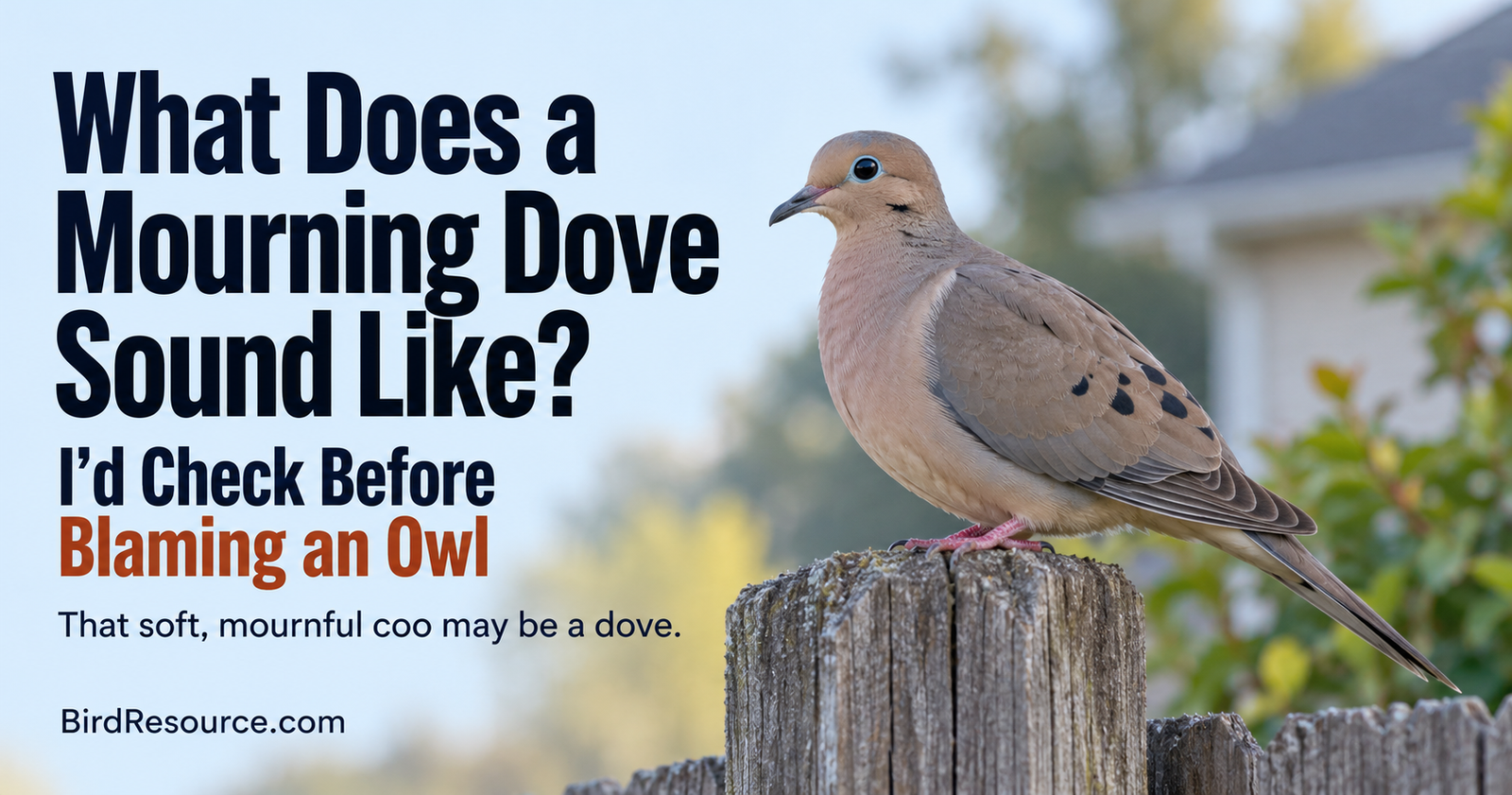
If I heard a low, drawn-out hoo-hoo-hoo coming from somewhere around the yard, especially when I couldn’t see the bird, I wouldn’t automatically assume there was an owl hiding in the trees.
I’d look for a Mourning Dove first.
That’s because the familiar Mourning Dove coo has fooled plenty of people.
The bird can sit quietly on a power line, rooftop, fence, or tree branch and produce a deep, hollow call that sounds much larger and more owl-like than you’d expect from the slim brown dove making it.
But here’s the part I find even more interesting:
The famous sad coo isn’t the only Mourning Dove sound worth learning.
They have different vocalizations around mates and nests.
And that loud whistle you hear when one suddenly blasts away from the driveway?
That isn’t its voice at all.
Its wings are making the sound.
Once I knew what to listen for, those two sounds became the easiest clues I’d use to recognize Mourning Doves without getting a perfect look at them.
The Famous Mourning Dove Coo
The classic Mourning Dove song is low, soft, and drawn out.
People write bird sounds in different ways, but something along these lines gets the idea across:
coo-OOO-oo… oo… oo
The exact written spelling doesn’t matter much.
Hearing the real bird is considerably more useful.
The Cornell Lab’s Mourning Dove recordings let you hear the actual calls rather than trying to turn bird sounds into English letters.
What I’d listen for is the rhythm.
There’s a stronger opening portion followed by softer, repeated coos.
Once that pattern becomes familiar, it’s surprisingly recognizable.


If I Thought I Heard an Owl, Here’s What I’d Do
I wouldn’t start by trying to memorize ten different owl calls.
I’d find the bird.
That sounds obvious, but it’s incredibly useful.
If the sound keeps coming from the same area, I’d quietly watch:
power lines,
bare branches,
rooftops,
fence posts,
and other exposed perches.
Mourning Doves frequently call from noticeable locations.
If I find a slender brownish-gray bird with dark wing spots and a long pointed tail sitting exactly where the mysterious “owl” sound is coming from, the case is pretty much solved.
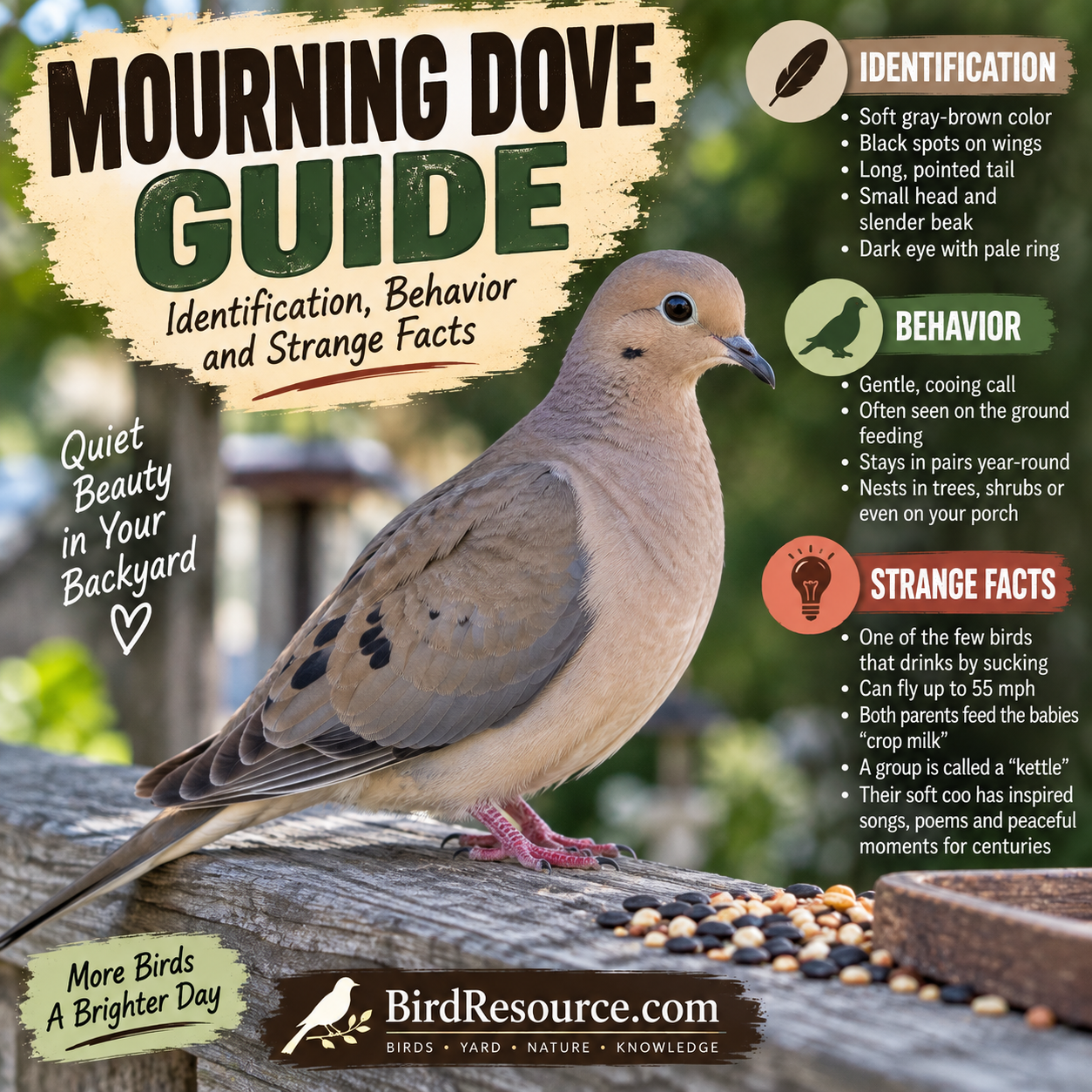
Our Mourning Dove identification guide covers the visual clues I’d use to confirm the bird.
Why Does a Mourning Dove Sound Like an Owl?
Part of the confusion comes from pitch and tone.
The Mourning Dove’s call is low and hollow enough to resemble the kinds of hooting sounds people associate with owls.
Then add distance.
Trees.
A house blocking your view.
Maybe early morning light.
Suddenly you have a mysterious low call coming from somewhere you can’t see.
It’s easy for your brain to fill in:
owl.
But there is one practical clue I’d use.
Listen to the Pattern, Not Just the “Hoo”
Owls and Mourning Doves don’t simply make one identical generic hoot.
Their rhythms differ.
For example, a Great Horned Owl commonly produces a deeper series of distinct hoots.
The Mourning Dove’s familiar song has its own repeated cooing pattern.
I wouldn’t trust myself to distinguish every distant bird from a written “hoo,” though.
If I’m uncertain, I want either a recording comparison or a visual confirmation.
That’s much more reliable than arguing with myself over whether the third hoot sounded slightly longer than the second.
The Bird Making That Coo Is Usually a Male
This is a useful clue.
The familiar perch-coo is primarily associated with unmated male Mourning Doves advertising from a perch.
So that dove sitting on a wire repeatedly making the classic call isn’t necessarily sad.
He’s communicating.
That’s an important distinction because the name Mourning Dove makes it tempting to assign human emotion to the sound.
It sounds mournful to us.
That doesn’t mean the bird is grieving.
The name describes how humans interpreted the call, not necessarily what the bird is feeling.

I’d Pay Attention to Where He Calls From
If I heard the same Mourning Dove every morning, I’d start noticing whether he uses the same perch.
That could be:
the same power line,
the same exposed tree branch,
the peak of a roof,
or the same section of fence.
That’s the kind of simple backyard observation I’d actually write down.
What time did he start?
How long did he call?
Did another dove arrive?
Did the calling change after another bird appeared?
You don’t need expensive equipment to make birdwatching interesting.
Sometimes you just need to stop treating a familiar sound as background noise.
Mourning Doves Make a Different Nest Call
The classic coo isn’t their only vocalization.
Paired males can make a nest call associated with potential nesting locations.
According to the Cornell Lab’s Mourning Dove sound guide, a male may give this call while showing a female possible nest sites.
That’s especially interesting if you already have a pair hanging around the property.
A male repeatedly calling from a particular tree, ledge, or other location during breeding season may be doing something very different from the lone bird advertising from a power line.
This is where combining sound with behavior becomes much more useful than simply memorizing noises.

A Quiet Call Near the Nest Can Mean Something Different
Mourning Doves also use softer calls between paired birds.
Cornell describes a greeting call used particularly when one member of a pair arrives at the nest and replaces the other.
That’s exactly the kind of behavior I’d want to watch if I had an active nest visible from a safe distance.
Mourning Doves share incubation duties.
The male generally handles much of the daytime incubation, while the female takes much of the later afternoon, overnight, and morning period.
If I could watch a shift change without disturbing them, I’d listen closely.
Does the arriving bird call?
Does the sitting bird answer?
How quickly do they exchange places?
That’s a much more interesting way to learn bird sounds than listening to an audio clip in isolation.
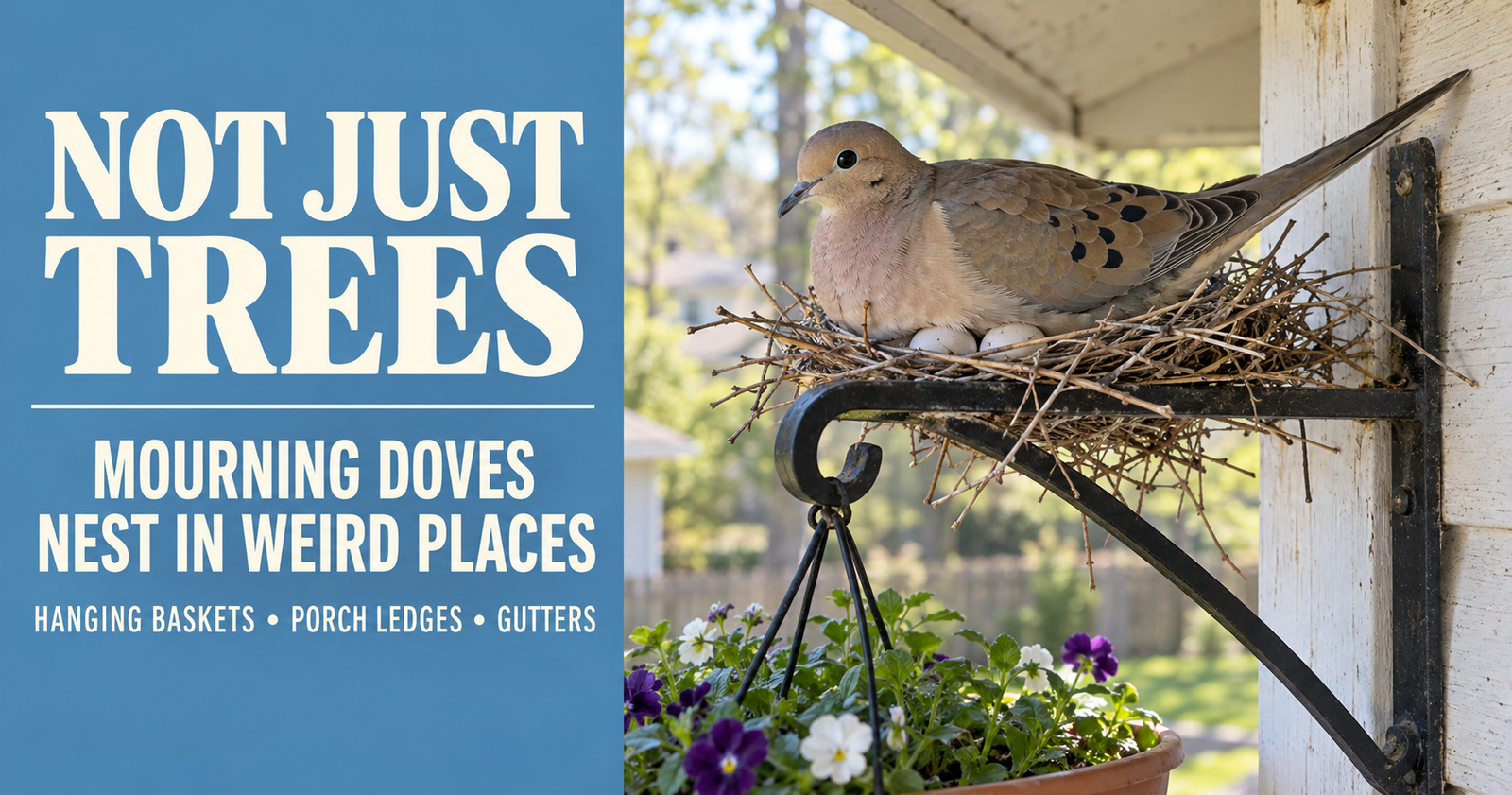
Our guide to finding Mourning Dove nests explains the behavioral clues I’d use to locate a nest without wandering around pulling branches apart.
That Loud Whistle Is Not a Mourning Dove Call
This is the sound almost everybody has heard.
You’re walking toward the driveway.
A Mourning Dove was feeding on the ground without you noticing it.
Suddenly:
WHIRRRR-WHEEE!
The bird rockets away.
It sounds almost like the dove made a startled whistle.
It didn’t.
The wings produced it.
Specialized flight feathers create the high-pitched sound as air moves across them during flight.
That means Mourning Doves effectively have a recognizable sound produced by their feathers in addition to the sounds produced by their voice.
The Wing Whistle May Actually Warn Other Doves
This is where the sound gets more interesting.
The wing whistle isn’t necessarily meaningless mechanical noise.
Research on Mourning Dove relatives and observations summarized by Cornell suggest that the sudden flight sound can function as an alarm-like signal.
Think about what happens on the ground.
Several Mourning Doves are feeding.
One notices danger.
It launches hard.
The rapid wingbeats immediately produce a loud sound.
Nearby doves don’t need to wait for a separate vocal warning.
The escape itself makes noise.
If I wanted to observe this in real life, I’d watch a group of doves feeding from a distance and pay attention when one suddenly takes off.
Do the others react immediately?
Do they launch too?
That’s something a backyard birdwatcher can actually notice.
Why Are Mourning Doves So Loud When They Take Off?
Part of it is simply how rapidly they accelerate.
Mourning Doves can go from quietly walking around on the ground to fast, direct flight almost instantly.
Those wings are moving hard.
The specialized feathers add the distinctive whistle.
That’s why the contrast can be so startling.
One second:
quiet brown bird picking up millet.
Next second:
WHIRRR!
Gone.
Once I connect that sound with Mourning Doves, I can sometimes identify the bird after it has already flown past me.
Do Female Mourning Doves Coo?
Yes, females aren’t silent.
But the famous advertising perch-coo is particularly associated with males.
Females can make softer vocalizations, including calls around nesting and pair interactions.
That’s why I wouldn’t use the simple rule:
cooing bird = male.
The type of call and the context matter.
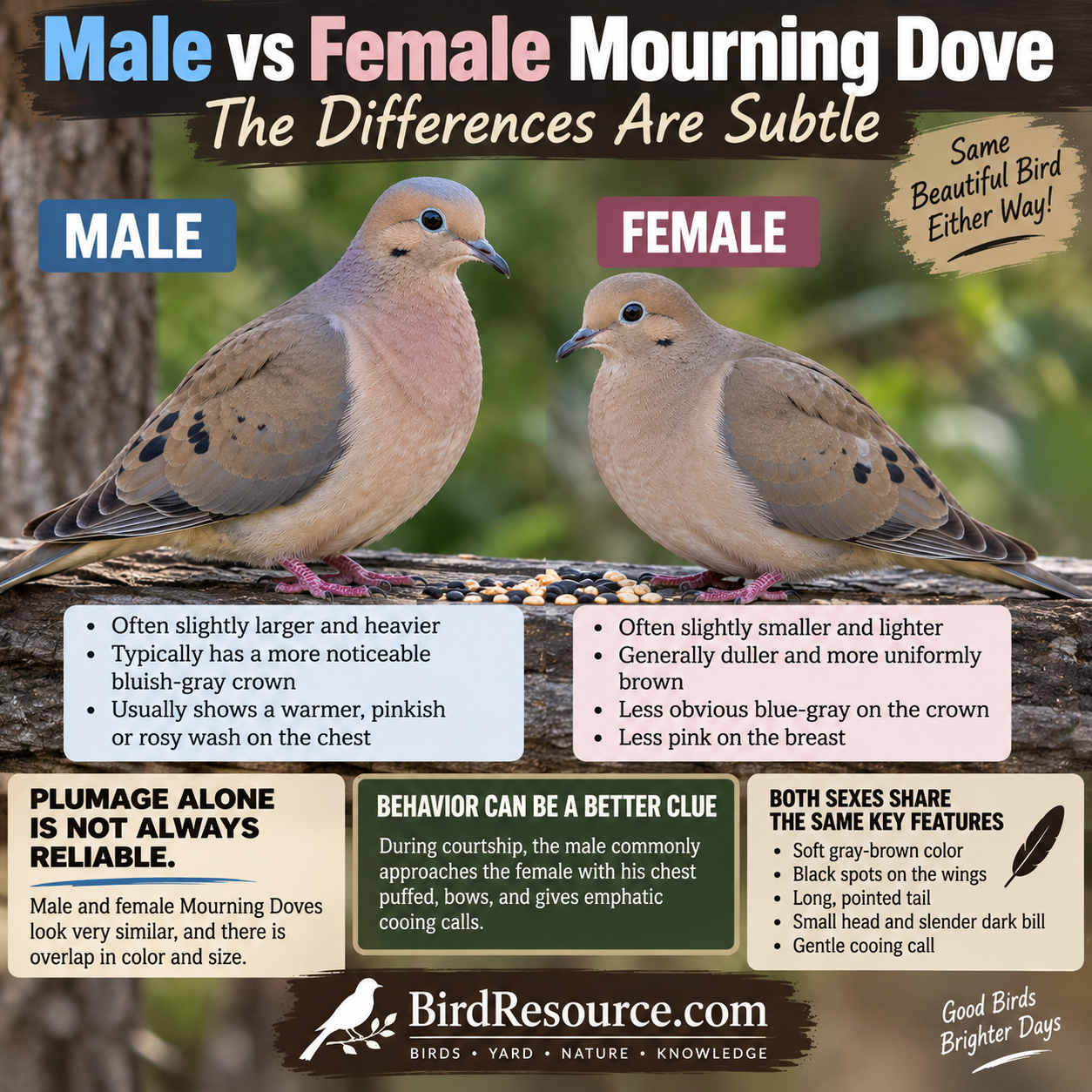
If sex identification is the goal, I’d combine vocal behavior with plumage and nesting behavior. Our male vs female Mourning Dove guide covers those clues together.
Why Is a Mourning Dove Cooing Over and Over?
If it’s the familiar perch-coo, the bird may be advertising for a mate.
That explains why the same sound can repeat so persistently.
From our perspective, it can feel like:
Surely you’ve said enough.
From the dove’s perspective, communication only works if another bird hears it.
I’d pay attention to whether the pattern changes when another Mourning Dove arrives.
That’s where a repetitive sound suddenly becomes behavior rather than background noise.
Why Do Mourning Doves Coo Early in the Morning?
Early morning is an excellent time to notice bird vocalizations because birds are active and the surrounding environment can be quieter.
A Mourning Dove calling from an exposed perch can carry surprisingly well.
But I wouldn’t assume they only call at sunrise.
You can hear Mourning Dove vocalizations at other times of day too.
The morning simply makes the sound especially noticeable when there are fewer lawn mowers, cars, people, and other noises competing with it.
What I’d Record If I Wanted to Learn Their Calls for Real
I wouldn’t try to learn Mourning Dove sounds from memory alone.
I’d use my phone.
Not to blast recordings at the birds.
Just to document what I’m already hearing.
I’d record:
time of day,
where the dove was sitting,
whether it was alone or paired,
what the bird did immediately before and after calling,
and whether another dove responded.
Then I’d compare my recording with reputable reference recordings afterward.
That turns:
“I heard a weird dove noise”
into:
“I heard this sound from a lone bird on a power line at 7:10 a.m., and it repeated it for five minutes.”
That’s actual observation.
And over time, patterns start becoming obvious.
Common Questions About Mourning Dove Sounds
What does a Mourning Dove sound like?
The best-known sound is a low, drawn-out coo with a mournful quality. Mourning Doves also produce quieter nesting and pair calls.
Do Mourning Doves sound like owls?
They can. Their low coo is frequently mistaken for an owl, particularly when the bird is hidden from view.
Which Mourning Dove makes the familiar coo?
The classic advertising perch-coo is primarily given by unmated males.
Why do Mourning Doves make a whistling noise?
The whistle heard during takeoff and flight is produced by the wings rather than the bird’s voice.
Do female Mourning Doves make sounds?
Yes. Females vocalize too, particularly during interactions with mates and around nests.
Why does the same Mourning Dove keep cooing?
A male may repeatedly advertise from a preferred perch while seeking or communicating with a mate.
Is a Mourning Dove cooing because it’s sad?
There’s no reason to interpret the normal advertising call as sadness. The mournful quality perceived by humans is what helped give the species its name.
The Next Time I Hear an “Owl” Outside
I wouldn’t go searching for an owl immediately.
I’d stop.
Listen to the rhythm.
Find where the sound is coming from.
Then I’d check the power lines, rooftops, fences, and exposed tree branches.
If I find a slim brown dove sitting there calmly producing that deep, sad-sounding coo, I’ve learned something much more useful than simply memorizing another bird fact.
I’ve connected the sound to the actual bird making it.
And later, when that same bird explodes off the driveway with a loud whistle, I’ll know something else too.
The first sound came from its voice.
The second came from its wings.
For such an ordinary-looking backyard bird, that’s a pretty remarkable sound system.
Mason Reed is the Bird Identification & Behavior Contributor for BirdResource.com, where he helps everyday birdwatchers connect the sounds, movements, and small behavioral clues they notice outside with the birds actually making them.