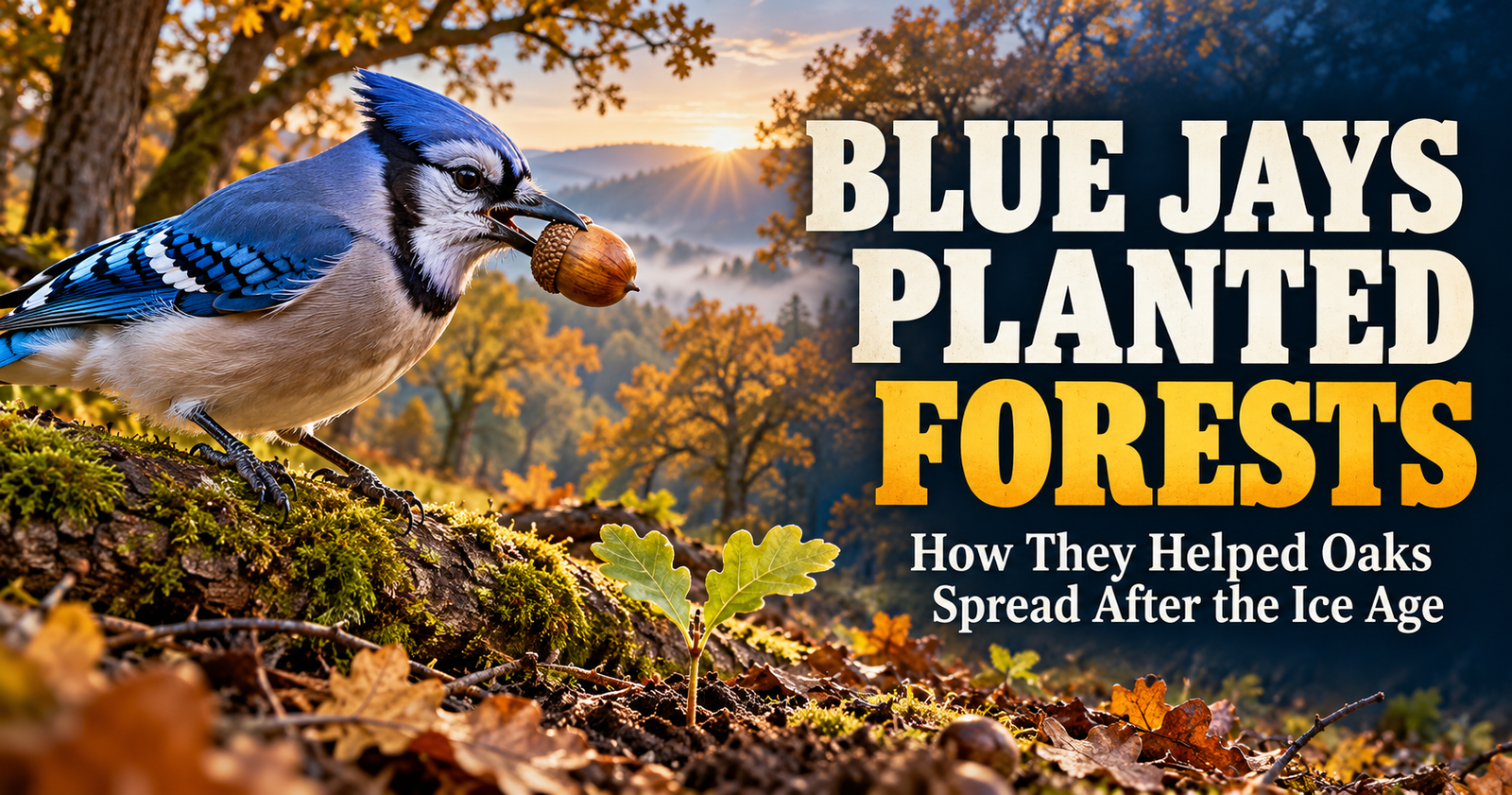
I used to look at a Blue Jay carrying an acorn and think it was simply taking lunch somewhere quieter.
Grab an acorn.
Fly away.
Eat it.
Nothing particularly mysterious about that.
Then I learned that Blue Jays don’t just eat acorns.
They move enormous numbers of them.
Some get carried surprisingly far from the tree where they fell. Many are hidden underground for later.
And inevitably, some never get retrieved.
Those forgotten acorns can become oak trees.
That behavior is so important that the Cornell Lab says Blue Jays are credited with helping spread oak trees after the last glacial period.
Think about that for a second.
The noisy blue bird yelling from the tree beside your house may belong to a species that helped move entire forests.
One Blue Jay Can Carry Five Acorns at Once
This is where the numbers started getting ridiculous.
A Blue Jay doesn’t necessarily pick up one acorn and fly away.
It has a storage area in its throat and upper esophagus commonly called a gular pouch.
Cornell reports that a Blue Jay can carry two or three acorns in that pouch.
Then it can hold another in its mouth.
And another at the tip of its bill.
Five acorns in one trip.
Once I knew that, I started looking at a Blue Jay with a bulging throat differently.
That bird may not be choking or swallowing some enormous meal.
It may be carrying groceries.
And it’s not necessarily planning to eat them immediately.
Researchers Followed Blue Jays and the Numbers Got Even Crazier
Scientists fitted Blue Jays with radio transmitters and followed their movements.
Six of those birds each cached an estimated 3,000 to 5,000 acorns during one autumn.
Not six birds combined.
Each bird.
Imagine trying to hide 5,000 individual acorns around your property and then remember where you put them.
That’s the kind of fall workload some Blue Jays take on.
They carry the nuts away and hide them in places where they can return later when food becomes harder to find.
Usually that means putting them into the ground.
And that’s where the Blue Jay accidentally becomes a tree planter.

The Blue Jay Doesn’t Intend to Plant an Oak Tree
This is the part I like most.
The bird isn’t planting trees because it wants shade in 30 years.
It’s hiding food.
An acorn buried in the ground is harder for another animal to see than one sitting on top of the leaves.
The jay plans to come back.
And Blue Jays have impressive spatial memory that helps them relocate stored food.
But thousands of caches create thousands of opportunities for something to go differently.
Maybe the bird forgets one.
Maybe it dies before returning.
Maybe there’s more stored food than it needs.
Whatever the reason, an acorn left underground now has something it didn’t have underneath the parent oak.
A chance to grow somewhere new.
The Distance Matters More Than I First Realized
An oak tree already drops acorns underneath itself.
It doesn’t need a Blue Jay to move an acorn three feet.
The interesting part is moving that seed away from the parent tree.
That’s how plants expand into new territory.
An acorn is relatively large and heavy.
Wind isn’t going to carry it across a field like a dandelion seed.
Something has to move it.
Squirrels certainly move acorns.
Other animals do too.
But Blue Jays can pick one up and fly.
Now a seed that would have fallen directly beneath one oak can suddenly end up much farther away.
That gives oak trees a transportation system with wings.
Oaks and Blue Jays Fit Together Almost Too Well
Once I learned about the acorn connection, I started noticing how often Blue Jays and oak trees seem to go together.
Cornell describes Blue Jays as especially abundant near oaks.
That makes sense.
An oak produces one of their favorite foods.
The jay gets a high-energy nut it can store.
The oak gets an animal capable of carrying its seeds away.
Neither one needs to understand the arrangement.
The system works anyway.
The oak feeds the jay.
The jay moves the oak.
This May Have Mattered After the Glaciers Retreated
This is where an ordinary backyard behavior connects with something enormous.
During the last Ice Age, massive portions of northern North America were covered by ice.
As the climate warmed and glaciers retreated, forests expanded northward again.
Trees had to recolonize land.
But an oak can’t walk north.
Its seeds have to get there somehow.
Cornell notes that Blue Jays’ fondness for acorns is credited with helping spread oak trees after the last glacial period.
That doesn’t mean Blue Jays single-handedly created North America’s oak forests.
Other animals and ecological processes were involved.
But imagine thousands upon thousands of generations of jays.
Each bird carrying acorns.
Each fall.
Some farther north.
Some into openings.
Some into fields.
Some into places where an oak hadn’t been growing.
A small behavior repeated millions of times becomes something much larger.
I Started Looking at Forgotten Acorns Differently
Usually when we talk about an animal forgetting where it stored food, it sounds like failure.
The bird messed up.
It lost dinner.
But ecologically, forgetting can be useful.
One forgotten acorn might become a seedling.
That seedling might survive.
Eventually it might become a mature oak producing thousands of its own acorns.
Now imagine that happening repeatedly across a landscape.
A mistake for the Blue Jay can become an opportunity for the forest.
Blue Jays Don’t Cache Only Acorns
Blue Jays store other foods too.
Nuts and seeds can be carried away and hidden for later.
But acorns are particularly important.
Cornell’s research on Blue Jay diets found that acorns, other nuts, fruits and grains make up a huge portion of their food.
That helps explain why Blue Jays are so closely associated with oak habitat.
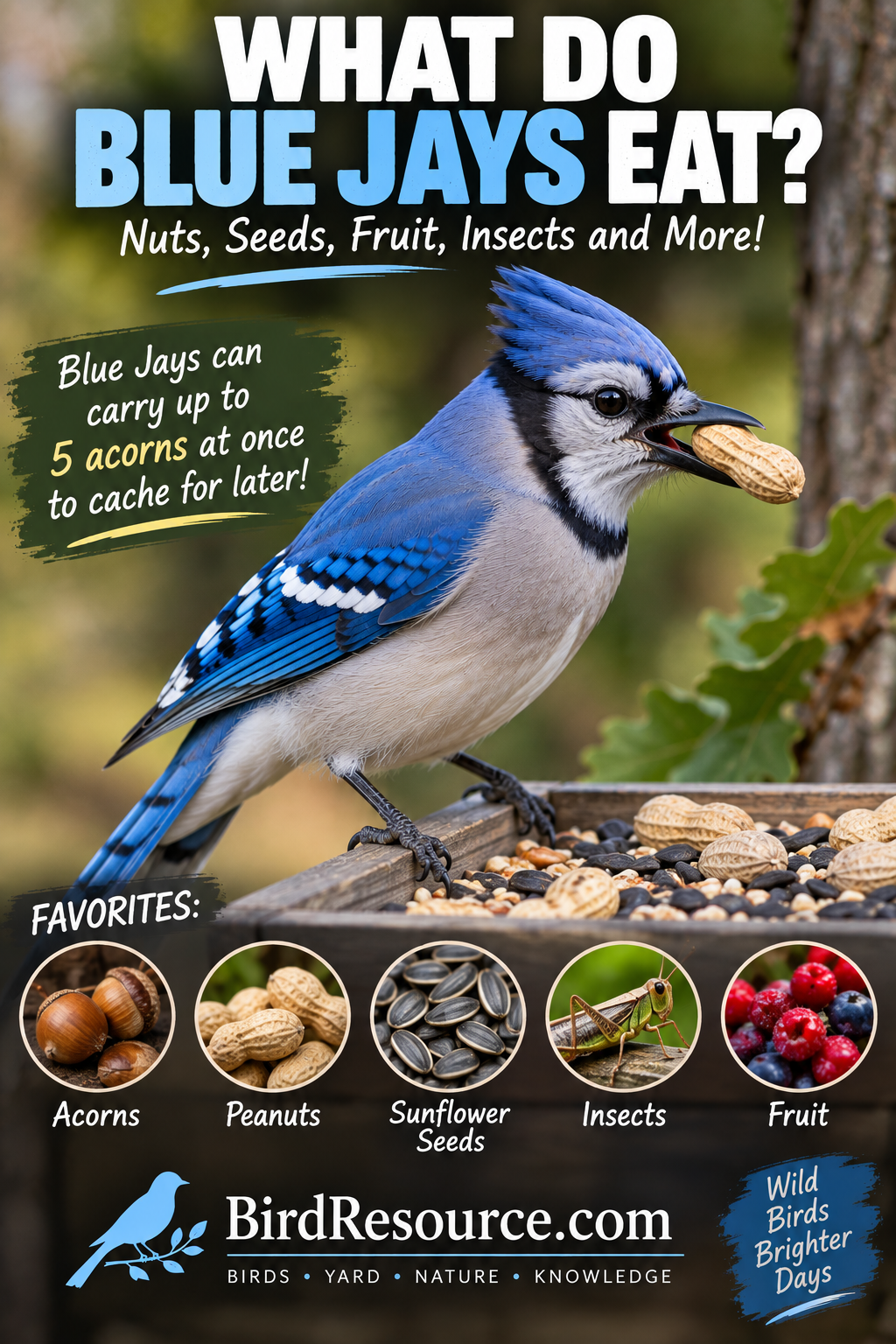
We’ve already looked at what Blue Jays eat from acorns to backyard feeders, but I think the caching behavior deserves attention by itself.
Eating an acorn is one thing.
Moving thousands of them around the landscape is something else entirely.
I Would Love to Follow One Blue Jay for an Afternoon
This would make an incredible BirdResource observation.
I’d find an oak producing acorns where Blue Jays were actively feeding.
Then I’d pick one bird I could reasonably keep track of.
I wouldn’t follow it through private property or disturb it.
I’d simply watch from one location and record what I could see.
How many acorns does it pick up?
Does it swallow them?
Carry them?
How many does it appear to carry at once?
Which direction does it fly?
How long before it returns?
Does it repeatedly use the same tree?
Even twenty minutes of observation could show how quickly one bird moves food.
The Bulging Throat Would Be the Detail I’d Photograph
If I could get a clear photograph without disturbing the bird, that’s what I’d want.
Not another beautiful portrait of a Blue Jay sitting on a branch.
I’d want the bird carrying acorns.
The gular pouch can allow a jay to transport several food items internally while carrying additional food in its bill.
A photograph showing that would tell the story better than a hundred words.
Here’s the bird.
Here’s the acorn.
And hidden inside that throat may be several more.
Suddenly “Blue Jays move thousands of acorns” doesn’t feel like an abstract bird fact anymore.
Could I Get Blue Jays to Plant Oaks in My Yard?
Technically, a Blue Jay could cache an acorn on your property and never retrieve it.
Whether that acorn successfully becomes a tree is another question.
The seed has to remain viable.
Conditions have to be suitable.
It has to escape being eaten by another animal.
Then the seedling has to survive.
I wouldn’t rely on Blue Jays as my landscaping crew.
If I actually wanted an oak tree in a particular location, I’d plant one intentionally.
But I absolutely wouldn’t be surprised to discover an oak seedling growing somewhere I never planted one if Blue Jays and mature oaks were nearby.
Squirrels Deserve Some Credit Too
Blue Jays aren’t the only animals moving acorns.
Squirrels are famous for caching nuts.
They also forget or fail to retrieve some of them.
So when an oak appears far from a mature tree, we can’t automatically look at the nearest Blue Jay and declare it responsible.
The interesting difference is mobility.
A Blue Jay can fly across open areas carrying acorns.
That makes it particularly effective at transporting seeds beyond places an acorn would reach by simply falling or rolling.
Different animals can contribute to the same forest.
Oak Trees Give Something Back for Generations
Here’s another reason I like this relationship.
A Blue Jay hides an acorn.
The acorn grows.
Years pass.
Eventually that oak may begin producing acorns of its own.
Now future Blue Jays have another food source.
The bird that originally moved the seed will be long gone.
But its behavior may have created food for generations of birds that come afterward.
The tree benefits from being moved.
Future jays benefit from the tree.
Nobody planned any of it.
An Oak Tree Also Becomes Much More Than Blue Jay Food
Once that forgotten acorn becomes a mature tree, the ecological payoff gets enormous.
Oak trees support insects.
Those insects become food for birds.
Branches provide perches.
Leaves provide cover.
Cavities can eventually provide shelter.
Acorns feed numerous animals.
So when a Blue Jay moves an acorn into a place where it successfully becomes a tree, the result can eventually benefit far more wildlife than Blue Jays alone.
That’s why seed dispersal matters.
It’s not simply about producing another tree.
It’s about helping create habitat.
The Blue Jay’s Bad Reputation Looks Different From Here
Blue Jays get accused of being bullies constantly.
They’re loud.
They’re big compared with many feeder birds.
They sometimes raid nests.
They can dominate a feeding station.
But even that reputation deserves context.
Cornell notes that in a study specifically searching Blue Jay stomach contents for evidence of birds or eggs, only 6 of 530 stomachs contained traces of eggs or nestlings.
Meanwhile, nuts, fruits and grains made up most of the non-insect diet.
And while we’re complaining about a jay stealing peanuts from the feeder, that same species has spent thousands of years moving acorns around North America.
Birds don’t fit neatly into “good” and “bad.”
They’re doing what their species evolved to do.
Sometimes those behaviors shape entire ecosystems.
Common Questions About Blue Jays and Acorns
Do Blue Jays bury acorns?
Yes. Blue Jays cache acorns and other foods for later use, often hiding them in the ground.
How many acorns can a Blue Jay carry?
Cornell reports that a Blue Jay may carry two or three acorns in its throat pouch, another in its mouth and another at the tip of its bill, potentially moving five in one trip.
How many acorns does a Blue Jay bury?
In one radio-tracking study, six Blue Jays each cached an estimated 3,000 to 5,000 acorns during one autumn.
Do Blue Jays remember where they hide acorns?
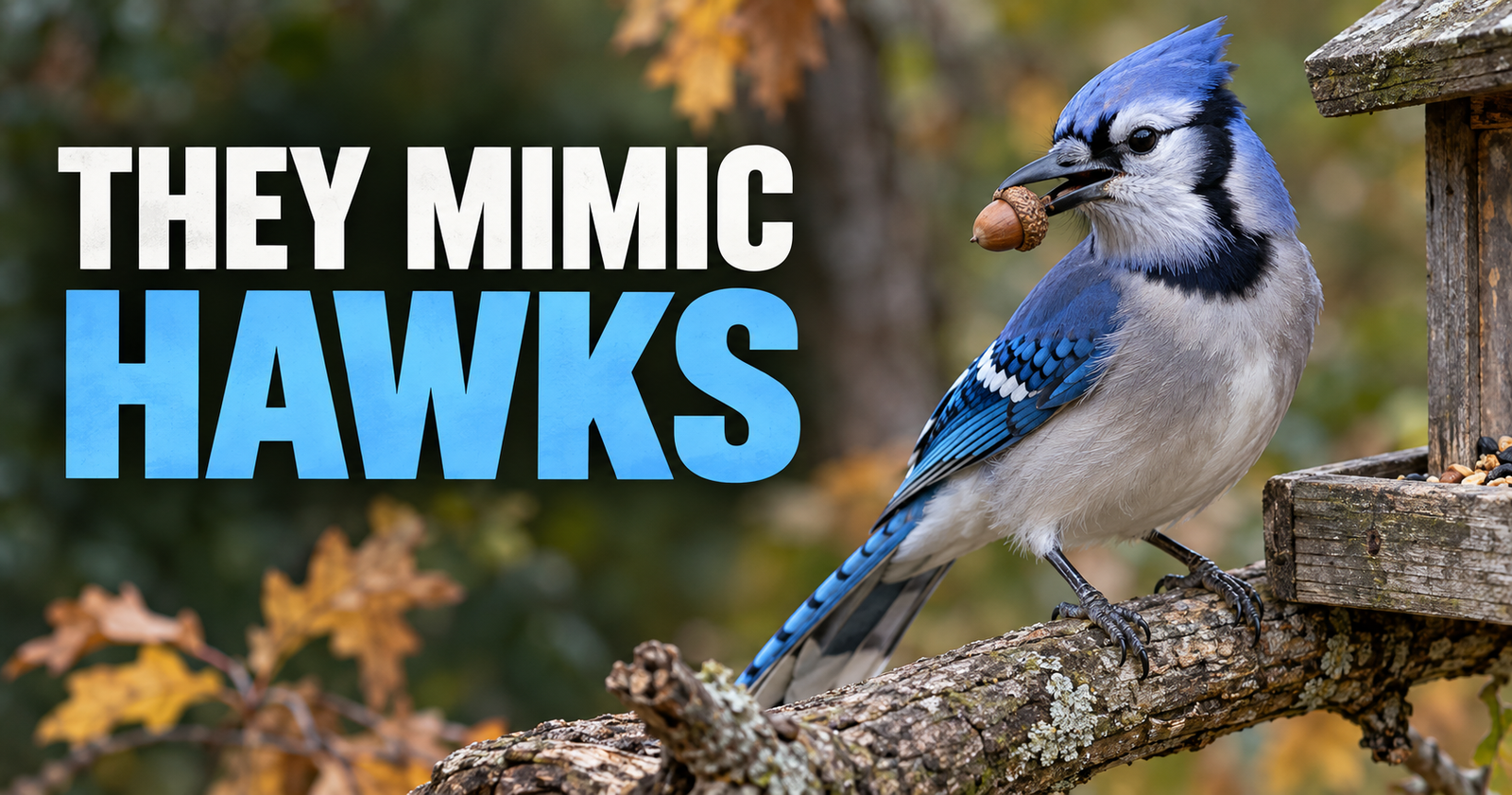
Blue Jays have strong spatial memory and can relocate stored food. However, not every cached acorn is necessarily recovered. The wider discussion of Blue Jay caching behavior explains how this memory-driven habit fits into Blue Jay ecology.
Do forgotten Blue Jay acorns grow into trees?
Some can. An unretrieved viable acorn buried in a suitable location may germinate and eventually become an oak.
Did Blue Jays really help spread oak trees?
Cornell credits Blue Jays’ acorn-caching behavior with helping spread oak trees after the last glacial period.
Why do Blue Jays like oak trees?
Acorns are an important food source for Blue Jays, and the birds are especially common around oak habitat.
Now I Can’t Watch a Blue Jay Carry an Acorn the Same Way
Before learning this, I would have watched the bird fly away and thought:
There goes lunch.
Now I wonder where that acorn is going.
Maybe the jay eats it ten minutes later.
Maybe it hides it and retrieves it in January.
Maybe another animal finds it first.
Or maybe nobody comes back.
The shell splits.
A root pushes into the soil.
A little oak appears.
And years later, nobody looking at that tree would have any idea that its life may have started inside the throat of a Blue Jay flying across a field.
That’s the kind of bird fact I love.
Not because it’s weird just for the sake of being weird.
Because one ordinary thing we’ve all seen a Blue Jay do can become part of something enormous when it’s repeated across thousands of years.
Corbin Ashford is a Bird Facts & Behavior Contributor for BirdResource.com, where he digs into the surprising true stories hiding behind ordinary birds and the things we see them doing every day.