

A Northern Cardinal can live for well over 10 years in the wild, but that doesn’t mean the bright red bird visiting your feeder should be expected to survive that long.
The record is much more impressive.
The oldest documented wild Northern Cardinal was a female that reached 15 years and 9 months old, according to both Cornell and the U.S. Bird Banding Laboratory. She had originally been banded in Pennsylvania and was encountered there again more than 15 years later.
But there’s an important distinction here that gets lost in a lot of articles about bird lifespan:
The oldest cardinal ever recorded is not the same thing as the lifespan of a typical cardinal.
Wild birds face predators, window collisions, disease, severe weather, accidents, and numerous other hazards throughout their lives. Young birds face particularly difficult odds before ever reaching adulthood.
So when someone asks me how long cardinals live, I wouldn’t simply answer “15 years.”
The much better answer is that Northern Cardinals have the biological ability to live into their teens, but many die considerably younger.
And once a cardinal successfully reaches adulthood, its chances become much more interesting.
How Long Do Northern Cardinals Live in the Wild?
There isn’t one exact age that every wild cardinal reaches.
That’s not really how wildlife lifespan works.
Some birds die extremely young.
Others survive their first year, establish territories, reproduce repeatedly, and remain alive for many years.
Estimates cited by the University of Michigan’s Animal Diversity Web put annual adult Northern Cardinal survival at approximately 60 to 65 percent.
That statistic tells us something much more useful than simply looking at the oldest known bird.
Imagine 100 adult cardinals.
If annual survival were around 60 to 65 percent, a substantial number wouldn’t survive to the following year.
Then the survivors face another year of risks.
Then another.
That’s why a cardinal reaching 10 or 15 years old is exceptional.
It had to survive those hazards year after year after year.

What Is the Oldest Cardinal Ever Recorded?
The official North American bird-banding longevity record for a Northern Cardinal is 15 years and 9 months.
And we know quite a bit about that bird.
She was female.
She was originally banded in Pennsylvania on March 16, 1956.
She was encountered again in Pennsylvania on March 17, 1971.
The U.S. Bird Banding Laboratory still lists that individual as the Northern Cardinal longevity record.
There’s also another remarkable female cardinal in the records that reached 15 years and 8 months in Virginia.
Two different wild cardinals surviving beyond 15 years tells us something important.
A 15-year-old cardinal isn’t merely theoretically possible.
It’s actually happened and been documented through bird banding.
How Do We Know How Old a Wild Cardinal Is?
This is where bird banding becomes incredibly valuable.
You can’t look at an adult cardinal sitting on your feeder and reliably say:
“That one is 7 years old.”
Once a bird reaches adult plumage, visual aging becomes much more limited than people sometimes assume.
Researchers solve that problem by banding birds.
A bird receives a uniquely numbered band, and information about the bird and banding event is recorded. If that individual is encountered again years later, researchers can determine the minimum age it reached.
The North American Bird Banding Program maintains millions of banding and encounter records and uses verified encounters to establish longevity records for species.
That’s why the 15-year, 9-month cardinal record means so much more than somebody saying they’ve “had the same cardinal in their backyard for 20 years.”
One is documented.
The other may simply involve several similar-looking birds visiting the same property over time.
Can I Tell How Old the Cardinal in My Yard Is?
Usually not precisely.
You can often separate juveniles from adults because young Northern Cardinals look different.
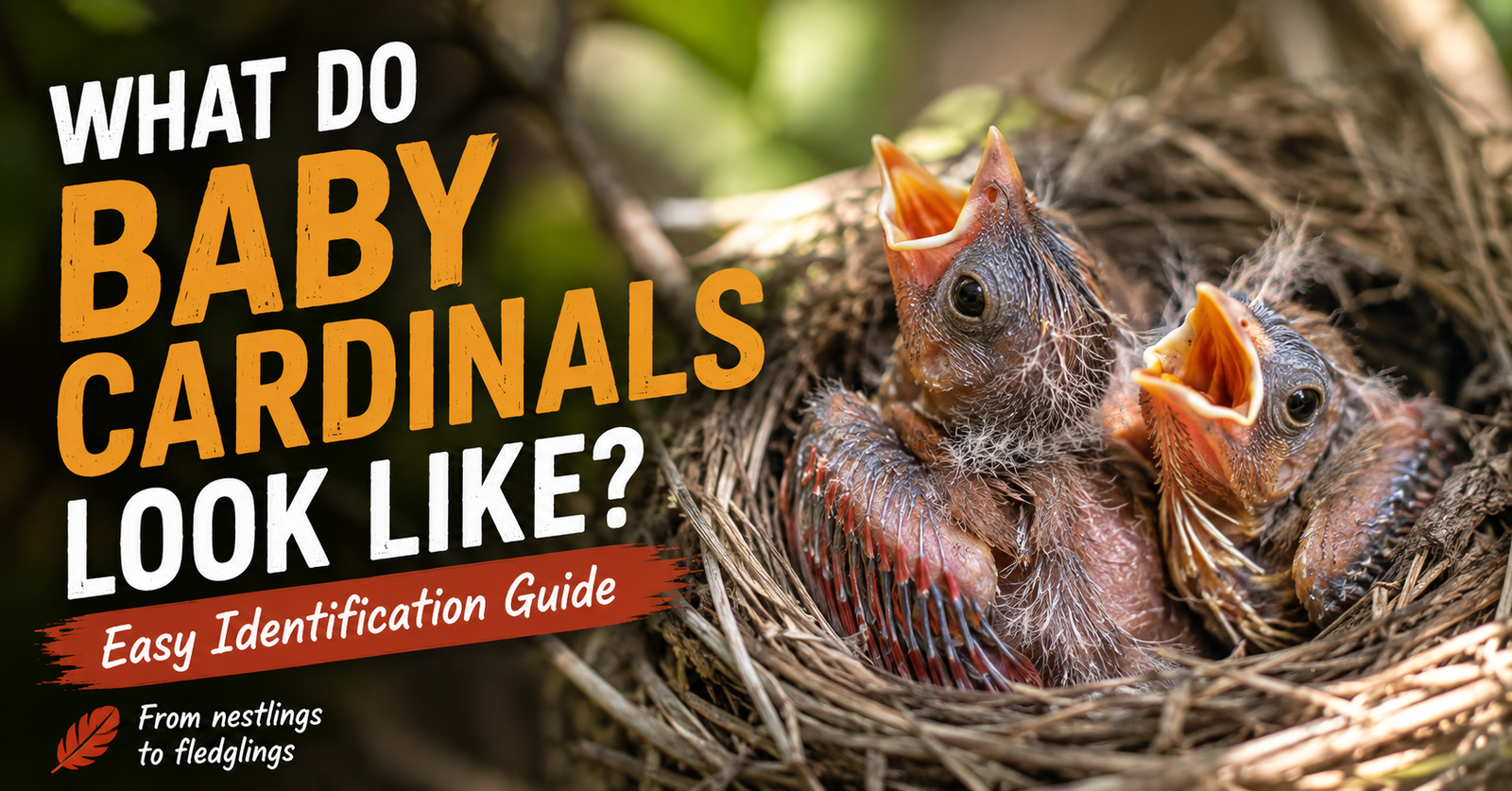
Juveniles have dark bills rather than the reddish-orange bills of adults, and young males don’t immediately have the complete brilliant-red appearance of mature males. Cornell describes adult males as brilliant red with a black face, while adult females are primarily pale brown with reddish coloration in the wings, tail, and crest. The age-related appearance behind those differences is broken down in Juveniles have dark bills.
Once you’re looking at a fully mature adult, though, things get harder.
A beautiful red male isn’t necessarily young.
A slightly rough-looking male isn’t necessarily old.
Feather condition changes with molt and wear.
Lighting changes how plumage appears.
Individual birds vary.
Without something like a known banding history, assigning an exact age is usually guesswork.
How Long Do Baby Cardinals Live?
This question sounds simple, but there’s no separate predetermined “baby cardinal lifespan.”
A baby cardinal that survives its vulnerable early stages can eventually become an adult and potentially live for many years.
Getting there is the difficult part.
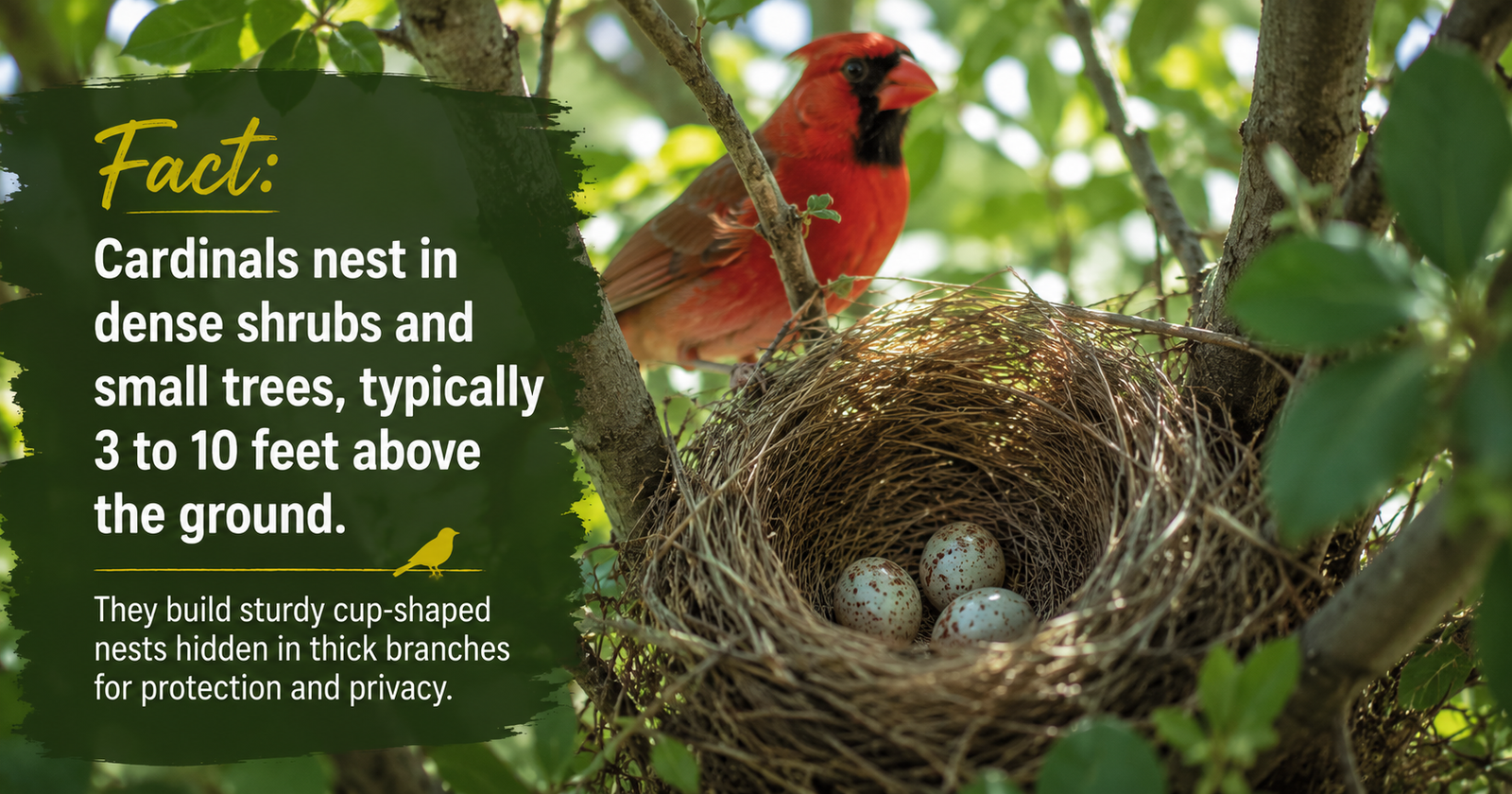
The nesting period moves incredibly fast. Northern Cardinal eggs incubate for roughly 11 to 13 days, and nestlings spend only about 7 to 13 days in the nest before fledging. Those short stages make it especially useful to know the places cardinals select for nests before a nest becomes easy to miss.
Leaving the nest doesn’t mean the danger is over.
A fledgling still has developing flight skills.
It spends time low in vegetation.
It may be on or near the ground.
It continues depending on its parents for food.
This is a vulnerable stage of life, and surviving it is one of the first major hurdles a cardinal faces.
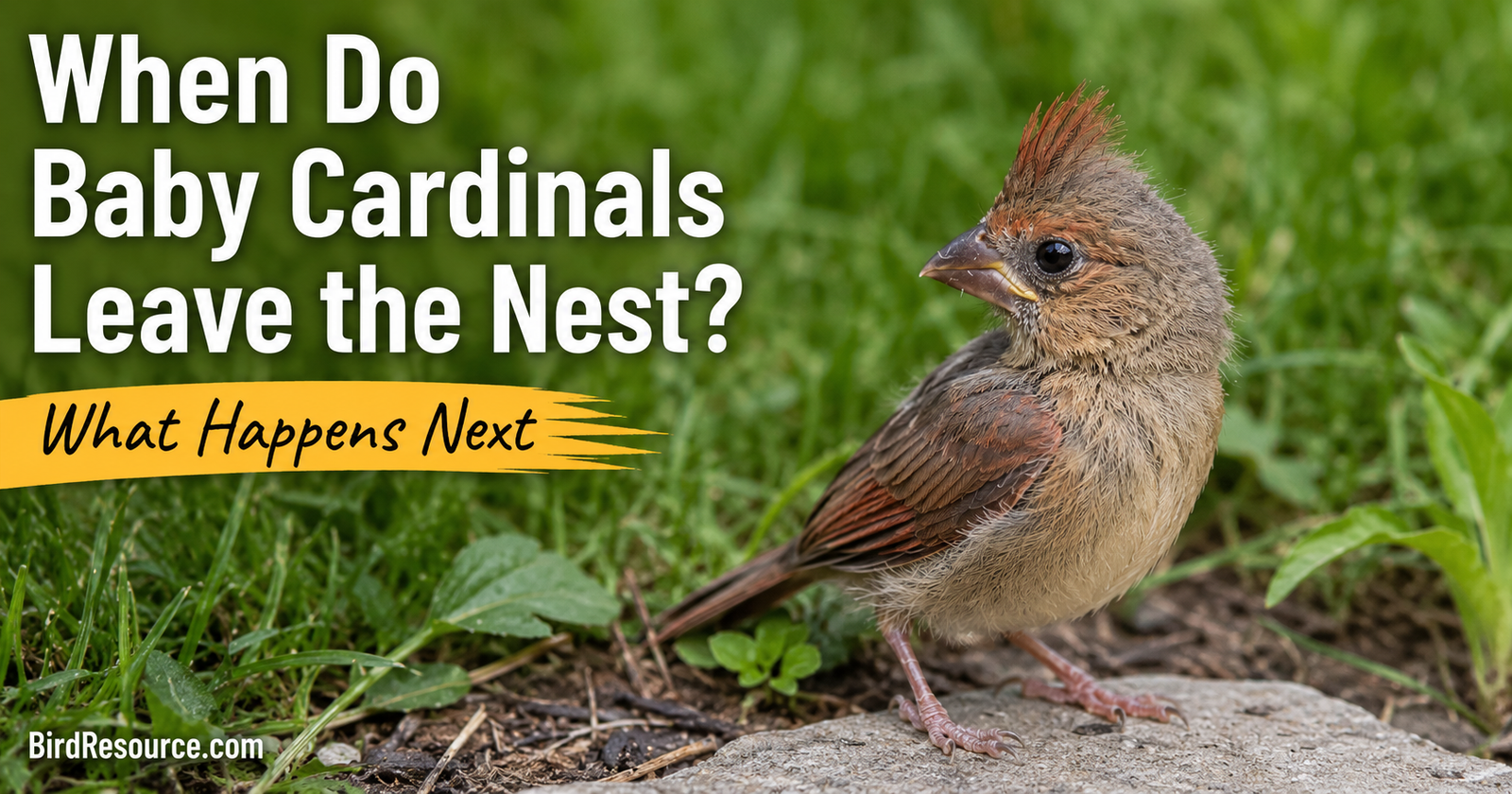
Our guide to what happens when baby cardinals leave the nest explains why a seemingly helpless young cardinal outside the nest may actually be behaving completely normally.
How Many Baby Cardinals Survive?
This is where I’d be careful with any website giving you a neat percentage without explaining exactly what it measures.
Nest success is not the same thing as fledgling survival.
Fledgling survival isn’t the same thing as first-year survival.
And first-year survival isn’t the same thing as adult annual survival.
Cornell’s NestWatch has previously reported that fewer than 40 percent of monitored Northern Cardinal nests fledged at least one young in the dataset it discussed.
That doesn’t mean 60 percent of all baby cardinals die.
It means many entire nesting attempts fail before producing even one fledgling.
Predation is a major reason.
That’s also why cardinals producing multiple eggs and potentially making additional nesting attempts during a breeding season makes biological sense.

How Many Eggs Do Cardinals Lay?
Northern Cardinals normally lay 2 to 5 eggs per clutch, and Cornell lists 1 to 2 broods as typical.
If every egg became a 15-year-old adult cardinal, we’d have a ridiculous number of cardinals very quickly.
Obviously, that doesn’t happen.
Many eggs don’t make it to adulthood.
Some nests fail.
Some nestlings are lost.
Some fledglings don’t survive.
Some young birds die during their first year.
Reproduction has to compensate for those losses.
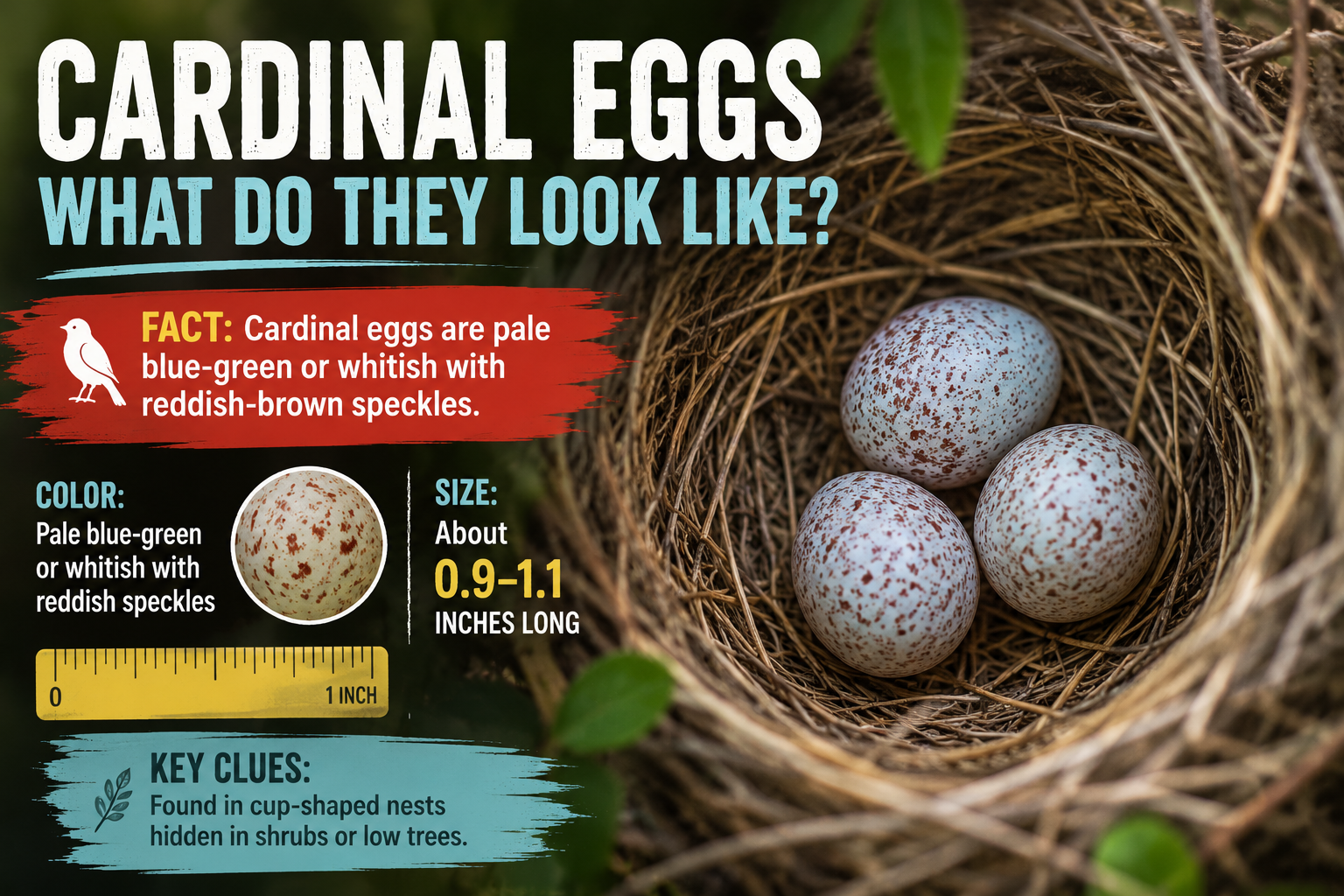
If you’ve ever found a cardinal nest and wondered what you were looking at, our cardinal egg identification guide covers their pale speckled appearance, size, clutch count, and incubation period.
What Usually Kills Cardinals?
There’s no single answer.
A wild cardinal spends its life navigating multiple risks.
Predators are one obvious threat.
Nest predators can take eggs and nestlings.
Fledglings become vulnerable when they leave the nest with limited flying ability.
Adults can also be taken by predators.
Then there are hazards created or intensified by living around people.
Windows are a major collision hazard for birds.
Free-ranging domestic cats can kill birds.
Vehicles, pesticides, disease, and extreme weather can also contribute to mortality.
A cardinal that reaches an unusually old age has successfully avoided a tremendous number of potential problems.

What Animals Eat Cardinals?
Northern Cardinals can face different predators depending on their life stage and location.
Eggs and nestlings are especially vulnerable because they’re concentrated in one location and can’t escape.
Potential nest predators can include snakes, squirrels, chipmunks, jays, crows, and various mammals.
Adult cardinals face predators capable of catching small birds, including hawks and other raptors.
Domestic cats are another serious danger, particularly around homes.
But I wouldn’t look at every missing cardinal and immediately blame a predator.
Wild birds move.
Feeding patterns change.
Seasonal behavior changes.
A bird that stops appearing at your feeder isn’t automatically dead.
Are Cardinals Easy for Predators to See Because They’re Red?
This is a fascinating question, especially when we’re talking about males.
A brilliant red bird doesn’t exactly seem designed for camouflage.
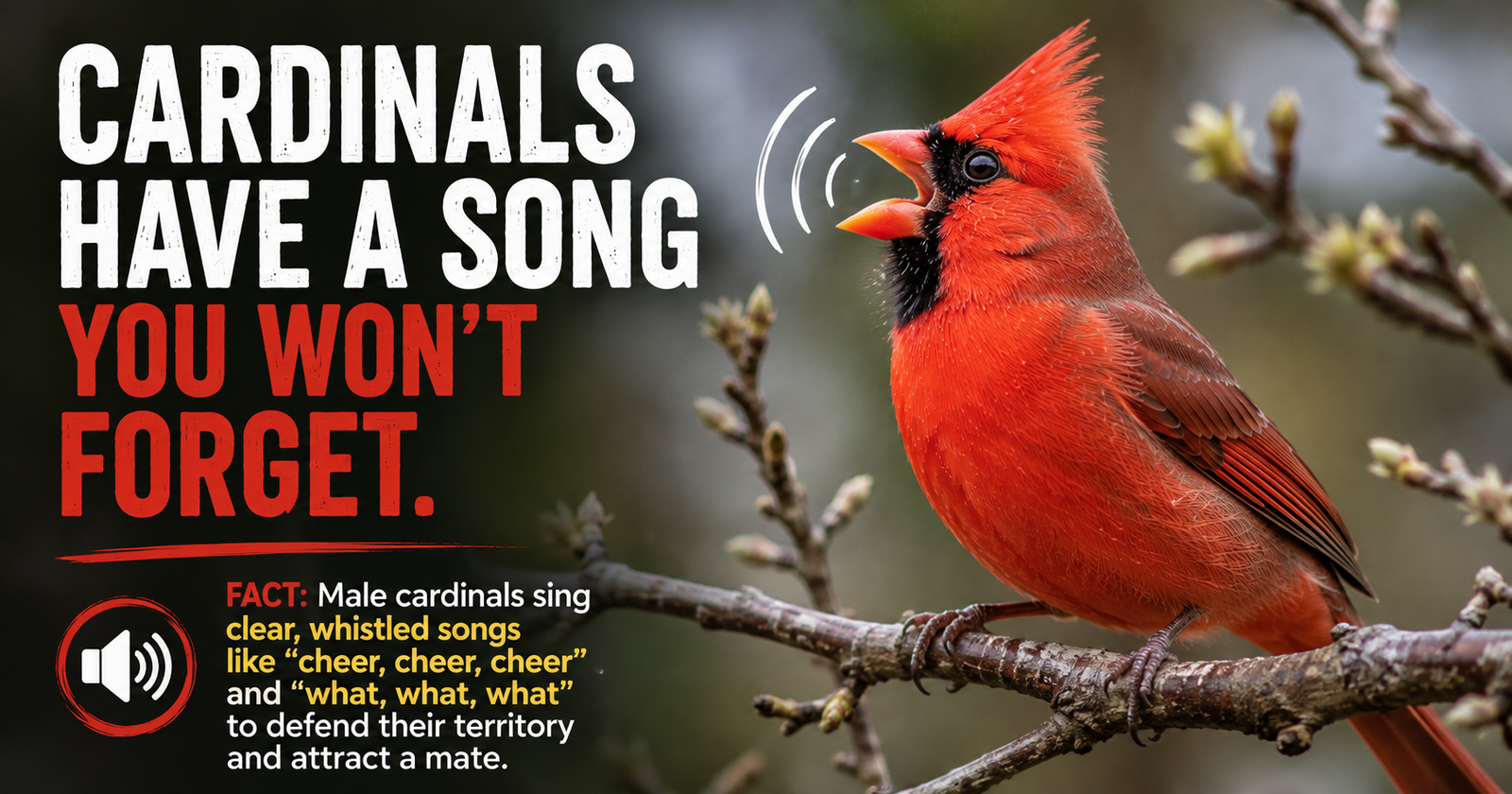
Cornell’s NestWatch points out the same apparent contradiction: male cardinals are extremely conspicuous, yet the species remains very successful. Female preference for redder males has helped drive that bright coloration through sexual selection, while females have much more muted plumage that provides better camouflage around nesting sites.
So that red plumage has benefits and costs.
A male cardinal isn’t red because blending into a brown shrub is the only thing evolution cares about.
Reproduction matters too.
Do Cardinals Die From Window Collisions?
They can.
And there are actually two different window problems worth separating.
A bird can collide with glass because reflections or transparency make the window difficult to recognize as a solid barrier.
Then there’s the famous cardinal behavior where a territorial bird repeatedly attacks its own reflection.
Those aren’t exactly the same problem.
During breeding season, a male cardinal may see his reflection and interpret it as another male refusing to leave his territory.
He can return repeatedly because every time he looks at the window, his “rival” is still there.

If that’s happening around your house, our guide explaining why cardinals attack windows and how to stop them covers practical ways to break that reflection.
Can Cardinals Freeze to Death?
Severe weather can certainly be dangerous to wild birds, but Northern Cardinals are remarkably capable of handling winter conditions.
Remember, these birds don’t normally migrate south for winter.
They’re year-round residents throughout their range, including areas that experience freezing temperatures and substantial snow.
Their feathers provide insulation, and birds can fluff their plumage to trap insulating air.
They also seek sheltered habitat and adjust feeding behavior according to conditions.
That doesn’t make them invincible.
A prolonged period of extreme cold combined with inadequate food, illness, or other stressors can be dangerous.
But seeing a cardinal sitting outside during a snowstorm doesn’t mean somebody forgot to tell it to fly south.
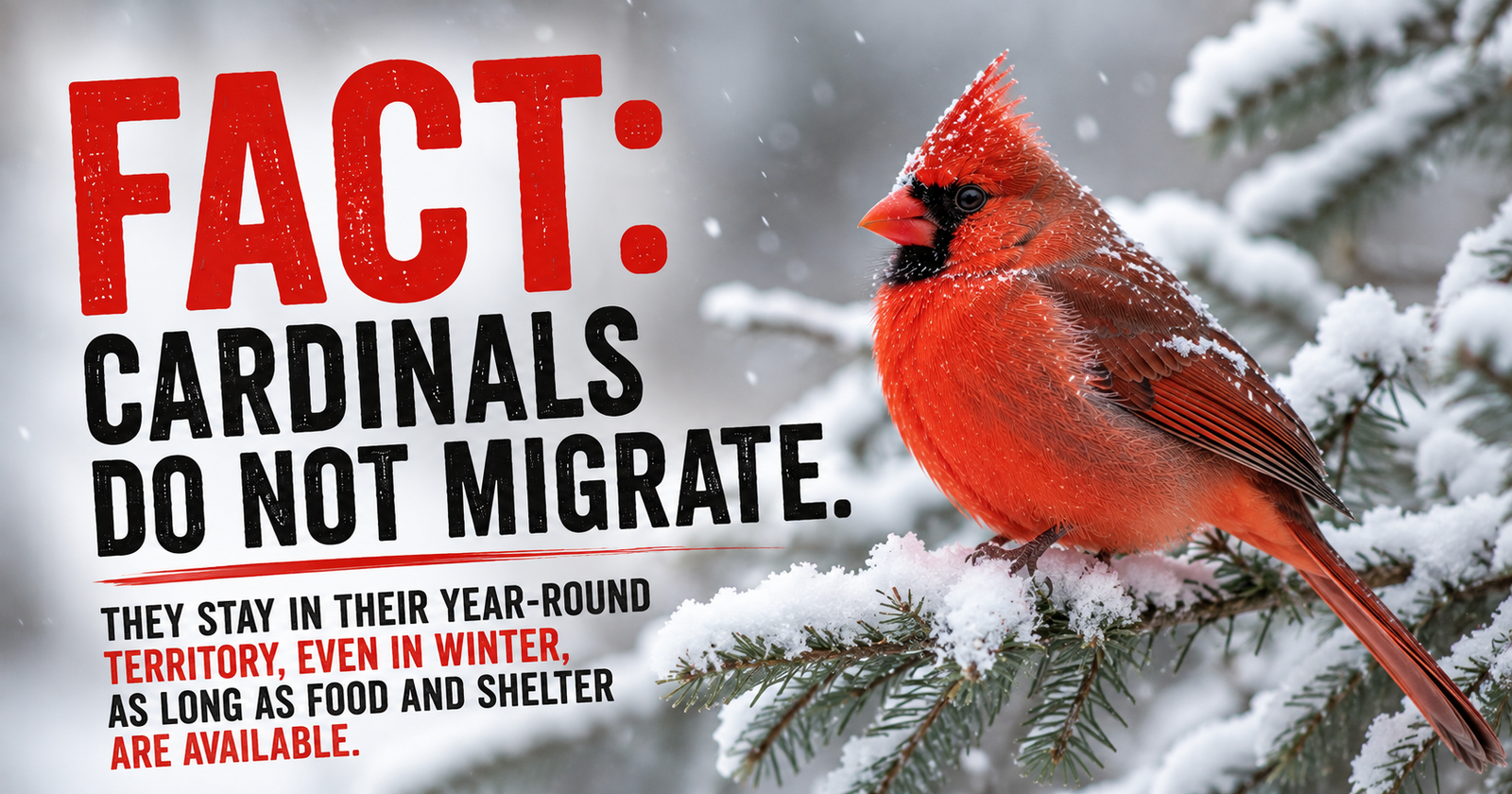
Our guide to where cardinals really go during winter explains why the birds you see in January may be the same local population you watched all summer.
Does Feeding Cardinals Help Them Live Longer?
This is one of those questions where I don’t want to make a claim stronger than the evidence supports. You can read more about Bird Resource's evidence-based approach and how we handle uncertainty in factual bird information.

Providing appropriate supplemental food can give cardinals another reliable food source. Readers considering supplemental feeding can also review the Best cardinal bird seed on Amazon listed for this article.

Cornell notes that Northern Cardinals readily visit feeders and particularly favor sunflower seeds. Their natural diet also includes numerous seeds, fruits, and insects. For readers comparing feeder foods, another seed option for cardinal feeders offers a focused alternative to consider.
But I wouldn’t promise:
“Put out sunflower seeds and your cardinal will live five years longer.”
We can’t make that connection for an individual backyard bird.
A feeder is one part of its environment.
Good habitat matters.
Natural food matters.
Water matters.
Cover matters.
Predator exposure matters.
Disease matters.
Safe feeder placement and cleanliness matter too.
The better goal isn’t trying to guarantee a particular lifespan. It’s making your yard a useful and reasonably safe place for birds.
Can Dirty Bird Feeders Shorten a Cardinal’s Life?
Poor feeder hygiene can contribute to conditions where disease spreads among birds.
That’s why I don’t treat bird feeders like decorations that can be filled indefinitely without maintenance.
Birds stand on them.
They leave droppings.
Seed gets wet.
Hulls accumulate.
Multiple birds congregate in a relatively small area.
Regular cleaning and replacing spoiled food are basic parts of responsible bird feeding.
If birds around a feeder appear sick, it’s worth taking the situation seriously rather than continuing to concentrate birds around the same contaminated feeding area.
A feeder should be helping the birds using it, not becoming another hazard.
Does What a Cardinal Eats Affect Its Health?
Of course, but cardinals don’t live on one magical “superfood.”
Wild Northern Cardinals eat a varied diet.
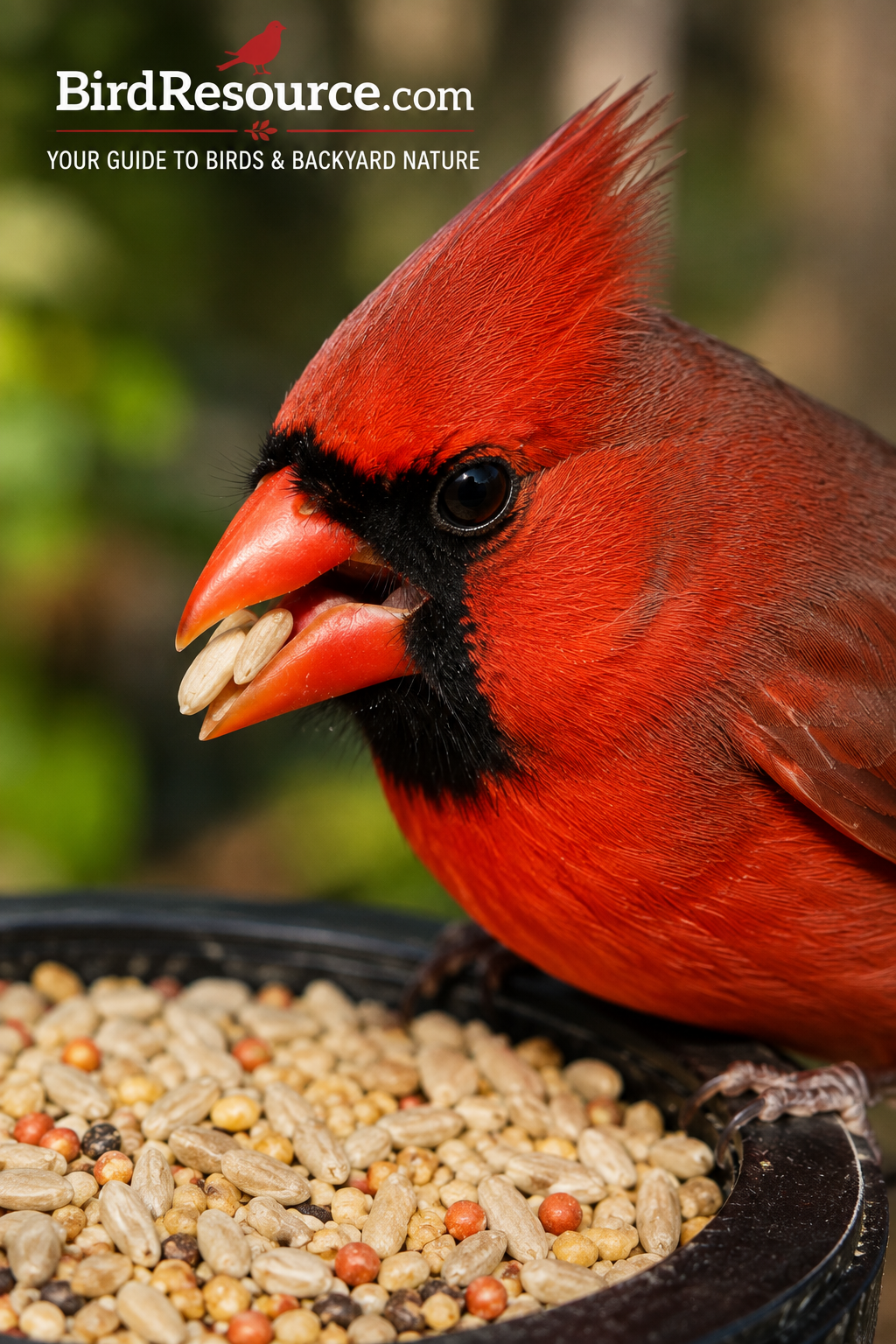
Cornell lists seeds and fruits as major foods, supplemented with insects. Foods include dogwood, wild grape, grasses, mulberry, hackberry, blackberry, sumac, and numerous other natural sources. They also eat insects and other invertebrates such as beetles, crickets, cicadas, spiders, butterflies, and moths. For feeder foods specifically, cardinal food preferences explains which seed options are most practical for cardinals.
At feeders, black oil sunflower seed is particularly attractive to them.

Our complete guide to what cardinals eat goes much deeper into their natural diet, feeder foods, seasonal changes, and what they feed their babies.
The big takeaway is variety.
A wild cardinal isn’t supposed to survive on one feeder containing one seed for its entire life.
Does a Redder Male Cardinal Live Longer?
Not necessarily.
Brighter coloration can tell us interesting things about male quality and diet, but we shouldn’t turn that into a simple lifespan calculator.
Cornell notes that the intensity of male cardinal coloration is connected to pigments obtained through food and can play a role in mate choice.
But looking at two males and deciding the brighter one will live three years longer would be going far beyond what that tells us.
A bird’s survival depends on far more than feather color.
Predation doesn’t check how red you are.
Neither does a window.
Do Male or Female Cardinals Live Longer?
The current longevity record belongs to a female, and interestingly, the second extremely old individual listed in the Bird Banding Laboratory records was also female.
But don’t turn two longevity records into a rule that female cardinals always outlive males.
Record-holding individuals are extreme cases.
They don’t necessarily tell us what happens across the entire population.
Male and female cardinals also face somewhat different pressures during breeding.
Females invest heavily in nest building, egg production, and incubation.
Males are extremely conspicuous and engage heavily in territorial behavior.
Both sexes face plenty of hazards.
The safest answer is that either sex is capable of living for many years under favorable circumstances.
Do Cardinals Live Longer Because They Don’t Migrate?
This is an interesting possibility.
Cornell’s NestWatch has suggested that the relatively high survival of Northern Cardinals may partly relate to avoiding the stresses and hazards of migration.
Migration is an extraordinary accomplishment, but it’s also dangerous.
Migratory birds encounter storms, exhaustion, unfamiliar habitat, predators, collisions, and the challenge of finding suitable stopover locations.
Cardinals don’t undertake those enormous seasonal journeys.
That removes one major category of risk from their lives.
It doesn’t mean staying put is easy.
They simply face a different set of challenges.
Do Cardinals Stay in the Same Area Their Whole Lives?
Northern Cardinals are nonmigratory, but that doesn’t mean an individual spends its entire life inside one backyard. For more species-focused information about behavior, habitat, and life history, browse our bird species and behavior guides.
Birds move locally.
Young birds disperse.
Adults forage beyond individual properties.
Territories and pair relationships can change.
Winter behavior differs from breeding-season behavior.
A cardinal can remain within the same broader region without appearing at your feeder every day for 10 years.
This distinction matters when people believe they’ve been watching the exact same bird for an extremely long time.
Maybe they have.
But without a band or genuinely distinctive identifying feature, proving it is another matter.
Is the Cardinal at My Feeder the Same One From Last Year?
It certainly could be.
That’s one of the coolest possibilities created by a resident bird capable of surviving for many years.
Northern Cardinals don’t normally leave for some distant wintering ground and return each spring.
So an adult using suitable habitat around your property one year could still be in the general area the following year.
But cardinals look remarkably similar to other members of the same sex.
One bright red adult male can look a whole lot like another bright red adult male.
Unless the bird is banded or has a reliable individual characteristic, I wouldn’t state with certainty that it’s the same bird.
You can enjoy thinking it might be without turning the possibility into a fact.
Do Cardinal Couples Stay Together for Their Whole Lives?
Not necessarily.
This is another place where lifespan and popular cardinal folklore collide.
People often say cardinals “mate for life,” which makes it sound like one male and female pair up as youngsters and spend the next 15 years together.
Real cardinal relationships are more complicated.
Pairs can remain together, including through winter, but Cornell notes that up to about 20 percent of pairs may split by the following breeding season.
Birds also lose mates.
A long-lived cardinal may therefore have more than one partner during its lifetime.
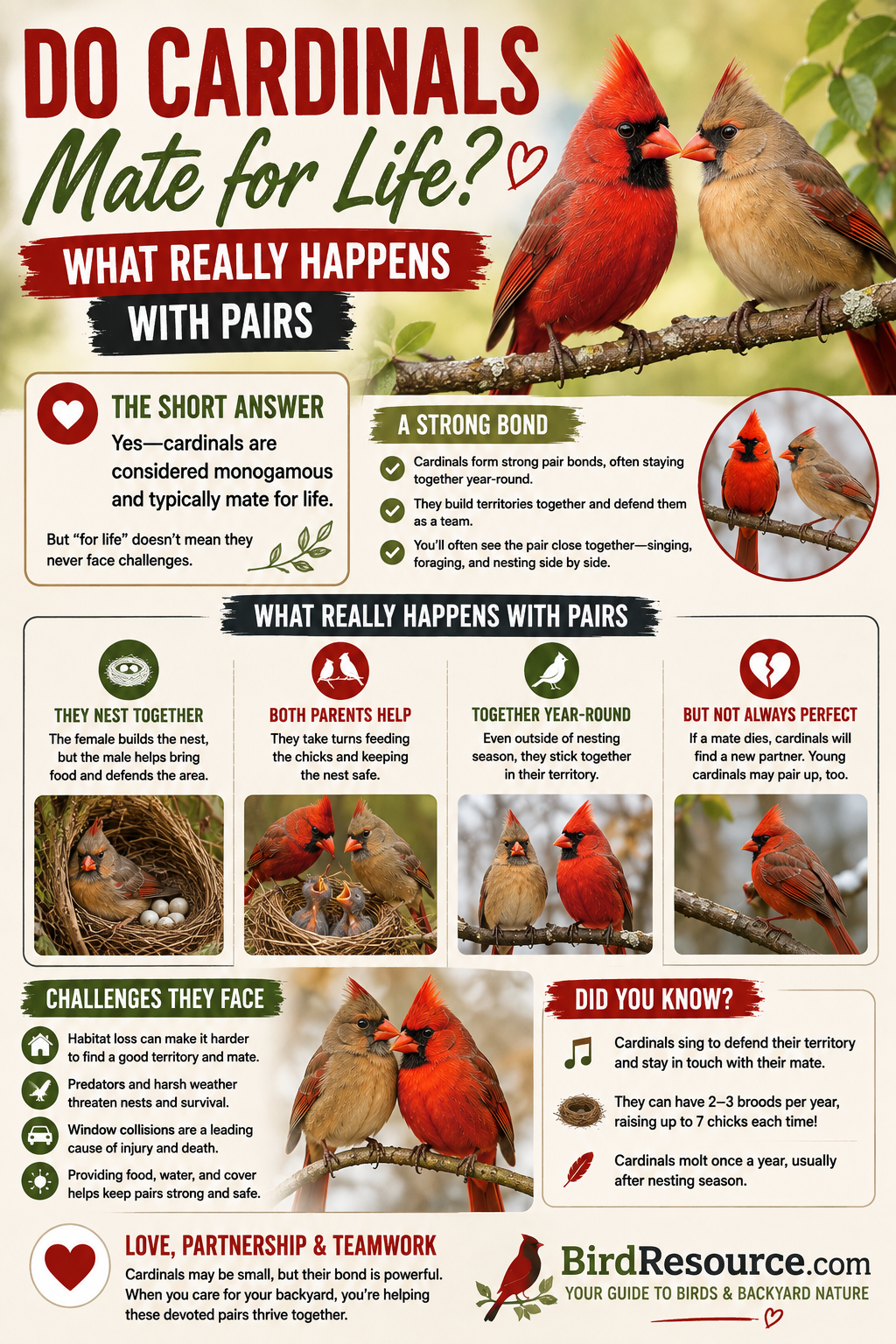
Our article on whether cardinals really mate for life separates the romantic saying from what researchers actually observe.
How Many Babies Could a Cardinal Have During Its Lifetime?
Potentially quite a few, but there’s no useful fixed number.
Cornell reports clutches of 2 to 5 eggs and generally 1 to 2 broods per year.
A long-lived adult that breeds successfully over multiple seasons could therefore participate in many nesting attempts.
But eggs laid isn’t the same as offspring raised.
Nests fail.
Eggs fail to hatch.
Nestlings are lost.
Fledglings die.
Some breeding seasons are more successful than others.
That’s exactly why I’d be suspicious of any precise claim such as “the average cardinal produces 47 babies during its lifetime” unless there were very specific research behind that number.
Nature rarely gives us numbers that neat.
What Happens When One Cardinal Dies?
If one member of a pair dies, the surviving bird doesn’t have to remain alone forever.
Cardinals can form new pair bonds.
This is important because of another popular belief surrounding these birds.
People sometimes interpret seeing a lone cardinal as proof that its mate must have died.
That’s possible.
But you can’t determine the fate of another bird simply because you see one cardinal by itself.
Its mate may be nearby.
The pair may be temporarily separated while feeding.
The bird may not currently have a mate.
Or a previous mate may indeed have been lost.
There are multiple possibilities.
Do Cardinals Mourn When Their Mate Dies?
This is another question where I’d rather be accurate than tell people a beautiful story we can’t prove.
Birds can respond behaviorally to the disappearance or loss of mates.
But assigning human concepts of grief to a particular cardinal based on a few observations requires caution.
A surviving bird may call, search, change behavior, or eventually pair with another bird.
Those behaviors are real.
Exactly what the bird experiences internally is much harder for us to know.
We don’t need to invent a human love story to make cardinal pair bonds interesting.
Their actual social behavior is fascinating enough.
Can a Cardinal Live 20 Years?
A wild Northern Cardinal living 20 years would exceed the current verified North American banding longevity record.
The official record remains 15 years and 9 months.
Could an unrecorded individual theoretically have lived longer?
Certainly.
Banding records only tell us about birds that researchers banded and later encountered or received reports about.
The Bird Banding Laboratory itself explains that longevity records are constrained by the available banding and encounter data.
So 15 years and 9 months shouldn’t be interpreted as a biological timer that kills every cardinal before its sixteenth birthday.
It’s the oldest verified wild individual in the record, not necessarily the oldest cardinal that has ever existed.
Is 15 Years Old Normal for a Cardinal?
No.
And this distinction is important enough to repeat.
When a website says:
“Cardinals live 15 years.”
it’s giving you the wrong impression.
What the evidence actually shows is:
A Northern Cardinal has been documented surviving 15 years and 9 months in the wild.
That’s a longevity record.
Records represent exceptional individuals.
It’s the same reason we don’t describe normal human lifespan by finding the oldest person who ever lived.
The record tells us what the species is capable of under extraordinary circumstances.
It doesn’t tell us what happens to most individuals.
Why Do Some Cardinals Live So Much Longer Than Others?
Survival is a combination of biology, environment, behavior, and luck.
One cardinal may encounter a predator during its first weeks outside the nest.
Another may collide with a window.
Another may become sick.
Another may survive multiple harsh winters, successfully avoid predators, find reliable food and shelter, and reproduce year after year.
There’s no way to look at a newly fledged cardinal and know which path lies ahead.
That’s part of what makes that 15-year record so impressive.
Think about how many winters that bird experienced.
How many breeding seasons.
How many predators it avoided.
How many storms.
How many nesting attempts.
How many times something could have gone wrong.
Surviving one year in the wild is an accomplishment.
Surviving more than fifteen is remarkable.
Can You Help Cardinals Live Longer?
We can’t control the life of a wild bird.
But we can reduce some of the unnecessary hazards we create around our homes.
Keep cats from roaming freely where birds feed and nest.
Make dangerous windows more visible to birds.
Keep feeders reasonably clean.
Replace wet or spoiled seed.
Avoid unnecessary disturbance around active nests.
Provide useful vegetation and cover.
Offer appropriate food rather than human junk food.
And remember that creating a bird-friendly yard involves much more than hanging one feeder.
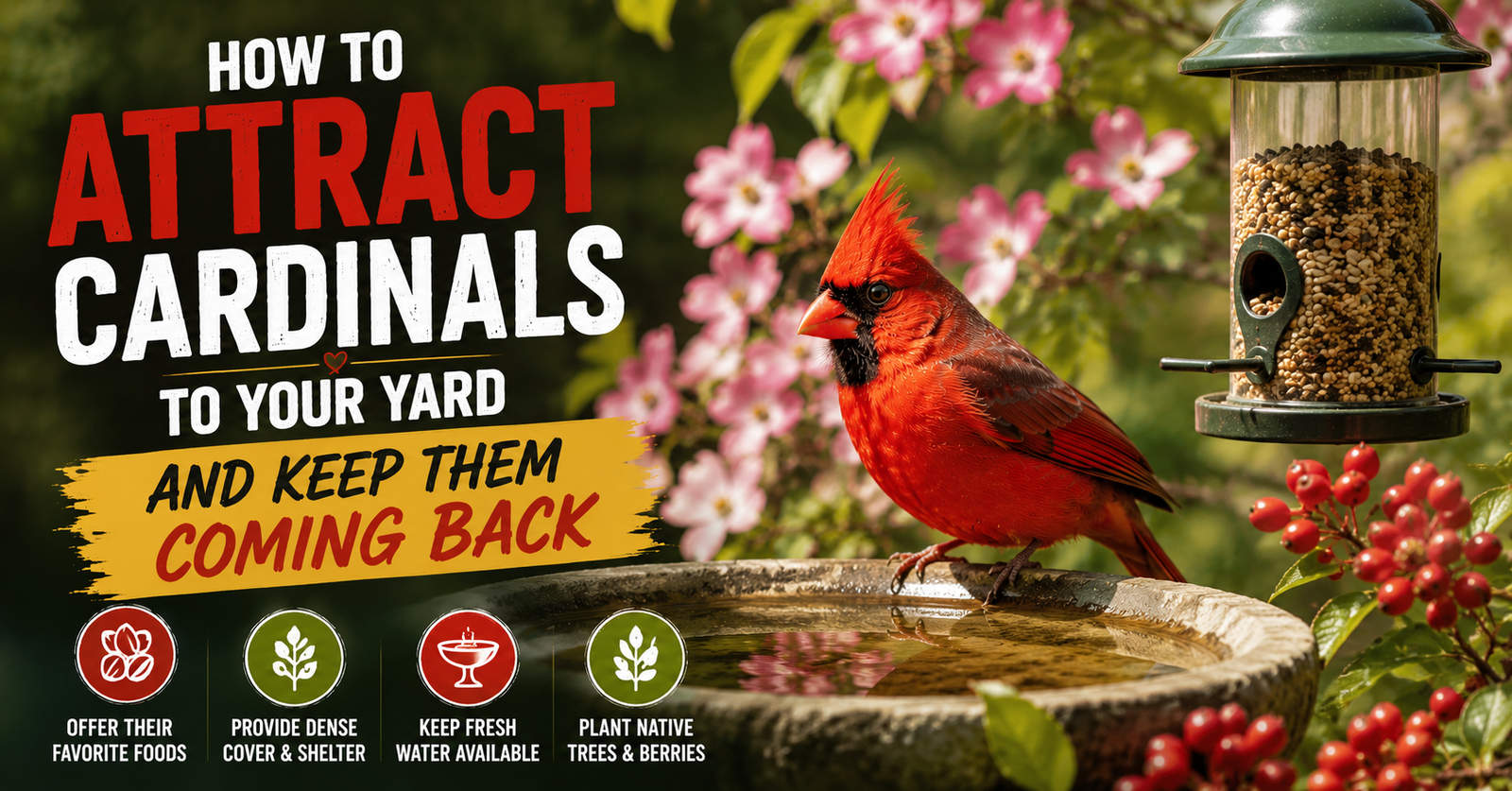
Our guide to attracting cardinals and keeping them coming back covers food, water, cover, vegetation, feeder placement, and the habitat features that make a yard genuinely useful to cardinals.
None of those things guarantees that a particular bird will reach 15.
They simply help remove some avoidable problems from an already difficult life.
That Cardinal Outside Your Window Could Be Older Than You Think
This is what I find most interesting about cardinal lifespan.
We see these birds so often that it’s easy to treat them like interchangeable pieces of the backyard.
There’s the male cardinal.
There’s the female.
There are two more at the feeder.
But each one is an individual animal with its own history.
That red male may have fledged last summer.
Or he may have already survived six winters.
The female quietly eating underneath your feeder could have raised young in your neighborhood for years.

And because Northern Cardinals remain within their range year-round, some birds can potentially become long-term residents of the same general area. You can also review the species’ appearance and year-round habits in this Northern cardinal range and residency.
We usually just don’t know which ones they are.
Somewhere in Pennsylvania, one female managed to survive 15 years and 9 months in the wild.
That’s not how long every cardinal lives.
It’s something much more interesting.
It’s proof of how long one of these familiar backyard birds can survive when everything goes right often enough.
Common Questions About Cardinal Lifespan
What is the average lifespan of a cardinal?
There isn’t a single simple average that should be confused with the species’ maximum lifespan. Mortality is high during early life, while adults that survive can persist for multiple years. Adult annual survival has been estimated around 60 to 65 percent.
What is the oldest wild cardinal ever found?
The official Bird Banding Laboratory record is a female Northern Cardinal that reached 15 years and 9 months in Pennsylvania.
Can cardinals live 10 years?
Yes. Northern Cardinals are capable of surviving beyond 10 years in the wild, although individuals reaching those ages are exceptional rather than typical. The longevity record exceeds 15 years.
How long do cardinals live in captivity?
You’ll sometimes see a captive lifespan of roughly 28 years cited online. For BirdResource.com, I would not treat that as the useful answer to normal cardinal lifespan because Northern Cardinals are wild native birds, and the strongest official North American banding record we have concerns wild birds. The verified wild record is 15 years and 9 months.
Do cardinals live longer than robins?
Individual longevity records differ among species, but comparing record-holders isn’t the same as comparing typical survival. If we’re answering how long another species lives, I’d evaluate its own banding and survival data rather than using maximum-age records as a shortcut.
Do cardinals come back to the same yard every year?
They can remain within the same general area because Northern Cardinals are nonmigratory residents. That makes repeat visits by the same individual possible, although you usually can’t prove an unbanded cardinal is the exact bird you saw the previous year.
How long do cardinals stay with their parents?
Young cardinals remain dependent after leaving the nest and gradually become independent. Fledging isn’t an instant transition into adult life.
How old are cardinals when they leave the nest?
Northern Cardinal nestlings generally leave approximately 7 to 13 days after hatching.
Do cardinals die in winter?
Some certainly do, but winter doesn’t automatically kill cardinals or force them to migrate. Northern Cardinals are year-round residents capable of surviving cold winters throughout much of their range.
How can I make my yard safer for cardinals?
Think beyond food. Reduce window-collision risks, keep cats away from birds, maintain clean feeding areas, protect useful shrubs and vegetation, avoid disturbing active nests, and provide appropriate food and water.

A feeder can help bring a cardinal into view. If you want to document those visits more closely, the Kiwibit observation feeder is one option to consider.
A good backyard habitat gives that bird far more reasons to stick around.
Caleb Hartwell is the Bird Identification & Behavior Contributor for BirdResource.com, where he turns everyday backyard bird questions into practical, research-backed guides covering identification, feeding, nesting, behavior, and the lives of the birds we see around us every day.